





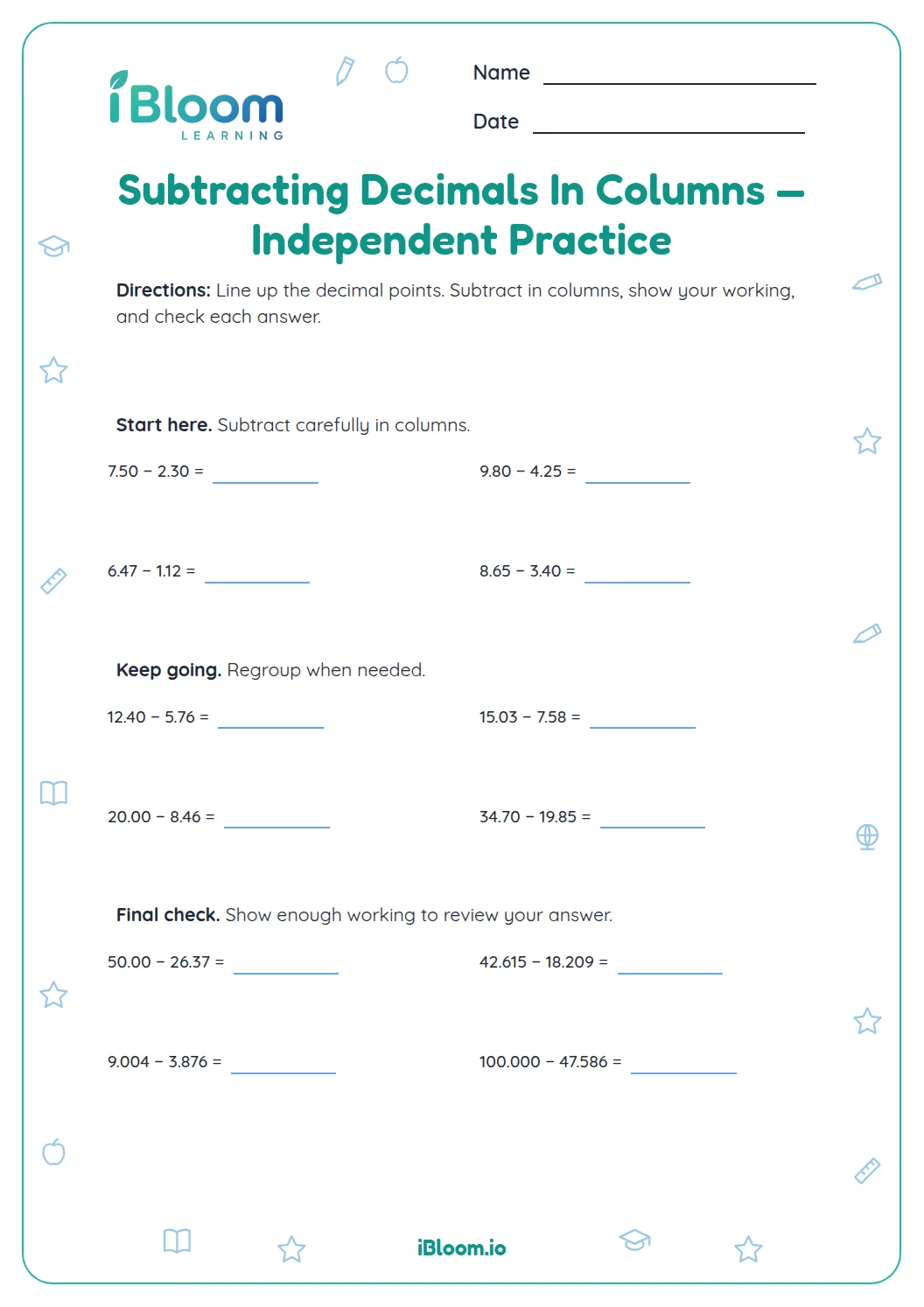
About this worksheet
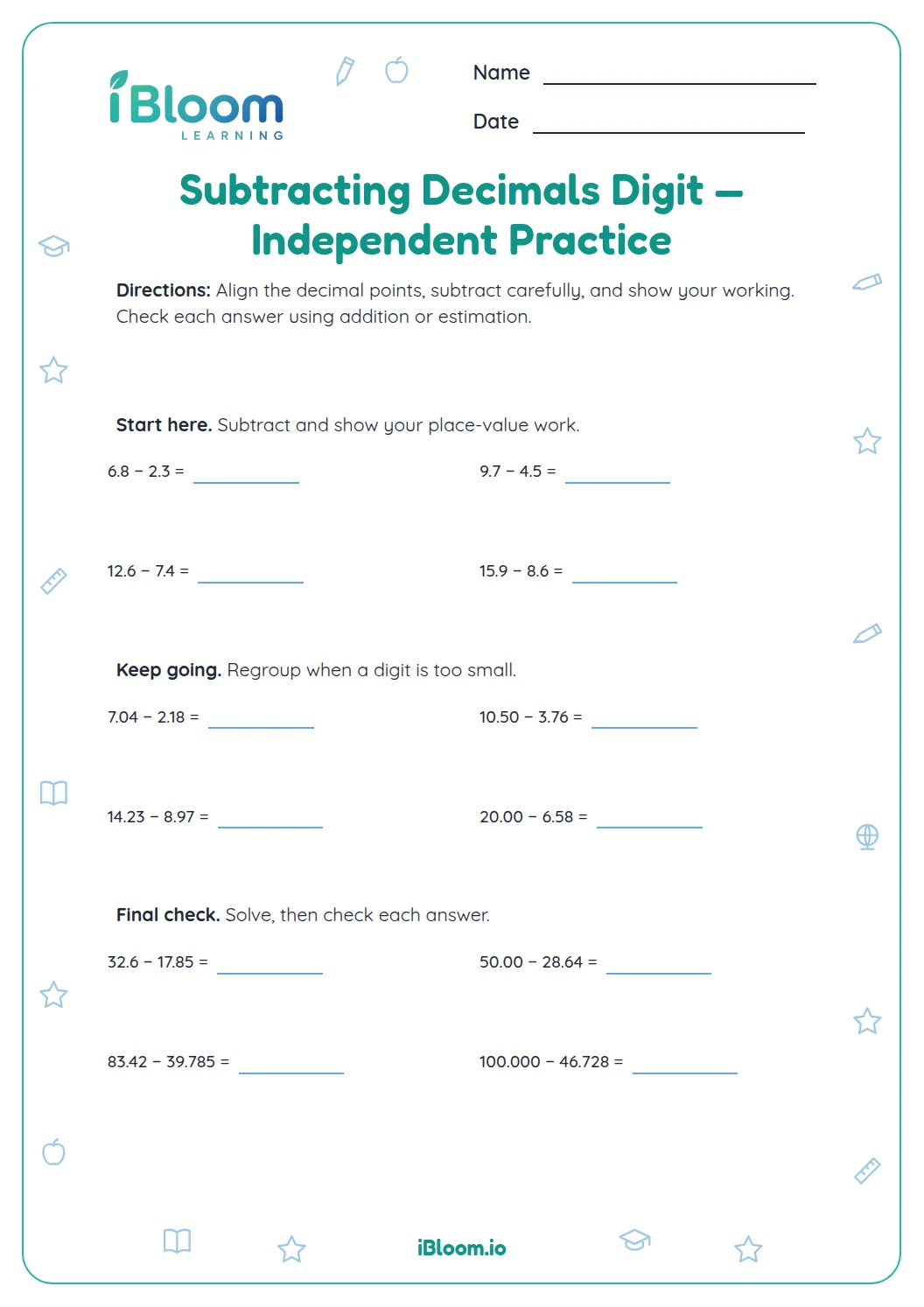
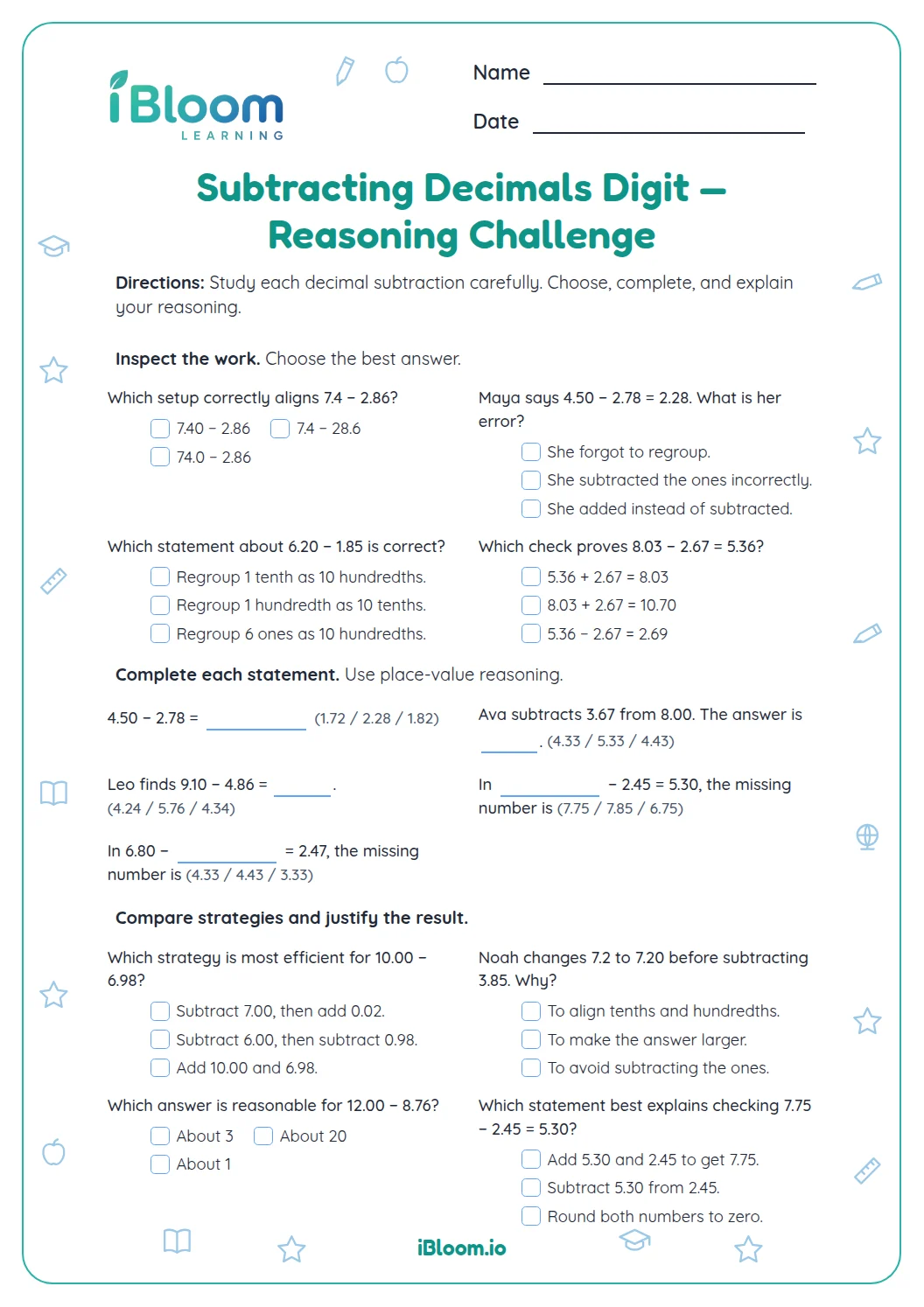
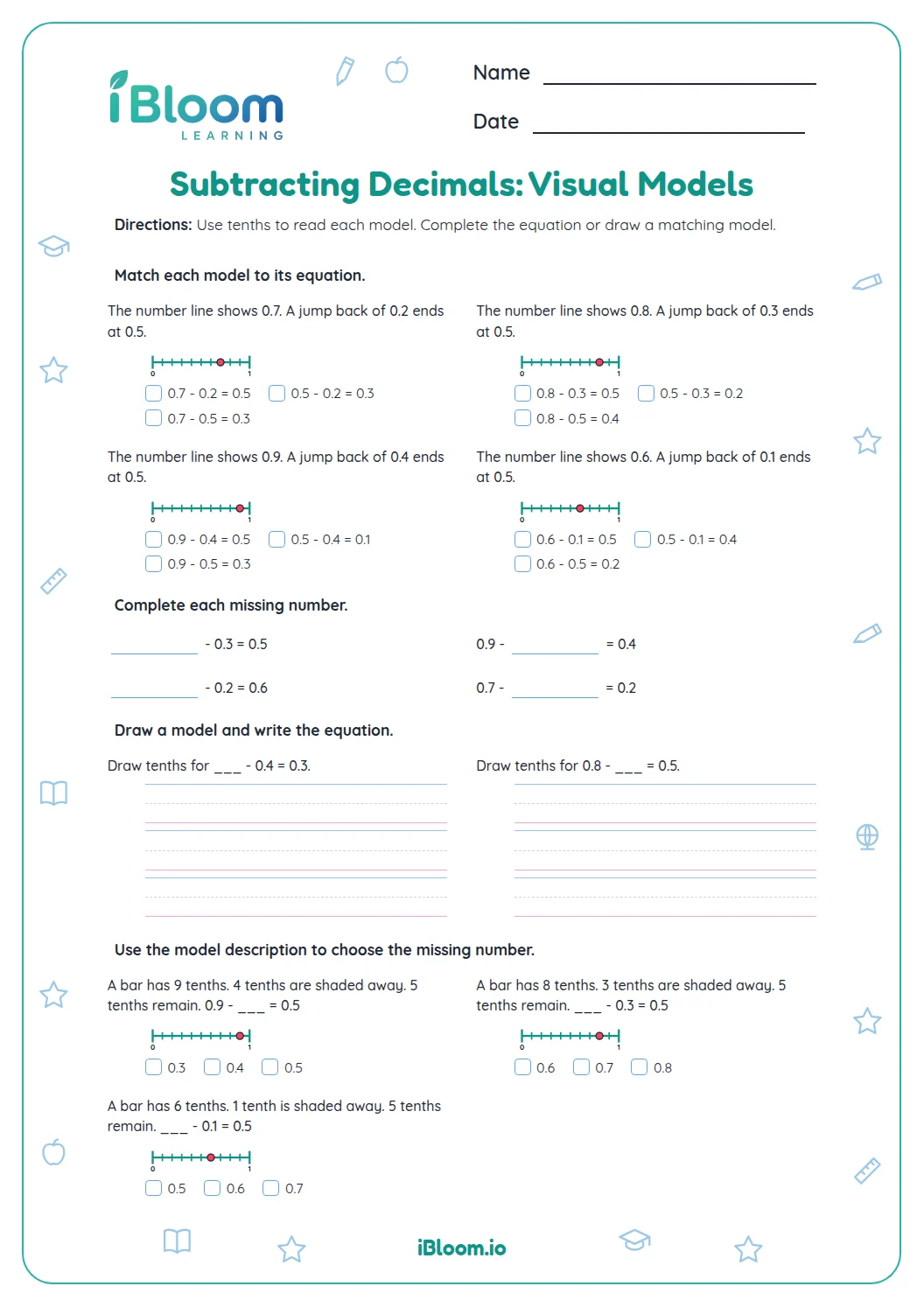
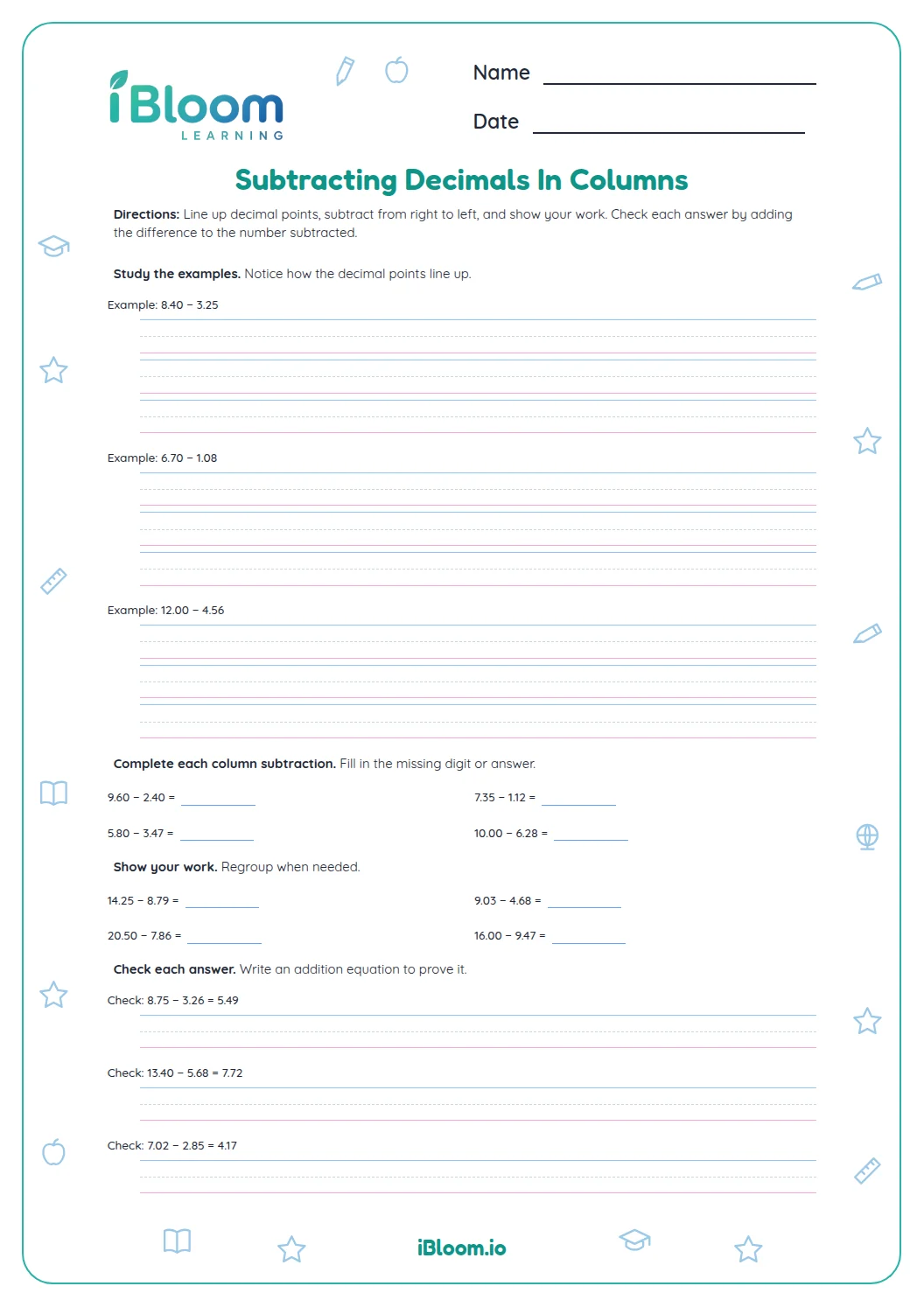
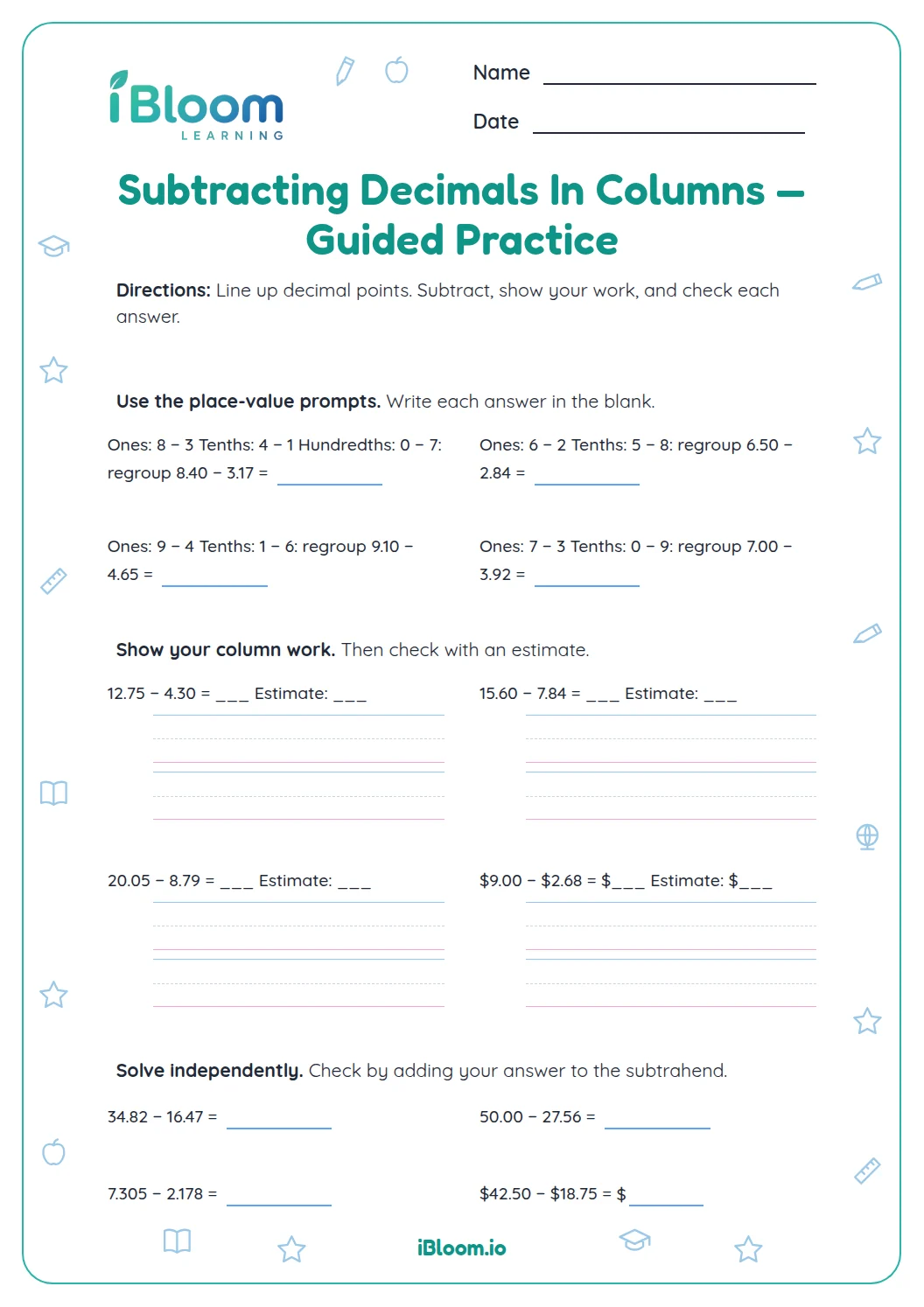
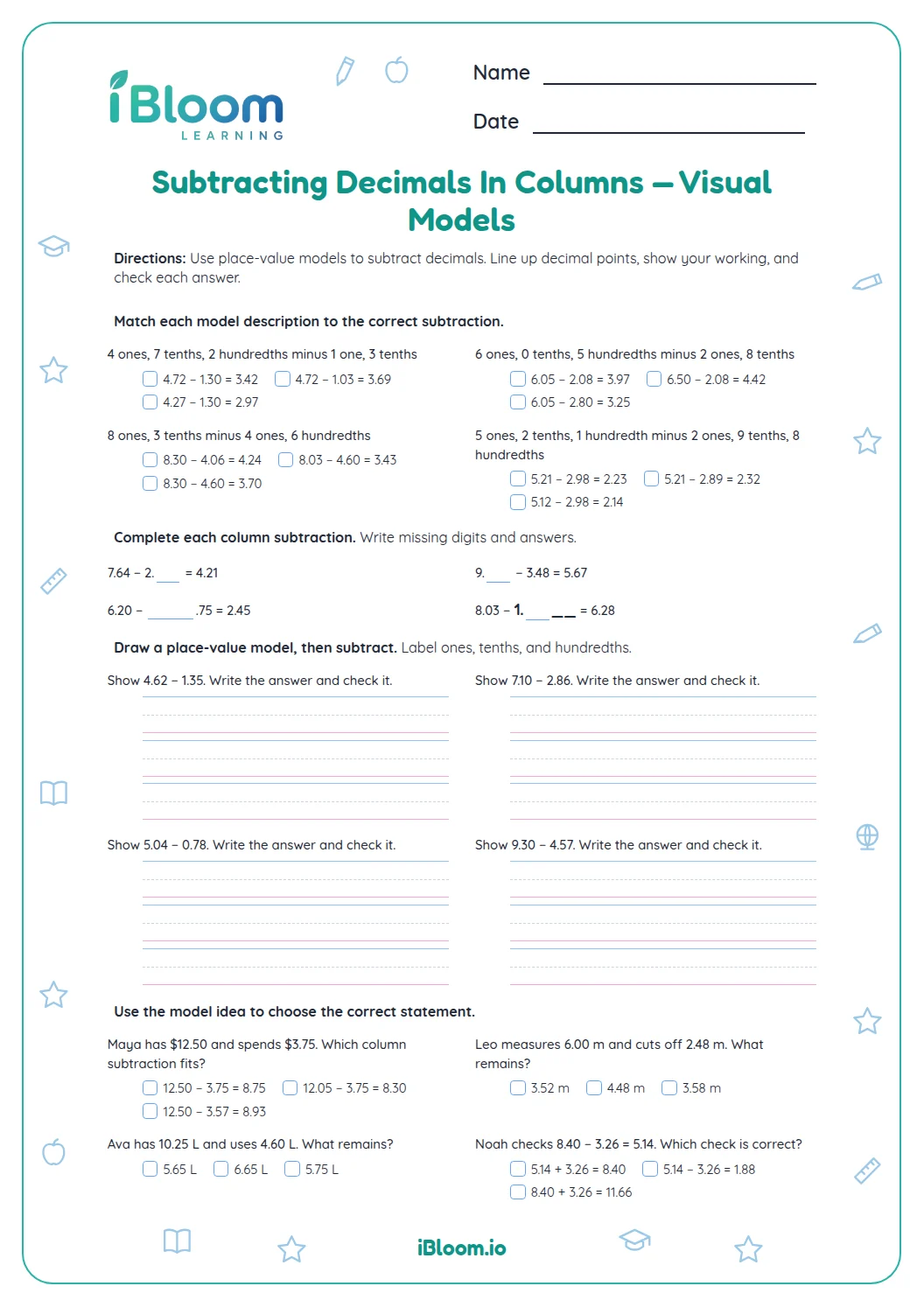
This free Grade 5 printable helps students subtract decimals by aligning place values and regrouping when a digit in the top number is too small. The 16 questions move from tenths to hundredths, include subtraction across a zero, and finish with short real-world problems and reasoning. Students can add a trailing zero to show equal decimal places, then subtract by column. The separate answer key supports quick checking. The practice aligns with Common Core 5.NBT.B.7.
Aligned to 5.NBT.B.7
How do you line up decimal places?
Write decimal points in one vertical line. A zero can hold an empty place without changing the number: 6.2 is equal to 6.20.
- 16.20 − 3.85
- 2Hundredths: regroup 2 tenths as 1 tenth and 10 hundredths.
- 3Subtract to get 2.35.
What happens when you subtract across a zero?
Regroup from the next nonzero place to the left, passing through each zero. Keep track of the value exchanged: one whole is ten tenths, and one tenth is ten hundredths.
How can you check a decimal difference?
Add the difference to the number subtracted. For 8.03 − 2.78 = 5.25, check 5.25 + 2.78 = 8.03.
How to use this worksheet
- 1Read the whole problem and identify the minuend and subtrahend.
- 2Line up the decimal points. Add a trailing zero if it helps.
- 3Regroup from left to right when a top digit is too small.
- 4Subtract each place-value column and bring down the decimal point.
- 5Check by adding the difference and subtrahend.
Common mistakes and quick fixes
The mistake
Lining up the last digits instead of the decimal points.
The fix
Place decimal points first, then keep tenths and hundredths in matching columns.
The mistake
Treating 6.2 and 3.85 as if the 2 were hundredths.
The fix
Rewrite 6.2 as 6.20 so the 2 stays in the tenths column.
The mistake
Regrouping over a zero but forgetting to change the digits passed.
The fix
Track each exchange across the columns before subtracting.
Common Core alignment
The problems use place-value reasoning to subtract decimals through hundredths.
Subtract decimals to hundredths using place value and explain the method.
On this sheet: Problems ask students to subtract decimals to hundredths, regroup by place value, and explain a place-value choice.
Show the official wordingHide the official wording
Add, subtract, multiply, and divide decimals to hundredths, using concrete models or drawings and strategies based on place value, properties of operations, and/or the relationship between addition and subtraction; relate the strategy to a written method and explain the reasoning used.
What to practice next
Make more practice
Further reading
Questions parents and teachers ask
Why should decimal points line up?
Each digit must stay with its place value. Lining up decimal points puts tenths over tenths and hundredths over hundredths, so each column can be subtracted correctly. The worksheet starts with tenths and moves to hundredths to make this alignment routine visible.
Can 6.2 be written as 6.20?
Yes. Adding a zero to the right of a decimal does not change its value, so 6.2 and 6.20 are equal. Writing 6.20 can help when subtracting a number with hundredths because both numbers then show matching decimal places. Pause after regrouping to confirm each digit now represents the correct tenths or hundredths.
How do students subtract across zeros?
Regroup from the first nonzero place to the left, then pass the value through the zero places. Each exchange changes the place-value digits along the way. Questions 9 and 10 give practice subtracting through zeros in the minuend. The final decimal point stays aligned throughout the column work.
What is the answer to question 8?
The difference is 2.35. Rewrite 6.2 as 6.20, regroup one tenth to make 10 hundredths, then subtract 3.85. Adding 2.35 and 3.85 returns 6.20, which checks the result. The answer key includes the completed differences for every calculation. This provides a useful estimate before checking every place-value column.
Does the worksheet include word problems?
Yes. Questions 11, 15, and 16 place decimal subtraction or its inverse in familiar measurement situations. Students should include the unit in the answer, such as meters, liters, or kilometers, and show their work in the space provided. These contexts use metric units so the decimal amounts stay easy to compare.