




About this worksheet
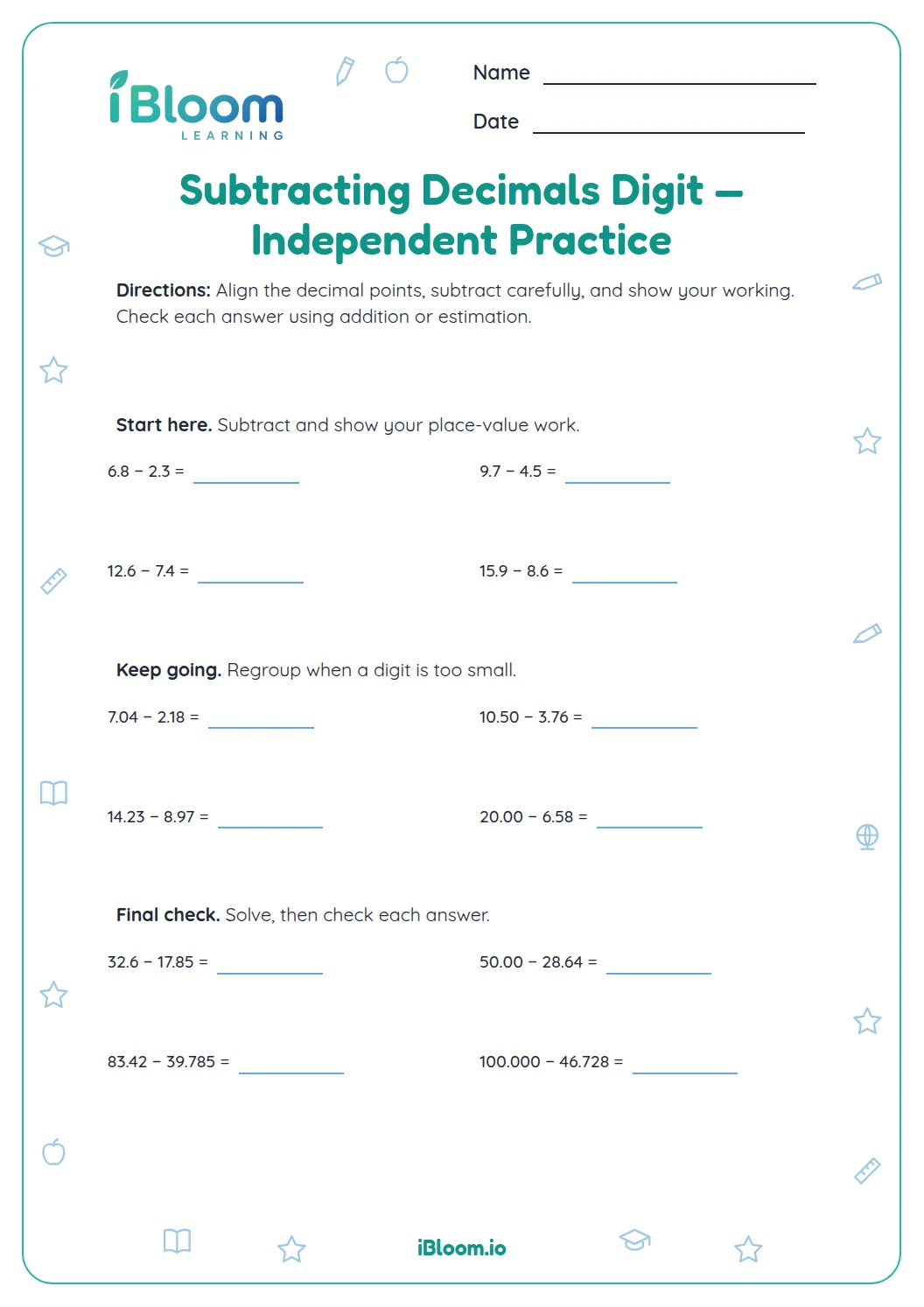
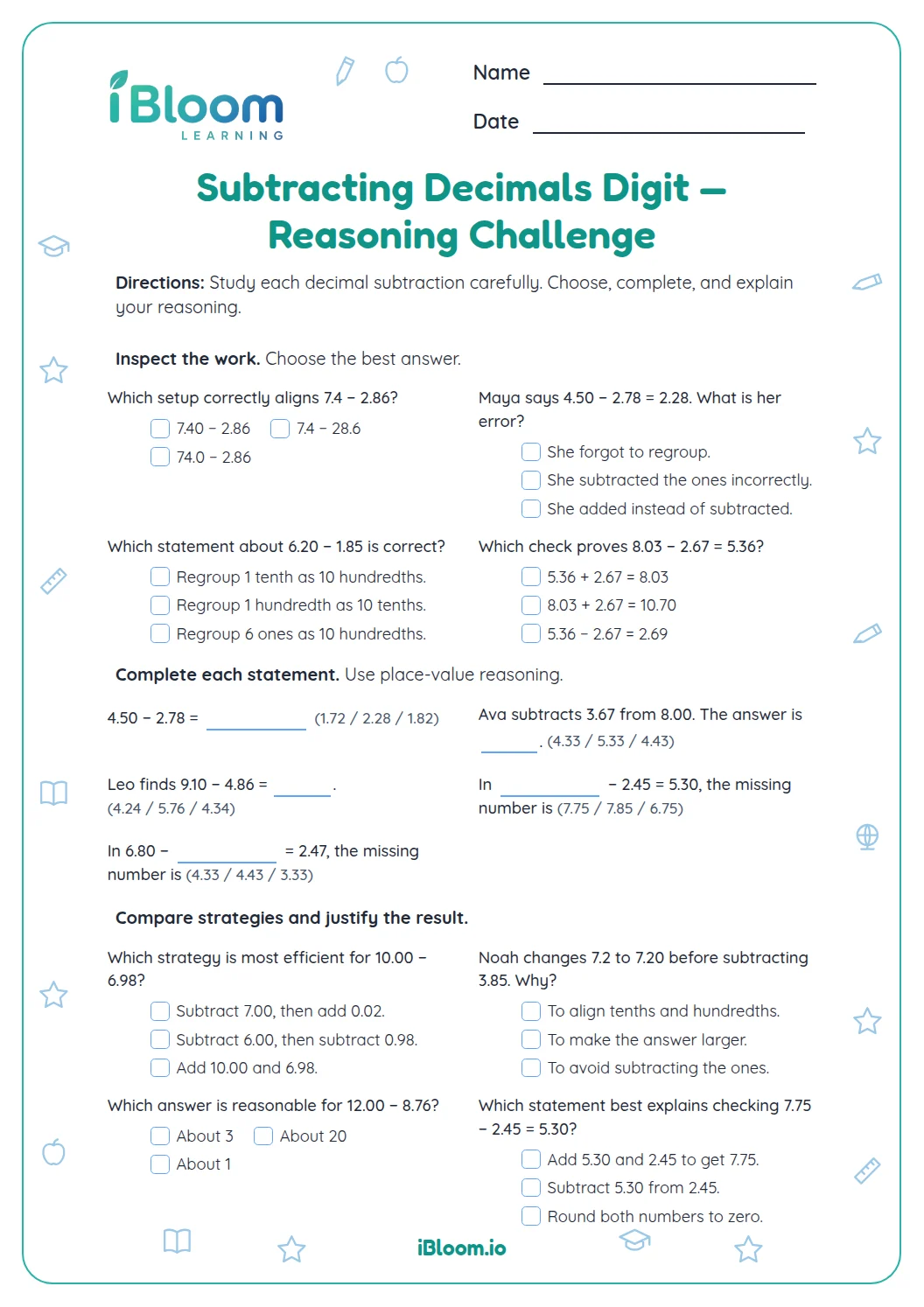
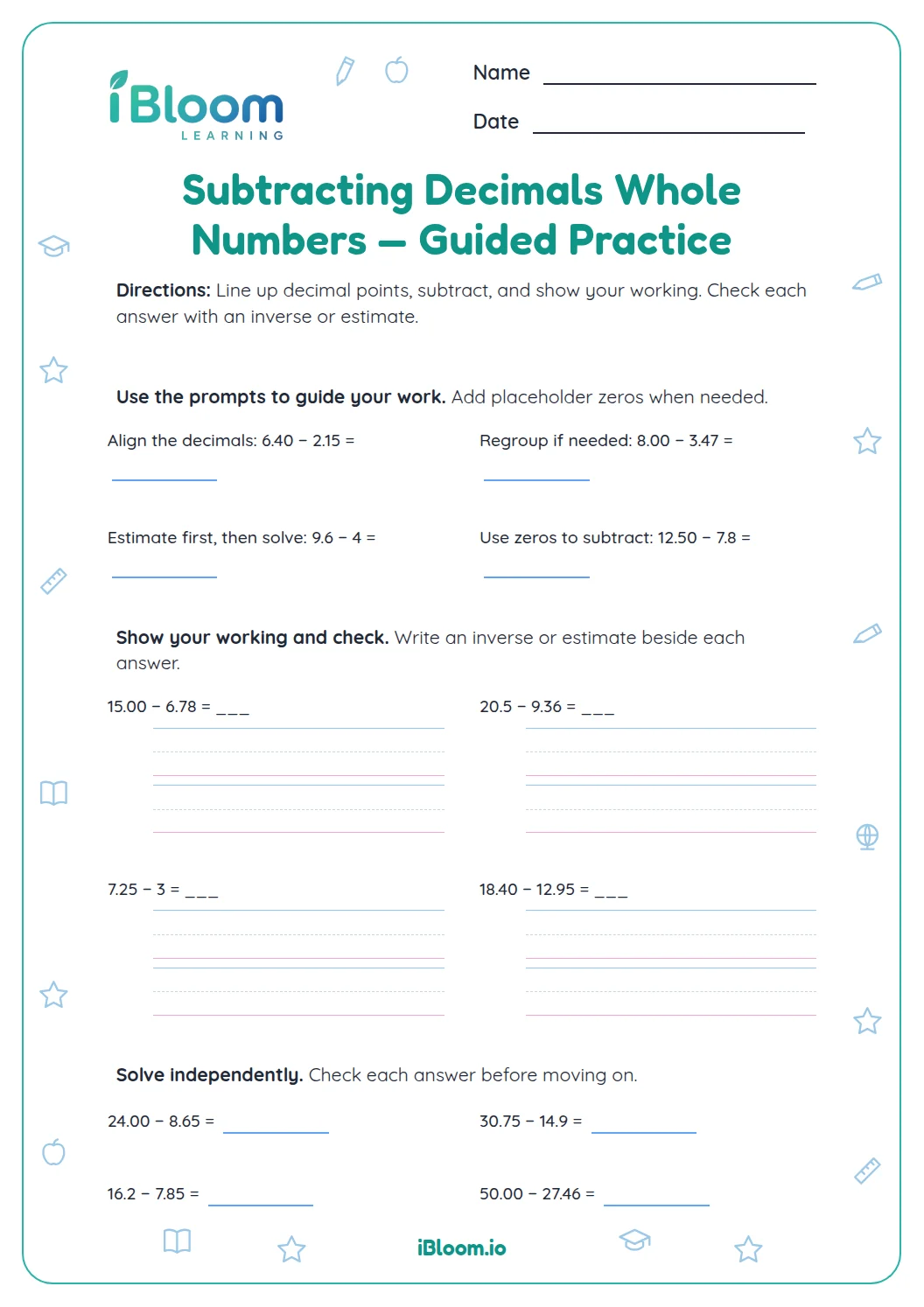
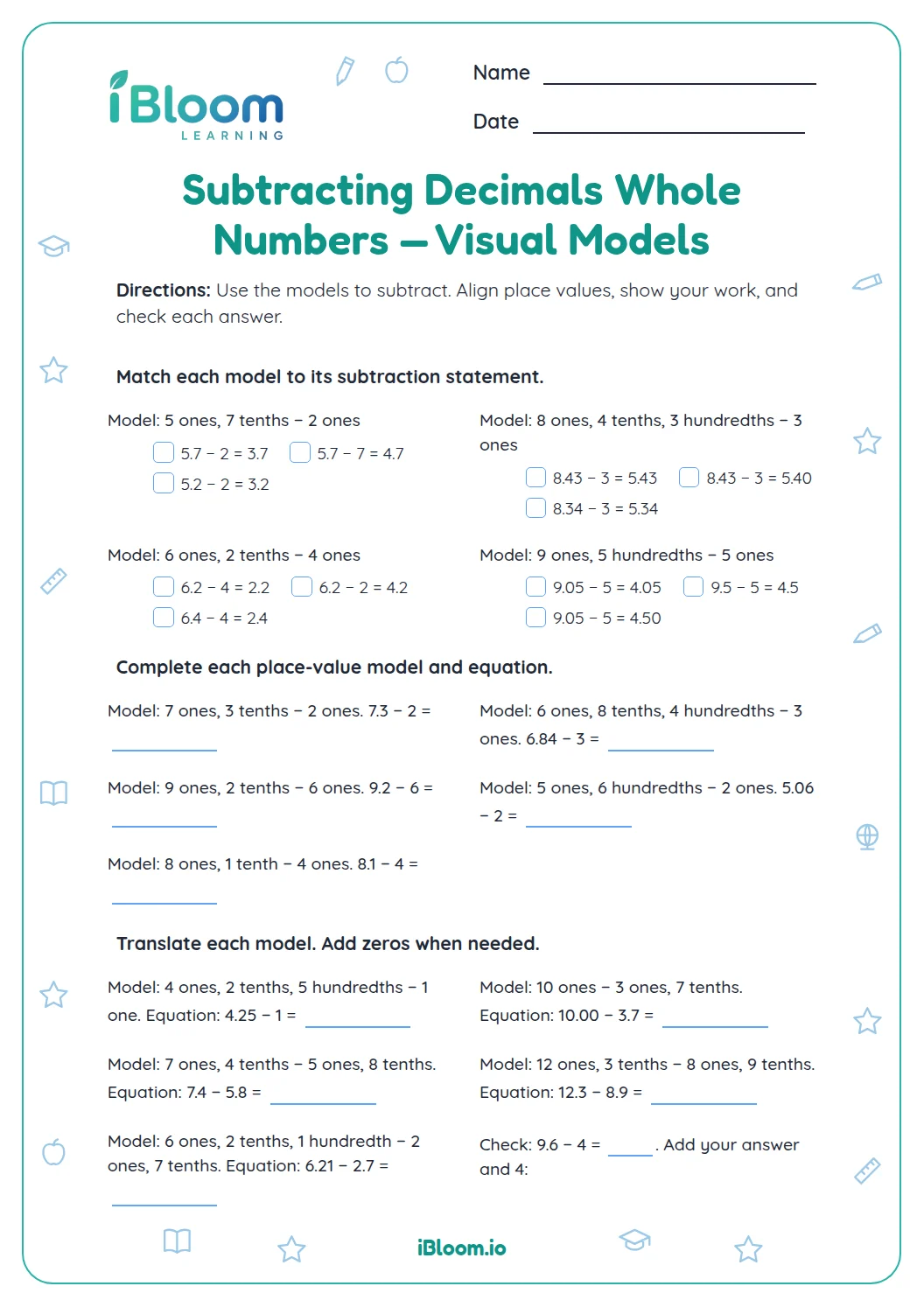
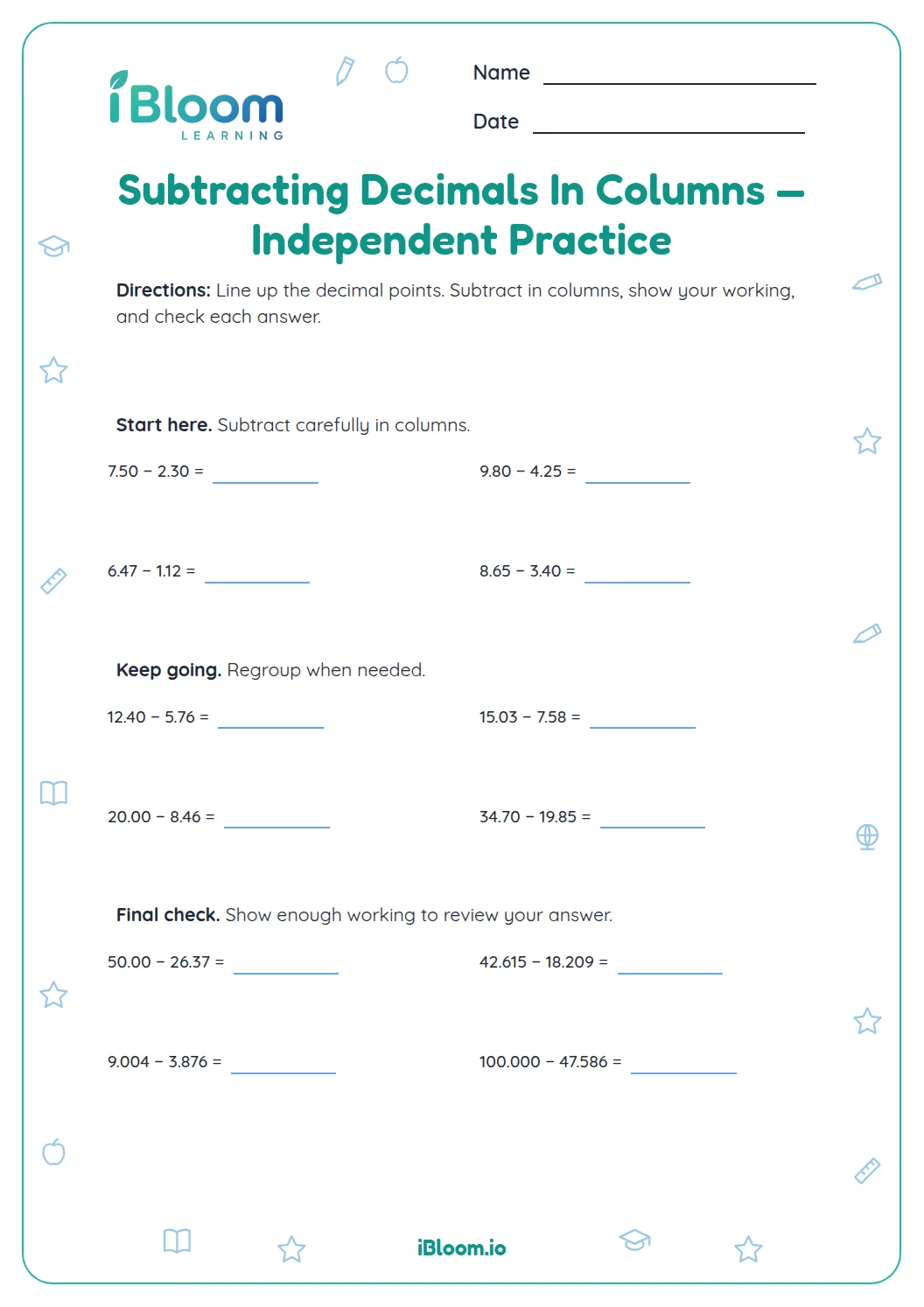
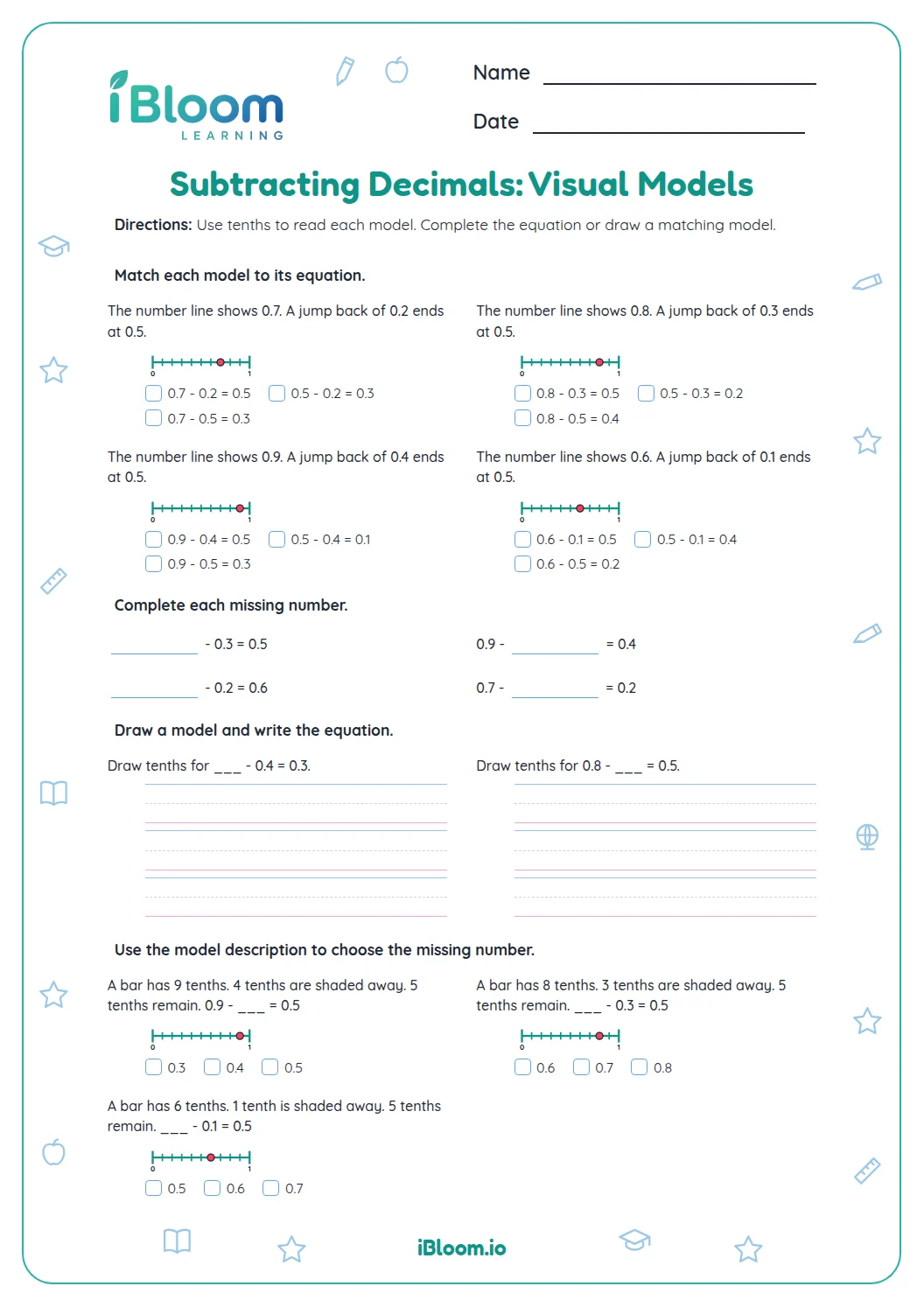
This free Grade 5 worksheet guides students through subtracting decimals with one digit after the decimal point. Four opening questions connect tenths to decimal notation, six calculations build from direct subtraction to regrouping, and two written responses ask students to explain an alignment rule and an addition check. The 12 questions practice Common Core 5.NBT.B.7 through place-value strategies and the relationship between subtraction and addition. Each part has a short direction to keep the method in view, and the separate answer key includes model explanations.
Aligned to 5.NBT.B.7
Why start by naming tenths?
Part A asks for two answers in tenths and then two answers in decimal form. For example, 8 tenths minus 3 tenths leaves 5 tenths. The next decimal question uses the same quantities: 0.8 − 0.3 = 0.5. Naming the unit makes the decimal point meaningful.
What happens when there are too few tenths?
In question 7, the starting number has only 2 tenths, but you need to subtract 7 tenths. Exchange one of the 6 ones for 10 tenths. Now the same amount is 5 ones and 12 tenths, and both columns can be subtracted.
- 16.2 − 2.7
- 26 ones + 2 tenths = 5 ones + 12 tenths
- 312 tenths − 7 tenths = 5 tenths
- 45 ones − 2 ones = 3 ones
- 5Answer: 3.5; check: 3.5 + 2.7 = 6.2
How do the final questions check understanding?
Part B includes 8 − 3.6, so students must recognize the whole number as 8.0 before regrouping. It also includes 10.0 − 4.8, which asks them to exchange a whole even though the tenths digit is zero.
Part C asks why decimal points line up and how addition checks 7.4 − 2.8 = 4.6. Listen for the units in the first explanation and the starting amount in the second. The key supplies a short model for each response.
How to use this worksheet
- 1Read the Part A direction and say what one tenth means.
- 2Complete questions 1 and 3 together to connect 5 tenths with 0.5.
- 3In Part B, line up decimal points on scratch paper and rewrite 8 as 8.0.
- 4For question 7, rename 6.2 as 5 ones and 12 tenths before subtracting.
- 5Ask students to finish the two explanations, then use the key to check calculations and reasoning.
Mistakes to check together
The mistake
Lining up the last digits in 8 − 3.6.
The fix
Write 8.0 so ones line up with ones and tenths with tenths.
The mistake
Subtracting the smaller digit from the larger in each column.
The fix
Keep the subtraction order. In 6.2 − 2.7, regroup before subtracting 7 tenths.
The mistake
Regrouping tenths but keeping all 6 ones.
The fix
Cross out 6 ones and write 5 ones when you change 2 tenths to 12 tenths.
Common Core alignment
Subtract decimals using tenths, regrouping, and addition to check.
On this sheet: Subtract decimals using tenths, regrouping, and addition to check.
Show the official wordingHide the official wording
Add, subtract, multiply, and divide decimals to hundredths, using concrete models or drawings and strategies based on place value, properties of operations, and/or the relationship between addition and subtraction; relate the strategy to a written method and explain the reasoning used.
What to practice next
Make more practice
Further reading
Questions parents and teachers ask
Which decimal places does this worksheet use?
This sheet uses tenths, with one digit after the decimal point. Part A names the unit before using decimal notation, and Part B combines tenths with whole numbers. The written questions then ask students to explain alignment and an addition check using those same place values.
What guidance is printed on the worksheet?
The directions name tenths, remind students to align decimal points, and say to regroup one whole as ten tenths. Part A also links subtraction in words to decimal subtraction. These prompts keep the method visible while leaving each answer for the student to work out.
How should my child solve 8 − 3.6?
Write 8 as 8.0 first, then regroup it as 7 ones and 10 tenths. Subtract 3 ones and 6 tenths to get 4 ones and 4 tenths, or 4.4. Adding 4.4 and 3.6 returns 8.0, so the subtraction checks correctly.
Why does the worksheet ask for explanations?
The two explanations connect the written method to place value and inverse operations. Question 11 asks why decimal points must align; question 12 asks how addition checks a difference. A brief answer using ones, tenths, or the starting amount is enough to make the reasoning clear.
Can a different explanation from the key be correct?
Yes, a student can use different wording if the mathematics is accurate. For question 11, look for matching place values. For question 12, look for adding 4.6 and 2.8 to get 7.4. The key’s model answers give examples of the ideas to listen for.