




About this worksheet
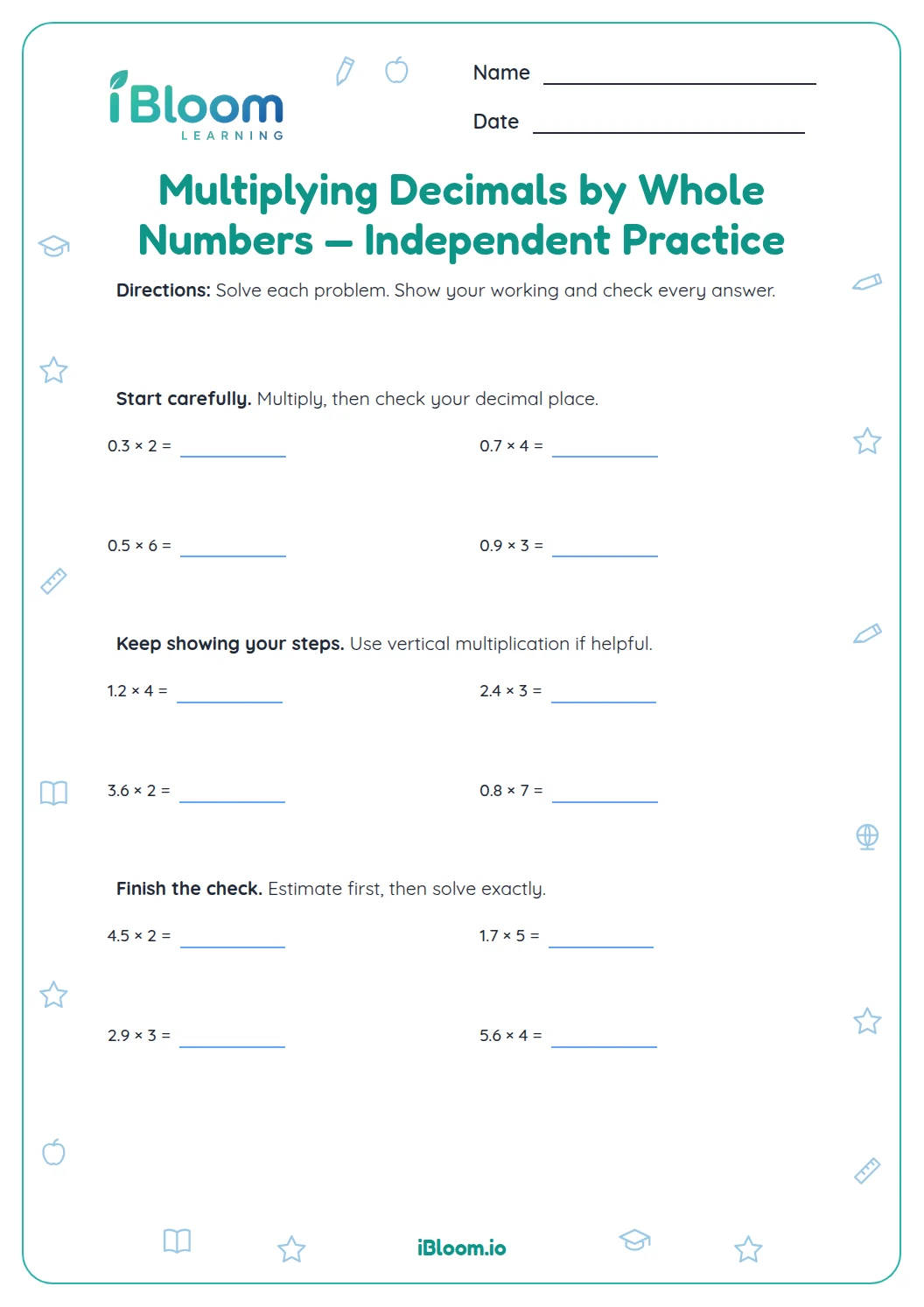
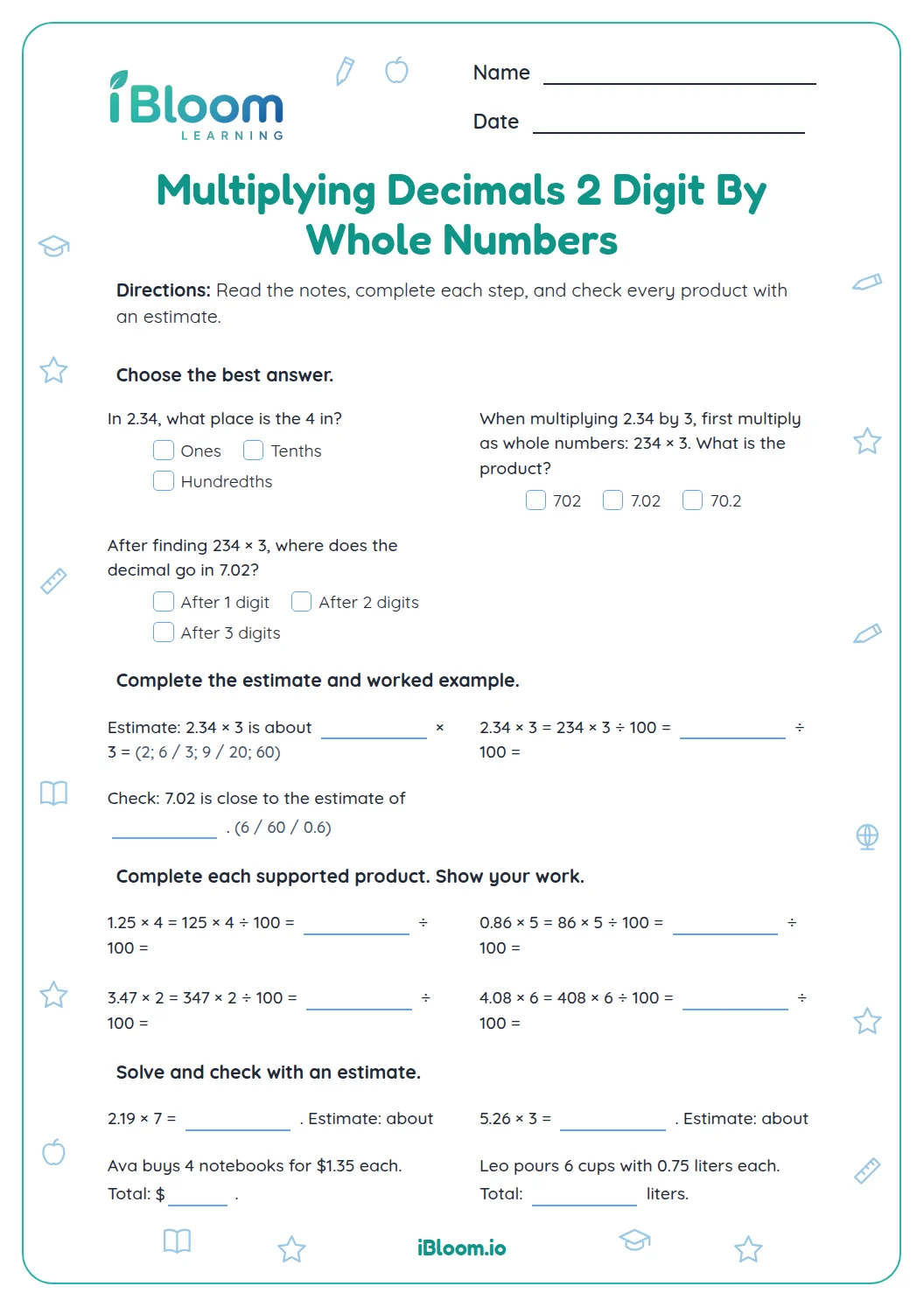
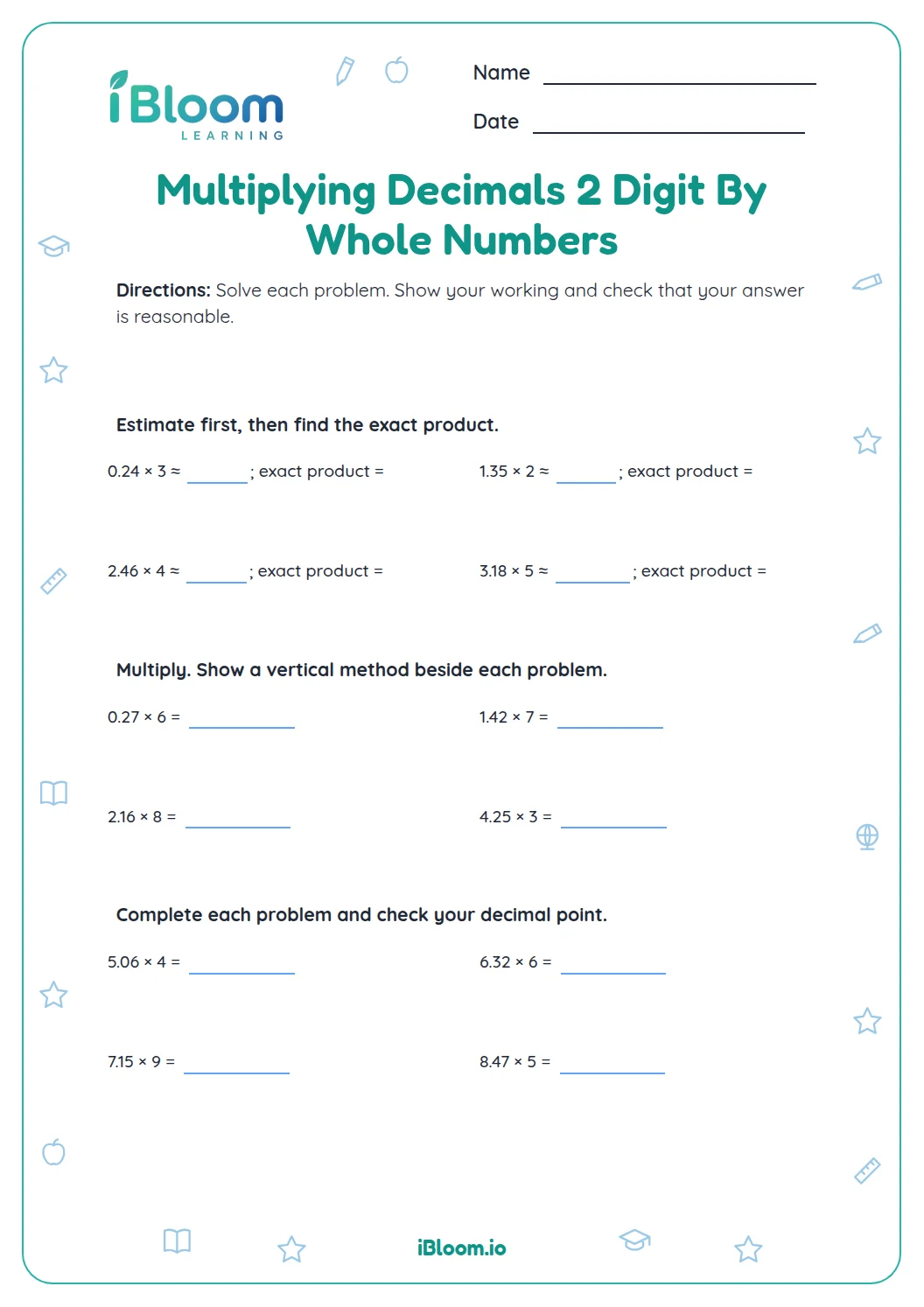
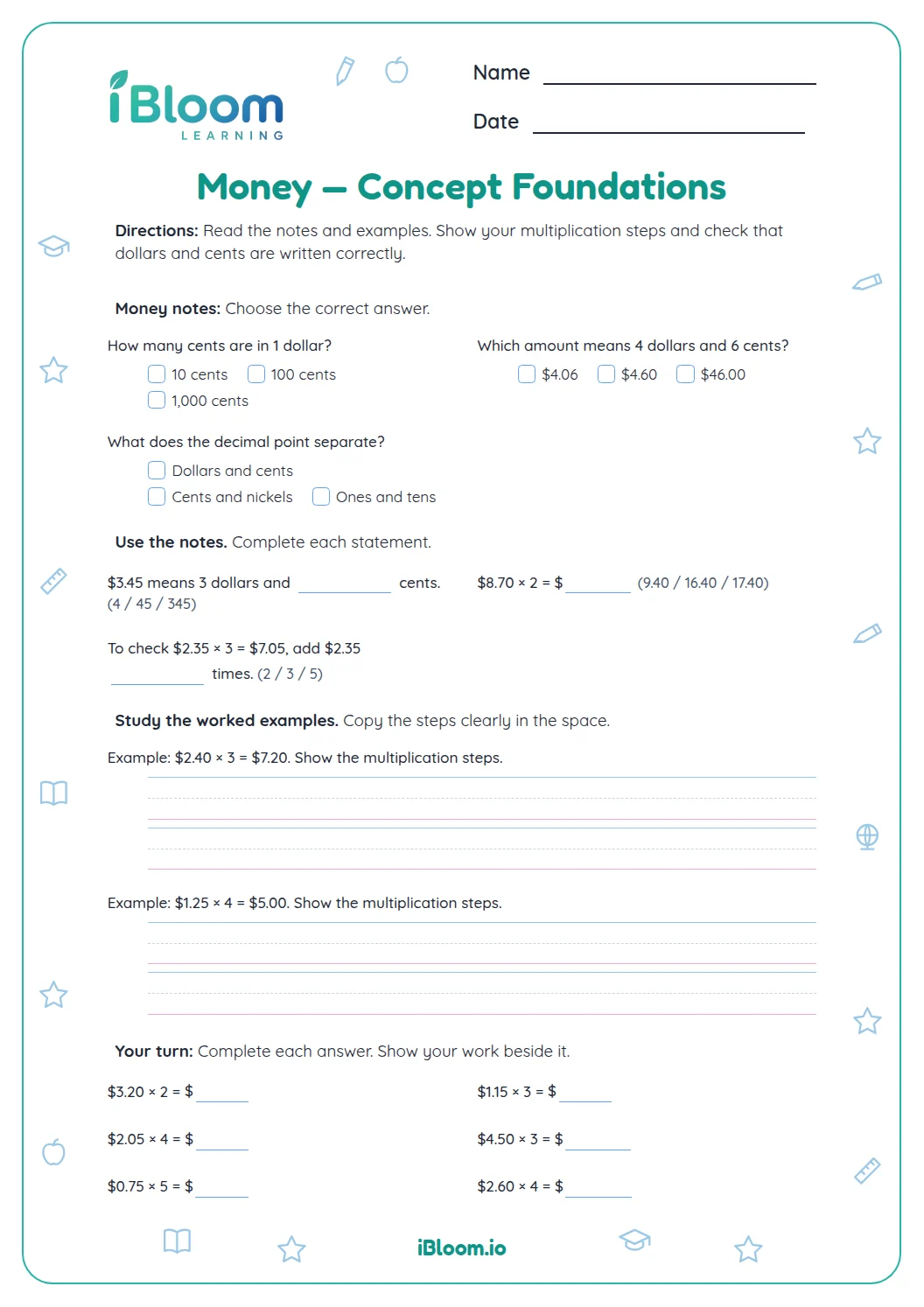
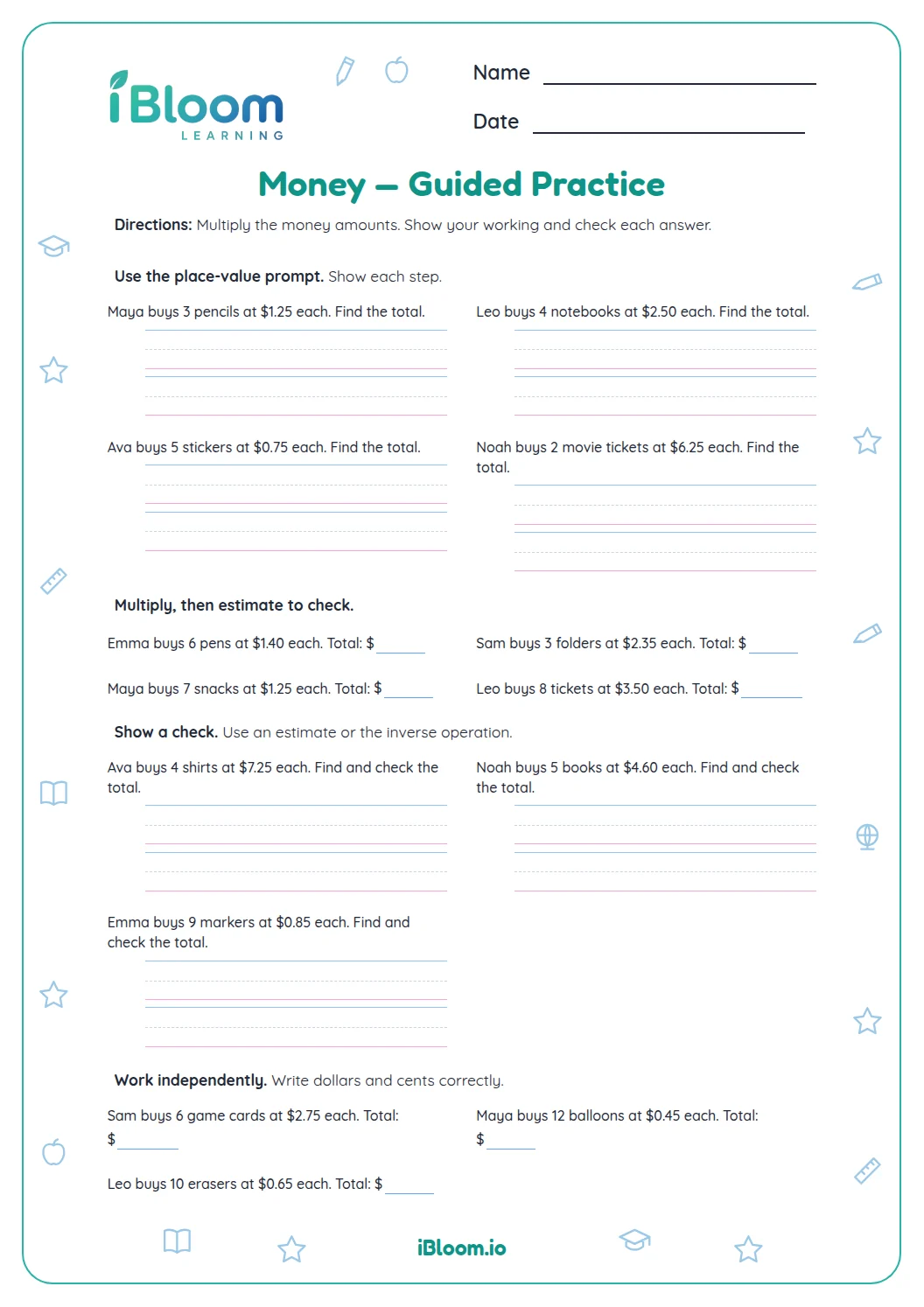
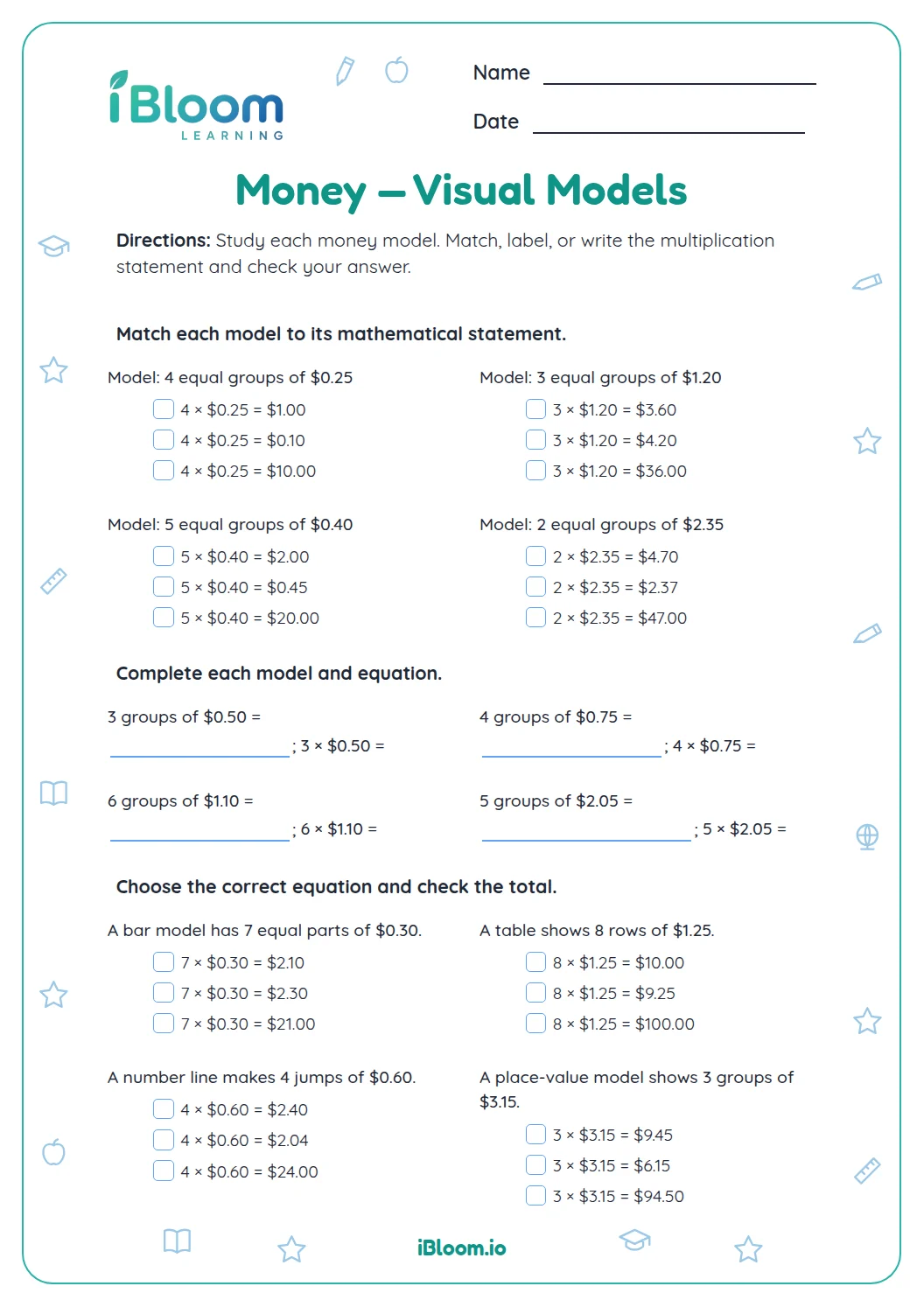
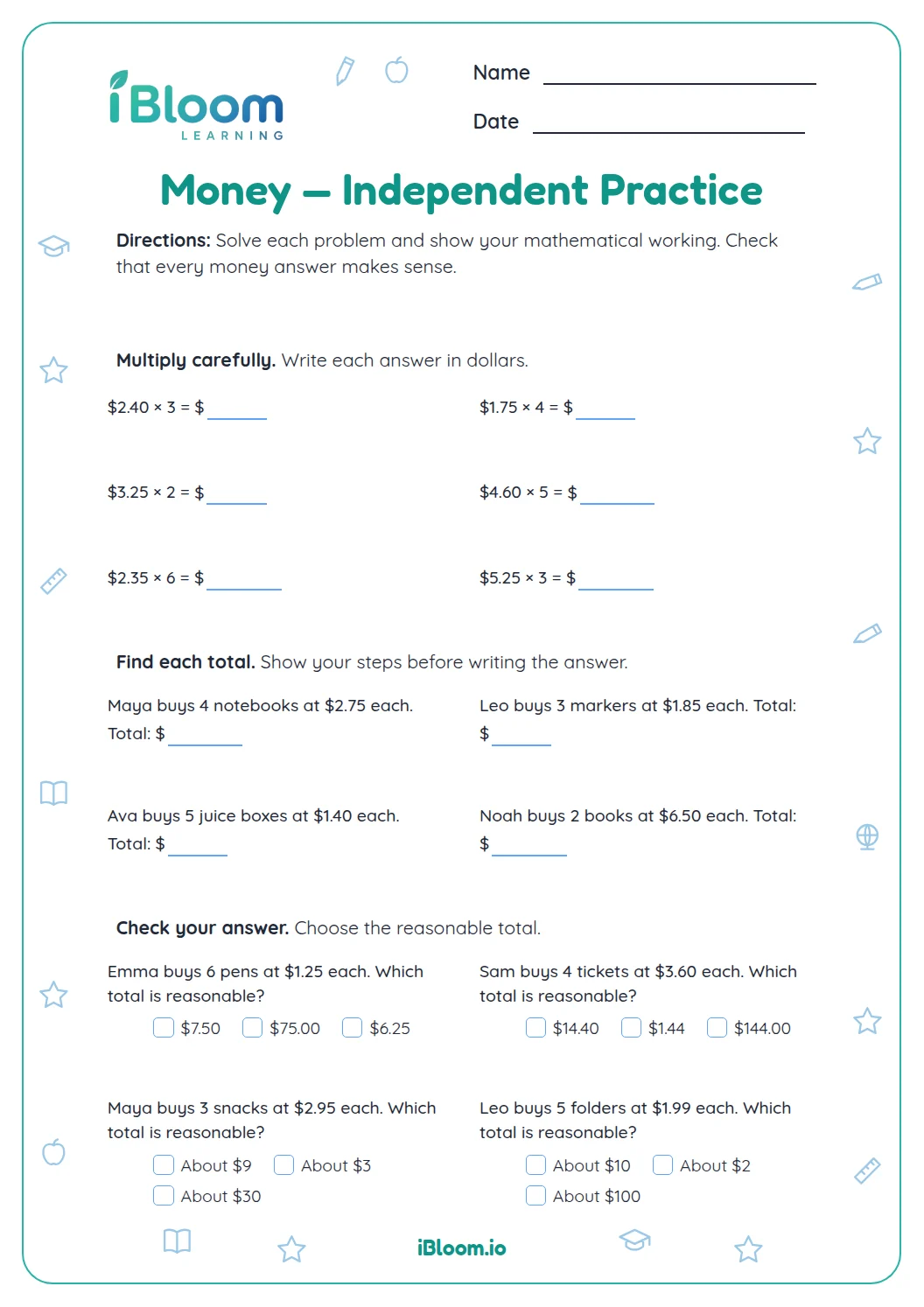
This Grade 5 worksheet practices multiplying decimals through real-world situations involving money, measurement, and groups. Students solve 12 context problems, then estimate two products to check whether an answer is reasonable. The two-page worksheet provides room to show work, and a separate answer key lists the products. It aligns with CCSS 5.NBT.B.7, applying decimal operations to real-world problems.
Aligned to 5.NBT.B.7
What situations do the problems use?
The first two parts apply decimal multiplication to quantities such as prices, lengths, weights, or amounts repeated across groups. Part C asks students to estimate two products. The problems are designed for written work, so students can show how they multiply and label each result with its unit.
- 12 real-world product problems
- 2 estimation questions
- Space to show calculations and units
How do you solve a decimal multiplication problem?
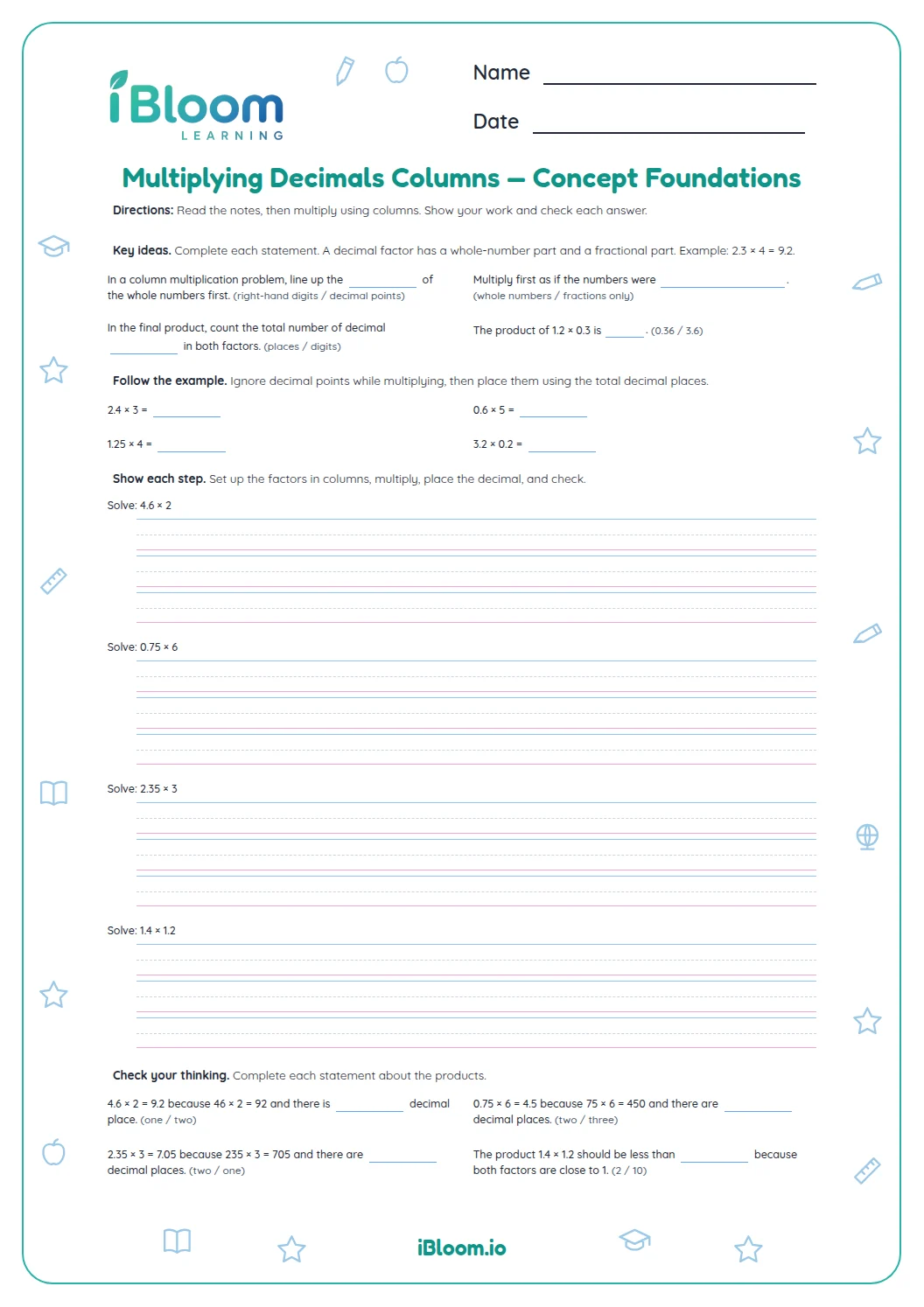
Multiply as with whole numbers, then place the decimal so the product has the total number of decimal places in the factors. In a context problem, identify what one group contains and how many groups there are.
- 1A 0.6-liter bottle holds 0.6 liter. Four bottles hold 0.6 × 4 = 2.4 liters.
- 2Estimate: about 1/2 × 4 = 2 liters, so 2.4 liters is reasonable.
Why estimate before checking a product?
An estimate gives a quick size check. Round a factor to a nearby friendly number, multiply, and compare that result with the exact product. If the exact answer is far away, revisit the decimal placement and multiplication.
Why should answers include units?
A number in a story represents a quantity. Write dollars for a cost, meters for a length, or liters for a capacity when the prompt asks for that measure. A clear unit helps explain what the product means.
Steps for solving each problem
- 1Mark the amount for one item or group and the number of groups.
- 2Write a multiplication sentence using the two quantities.
- 3Multiply the digits, then place the decimal using the factors’ decimal places.
- 4Attach the unit that matches the situation.
- 5Estimate the size and compare it with your exact result.
- 6Check each product against the answer key.
Decimal multiplication checks
The mistake
Placing the decimal without counting decimal places in both factors.
The fix
Count the total decimal places in the factors and use that count in the product.
The mistake
Adding quantities when the same amount is repeated in equal groups.
The fix
Represent equal groups with multiplication, such as amount per group × number of groups.
The mistake
Writing a bare number for a money or measurement problem.
The fix
Include the unit named in the question so the product answers the real situation.
Curriculum alignment
These standards describe the grade-level skills practiced on this worksheet.
Multiply decimals to hundredths using place value strategies.
On this sheet: The worksheet directly practices this grade-level skill through sentence and context-based application.
Show the official wordingHide the official wording
Add, subtract, multiply, and divide decimals to hundredths, using concrete models or drawings and strategies based on place value, properties of operations, and/or the relationship between addition and subtraction; relate the strategy to a written method and explain the reasoning used.
What to practice next
Make more practice
Further reading
Questions parents and teachers ask
How many problems are on the worksheet?
The worksheet has 14 questions in three parts: 12 real-world decimal multiplication problems and 2 estimation checks. It prints across two worksheet pages, followed by a separate two-page answer key with the products and estimates for checking each result against the student work.
How should students start a word problem?
Find the quantity for one item or group and how many equal groups there are. Multiply those values, then read the question again to see which unit belongs in the answer. This helps distinguish a product problem from a situation that asks for a sum or difference.
How do you place the decimal in a product?
Multiply the digits as if the factors were whole numbers, then count the decimal places in both factors together. The product needs that many decimal places. Compare it with an estimate, and add the unit named in the problem to complete the answer.
What are the estimate questions for?
They ask students to judge the size of a product with friendly rounded values. For instance, 2.4 × 5 is near 2 × 5, or 10. An estimate is a reasonableness check; it does not replace the exact calculation required by a word problem.
Why does the answer need a unit?
The unit tells what the product measures. A price multiplied by a number of items gives a money amount, while a length repeated across groups gives a length. Write the unit used in the prompt so the answer is meaningful in its context.