
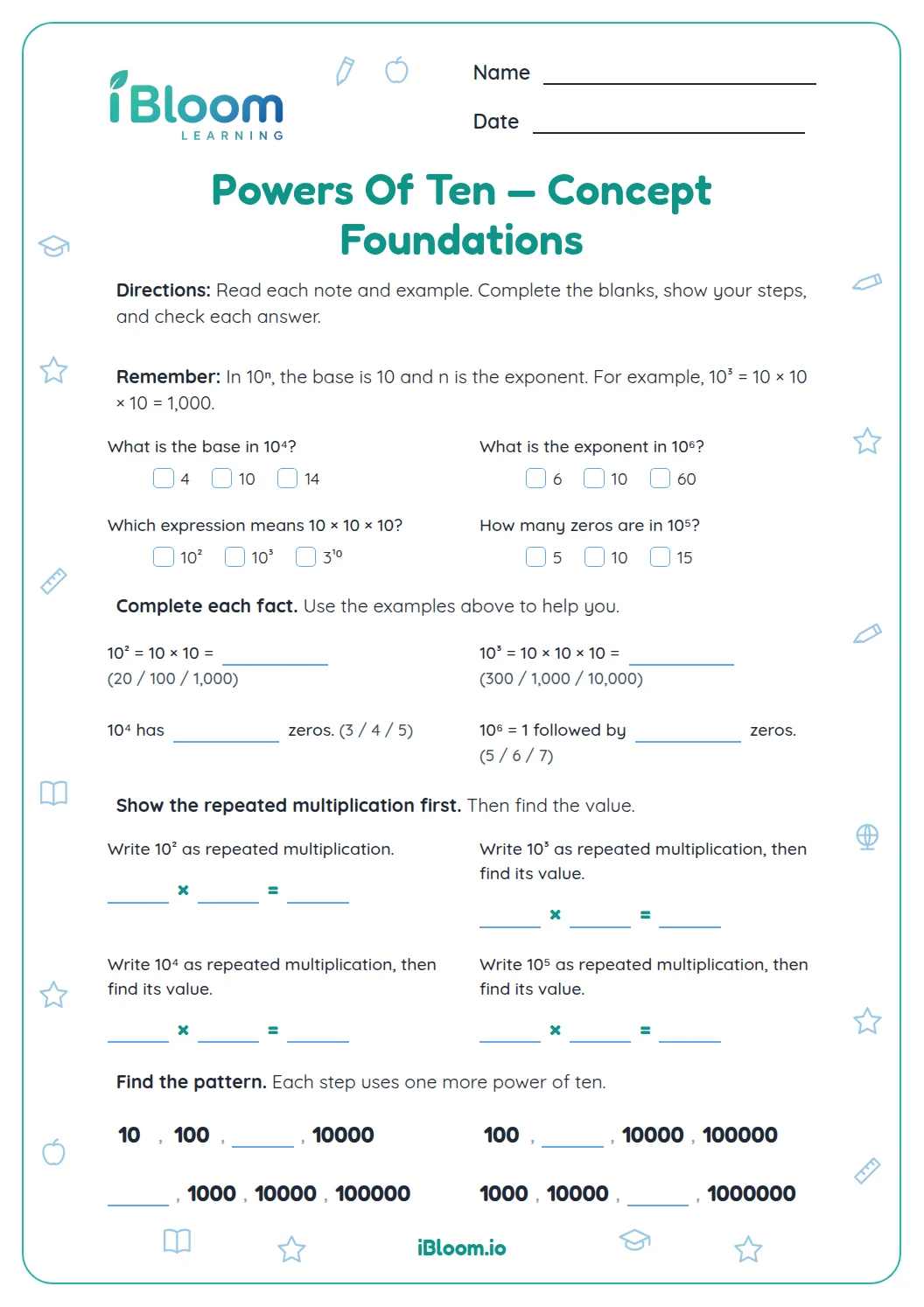
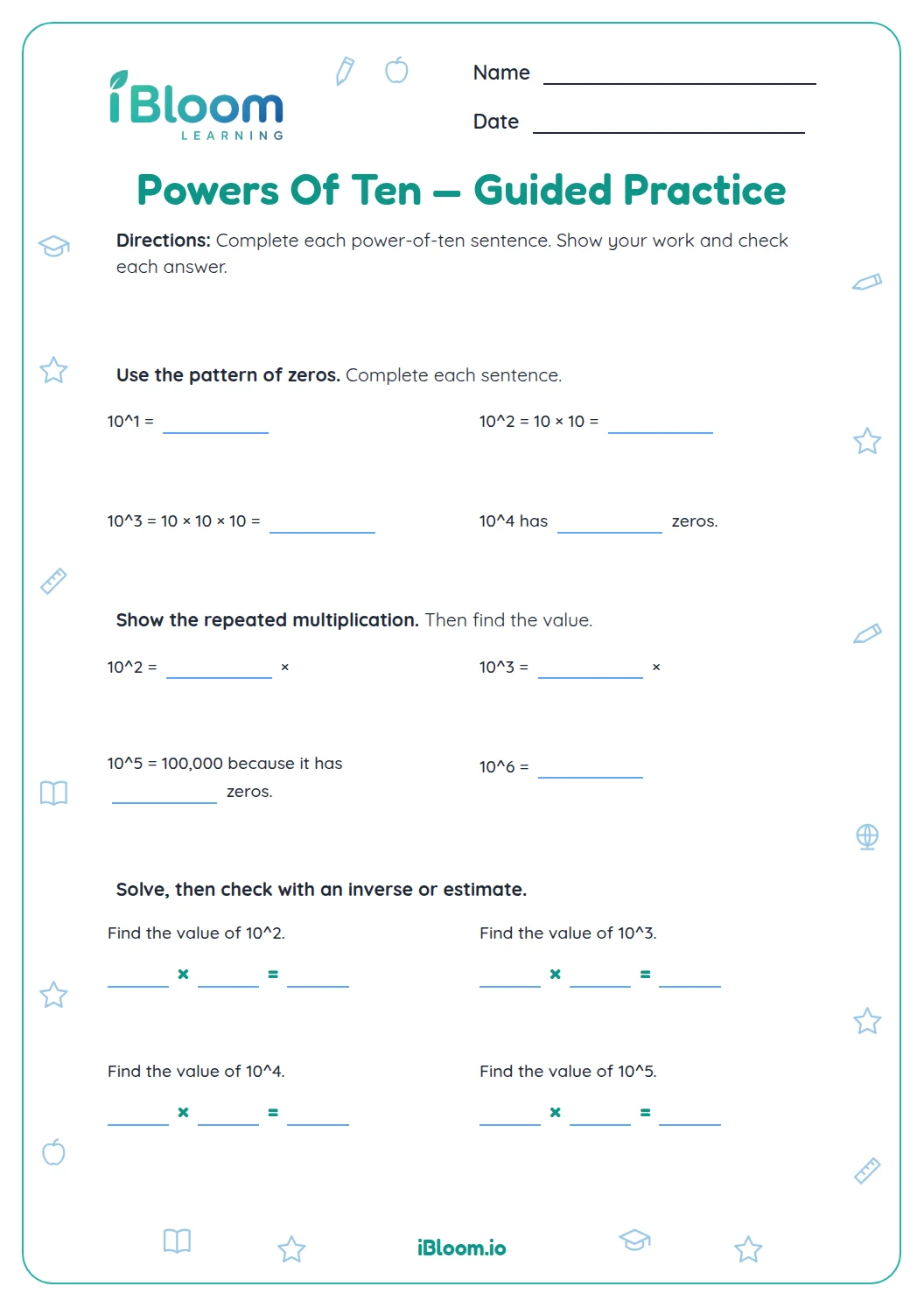
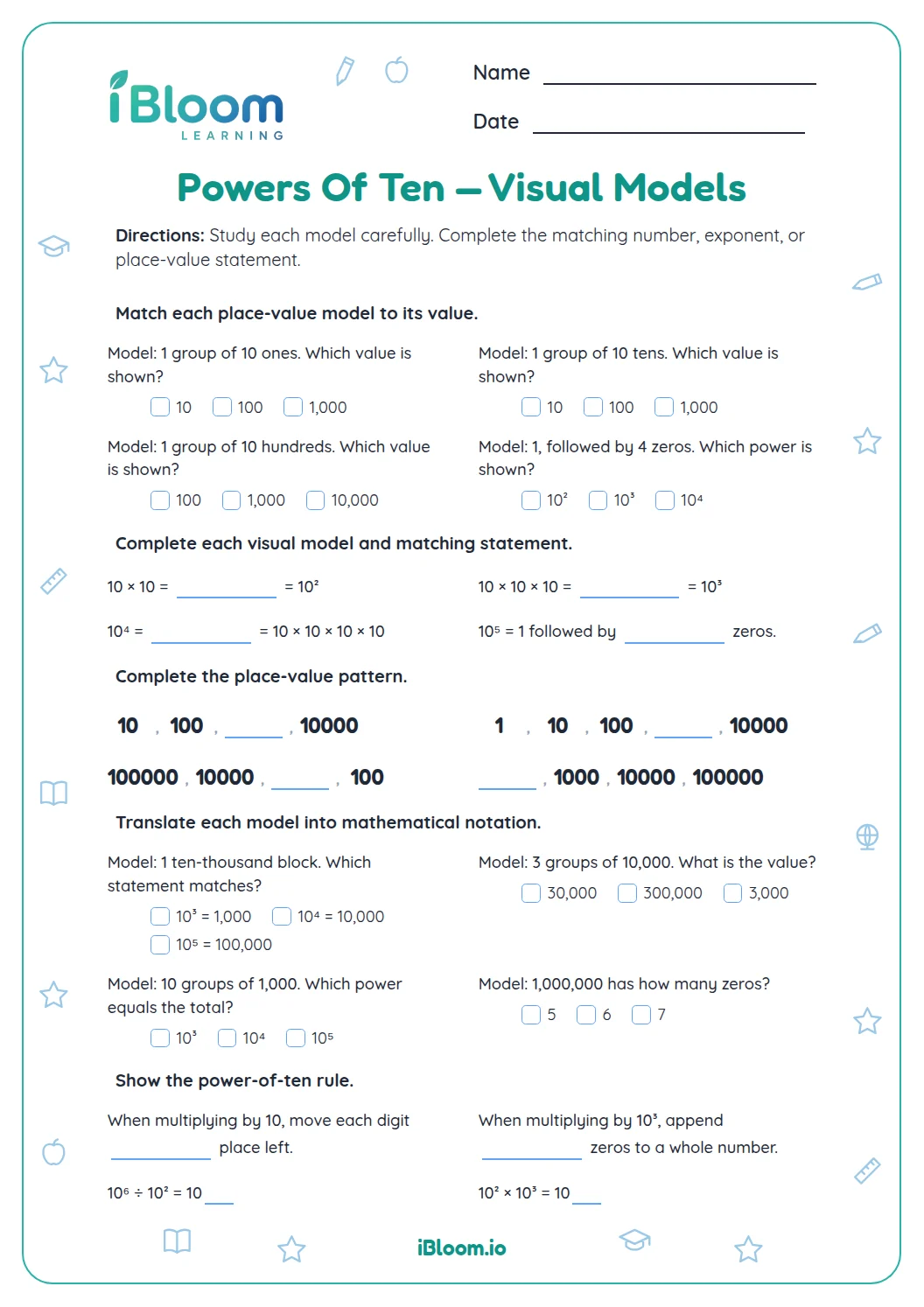
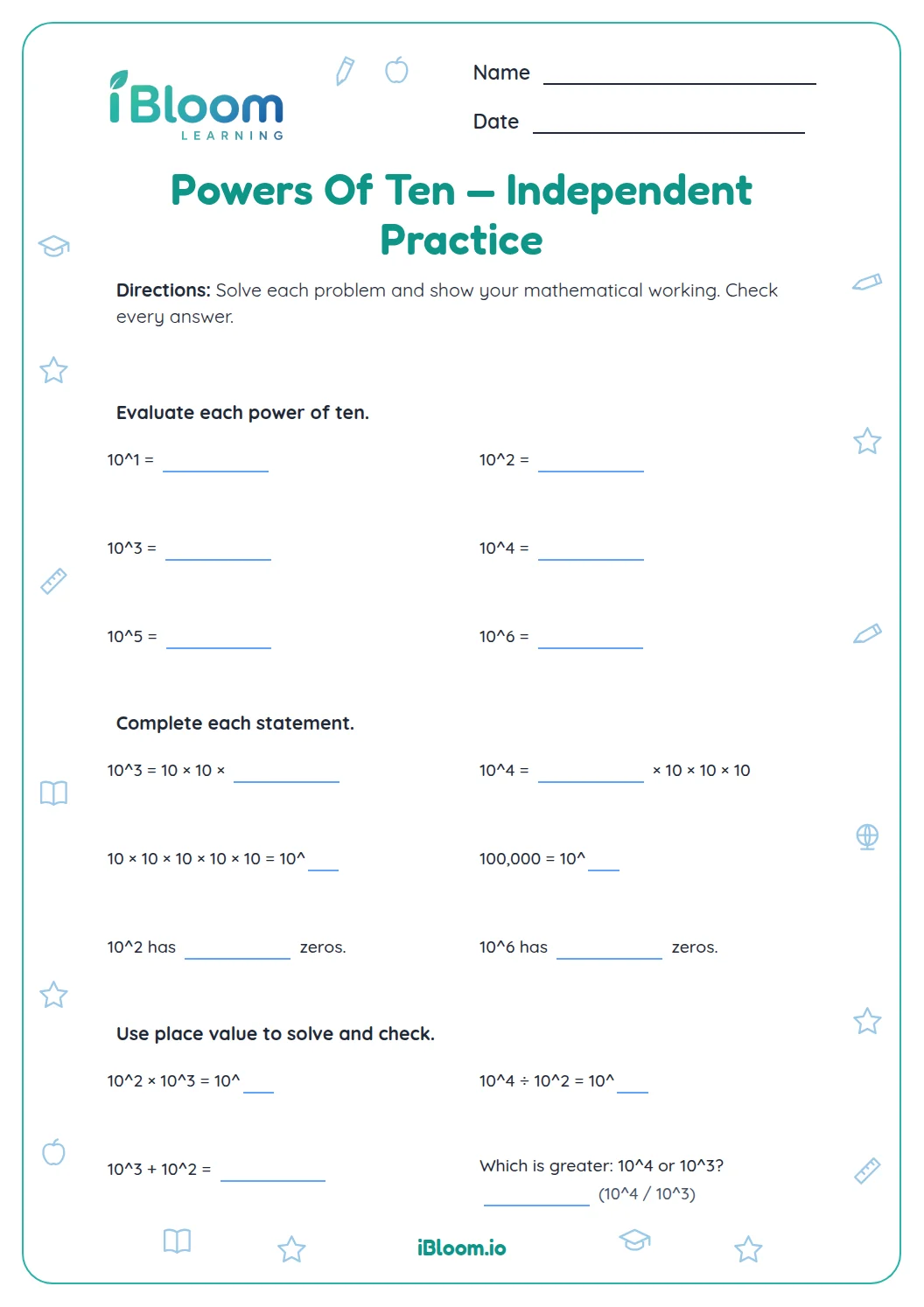



About this worksheet
This Grade 5 worksheet gives students 16 real-world questions about powers of ten. Each prompt describes a quantity or equal groups and asks for the total, from beads and flags to books and seats. Students write a number for each blank, then use the separate answer key to check their calculations.
Aligned to 5.NBT.A.2
How do powers of ten show quantities?
A power of ten represents repeated multiplication by 10. For example, 10² is 10 × 10, or 100. Students use these powers in story situations with groups of countable items.
How can students find each total?
Identify the number of groups and the amount in each group. Multiply the factors, then check that the result makes sense for the story.
How can a student check a product?
For 7 groups of 1,000 seeds, write 7 × 10³. Since 7 × 1,000 = 7,000, the answer is 7,000 seeds.
How to use this worksheet
- 1Underline the number of groups and items per group.
- 2Write the multiplication expression.
- 3Represent the factors of ten with an exponent.
- 4Calculate the total.
- 5Expand the power to check your answer.
Power-of-ten checks
The mistake
Using the group count but forgetting the amount in each group.
The fix
Write both factors before using an exponent.
The mistake
Writing the exponent as the product.
The fix
Use the exponent to count factors; multiply to find the product.
The mistake
Adding zeros without checking the factors.
The fix
Expand the power and multiply by place value.
Common Core alignment
Students interpret exponents on powers of ten and solve real-world quantities.
On this sheet:
Show the official wordingHide the official wording
Explain patterns in the number of zeros of the product when multiplying a number by powers of 10, and explain patterns in the placement of the decimal point when a decimal is multiplied or divided by a power of 10. Use whole-number exponents to denote powers of 10.
What to practice next
Make more practice
Further reading
Questions parents and teachers ask
What does this powers-of-ten worksheet practice?
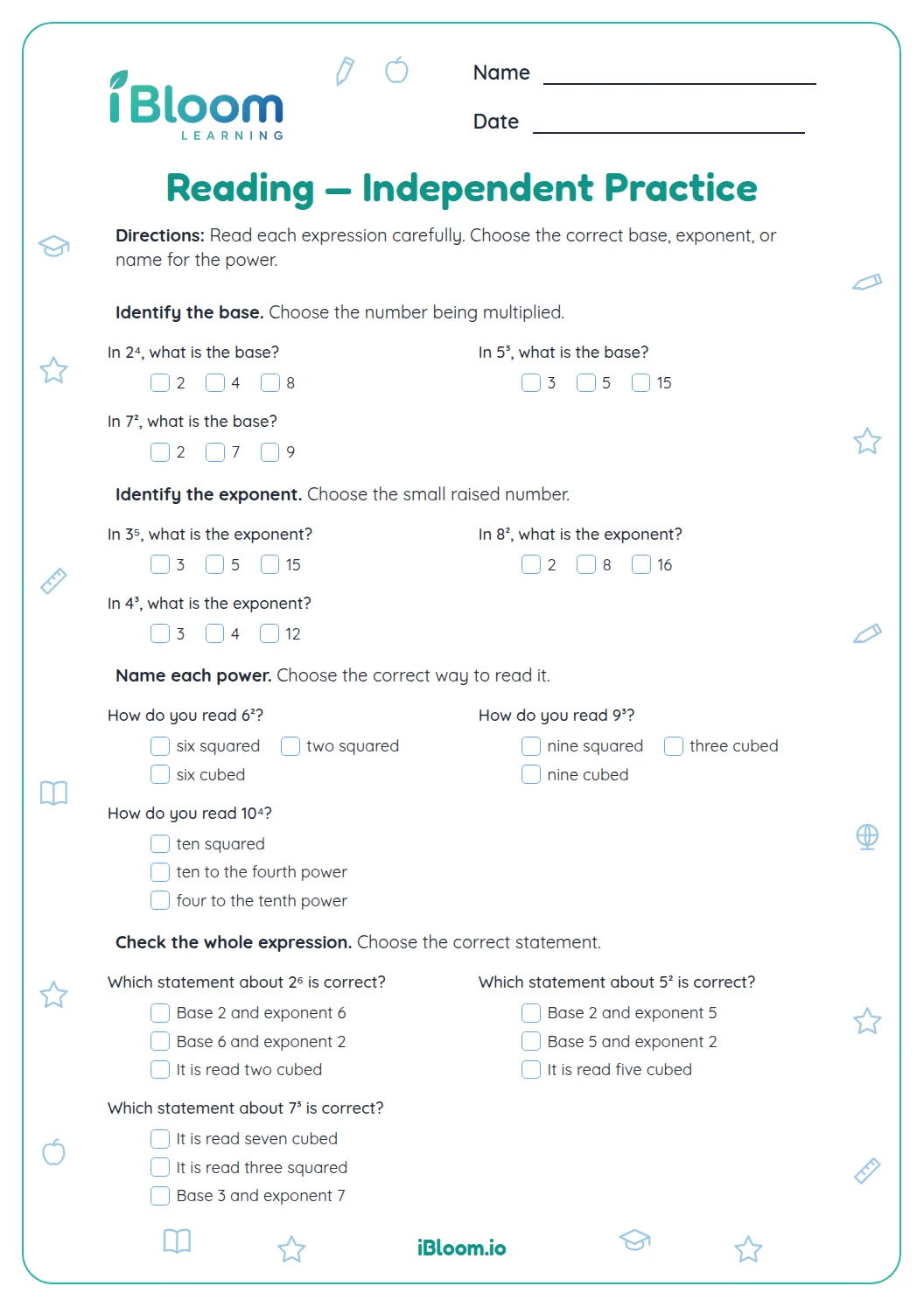
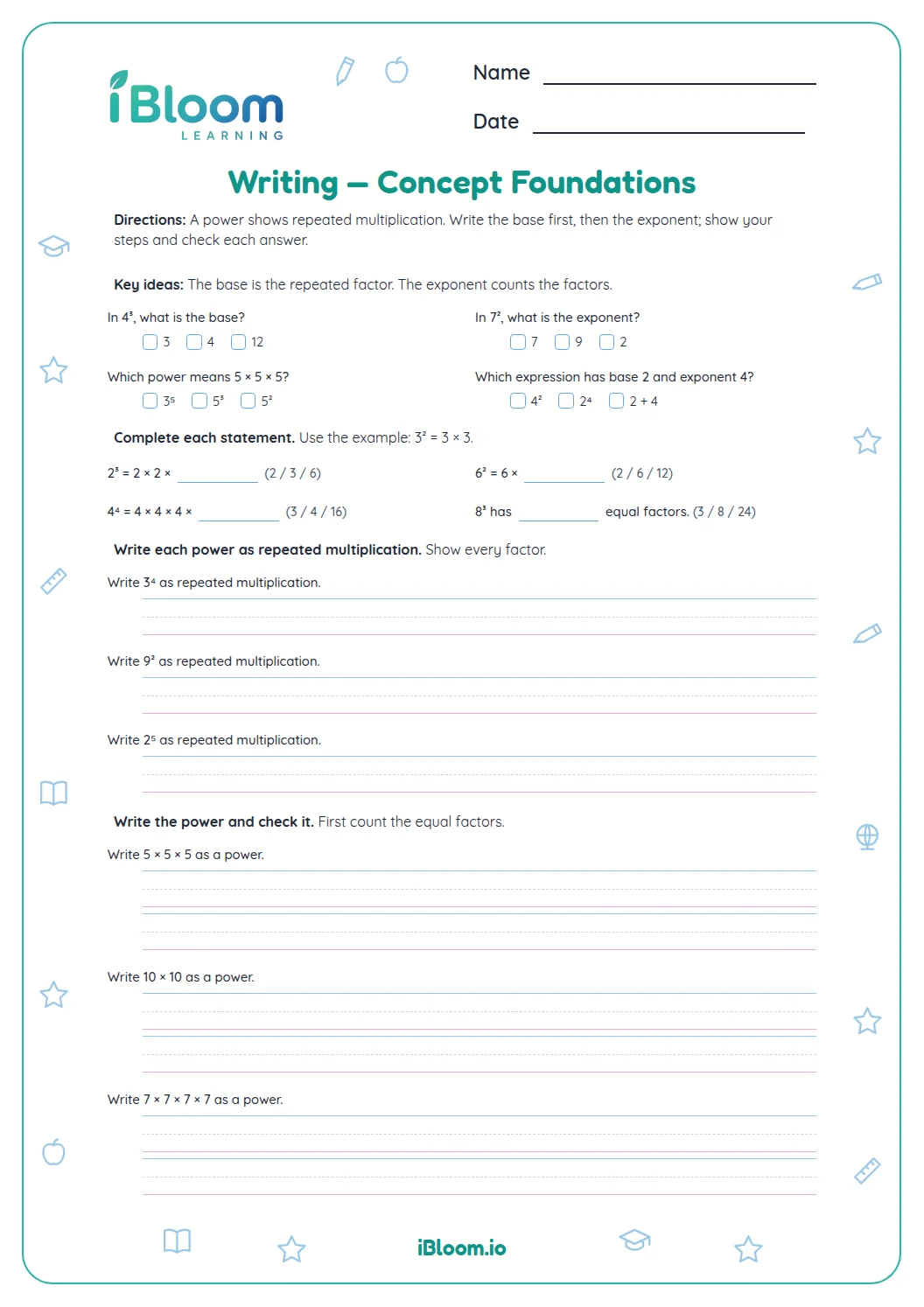
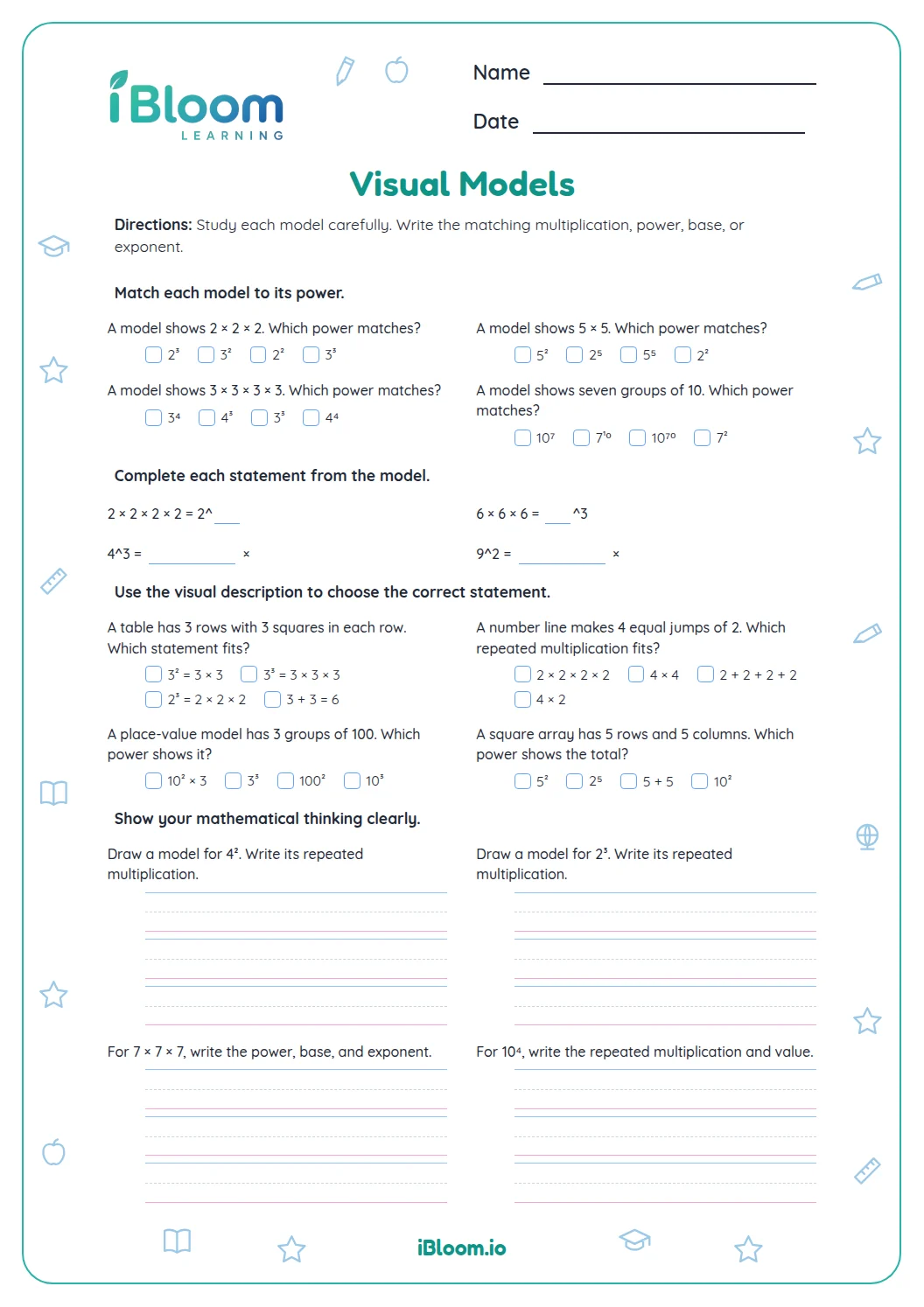
Students use powers of ten and equal groups to find real-world totals. The 16 questions include beads, seeds, visitors, books, stickers, and other countable items. Every prompt has one numeric blank, and the separate answer key lists the total for checking.
How many problems are included?
There are 16 fill-in questions in two parts. Each describes a power of ten or equal groups and asks for a total. Students write a number in each blank, then use the separate answer key to check their products and review any calculation.
What is an example of a power-of-ten expression?
For example, ten squared means 10 × 10, which equals 100. If a box holds 10² beads, the box holds 100 beads. The exponent tells how many factors of 10 to multiply, and the answer can be checked by expanding the power.
Should students show their multiplication?
Students can write a multiplication expression before calculating a total. For example, seven boxes with 100 pencils each can be represented as 7 × 10², which equals 700 pencils. This connects the story, the power, and the product.
What is included with the printable?
There are worksheet pages and a separate answer key. Each problem uses countable groups, and the key provides a power-of-ten expression and the resulting total for checking each response. This gives the student a clear way to practice the skill and review the work with an adult or independently.