


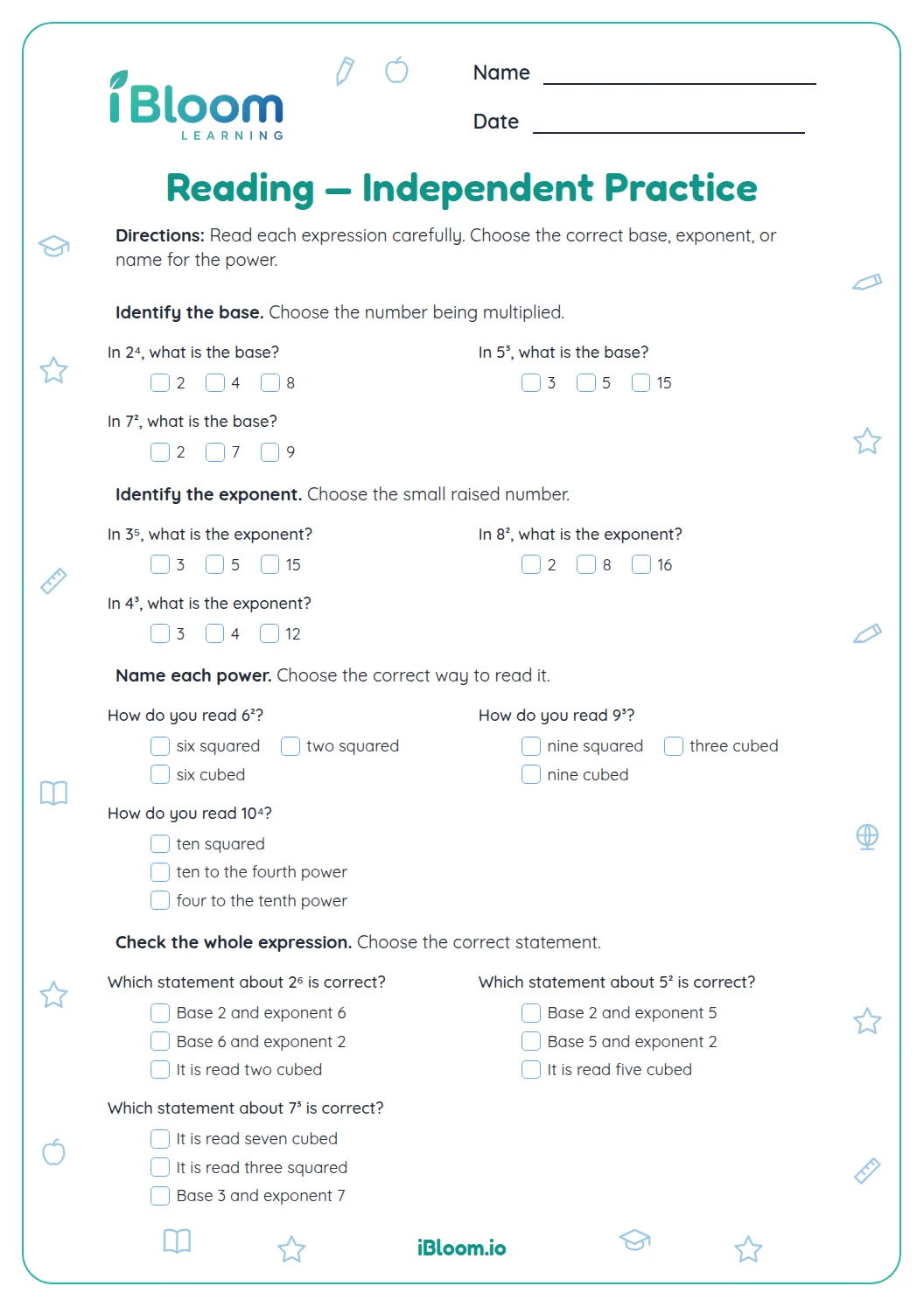
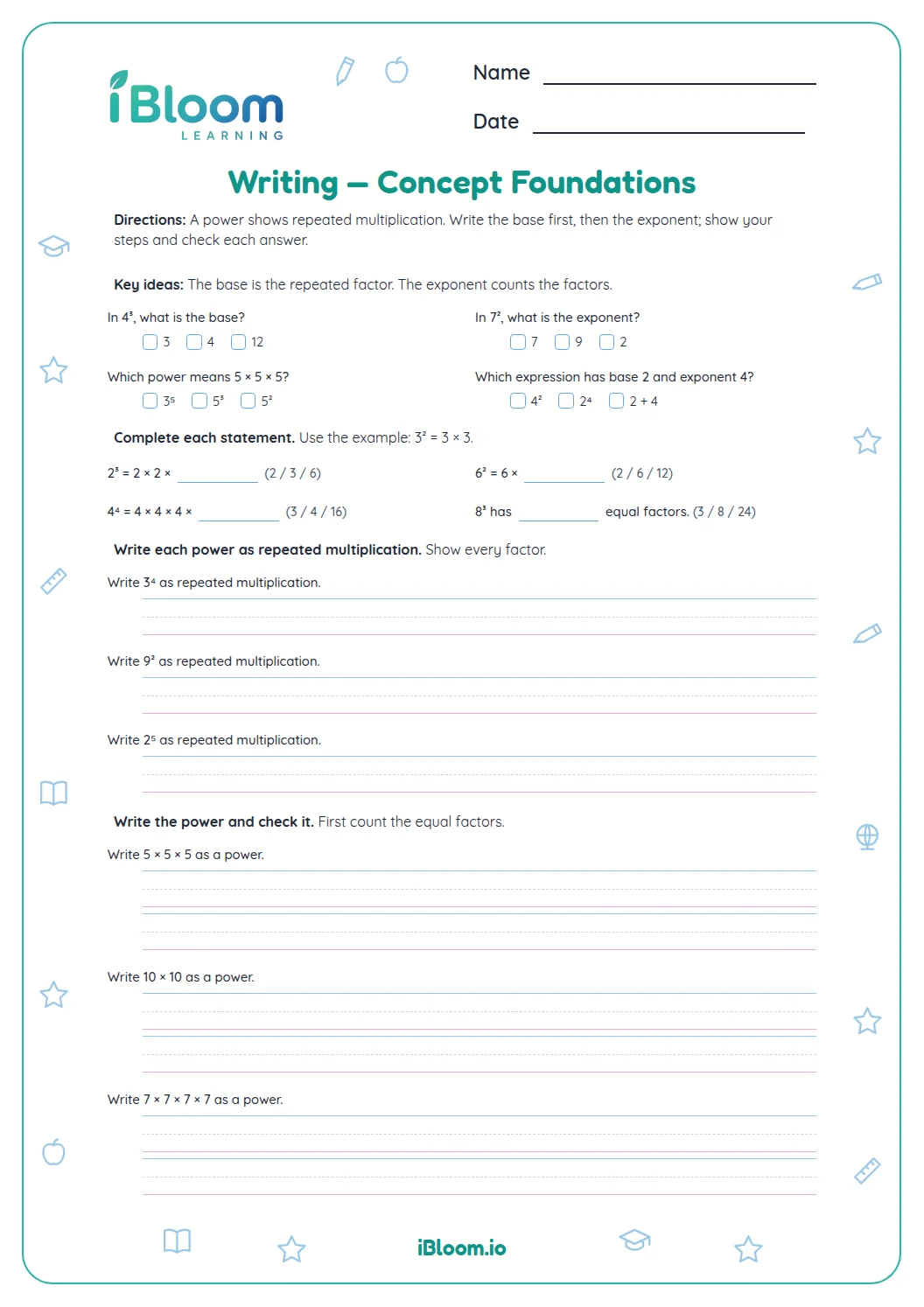
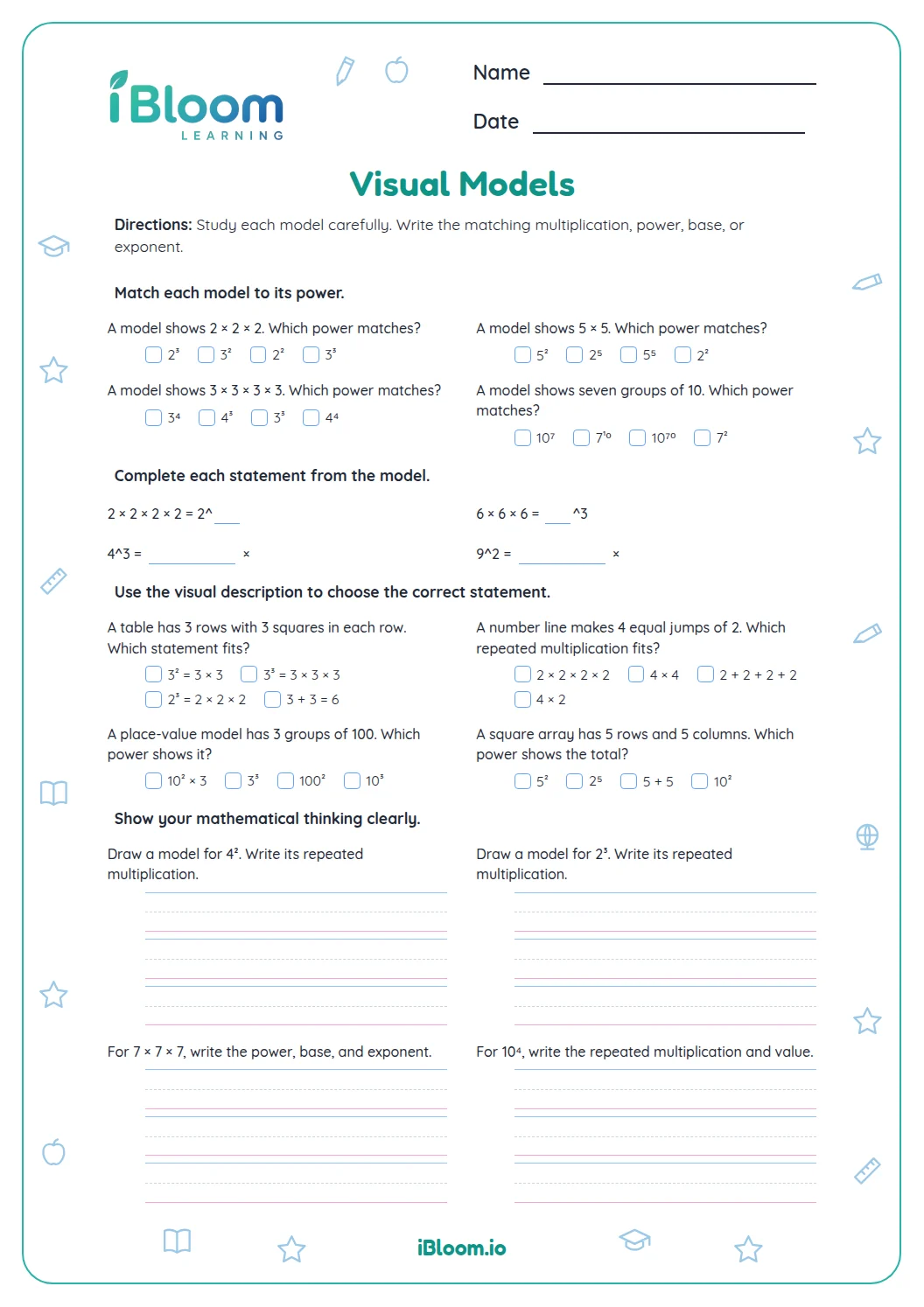

About this worksheet
This Grade 5 powers-of-ten worksheet asks students to judge claims, complete equations and explain place-value patterns. It connects repeated multiplication by 10 with whole-number exponents, then applies the patterns to larger values. The separate answer key gives short answers and a model explanation for the written response.
Aligned to 5.NBT.A.2
What does an exponent tell you?
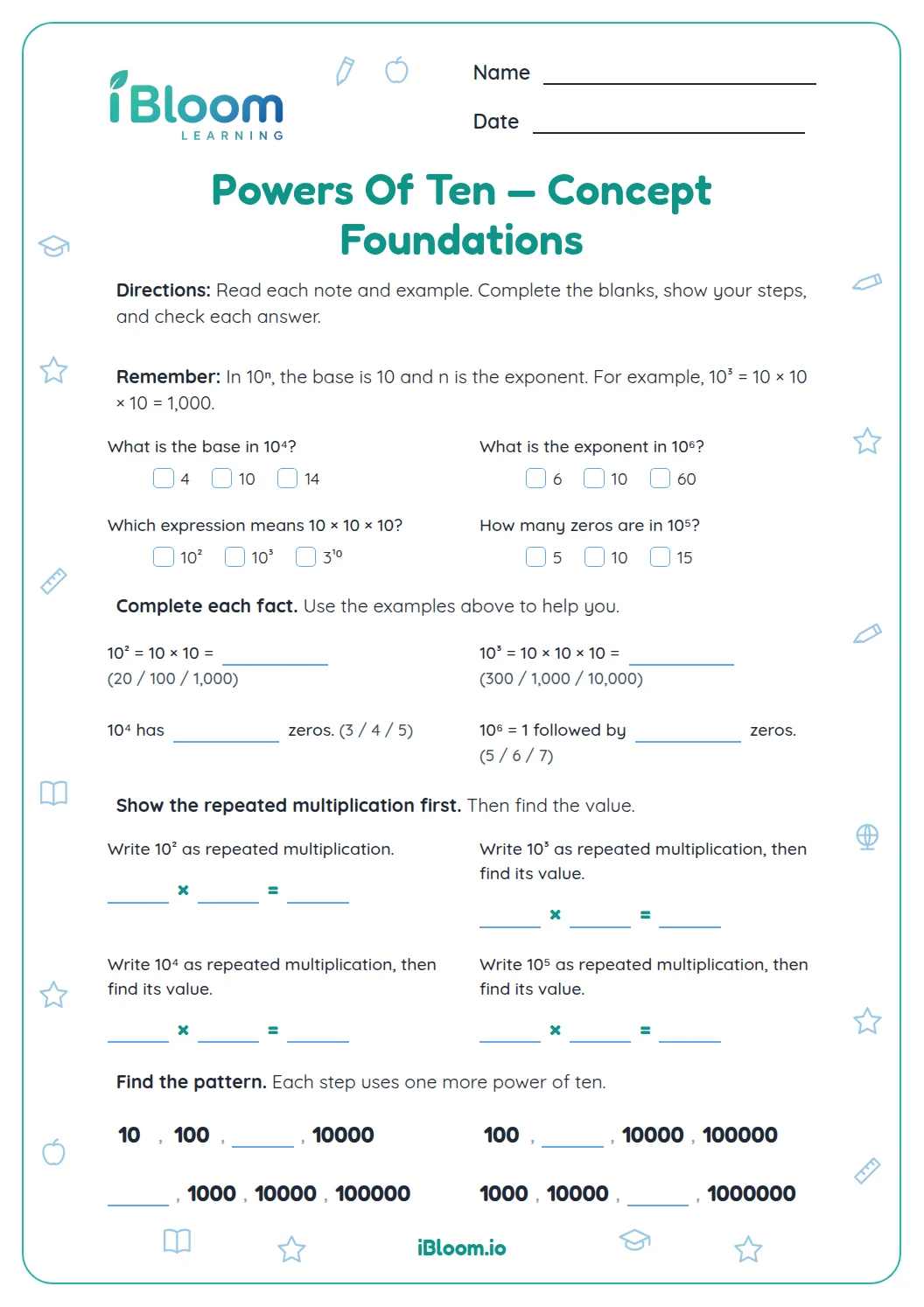
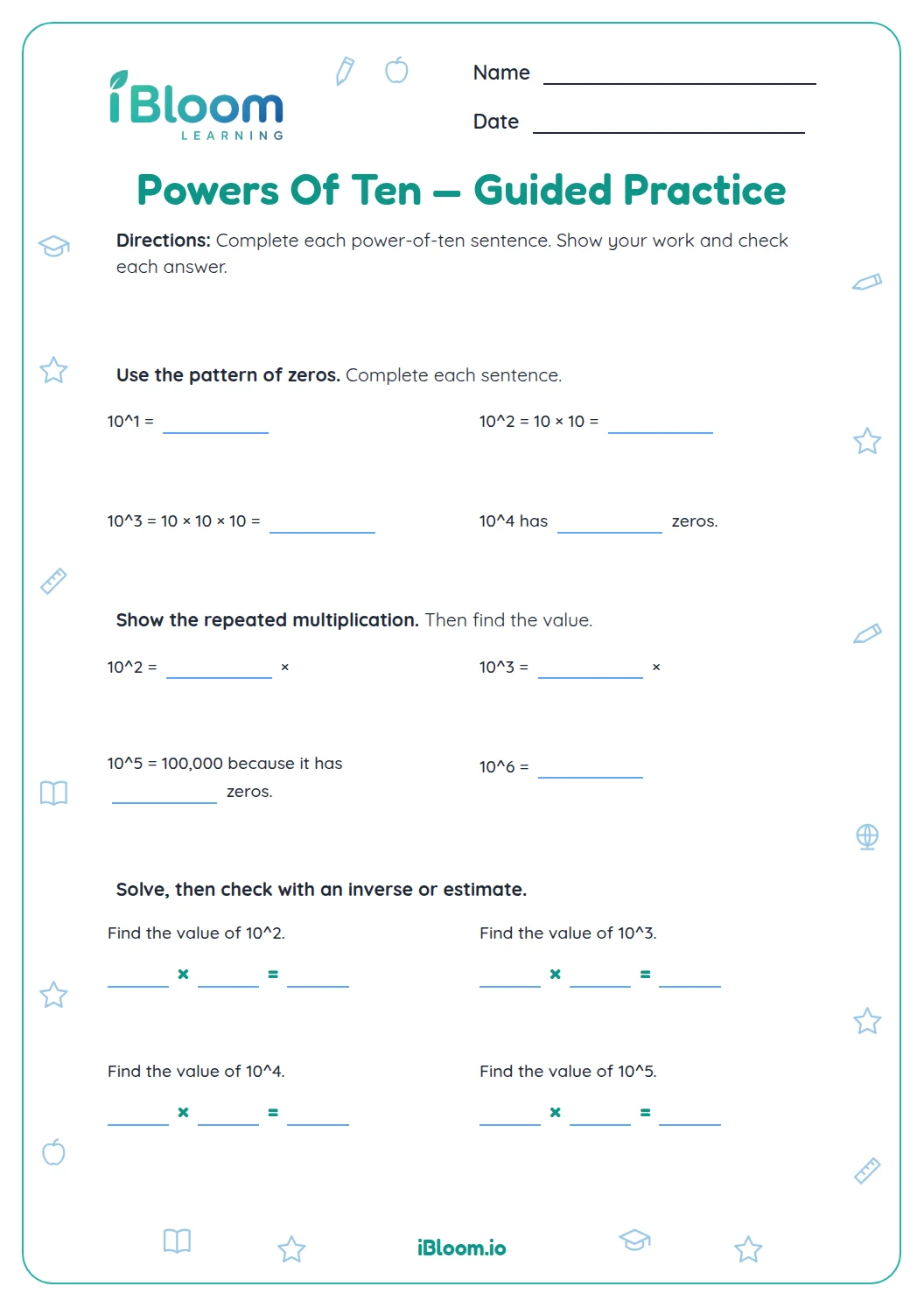
For a power of ten, the exponent counts how many factors of 10 are multiplied. For example, 10⁴ means four factors of 10.
- 1Question 1: 10³ = 10 × 10 × 10 = 1,000.
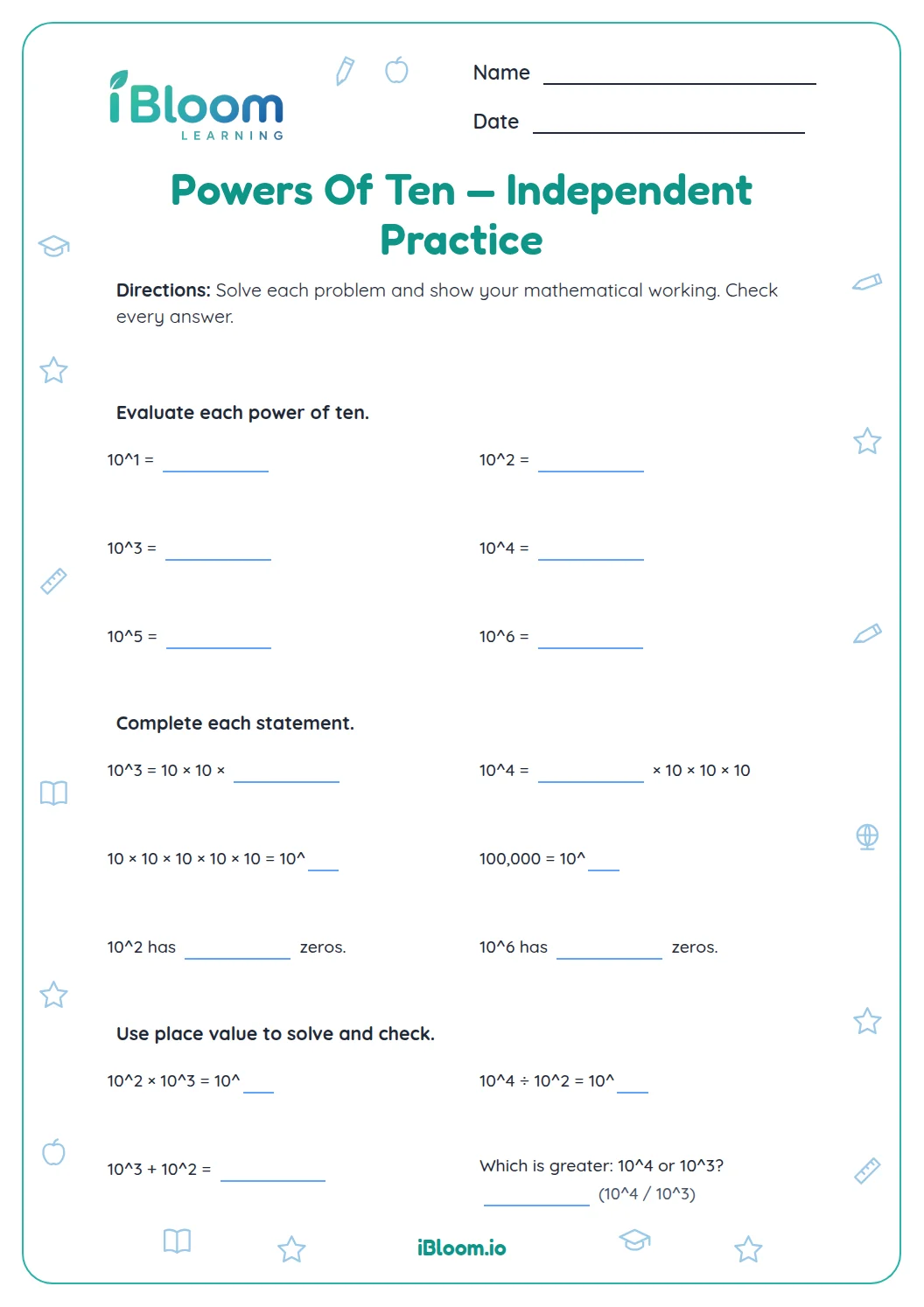
- 2Question 8: 10⁴ × 10² = 10⁶ because the six factors of 10 can be counted together.
How do powers of ten change place value?
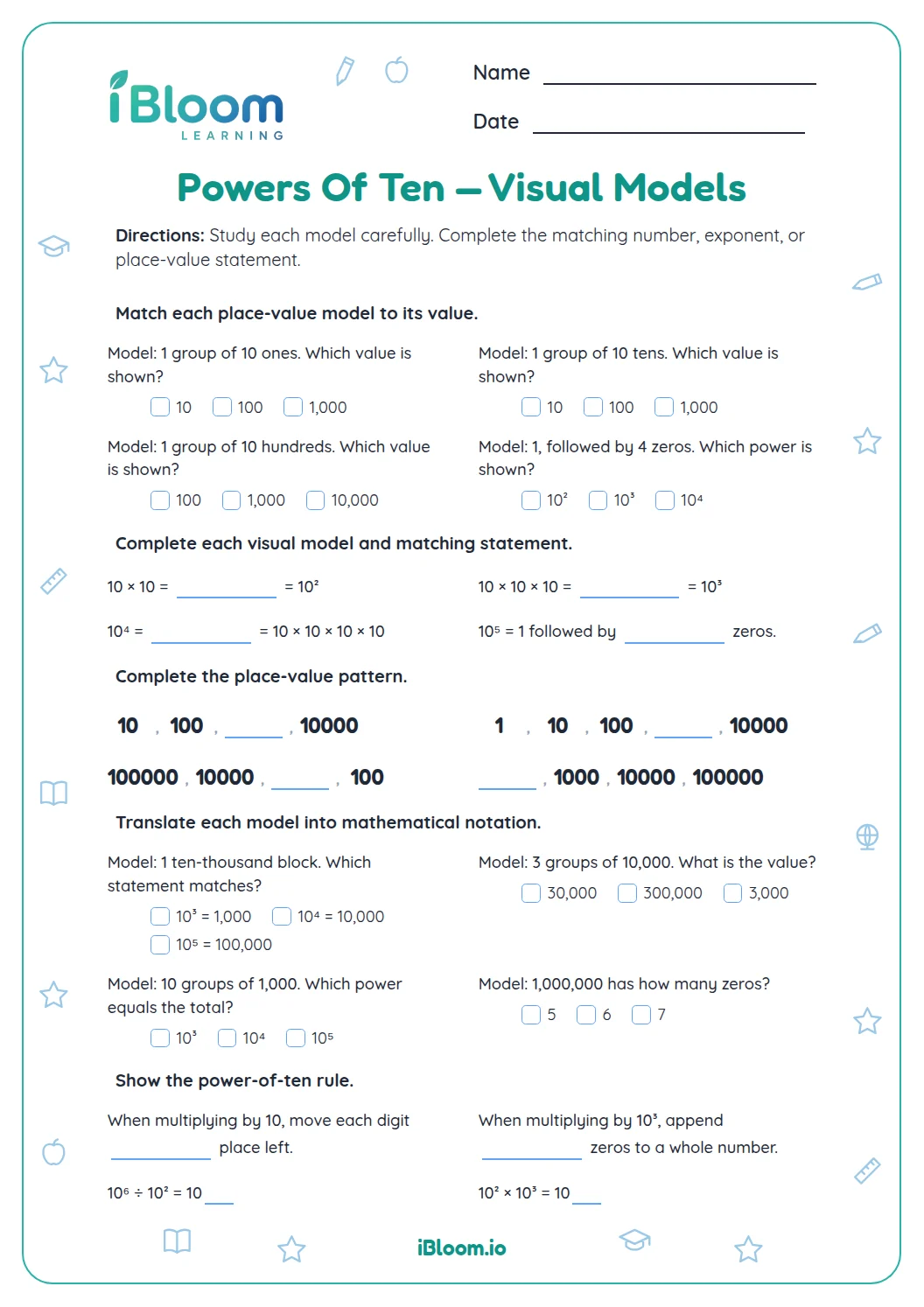
Multiplying by 10, 100 or 1,000 shifts a whole number’s digits left by one, two or three places. The number of zeroes in the power records that shift.
How can you test another student’s claim?
Rewrite the power as repeated factors or standard form, then compare that value with the claim. This keeps the reasoning tied to place value rather than a memorized zero rule.
How to work through this page
- 1Expand the power as repeated factors when unsure.
- 2Use the exponent to count factors of 10.
- 3Check the number of zeroes against the exponent.
- 4For a claim, calculate first and then decide whether it is correct.
Common mistakes and quick fixes
The mistake
Reading the exponent as a factor to multiply
The fix
Expand the power as repeated factors of ten.
The mistake
Adding the base digits instead of counting factors
The fix
Count how many factors of ten appear.
The mistake
Comparing exponents without checking values
The fix
Write both products in standard form and compare them.
Common Core alignment
This worksheet gives students focused practice with the named skill.
Use whole-number exponents to denote powers of 10 and explain the patterns.
On this sheet: Questions connect powers of 10 with repeated factors, zero patterns and place value.
Show the official wordingHide the official wording
Explain patterns in the number of zeros of the product when multiplying a number by powers of 10, and explain patterns in the placement of the decimal point when a decimal is multiplied or divided by a power of 10. Use whole-number exponents to denote powers of 10.
What to practice next
Make more practice
Further reading
Questions parents and teachers ask
What does 10⁴ mean?
10⁴ means ten multiplied by itself four times: 10 × 10 × 10 × 10. The product is 10,000; the exponent counts factors. For example, 10³ is 10 × 10 × 10, or 1,000. It has three factors of ten and three zeroes in standard form.
Why does 10⁵ have five zeroes?
Each factor of ten adds one zero to a power of ten. Five factors make 100,000, which has five zeroes. For example, 10³ is 1,000 and 10⁵ is 100,000. Expanding the powers makes the zero count visible. Students can count each zero to verify.
How do I multiply powers with the same base?
For powers with the same base, add the exponents: 10⁴ × 10² = 10⁶. The four factors and two factors make six factors of ten. For example, 10⁴ has four factors and 10² has two more. Together they make six factors, so the product is 10⁶.
Why does 8 × 10² equal 800?
10² equals 100, so 8 × 10² = 8 × 100 = 800. The 8 is in the hundreds place. For example, 8 × 10² means 8 groups of 100. That is 800, so the 8 appears in the hundreds place.
What should I check in a written explanation?
Name the powers or place values and support the comparison with a calculation. For example, 7,000 is ten times 700. For example, compare 7 × 10³ with 7 × 10²: the values are 7,000 and 700. The first is ten times as large.