



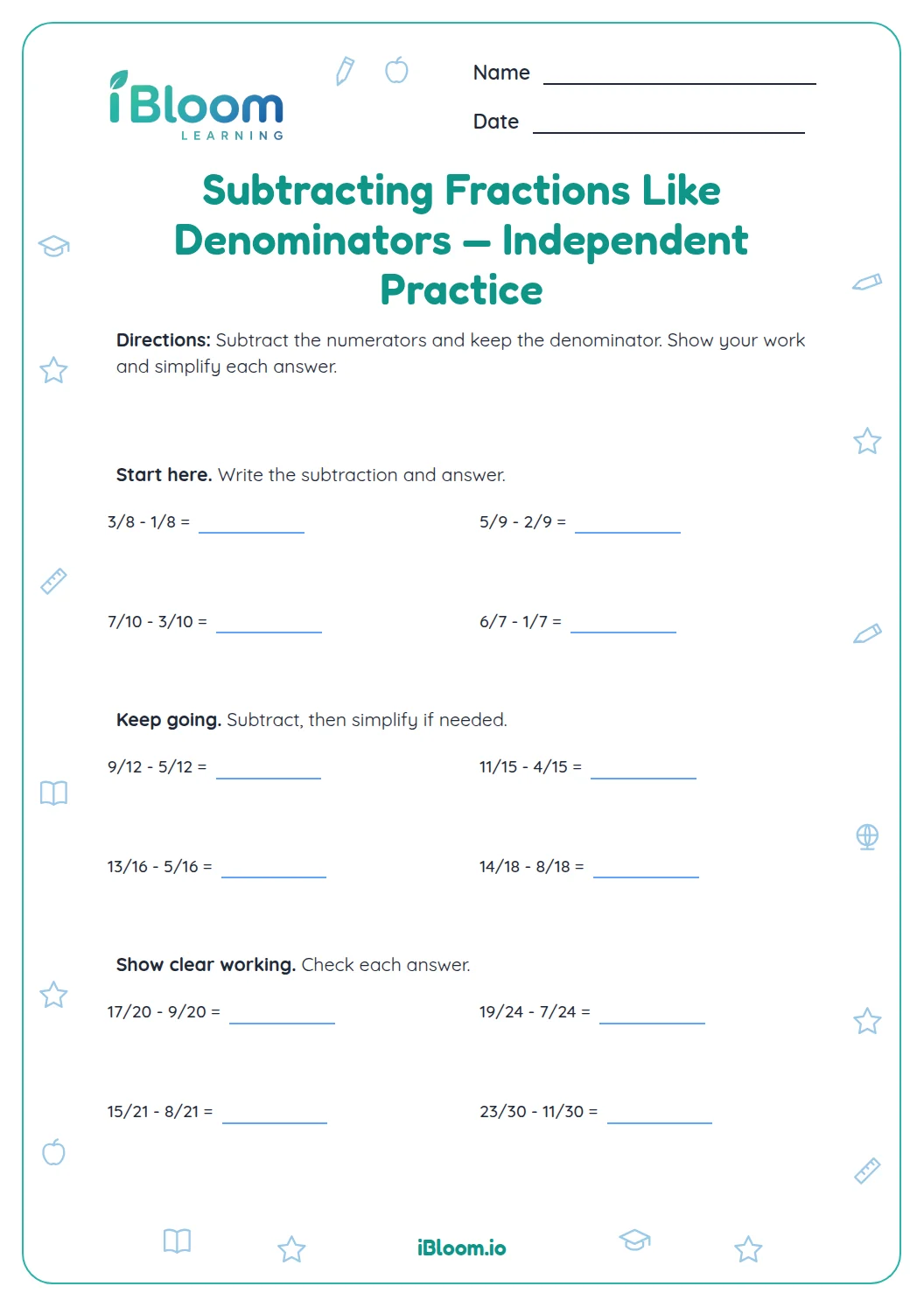

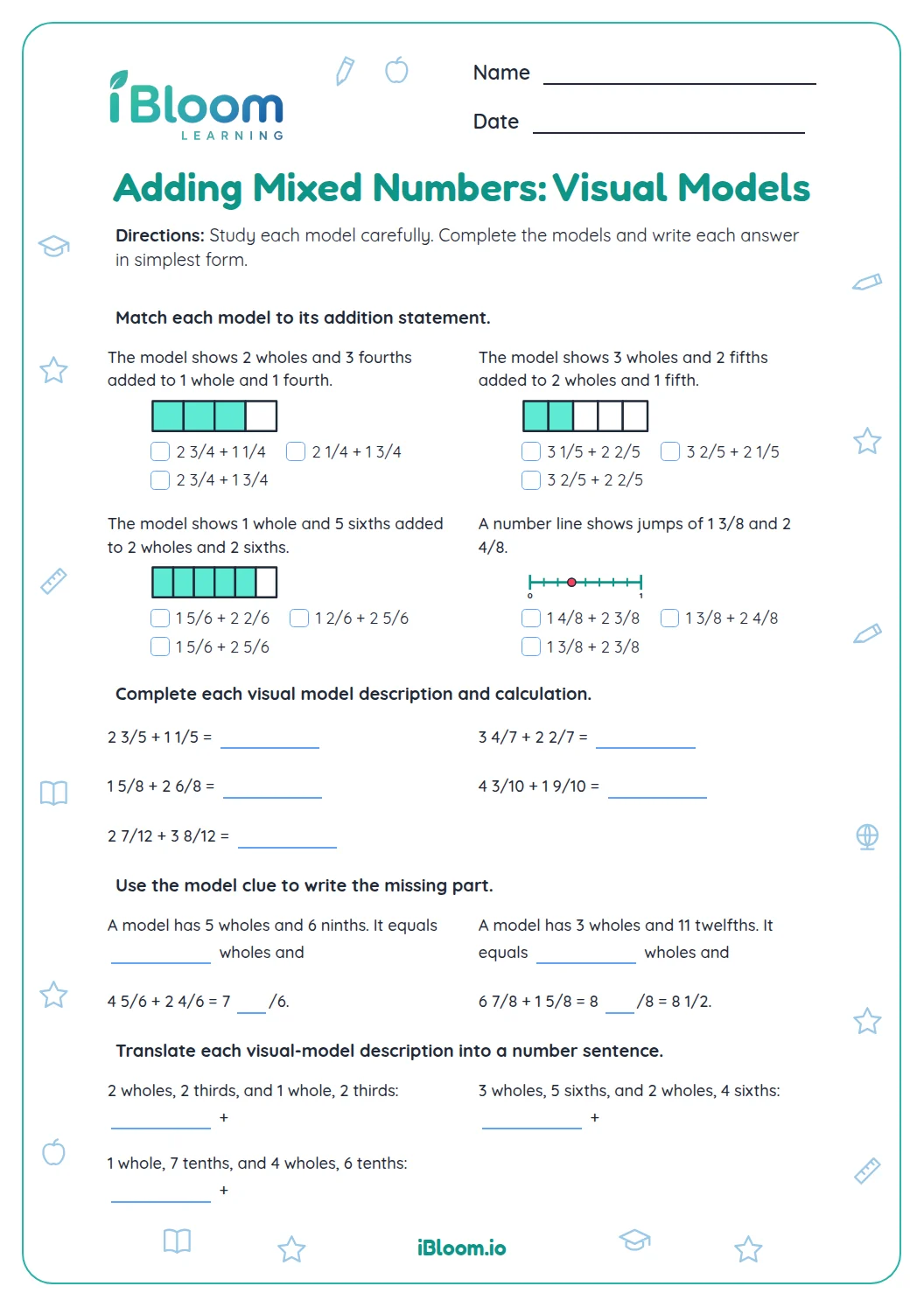

About this worksheet
This Grade 5 practice sheet builds fluency with adding and subtracting fractions that have like denominators. Children solve equations and read shaded bars, circles, and squares divided into equal parts. The work uses the Common Core idea of joining and separating fractional parts that refer to the same whole (4.NF.B.3a). A separate answer key is included.
Aligned to 4.NF.B.3a
How do you add or subtract fractions with like denominators?
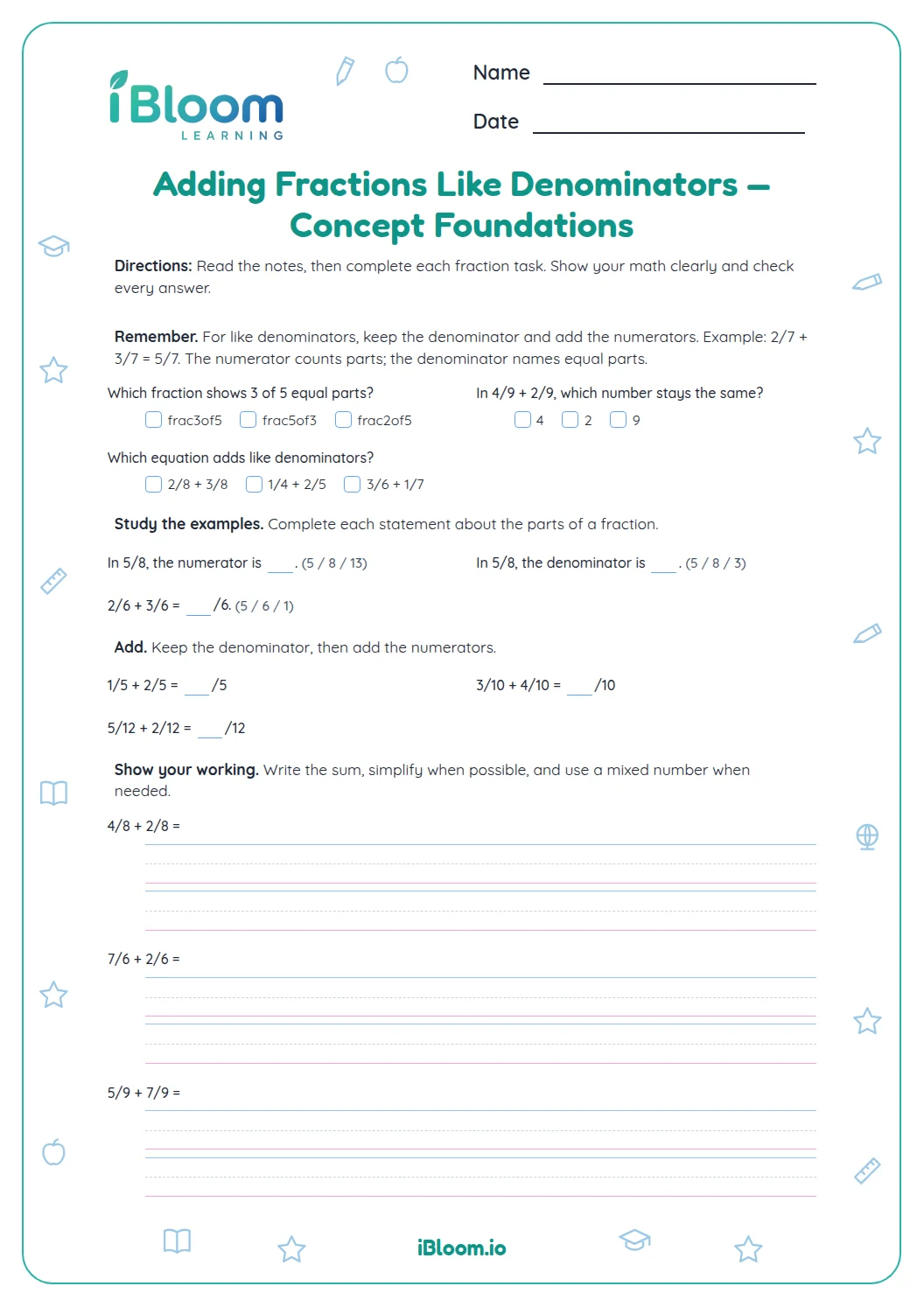
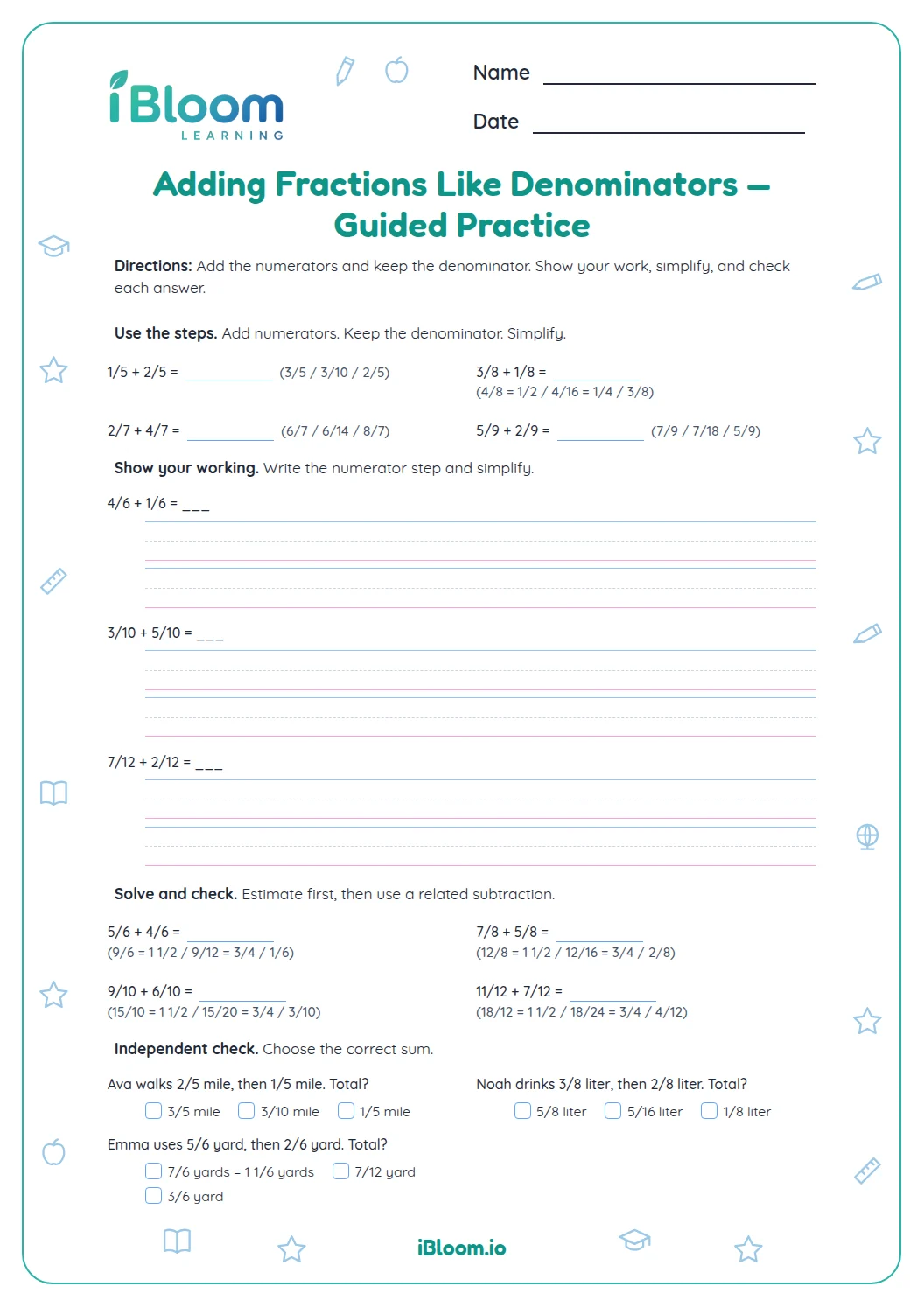
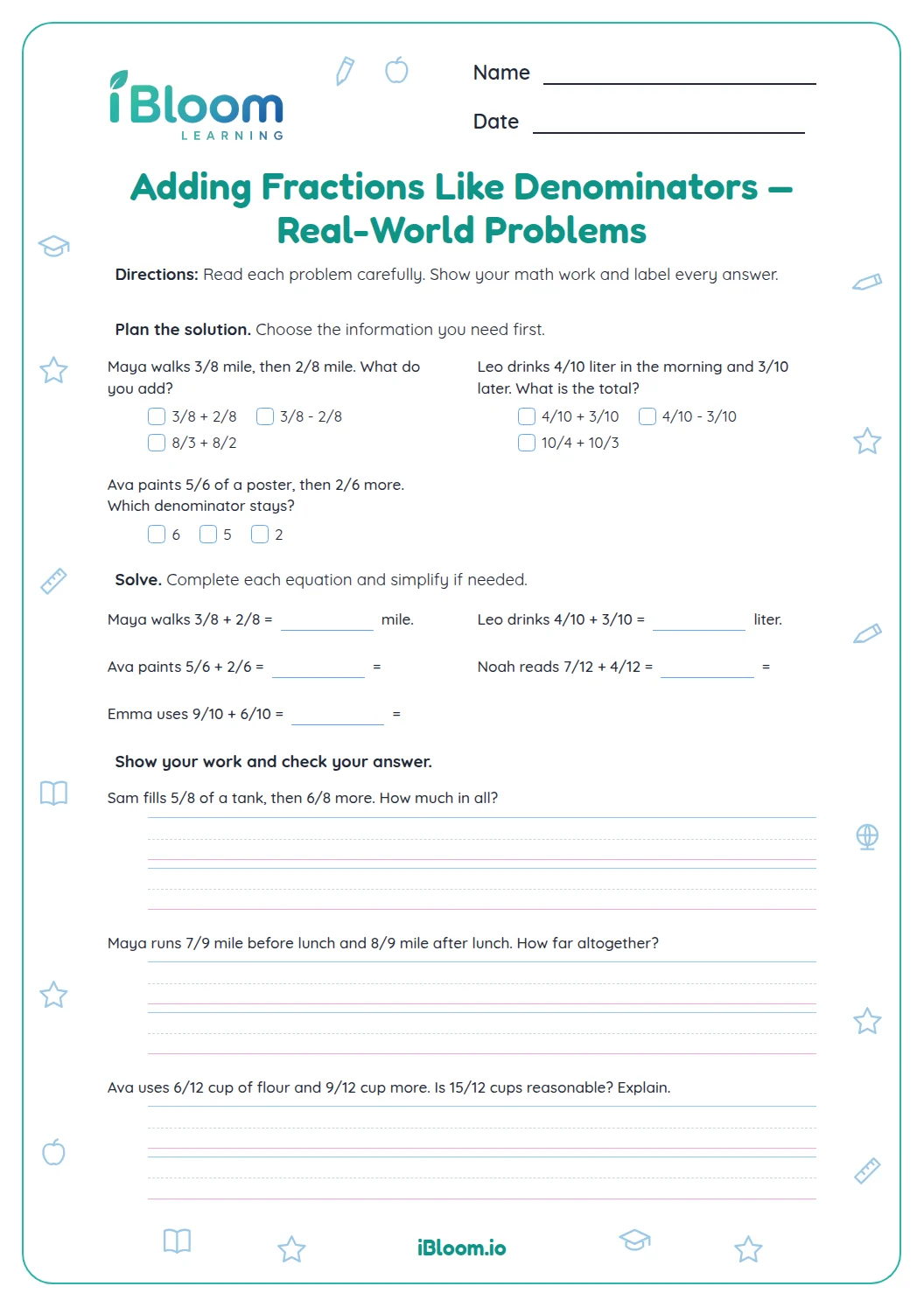
The denominator names the size of the parts. When the denominators match, add or subtract the numerators and keep that denominator. For example, 2/8 + 3/8 = 5/8 because five eighth-size pieces are shaded.
How do fraction models show the operation?
The model gives a starting amount divided into equal parts. Add the numerator for more shaded pieces or subtract it for pieces taken away. The denominator stays the same because the pieces keep the same size.
- 1The bar has 3 of 8 equal parts shaded.
- 2Count the shaded parts: 3/8.
- 3Answer: 3/8
How can you check the answer?
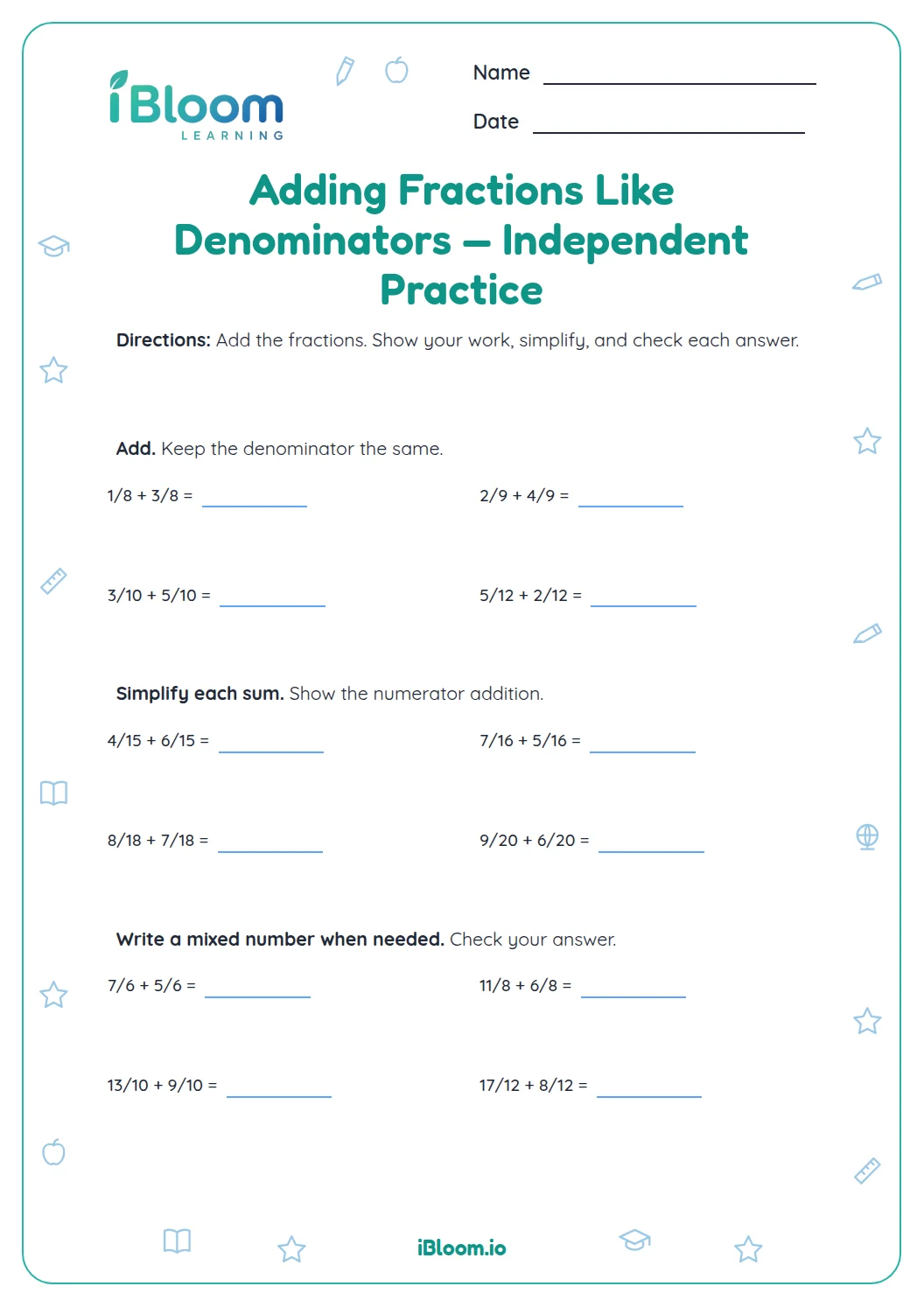
Count the total shaded parts and compare that count with the numerator. Make sure every part still has the same denominator. Simplify only when asked; equivalent answers are accepted by the key.
How to use this worksheet at home or in class
- 1Read the denominator to identify the part size.
- 2Add or subtract only the numerators.
- 3Keep the common denominator.
- 4For a model, count the starting shaded parts and apply the operation.
- 5Check that the answer names the correct number of equal parts.
Common mistakes and quick fixes
The mistake
Adding the denominators as well as the numerators.
The fix
Keep the denominator because the parts remain the same size.
The mistake
Subtracting the smaller numerator from the denominator.
The fix
Subtract the numerators in the fraction expression.
The mistake
Reading the shaded amount as the unshaded amount.
The fix
Count the filled sections, not the open sections.
Common Core alignment
This worksheet gives focused practice with a grade-level skill named in the Common Core standards.
Understand fraction addition and subtraction as joining or separating parts of the same whole.
On this sheet: The equations and shaded models join or separate equal fractional parts of one whole.
Show the official wordingHide the official wording
Understand addition and subtraction of fractions as joining and separating parts referring to the same whole.
What to practice next
Make more practice
Further reading
Questions parents and teachers ask
Why does the denominator stay the same?
The denominator names the size of each part. When the parts stay the same size, adding or removing some parts changes the numerator while the denominator remains unchanged. For example, 2/8 + 3/8 = 5/8; the pieces are still eighths.
Should children simplify each fraction?
The answer key accepts equivalent fractions, so 6/9 may also be written as 2/3. On the equation questions, keep the common denominator visible as you add or subtract the numerators. The shaded models are read by counting equal parts in one whole.
Does the worksheet include subtraction?
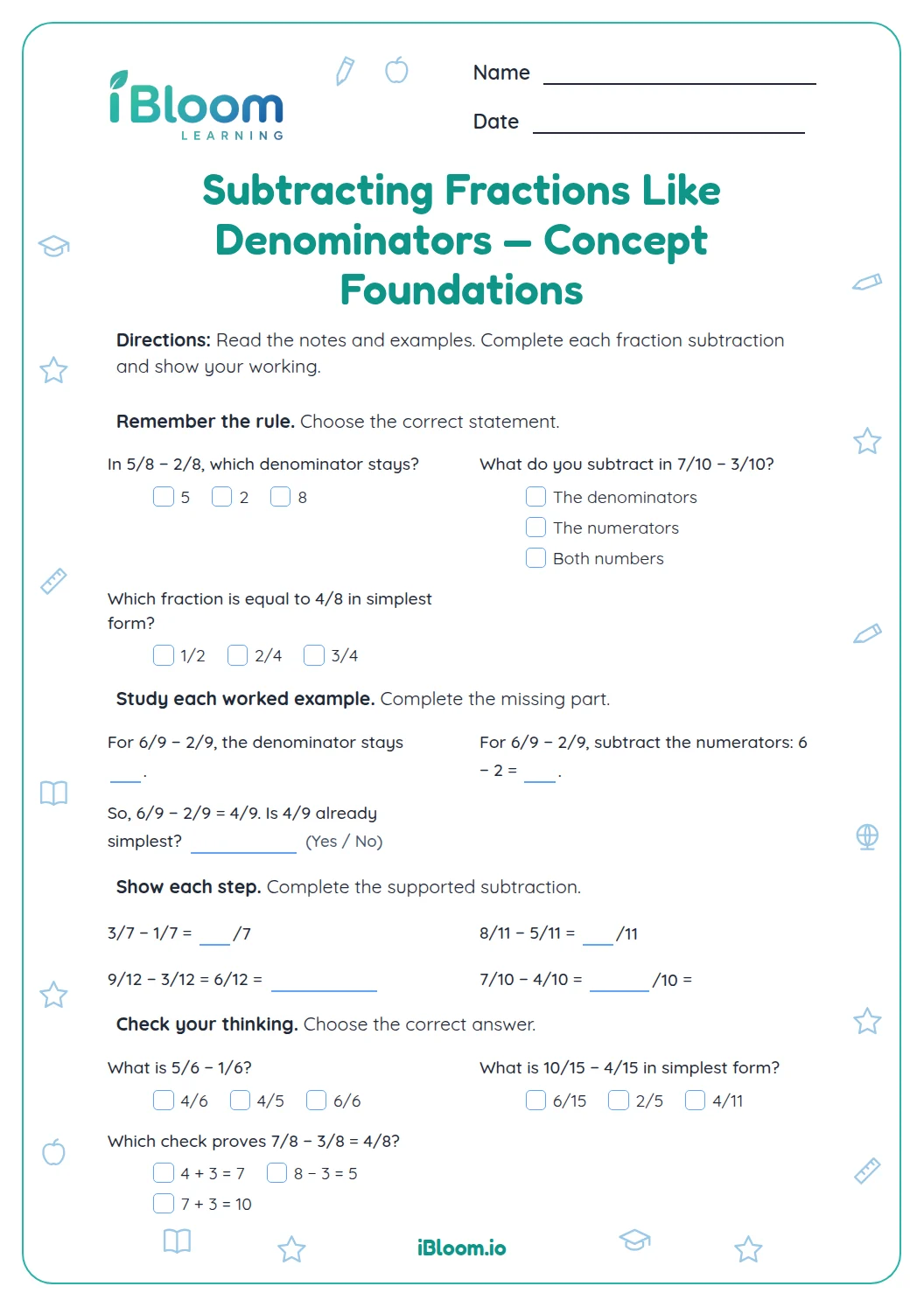
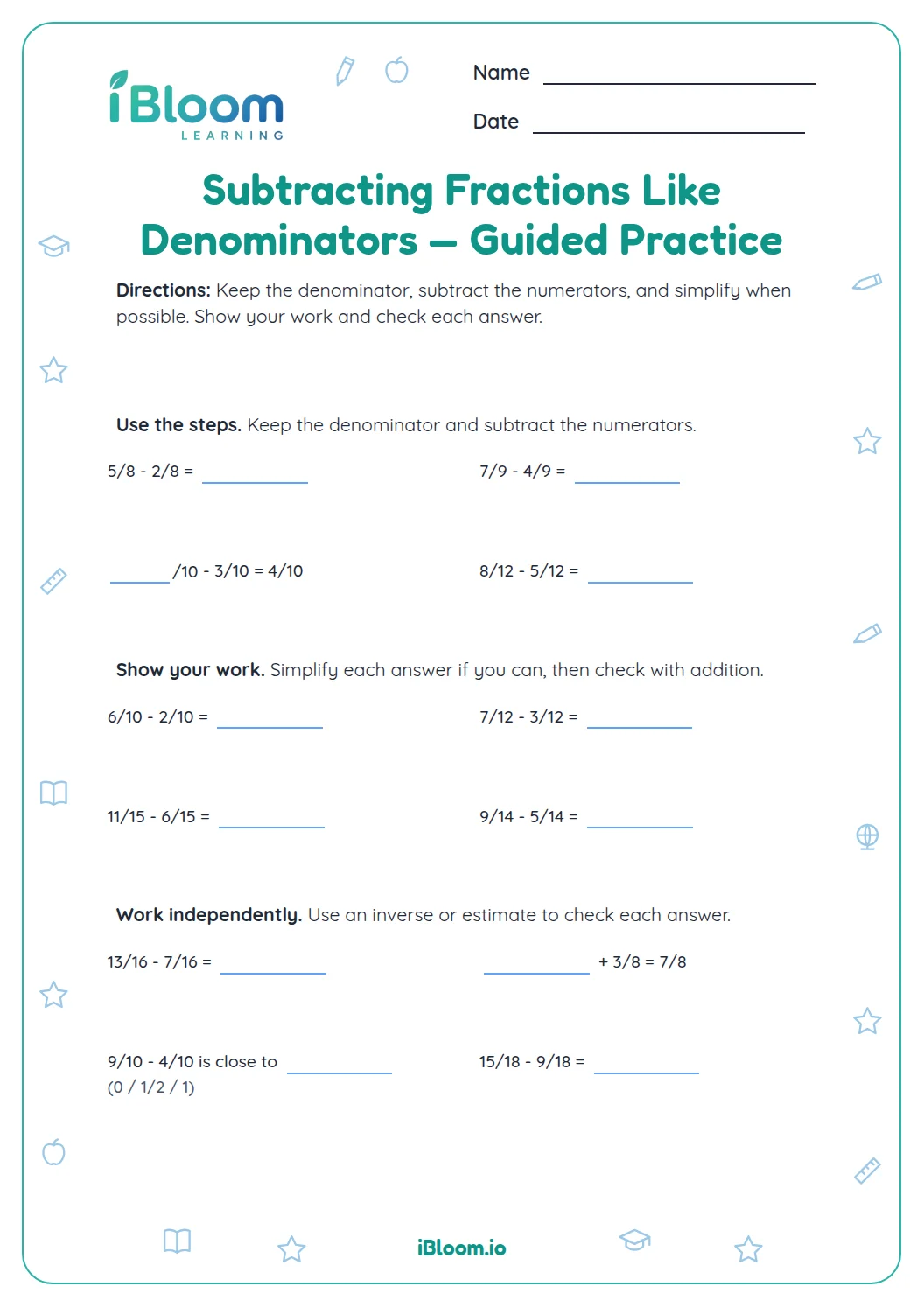
Yes. Part B has like-denominator subtraction equations. The visual model section also gives shaded amounts to read before children connect the picture of equal parts with the fraction operation. The answer key gives each expected fraction. The key shows both operation types.
How do fraction models support the work?
The bars, circle, and square are divided into equal parts. Children count the shaded parts to read the fraction and see that the denominator tells how many equal pieces make one whole. Then the equations ask them to combine or take away same-sized parts.
What does the denominator tell you?
The denominator tells how many equal parts make one whole. In 5/8, the whole is divided into eight equal pieces and five are named. Each model on the sheet divides its shape into equal parts so students can connect the denominator to the drawing.