



About this worksheet
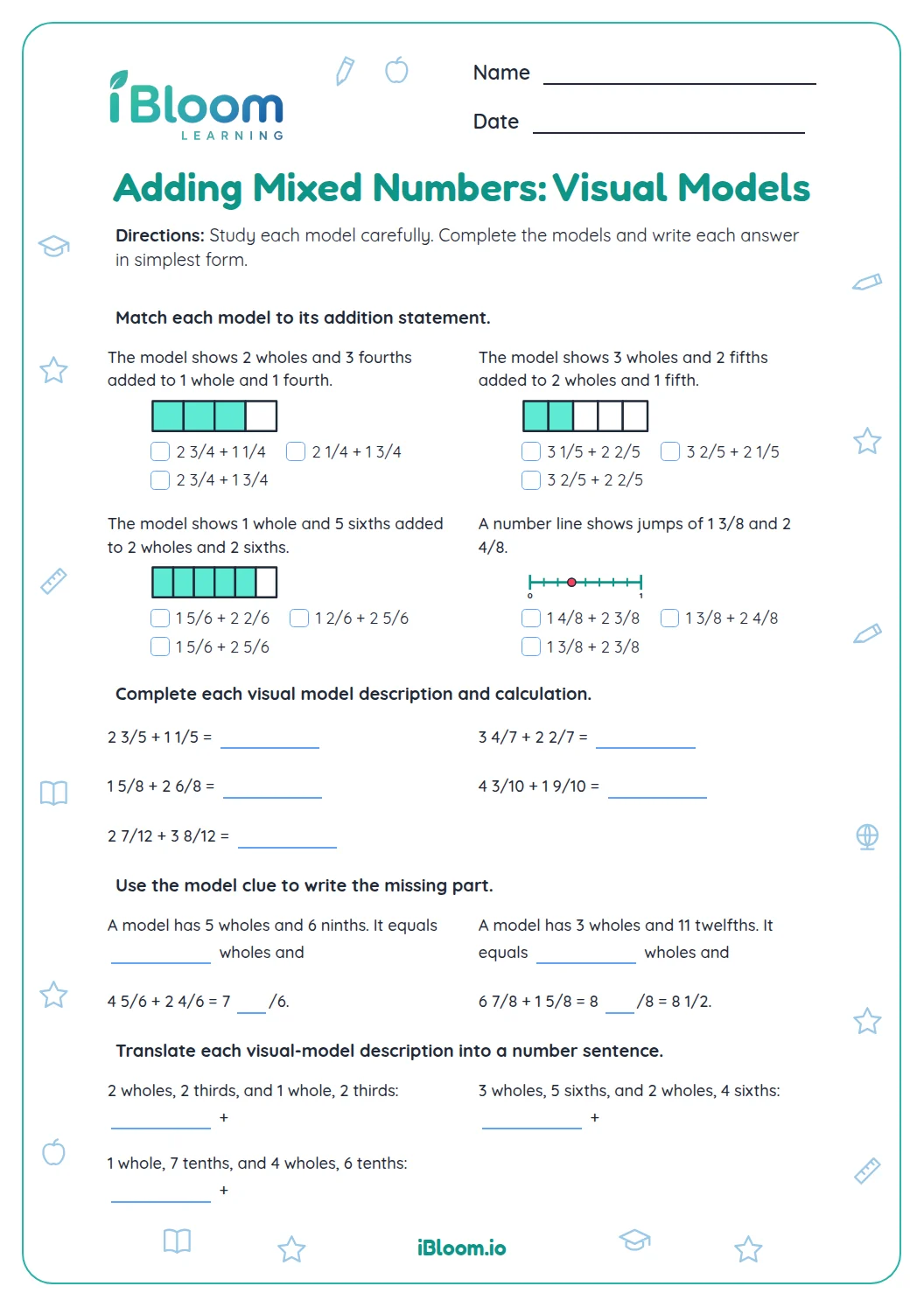
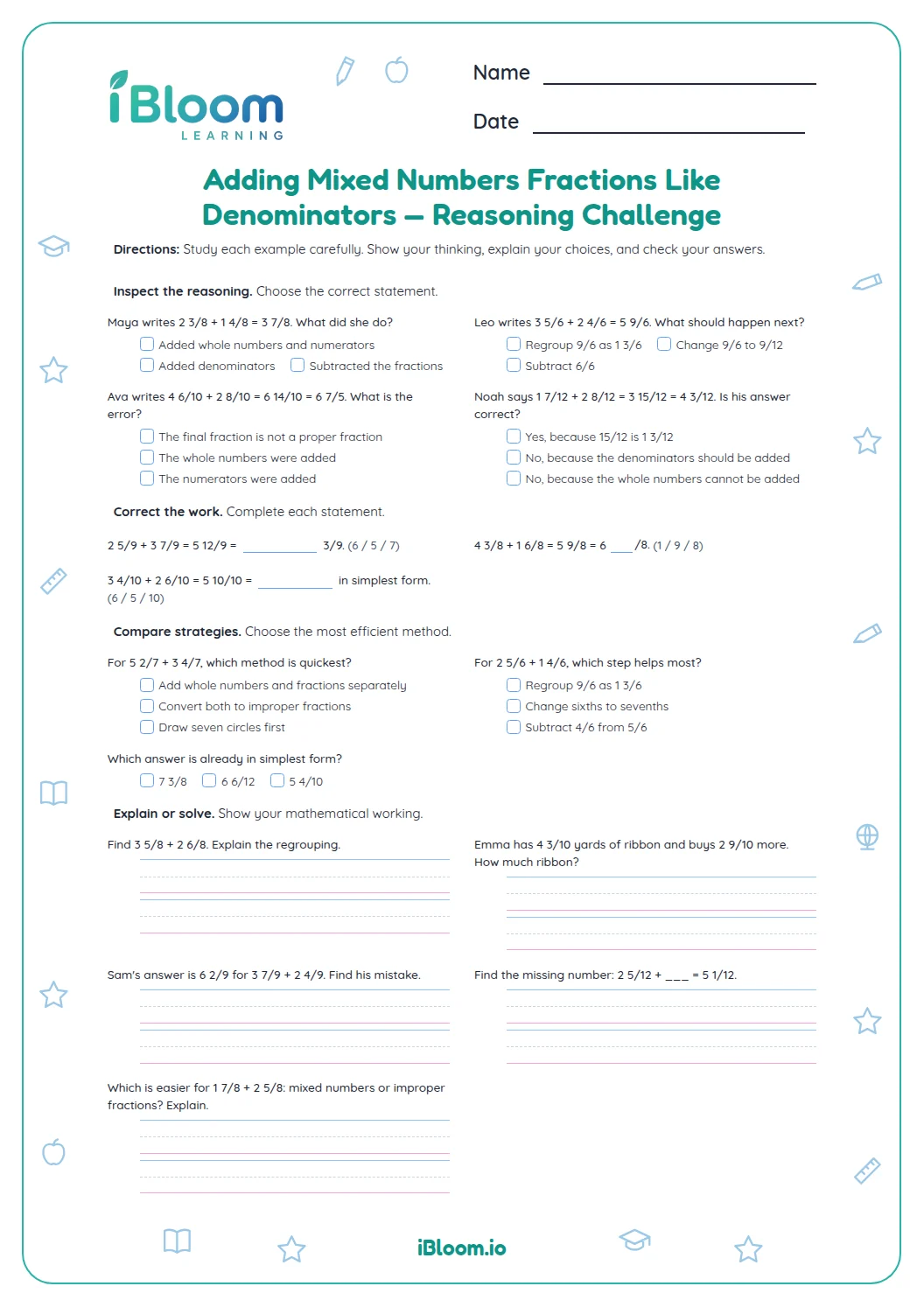
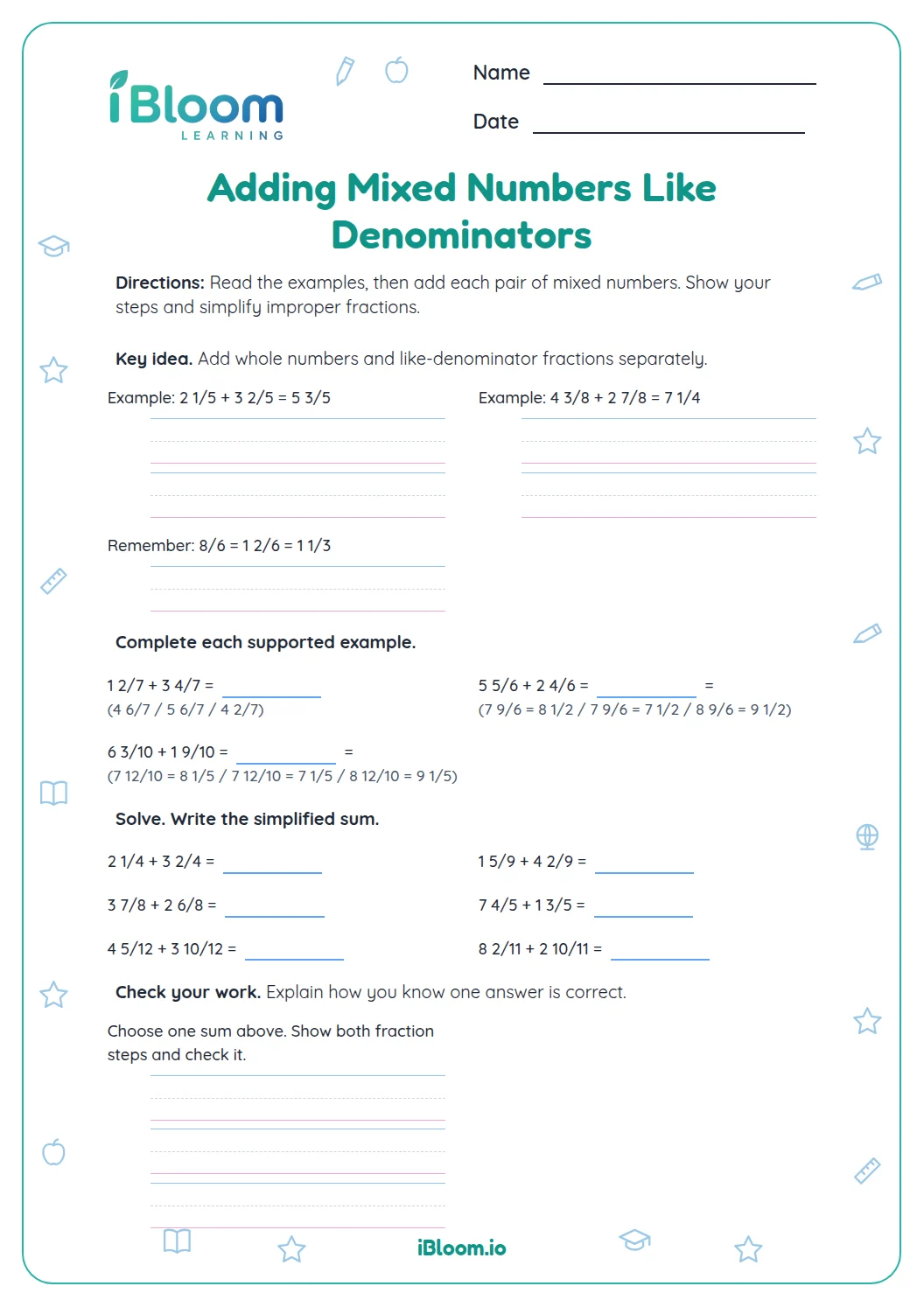
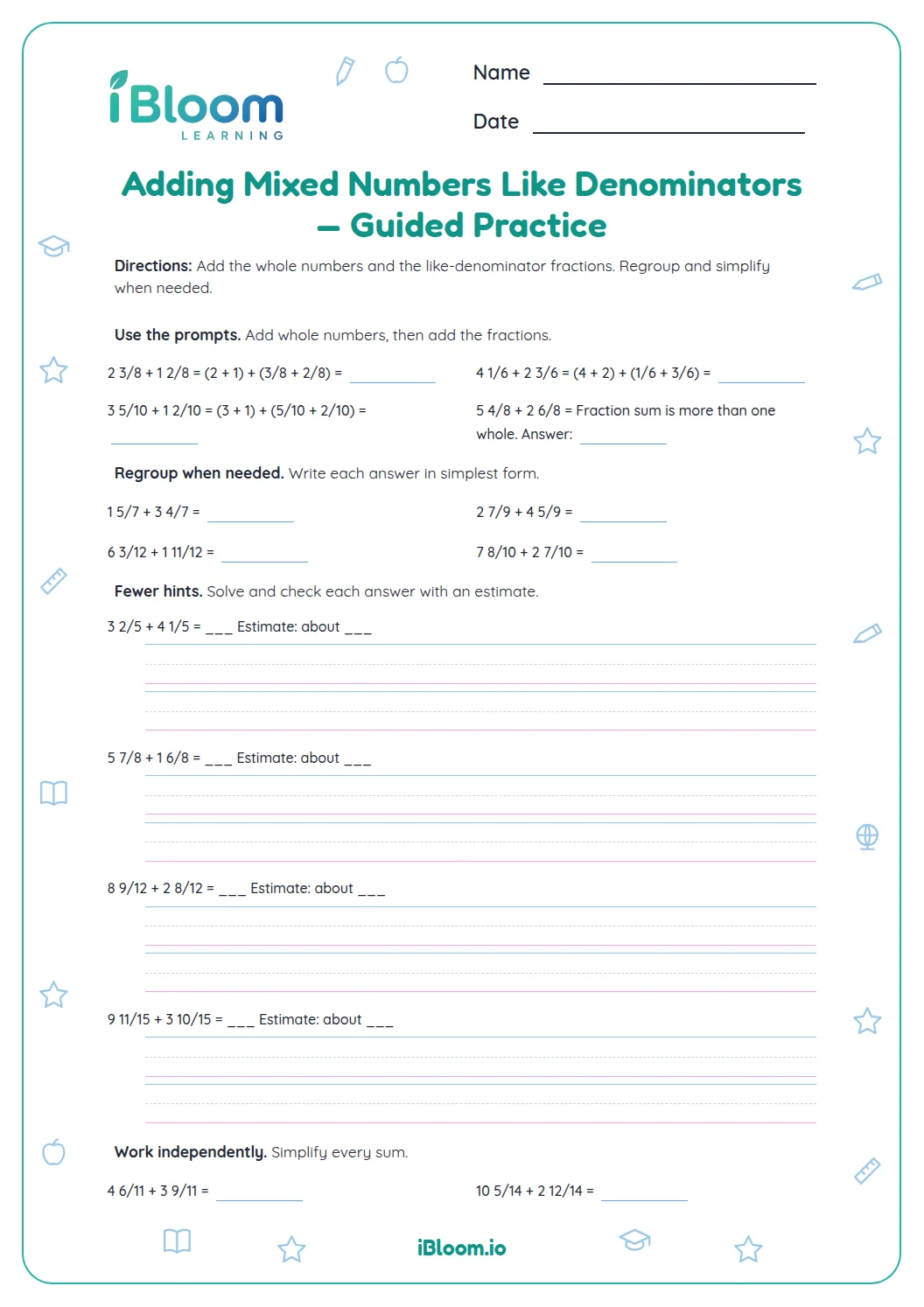
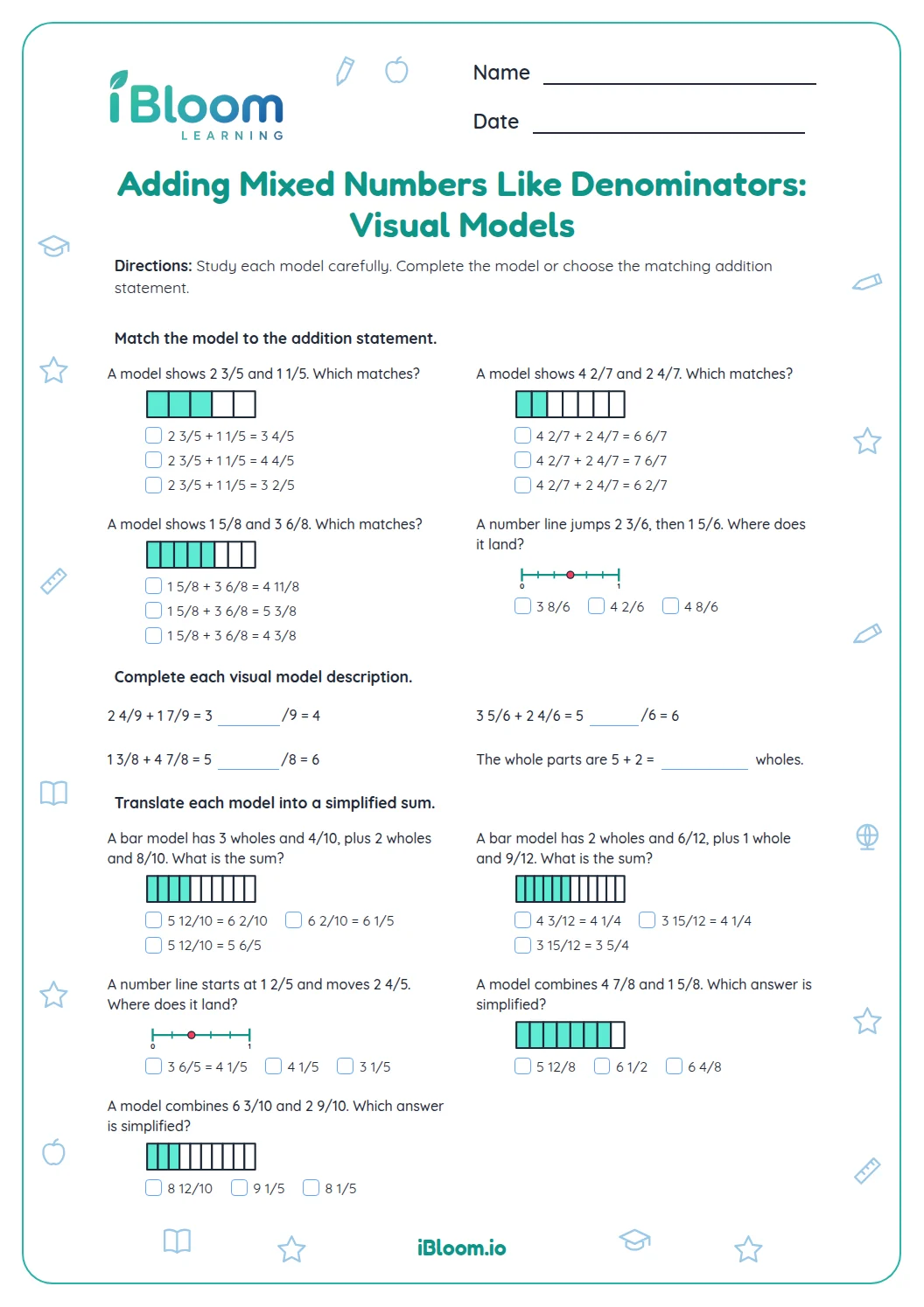
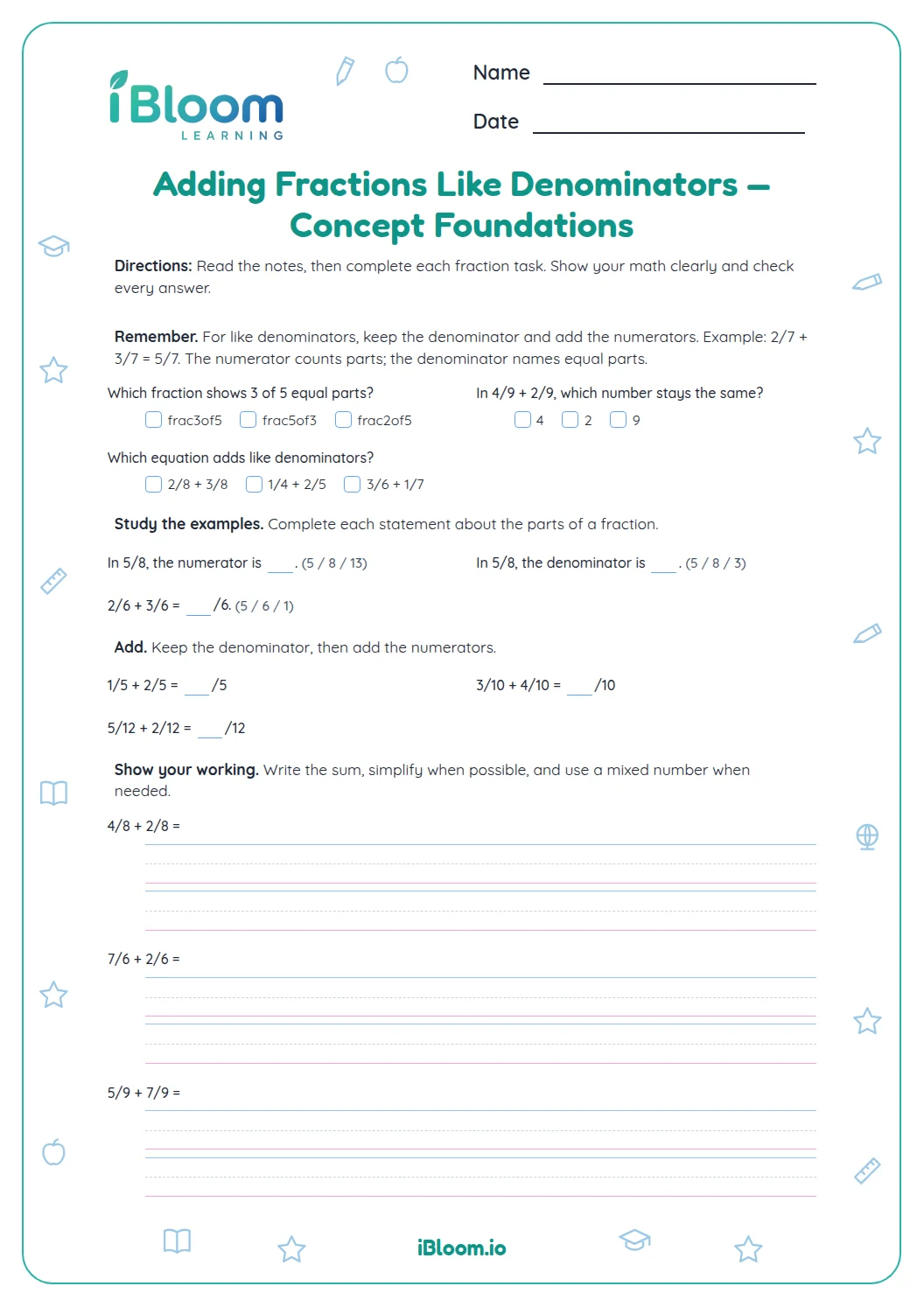
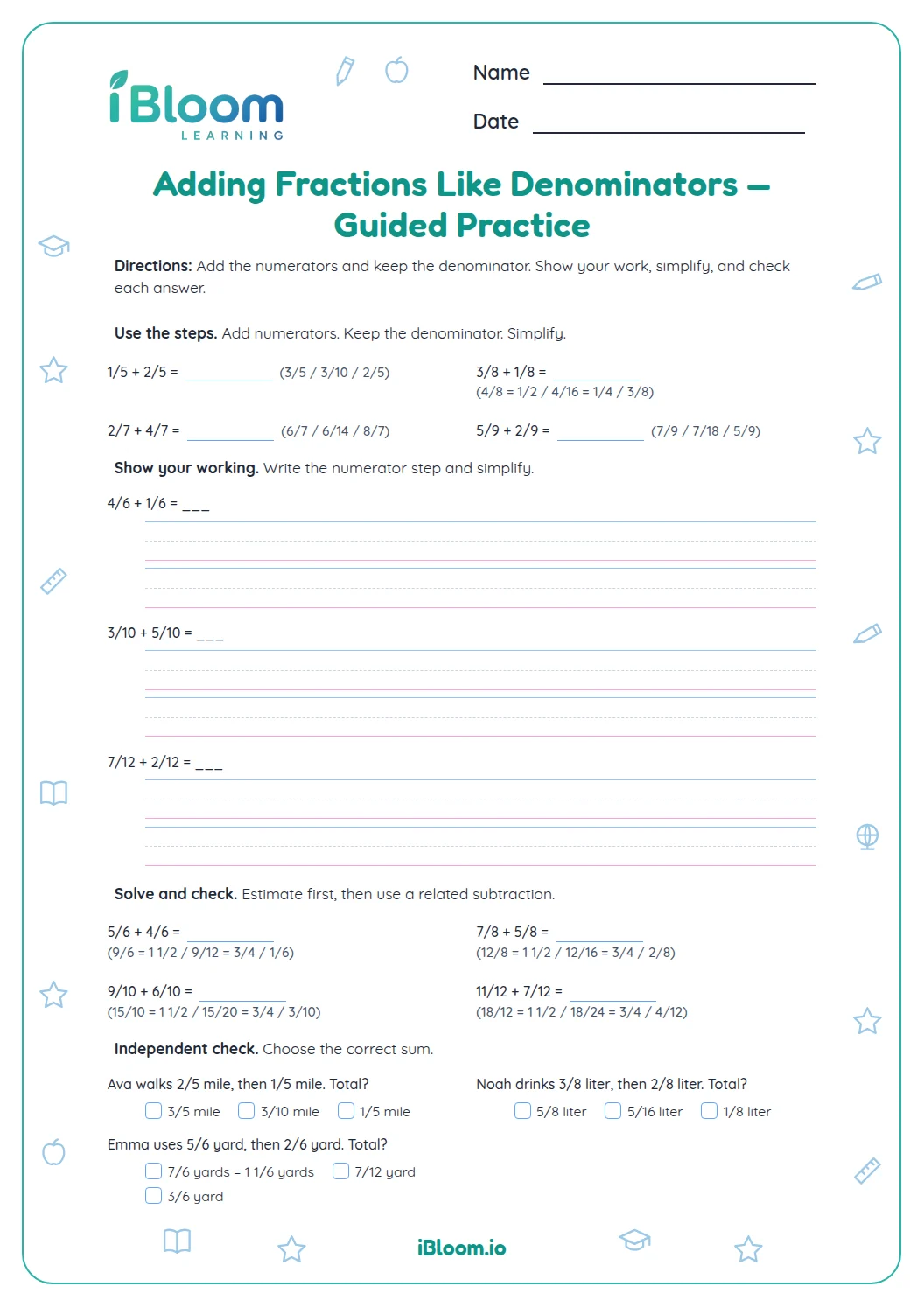
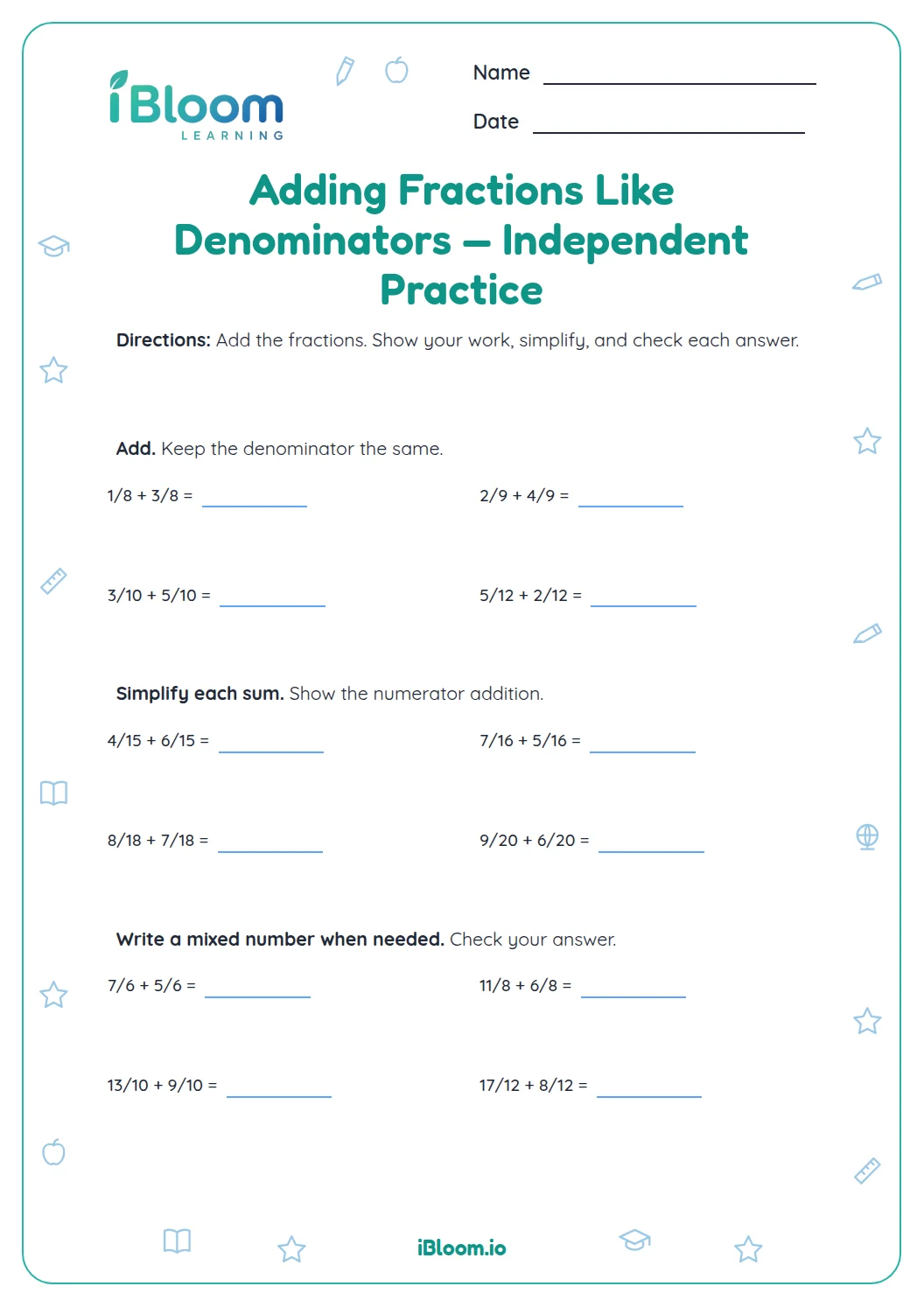
This Grade 5 printable builds a clear routine for adding mixed numbers with like denominators. Students add the whole-number parts, add the fractional parts without changing the denominator, and regroup when needed. The sheet includes 16 mixed-number equations and 3 equivalent-fraction questions that reinforce same-value fractions. A separate answer key shows each result. The addition questions practice CCSS 4.NF.B.3.c.
Aligned to 4.NF.B.3.c
Why do like denominators matter?
A denominator names the size of the pieces. When both fractions have the same denominator, their pieces match, so the numerators can be added directly.
- 12 1/5 + 1 2/5
- 22 + 1 = 3 wholes
- 31/5 + 2/5 = 3/5
- 4Sum: 3 3/5
When should a fraction sum be regrouped?
When the numerator total equals or exceeds the denominator, trade one full fraction for a whole. For example, 5/8 + 6/8 = 11/8 = 1 3/8.
How can you check a mixed-number sum?
Estimate the whole-number total first, then check the fractional part. For question 15, 2 3/4 + 2 2/4 is a little more than 5 because the fractional parts total 5/4. The final three questions check that equivalent fractions keep the same value.
How to use this worksheet
- 1Circle the common denominator in both addends.
- 2Add the whole numbers.
- 3Add the numerators and keep the denominator.
- 4If the fraction is at least one whole, regroup and simplify.
- 5For the final three questions, preserve the fraction’s value.
Common mistakes and quick fixes
The mistake
Adding denominators
The fix
Keep the shared denominator; add only the numerators.
The mistake
Leaving an improper fraction unreduced as a mixed number
The fix
Trade groups of the denominator for whole units.
The mistake
Forgetting to carry a regrouped whole
The fix
Add the new whole to the whole-number sum.
Common Core alignment
The worksheet practices adding mixed numbers with a like denominator.
Add mixed numbers with like denominators and regroup a whole.
On this sheet: The questions add mixed numbers whose fractional parts have like denominators.
Show the official wordingHide the official wording
Add and subtract mixed numbers with like denominators, e.g., by replacing each mixed number with an equivalent fraction, and/or by using properties of operations and the relationship between addition and subtraction.
What to practice next
Make more practice
Further reading
Questions parents and teachers ask
What does like denominator mean?
Like denominators are the same denominator, so both fractions name pieces of the same size. For example, fifths can be added to fifths without renaming the pieces. The last three questions also review equivalent fractions, which keep the same value even when written with different numbers.
What is the first step?
Add the whole-number parts and numerators separately. Keep the denominator unchanged, then regroup if the fractional parts total one whole or more. Reduce the fraction if needed. This check connects the written steps to the size of the fractional pieces being combined.
How do you regroup 11/8?
Eight eighths make one whole. Trade 8/8 for 1 and leave 3/8, so 11/8 is 1 3/8. Check by writing 1 as 8/8 and comparing the parts. Invite the learner to explain one answer aloud, then compare it with the key and correct any regrouping.
Are the answers simplified?
Write each final fractional part in simplest form when its numerator and denominator share a factor. For example, question 3 gives 4/6, which simplifies to 2/3, so the full sum is 3 2/3. The answer key uses simplified forms.
Does the worksheet include an answer key?
Yes. The separate two-page key gives the results for 16 mixed-number equations and 3 equivalent-fraction questions. Check the whole-number addition, fractional addition, regrouping, and equivalent forms separately. The simplified answer to question 3 is 3 2/3. Ask the learner to explain why the denominator stays unchanged in each sum.