





About this worksheet
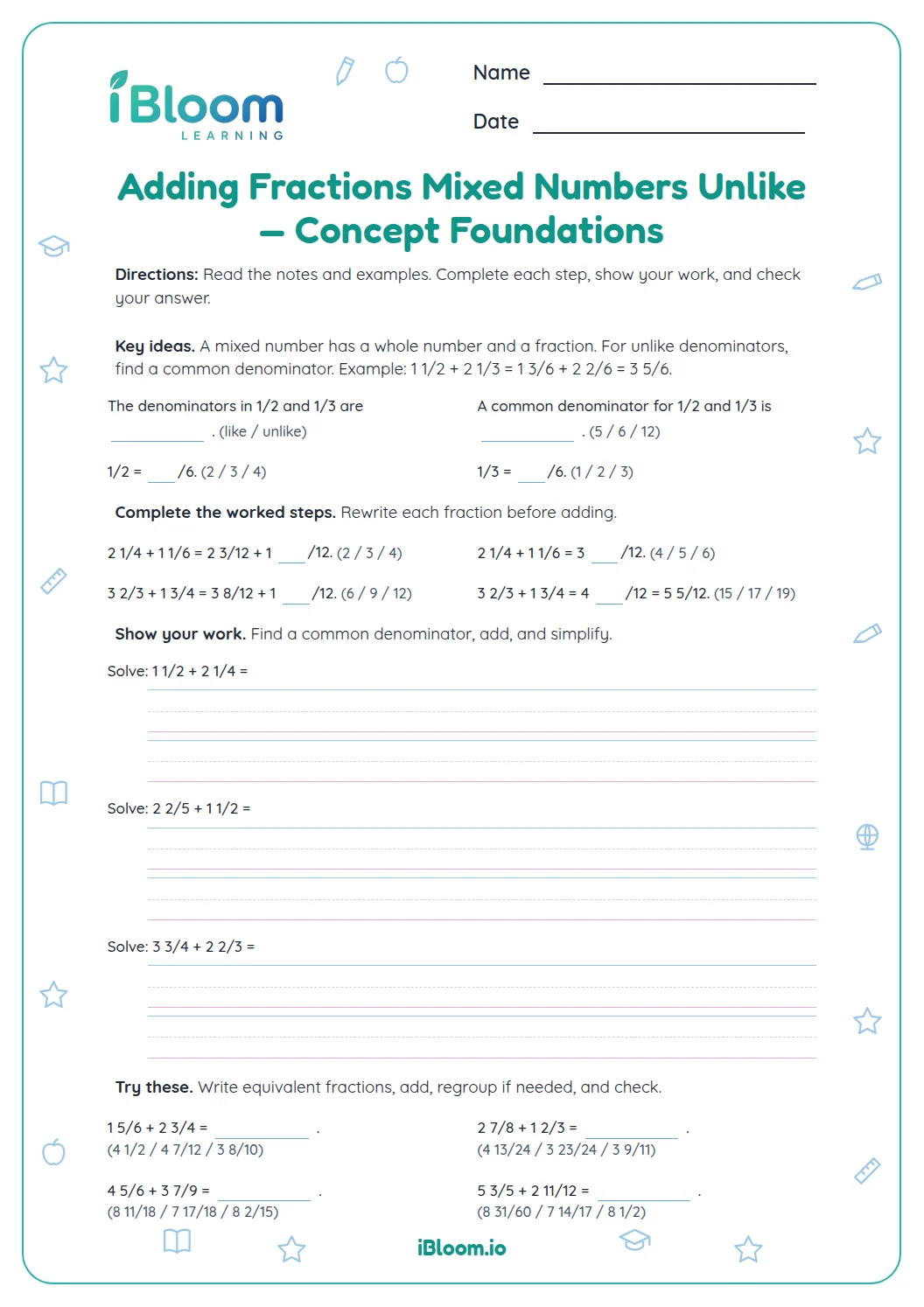
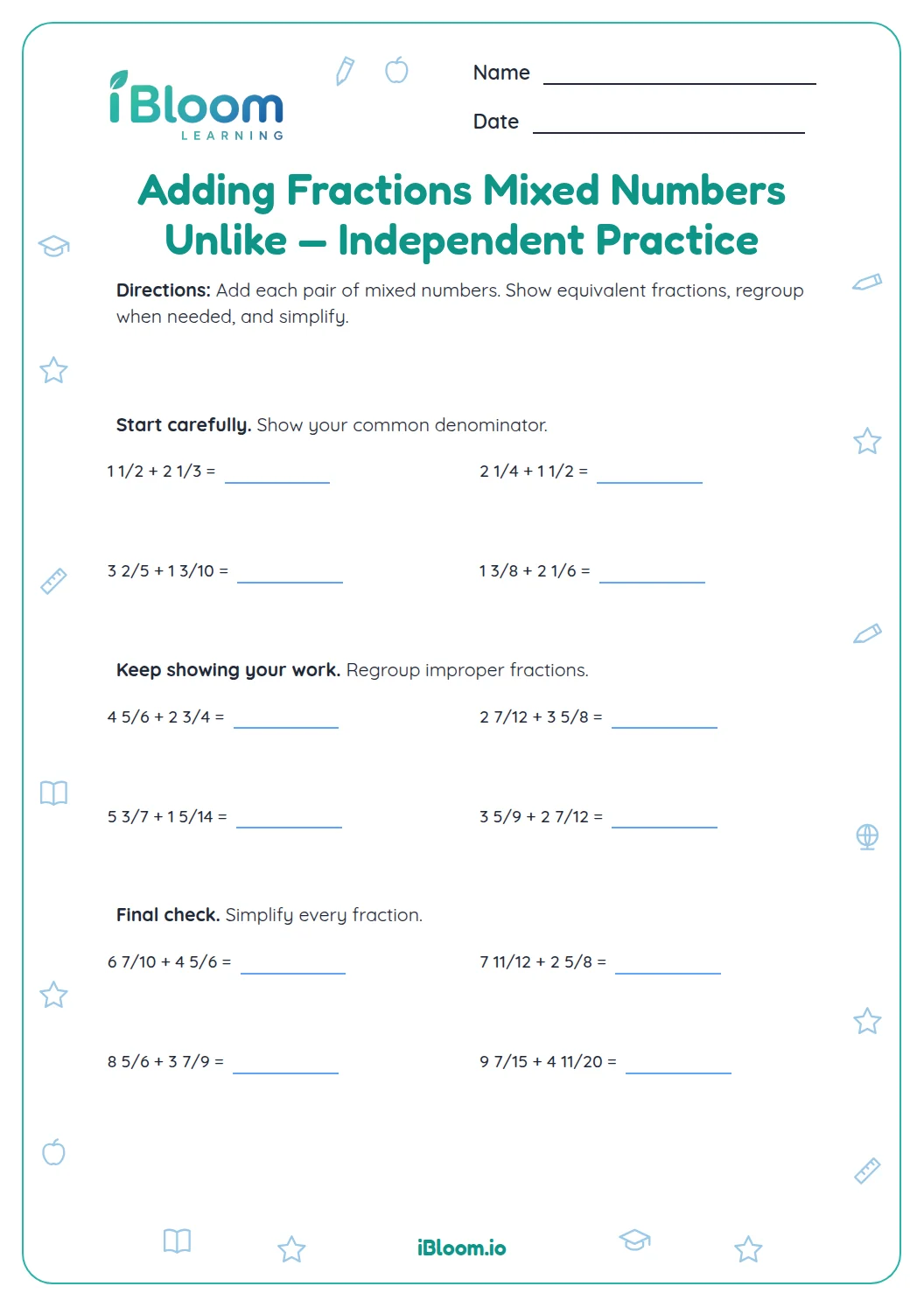
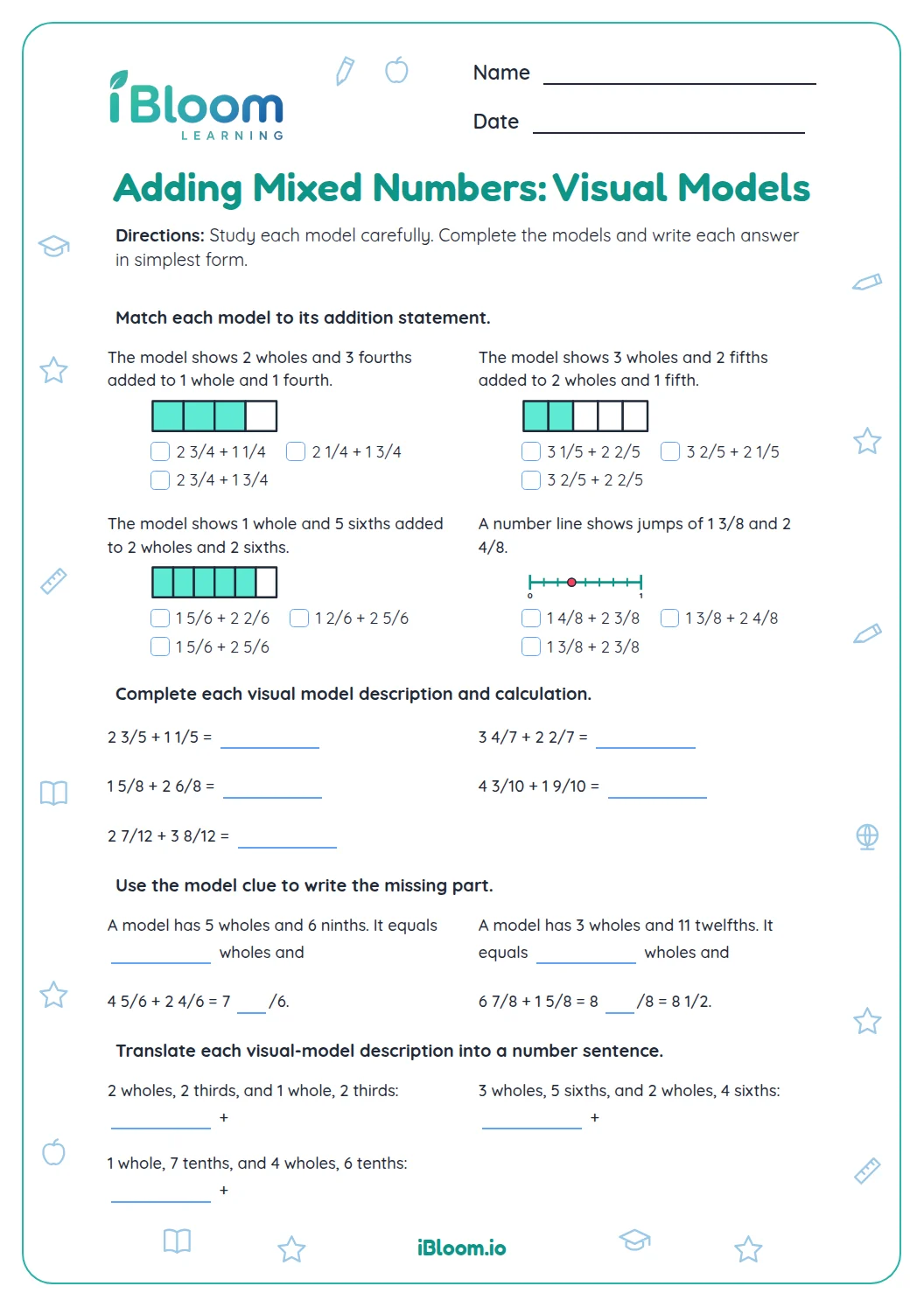
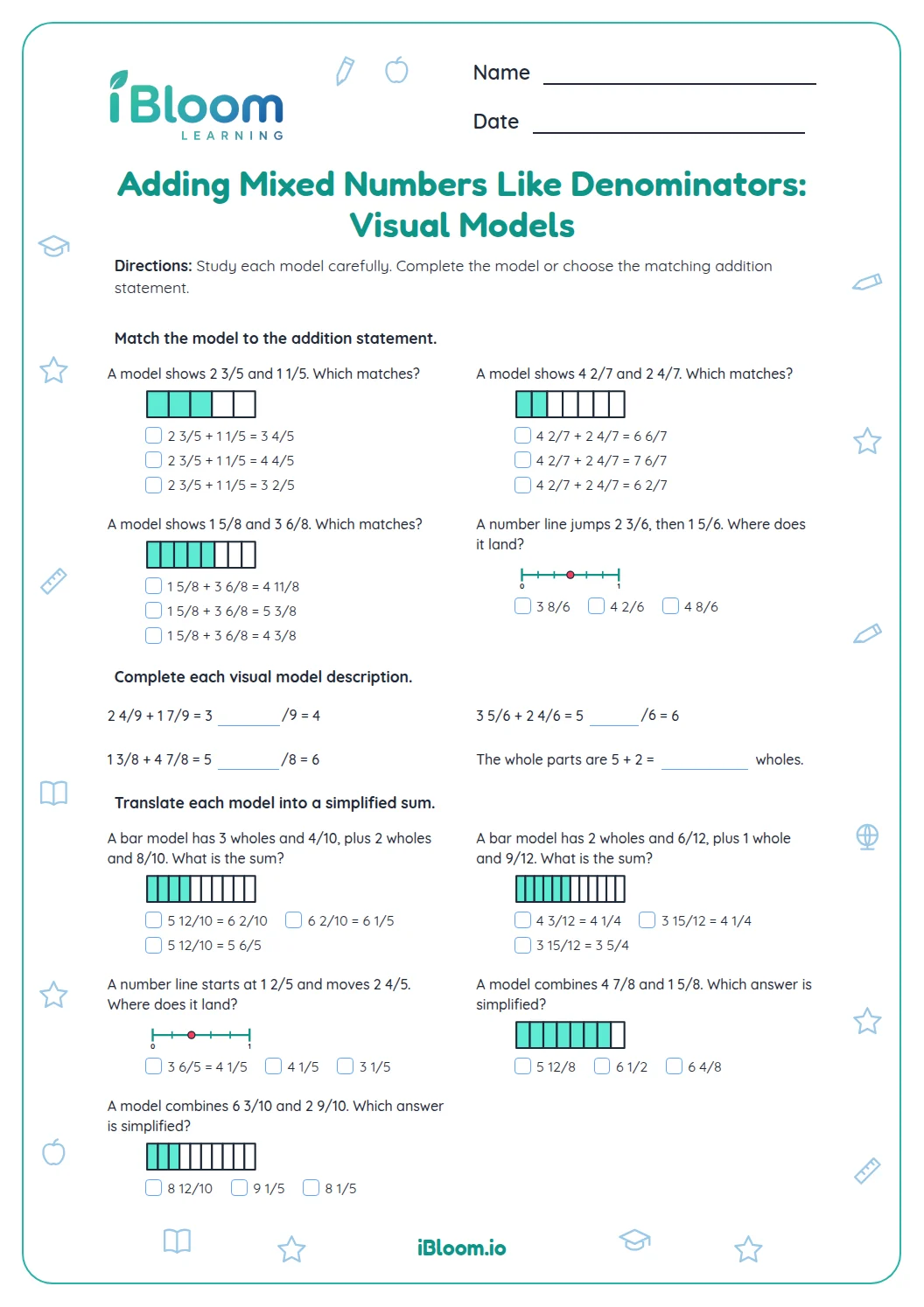
Read four mixed-number bar models, then add 12 pairs of mixed numbers with unlike denominators. Use equivalent fractions, regroup, and simplify; a separate answer key is included. CCSS 5.NF.A.1.
Aligned to 5.NF.A.1
What is the main move in adding mixed numbers with unlike denominators?
Read four mixed-number bar models, then add 12 pairs of mixed numbers with unlike denominators. Use equivalent fractions, regroup, and simplify; a separate answer key is included. CCSS 5.NF.A.1.
How does one problem work from start to finish?
For 1 1/2 + 2/3, rename 1/2 as 3/6 and 2/3 as 4/6. Add to get 1 7/6, then regroup as 2 1/6.
- 11 1/2 + 2/3
- 21 3/6 + 4/6 = 2 1/6
How can students check each result?
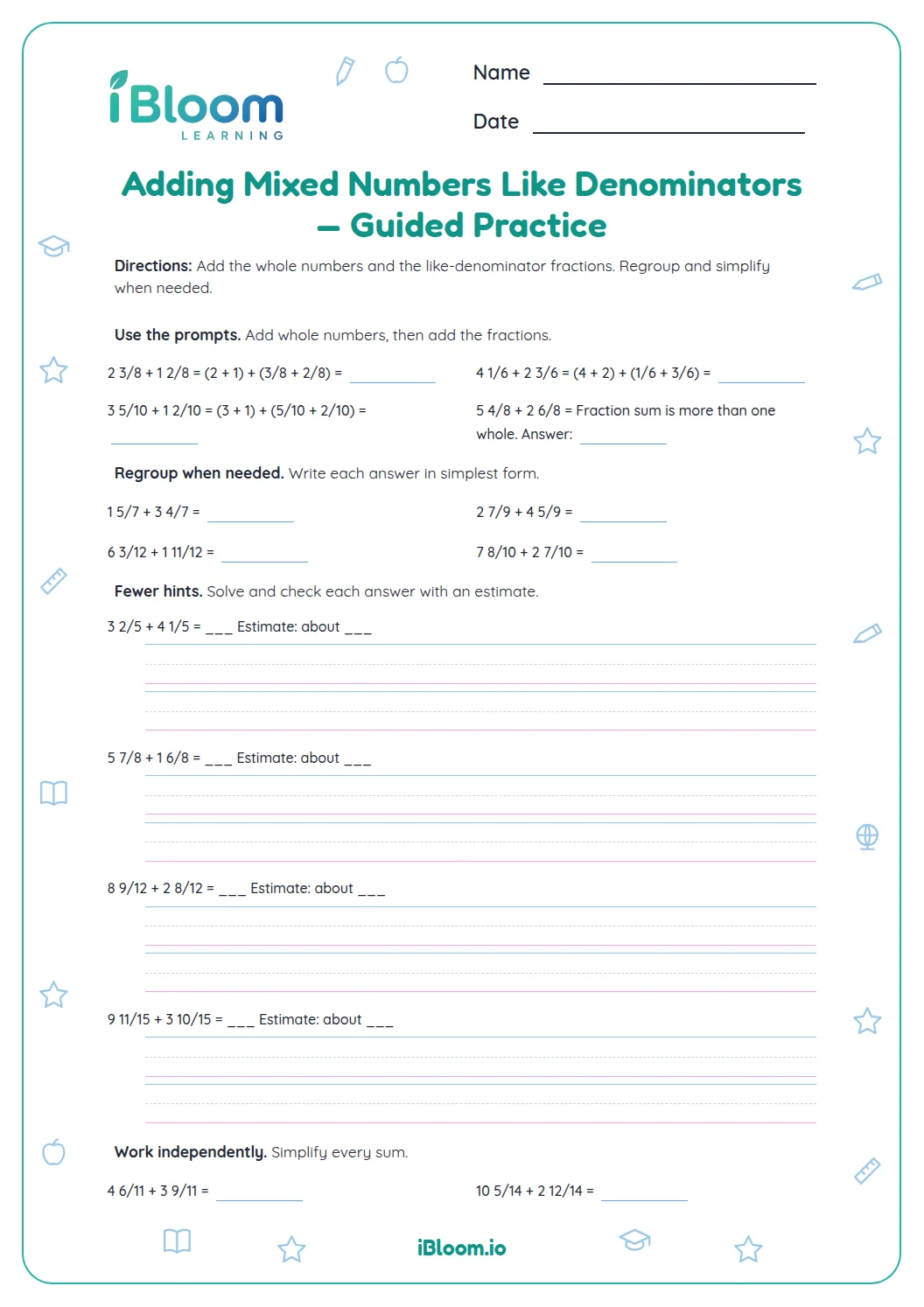
Find a denominator both fractional parts can use. Rewrite each fraction with an equivalent numerator and denominator. Review the answer key only after completing the calculation.
How to use this worksheet
- 1Find a denominator both fractional parts can use.
- 2Rewrite each fraction with an equivalent numerator and denominator.
- 3Add whole numbers and fractional parts.
- 4Regroup one whole when the numerator reaches the denominator.
- 5Reduce the fractional part if possible.
Common mistakes and quick fixes
The mistake
Adding denominators: 1/2 + 1/3 = 2/5.
The fix
Fix: Rename both fractions with sixths, then add 3/6 + 2/6.
The mistake
Forgetting to regroup an improper fractional sum.
The fix
Fix: Trade 6/6 for 1 whole before writing the mixed number.
The mistake
Stopping before simplifying, such as 2 2/4.
The fix
Fix: Divide numerator and denominator by their common factor to get 2 1/2.
Common Core alignment
This page connects the printed practice to the following Common Core standard.
Rename unlike denominators, then add mixed numbers.
On this sheet:
Show the official wordingHide the official wording
Add and subtract fractions with unlike denominators (including mixed numbers) by replacing given fractions with equivalent fractions in such a way as to produce an equivalent sum or difference of fractions with like denominators.
What to practice next
Make more practice
Further reading
Questions parents and teachers ask
Why do the denominators need to match?
The denominator names the size of the parts. Halves and thirds are different sized pieces, so rewrite them as equivalent sixths before adding. For question 5, 1/2 becomes 3/6 and 2/3 becomes 4/6; then 3/6 + 4/6 = 7/6, or 1 1/6.
What do the first four models show?
The first four bars each show a mixed number as fully shaded wholes plus a shaded part of another bar. They ask students to read values such as 1 1/2 and 2 2/3. The addition problems that follow then practice finding common denominators and adding mixed numbers.
What if the fractional sum is greater than one?
Regroup one full denominator’s worth as a whole. For example, question 5 changes 1/2 + 2/3 to 3/6 + 4/6 = 7/6. Since 7/6 is 1 1/6, adding the original whole gives 2 1/6. Keep the whole number and fractional part together.
Should answers be simplified?
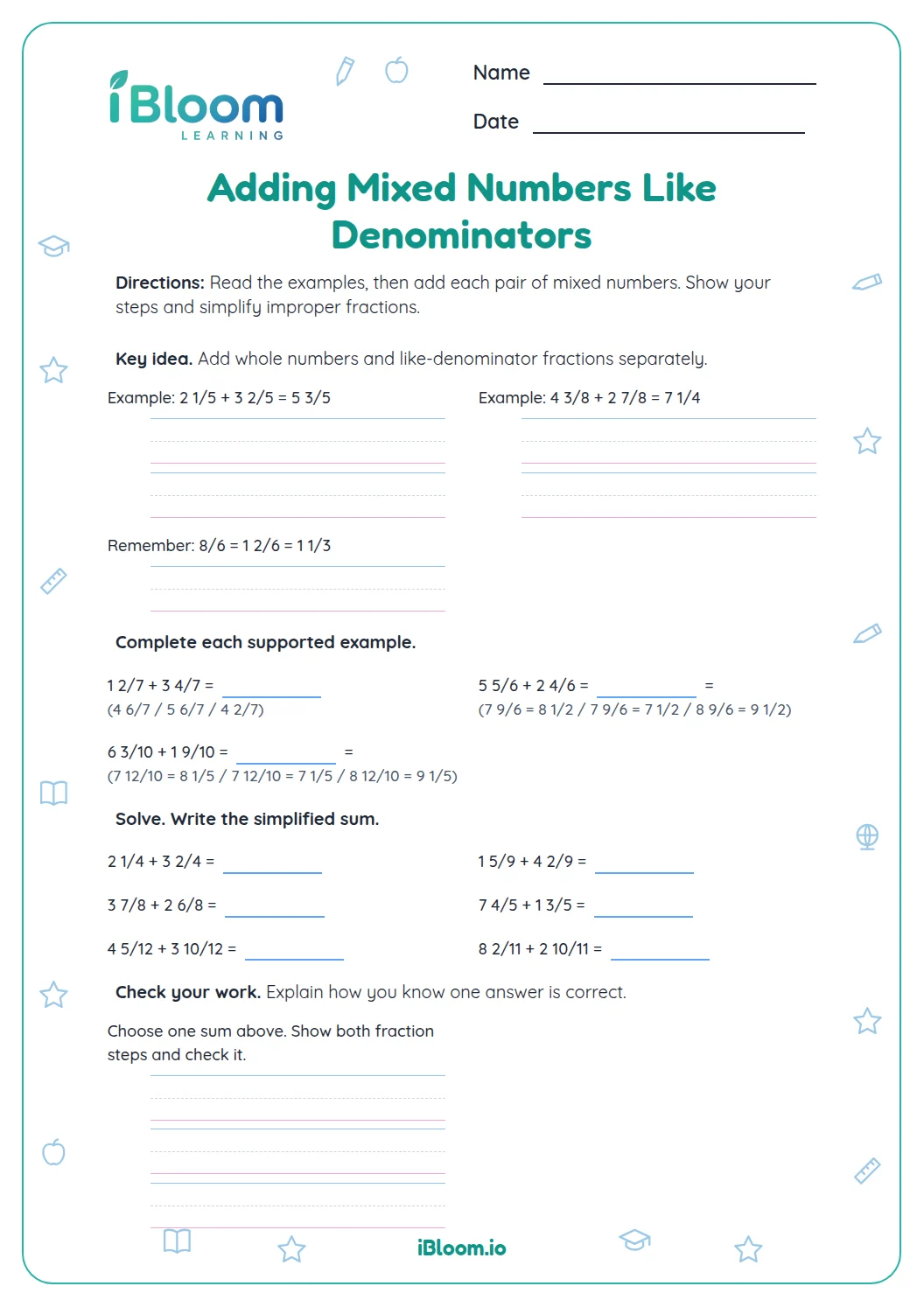
Yes. Reduce the fractional part when its numerator and denominator share a factor. For example, 2/4 reduces to 1/2 by dividing both numbers by 2. The key gives simplified answers, so students can compare equivalent forms and practice writing the most concise mixed number.
What does the answer key show?
The separate key lists the mixed-number result for all 16 questions. Questions 1–4 identify the values shown by the bars; questions 5–16 give addition sums in simplest form. Students can use the worked steps to check equivalent fractions, regrouping, and reduction when a result differs.