





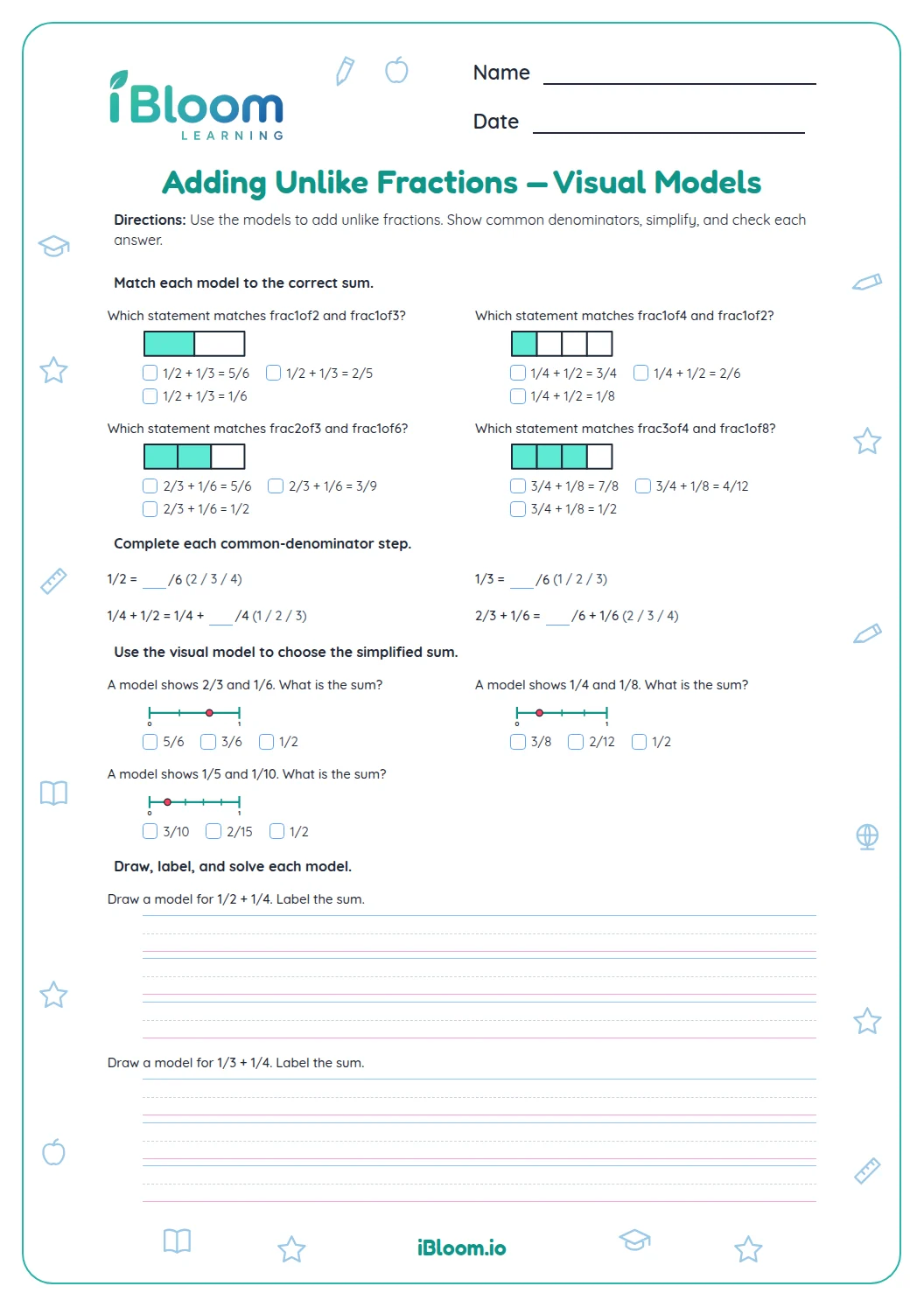
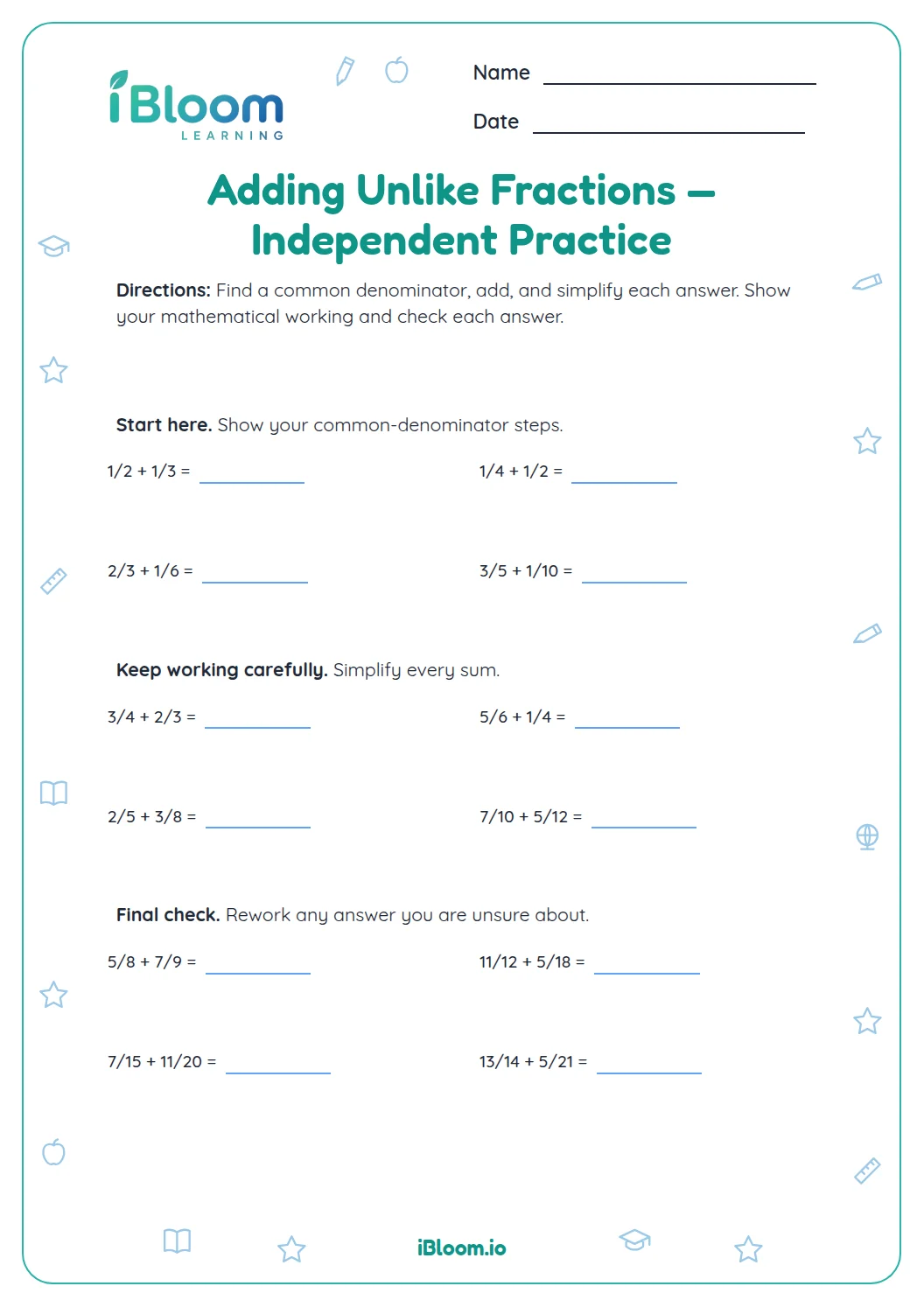
About this worksheet
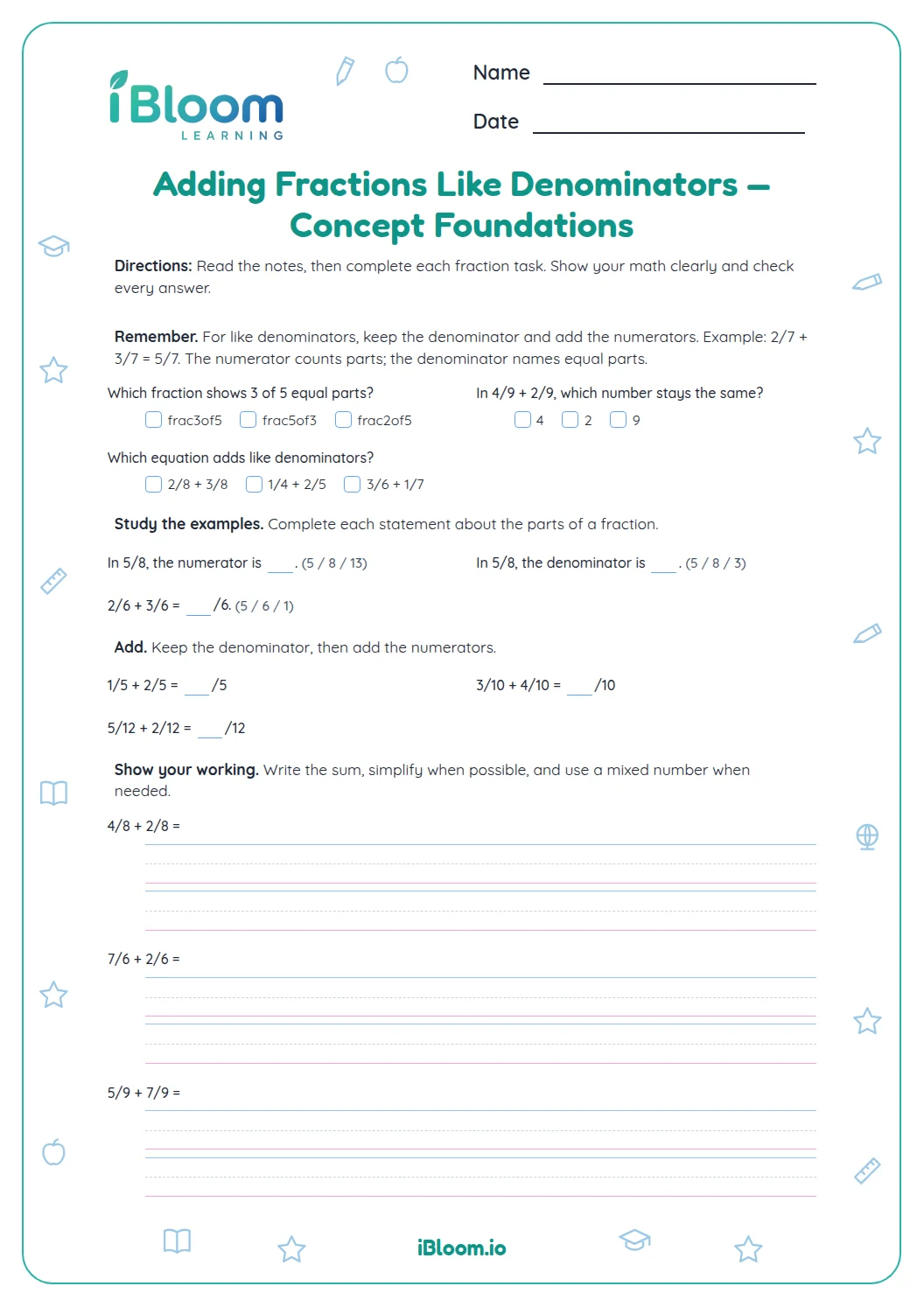
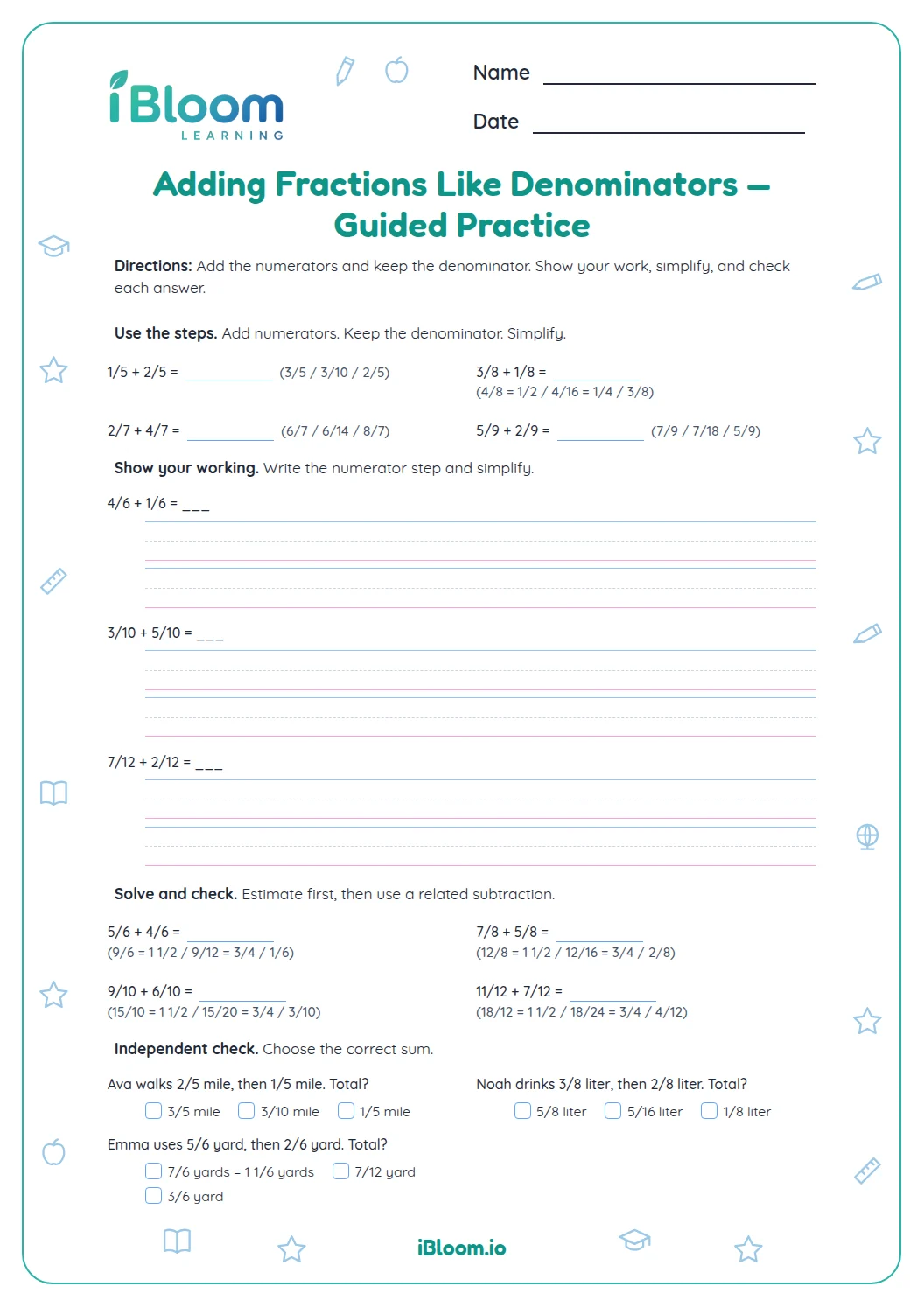
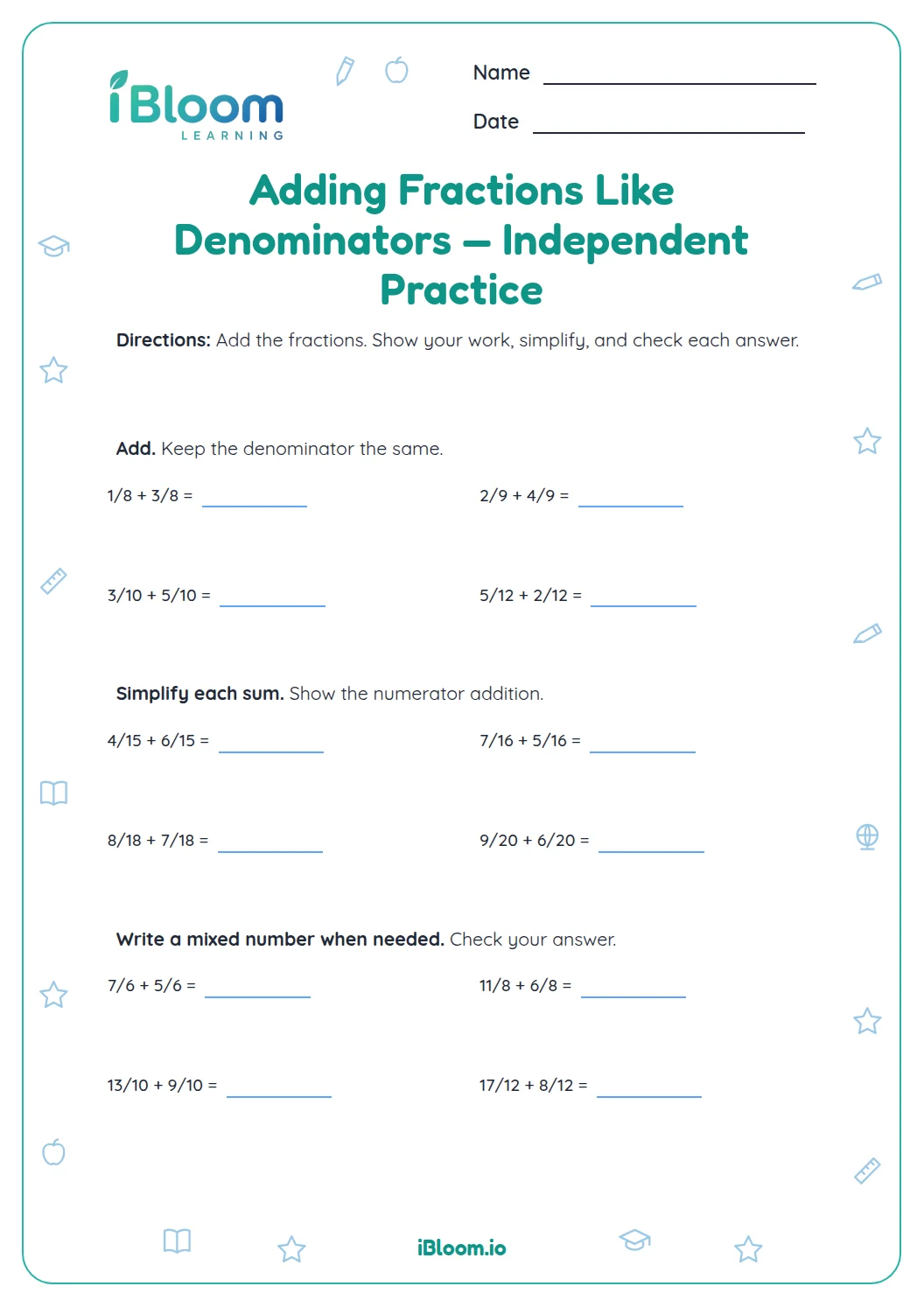
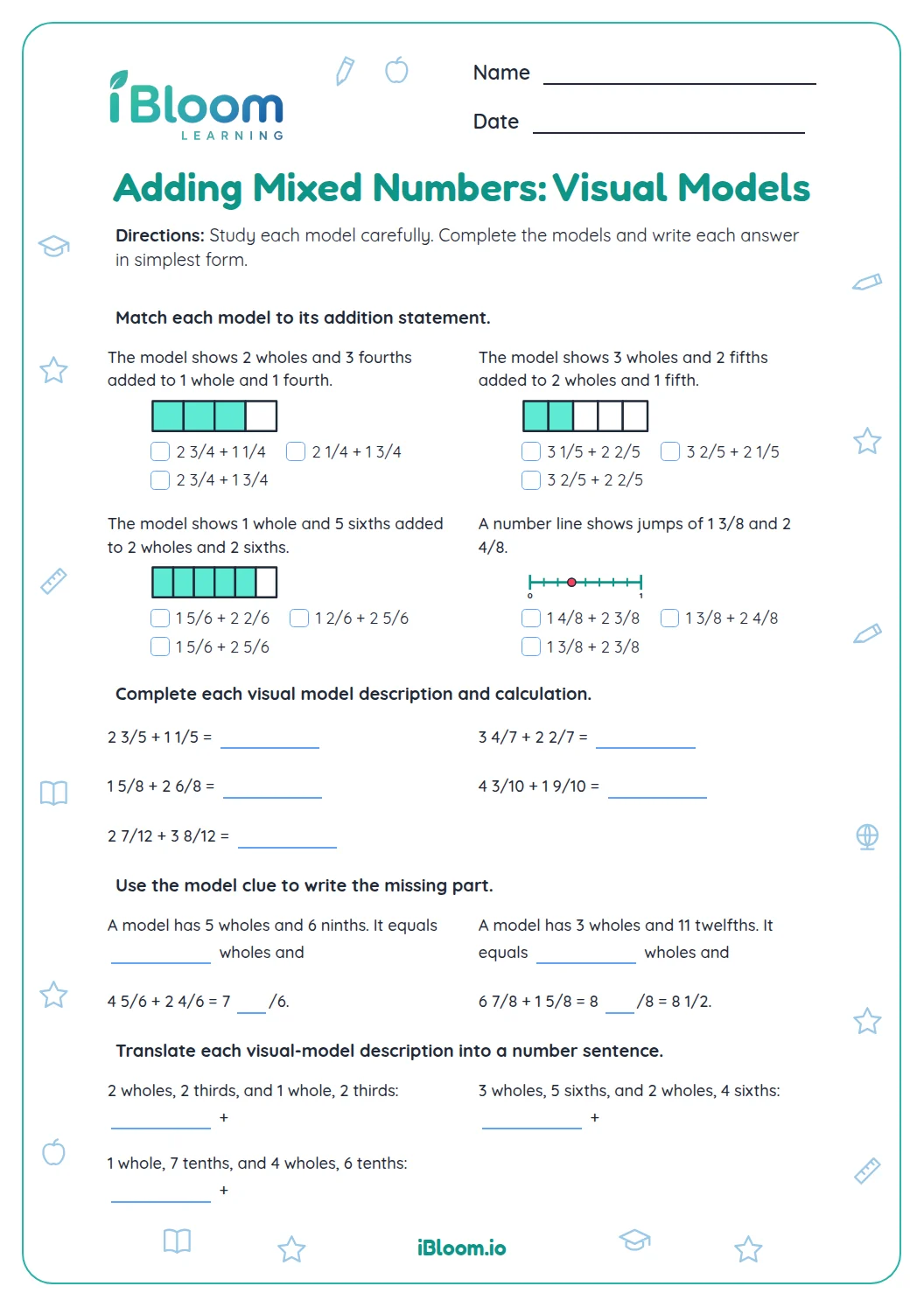
This Grade 5 printable gives fourteen mixed-number addition problems with unlike denominators. Students find common denominators, regroup when needed and solve two distance situations. The answer key provides each simplified sum so students can check their work.
Aligned to 5.NF.A.1
How do you add unlike fractional parts?
Rename each fraction with a common denominator before adding. Add the whole numbers and fractional parts, then rename an improper fractional sum as a mixed number.
- 11 1/2 + 2 1/4 = 3 3/4
- 2Rename 1/2 as 2/4, then add 1/4 to get 3/4.
When should a sum be simplified?
Reduce a fractional part when its numerator and denominator share a factor. Regroup an improper fraction as one more whole and the remaining fraction.
How to use this worksheet
- 1Find a common denominator for the fractional parts.
- 2Write equivalent fractions without changing their values.
- 3Add whole numbers and numerators.
- 4Regroup an improper fractional sum as needed.
- 5Reduce the fractional part when possible.
Common mistakes and quick fixes
The mistake
Adding denominators along with numerators.
The fix
Make equivalent fractions first, then add numerators only.
The mistake
Forgetting to add the whole-number parts.
The fix
Keep whole numbers and fractions visible in separate steps.
The mistake
Leaving an improper fraction in a mixed-number answer.
The fix
Regroup it into one or more wholes.
Curriculum alignment
Add unlike fractions by making equivalent fractions.
On this sheet: Every equation requires rewriting unlike fractional parts with a common denominator.
Show the official wordingHide the official wording
Add and subtract fractions with unlike denominators (including mixed numbers) by replacing given fractions with equivalent fractions in such a way as to produce an equivalent sum or difference of fractions with like denominators.
What to practice next
Make more practice
Further reading
Questions parents and teachers ask
What does “unlike denominators” mean?
It means the fractional parts have different denominators. For example, 1/2 and 1/4 name different-sized parts, so rewrite one or both as equivalent fractions with the same denominator before adding them together. Ask the student to explain how the response meets the direction before checking the answer key together.
Why do I need a common denominator?
A common denominator names equal-sized parts. Once both fractions count the same size part, their numerators can be added while the denominator stays unchanged. This preserves the value of each fractional amount. Ask the student to explain how the response meets the direction before checking the answer key together.
Should answers be simplified?
Yes. Reduce the fractional part when numerator and denominator share a factor, and regroup any improper fraction as a whole number plus a proper fraction. The key gives simplified mixed-number sums for comparison. Ask the student to explain how the response meets the direction before checking the answer key together.
How can I check a mixed-number sum?
Estimate first by rounding each fraction to a nearby benchmark such as one-half or one. Then check the common-denominator work and confirm that the exact answer is near your estimate. Ask the student to explain how the response meets the direction before checking the answer key together.
What do the last questions practice?
The last two questions place mixed-number addition in distance situations. Students write an equation, add the fractional amounts and include the appropriate unit in the final answer. Ask the student to explain how the response meets the direction before checking the answer key together.