






About this worksheet
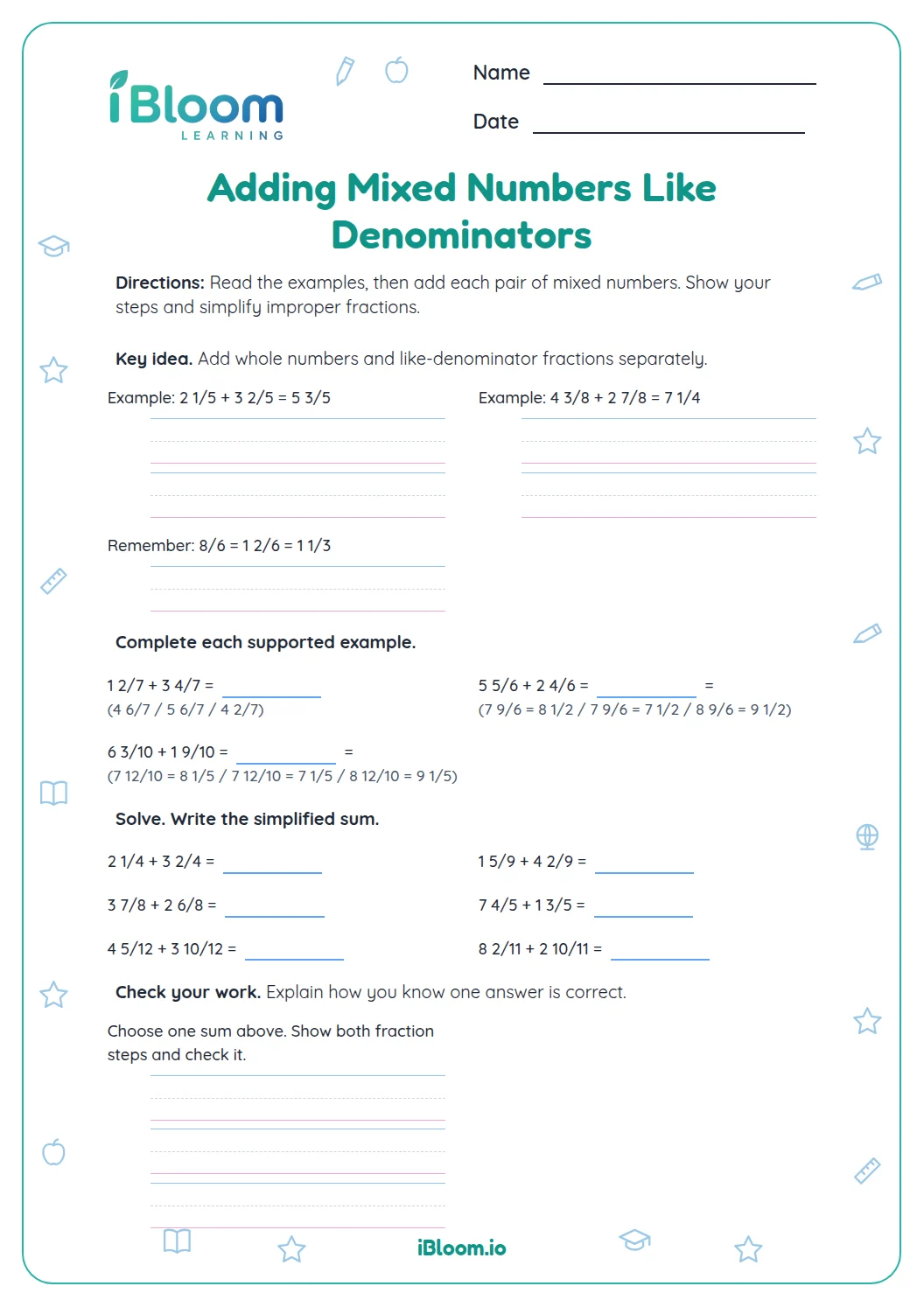
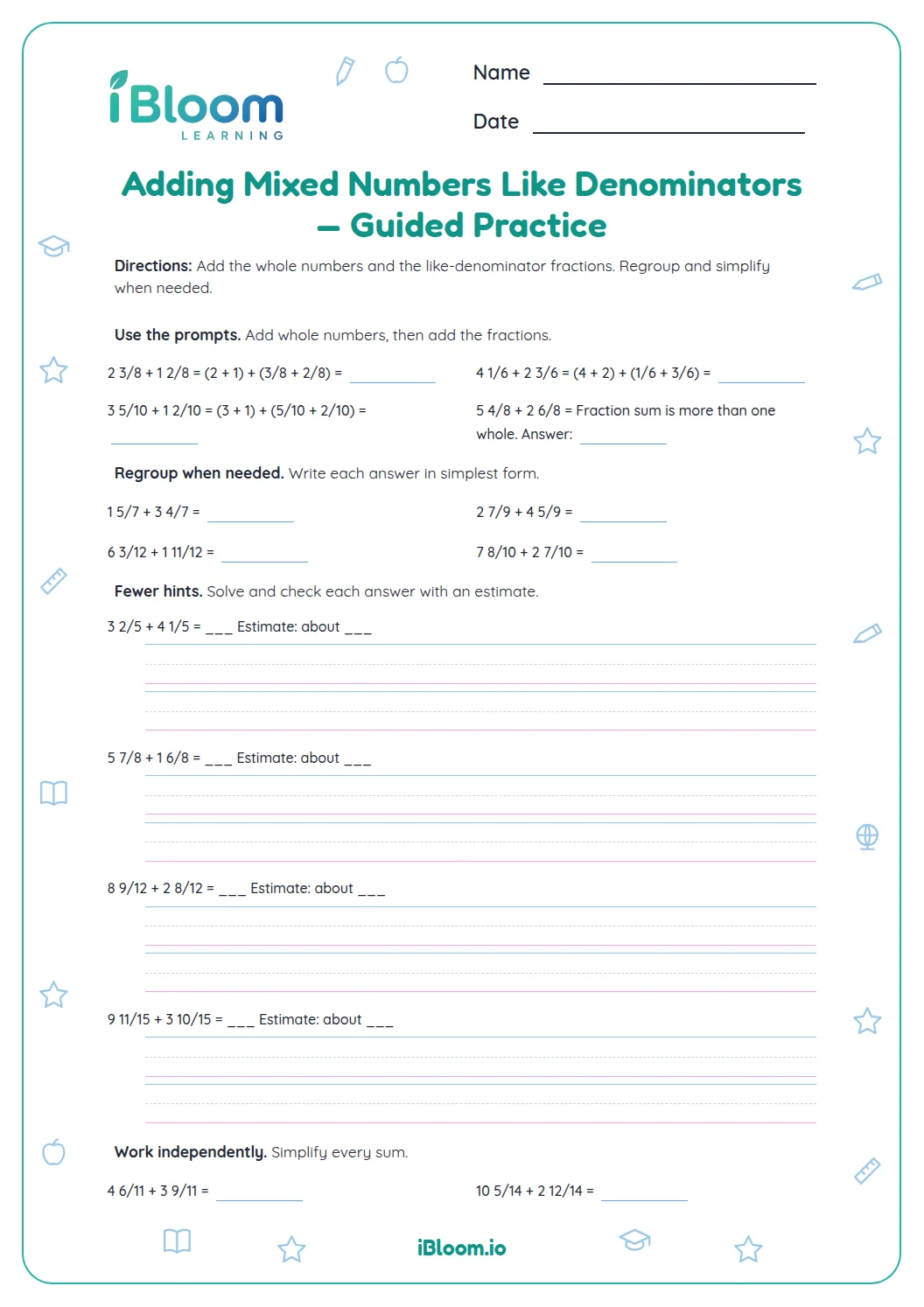
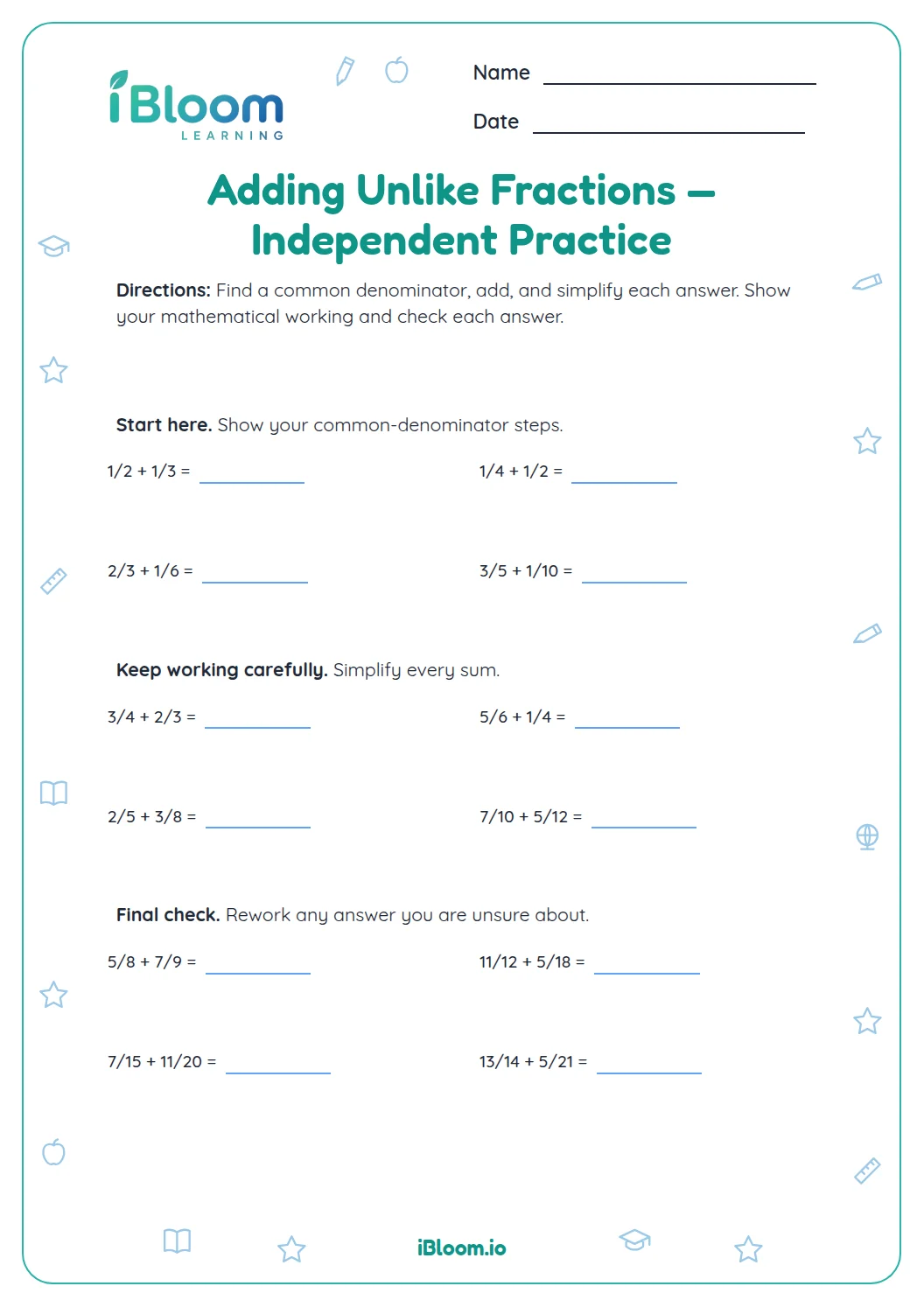
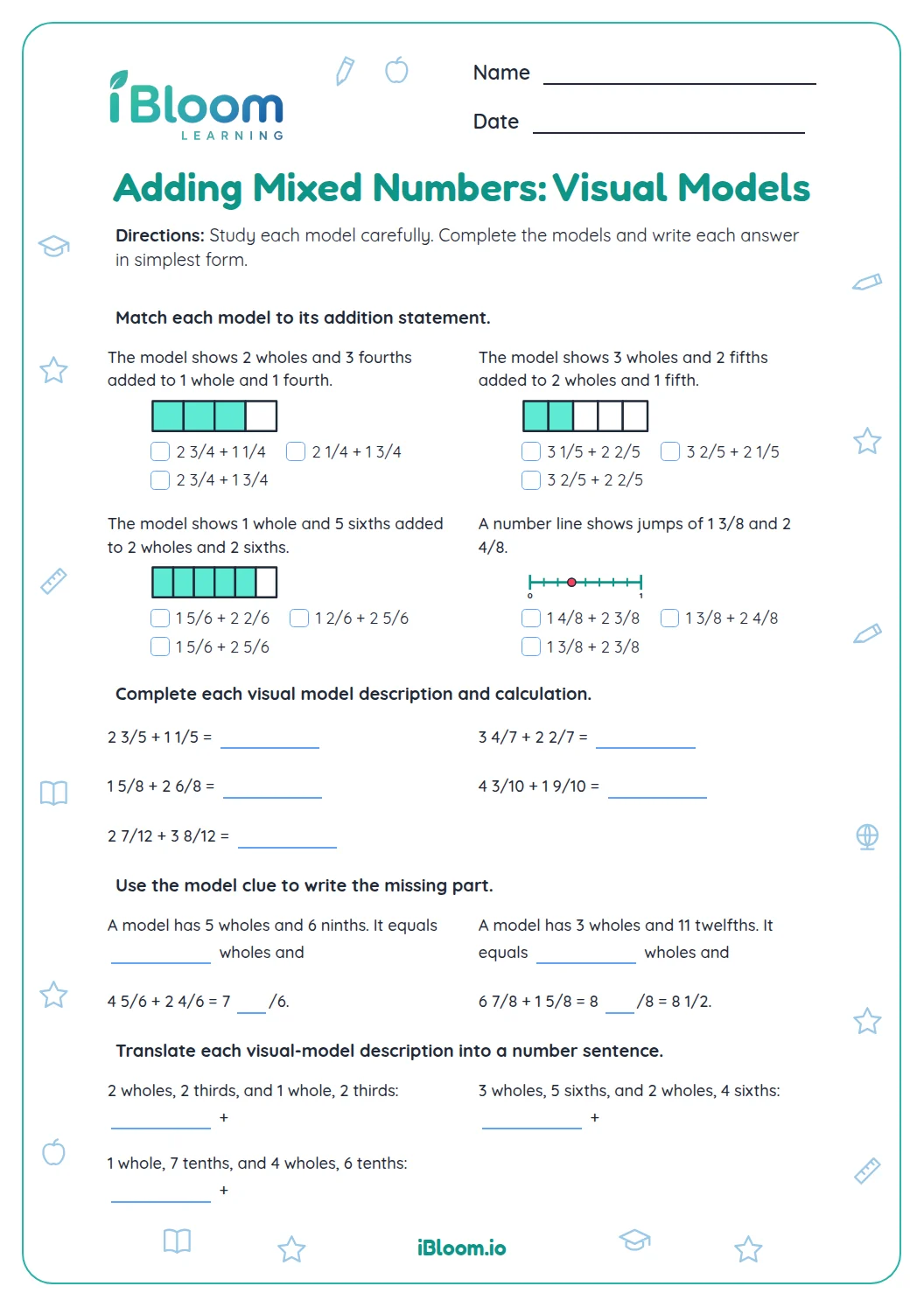
This Grade 5 reasoning challenge focuses on adding mixed numbers with unlike denominators. Students solve eight sums, diagnose three worked errors, choose correct equivalent-fraction strategies, and finish with two length problems. The prompts encourage common denominators and regrouping when the fractional sum is at least one whole. The answer key accepts equivalent forms. This work aligns with CCSS 5.NF.A.1.
Aligned to 5.NF.A.1
Why find a common denominator first?
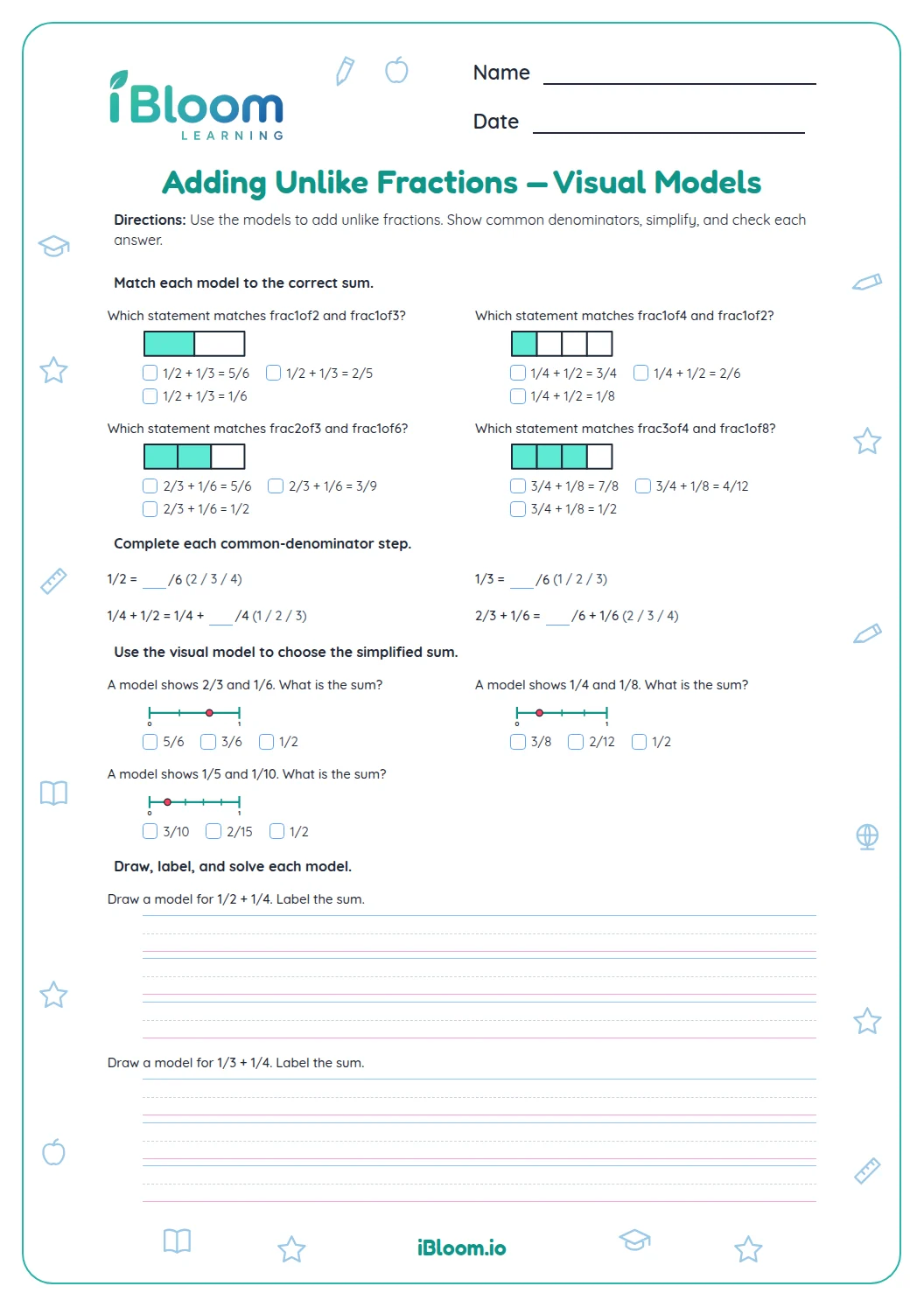
Fractional parts can be combined only after they describe the same-sized pieces. For example, fourths and thirds can both be renamed as twelfths. Then add the numerators and keep the denominator.
- 12 1/3 + 1 1/4 = 2 4/12 + 1 3/12 = 3 7/12.
When should you regroup a mixed-number sum?
If the fraction sum is an improper fraction, trade a whole group of fractional parts for one whole. Reduce the remaining fraction when possible.
- 11 3/4 + 2 2/3 = 3 17/12 = 4 5/12.
How can error analysis sharpen the method?
A wrong solution can reveal a specific step to repair. Adding denominators is a common error; equivalent fractions keep the size of the pieces consistent. Students explain the correction rather than just choosing a result.
How to use this worksheet
- 1Find a common denominator for the fractional parts.
- 2Rename each fraction without changing its value.
- 3Add whole numbers and fractional numerators.
- 4Regroup one whole if the fractional sum is at least 1.
- 5Simplify and check that the answer is near the expected total.
Common mistakes and quick fixes
The mistake
Adding the denominators.
The fix
Rename both fractions with a common denominator, then add numerators.
The mistake
Forgetting the whole numbers.
The fix
Add whole-number parts as well as the fractional parts.
The mistake
Leaving an improper fractional part in the final mixed number.
The fix
Regroup one whole and write the remaining proper fraction.
Common Core alignment
This worksheet practices adding fractions and mixed numbers by using equivalent fractions.
Use equivalent fractions to add and subtract fractions with unlike denominators.
On this sheet: Every computation and context problem requires common-denominator addition of mixed numbers.
Show the official wordingHide the official wording
Add and subtract fractions with unlike denominators (including mixed numbers) by replacing given fractions with equivalent fractions in such a way as to produce an equivalent sum or difference of fractions with like denominators. For example, 2/3 + 5/4 = 8/12 + 15/12 = 23/12. (In general, a/b + c/d = (ad + bc)/bd.)
What to practice next
Make more practice
Further reading
Questions parents and teachers ask
What is a common denominator?
A common denominator is a shared multiple of two denominators. For 1/3 and 1/4, 12 works because both denominators divide evenly into 12. Rewrite each fraction with denominator 12, then add the numerators while keeping that denominator before simplifying or regrouping.
When does a mixed-number sum need regrouping?
Regroup when the fractional parts add to at least one whole. For example, 3/4 + 2/3 = 9/12 + 8/12 = 17/12, which is 1 5/12. Add that whole to the whole-number parts, then write the remaining fraction in simplest form.
How many problems are included?
There are 15 questions in four parts: eight sums, three error-analysis items, two strategy choices, and two word problems. The parts move from calculating to explaining and applying a method. Each answer key entry gives an equivalent mixed-number form when regrouping is needed.
Can equivalent answers be used?
Yes. A correct answer may be written as an equivalent fraction or mixed number, provided it has the same value. For example, an improper fractional part can be regrouped into a whole number and a proper fraction. The key lists a simplified mixed-number answer to make checking straightforward.
What should students do when a solution adds denominators?
Pause and find a common denominator instead. Denominators name the size of the parts, so adding them changes the unit rather than combining like-sized pieces. Rewrite both fractions as equivalent fractions with a shared denominator, add the numerators, then regroup the fractional sum if it reaches one whole.