




About this worksheet
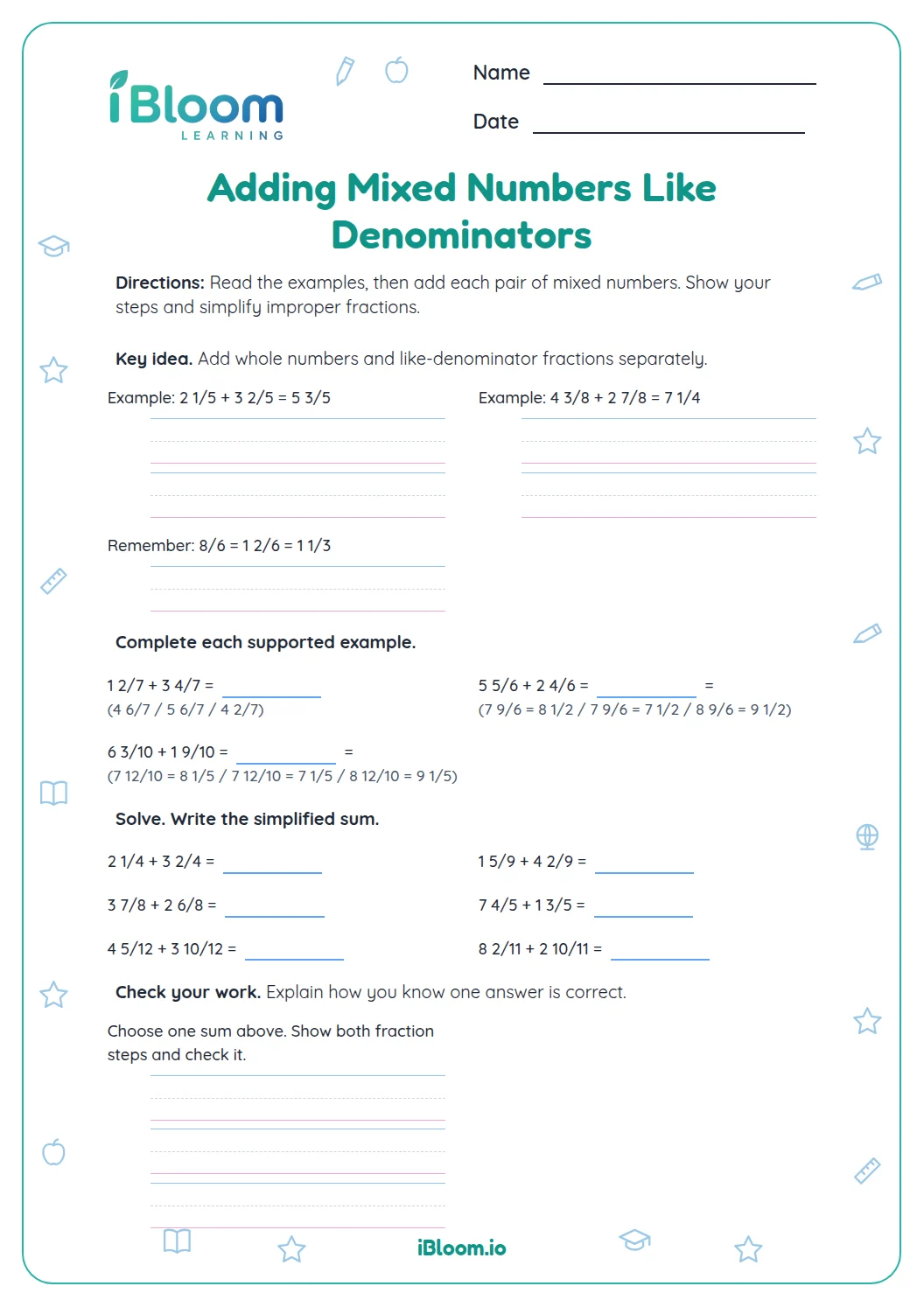
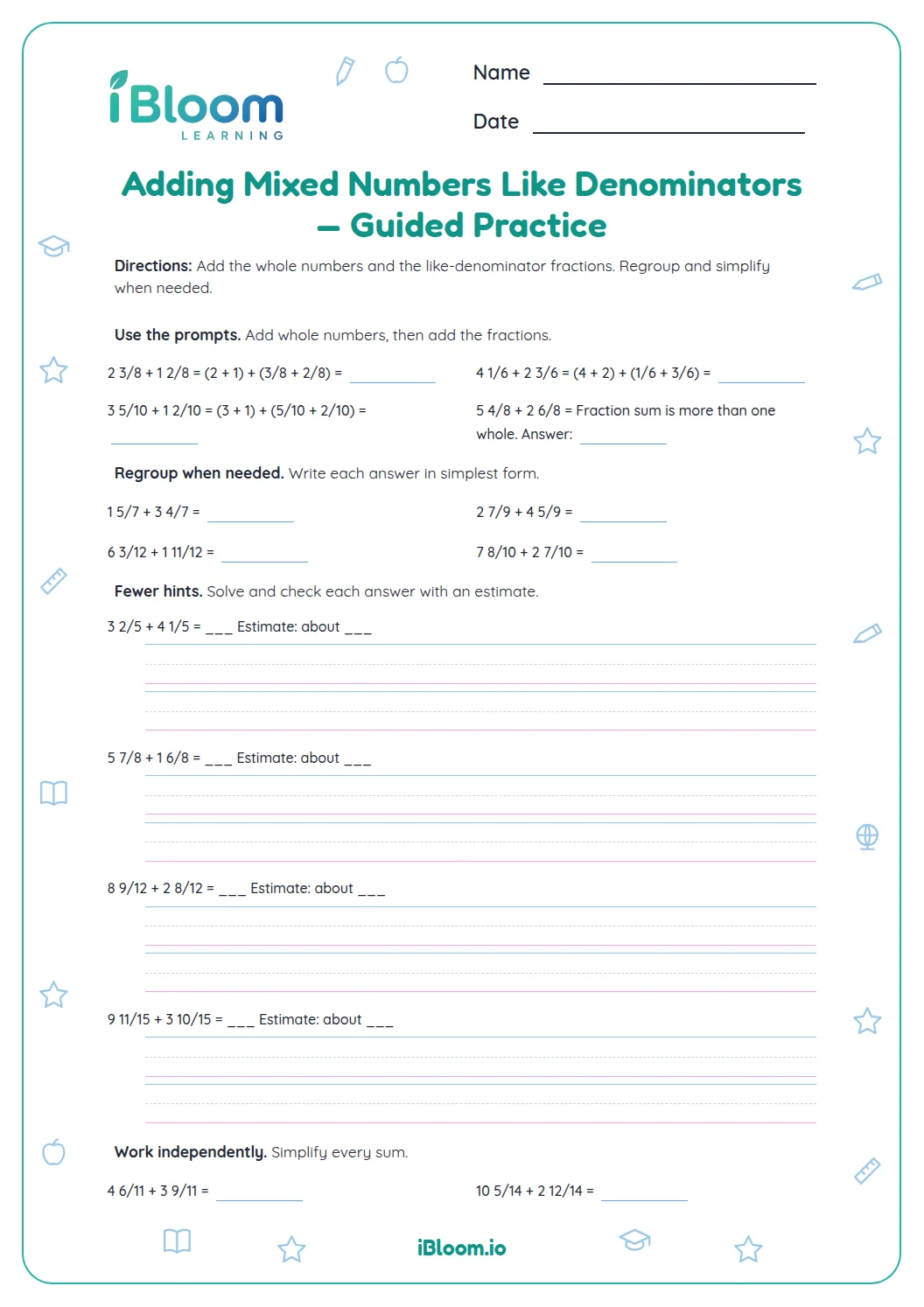
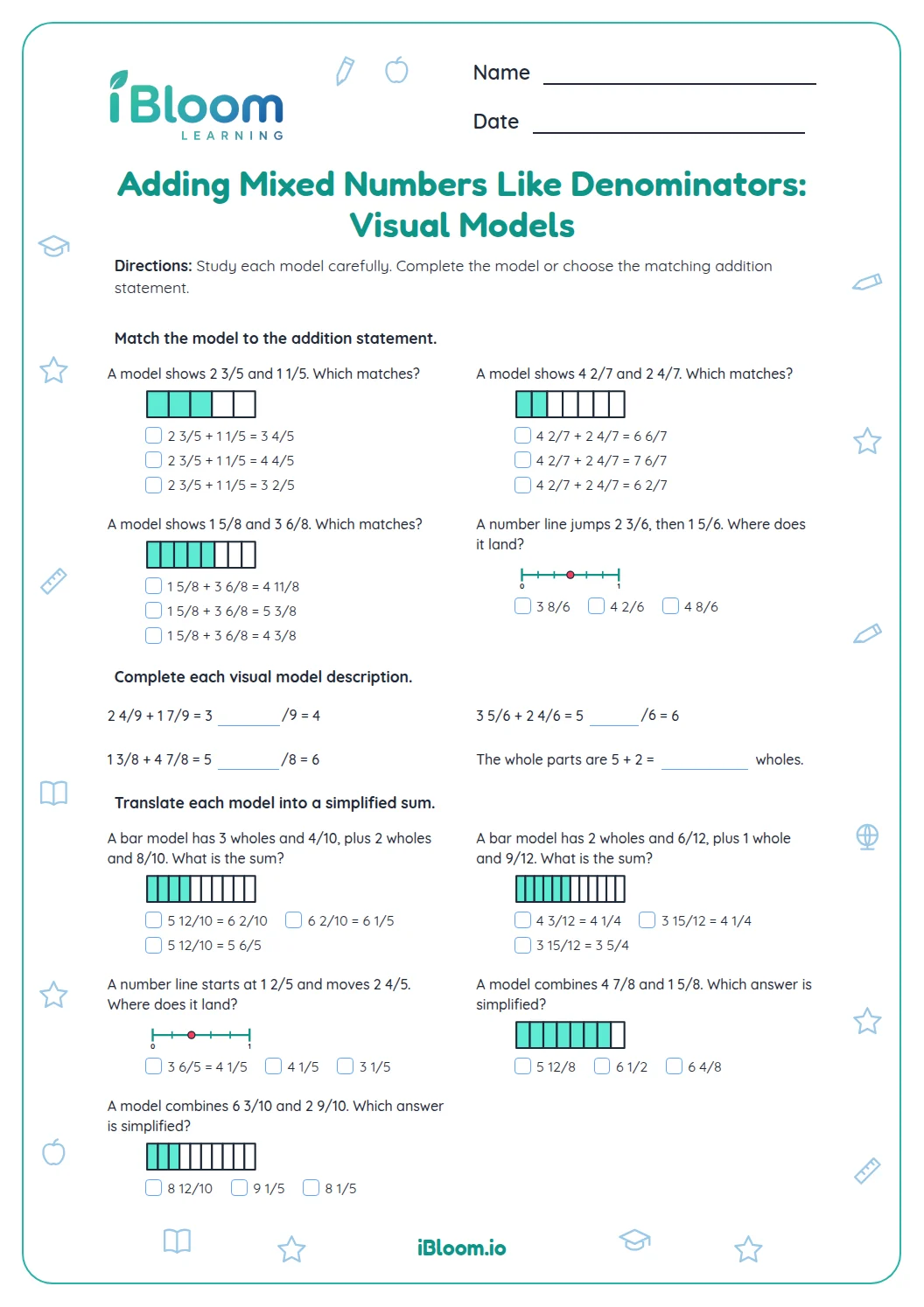
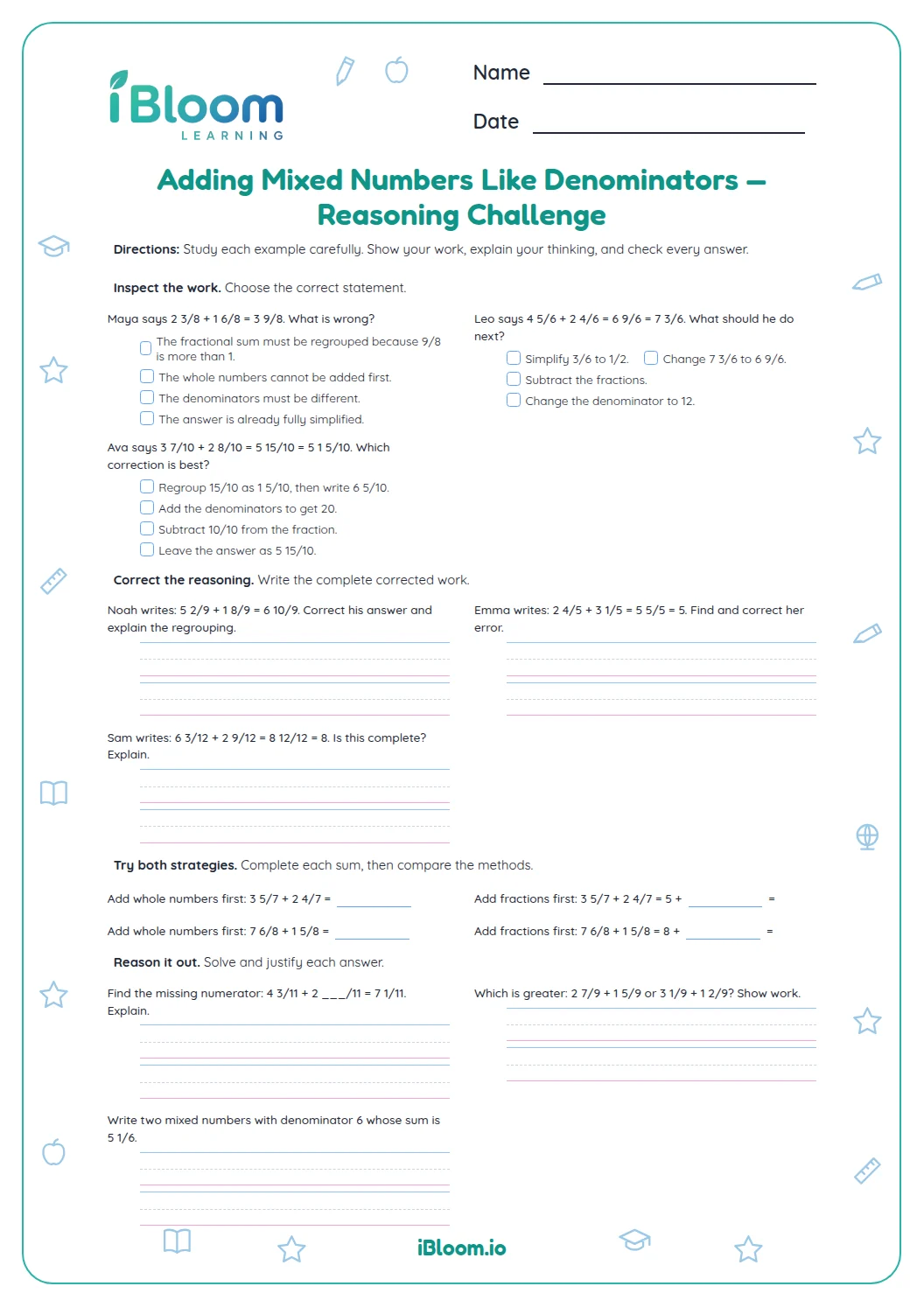
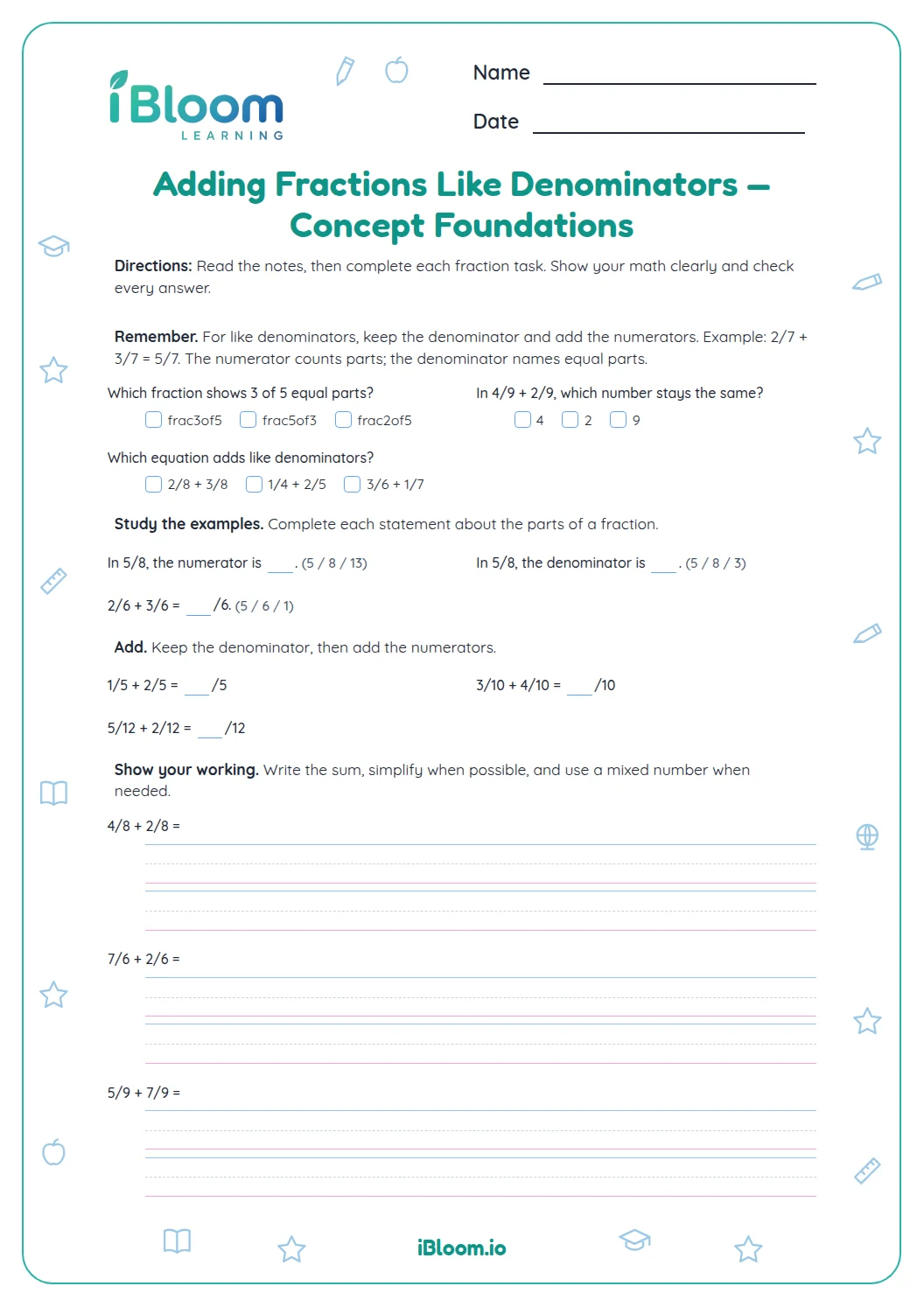
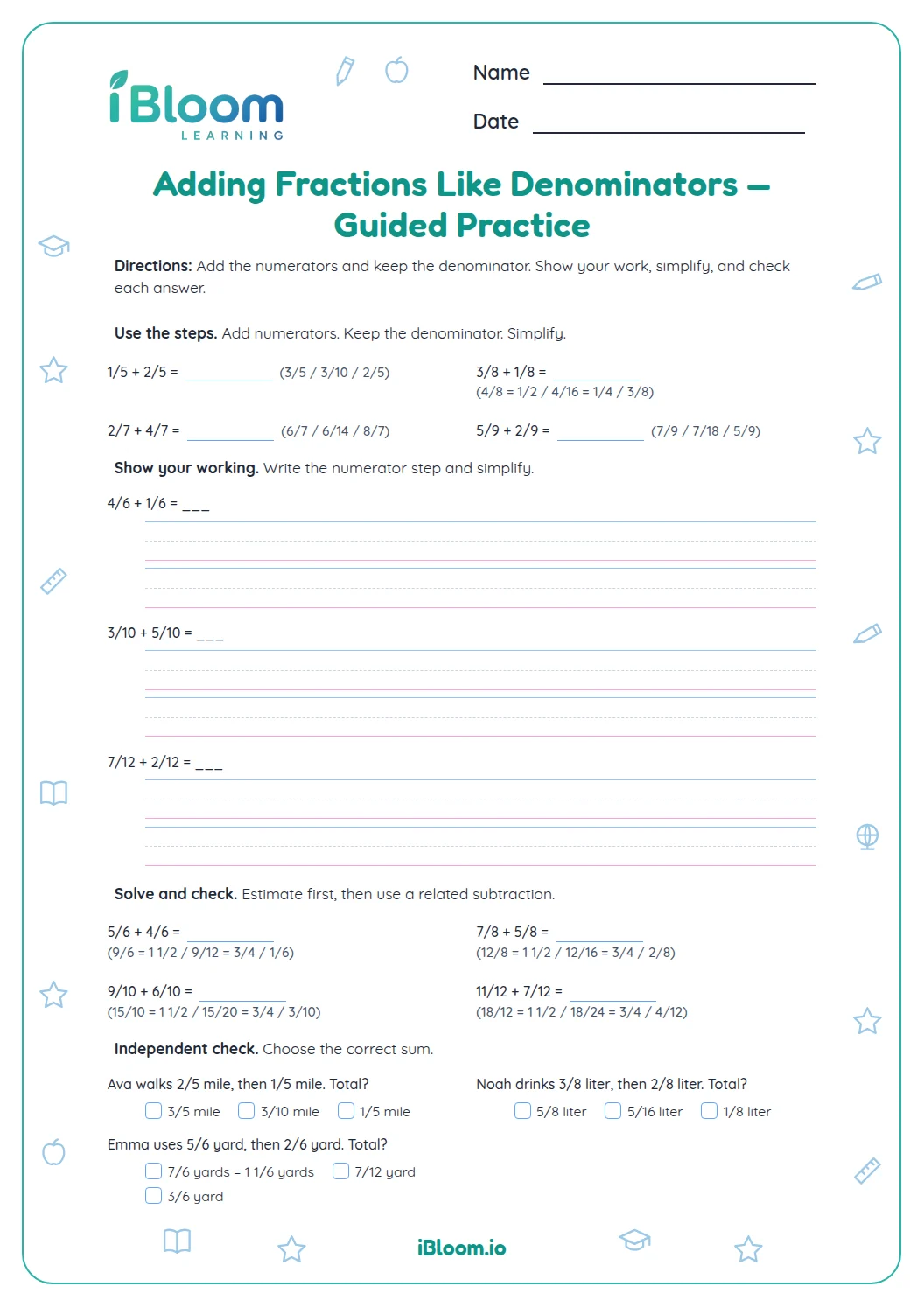
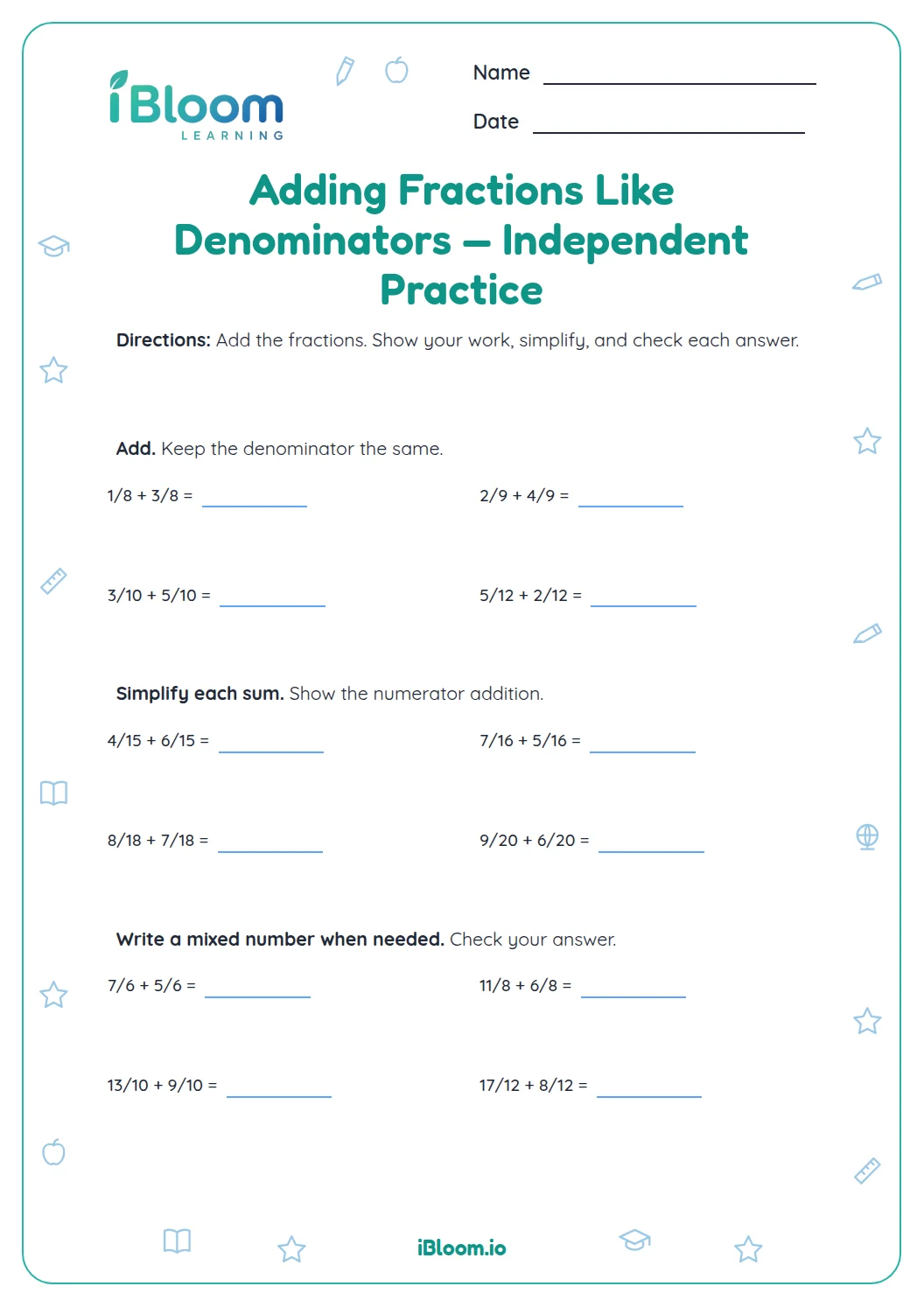
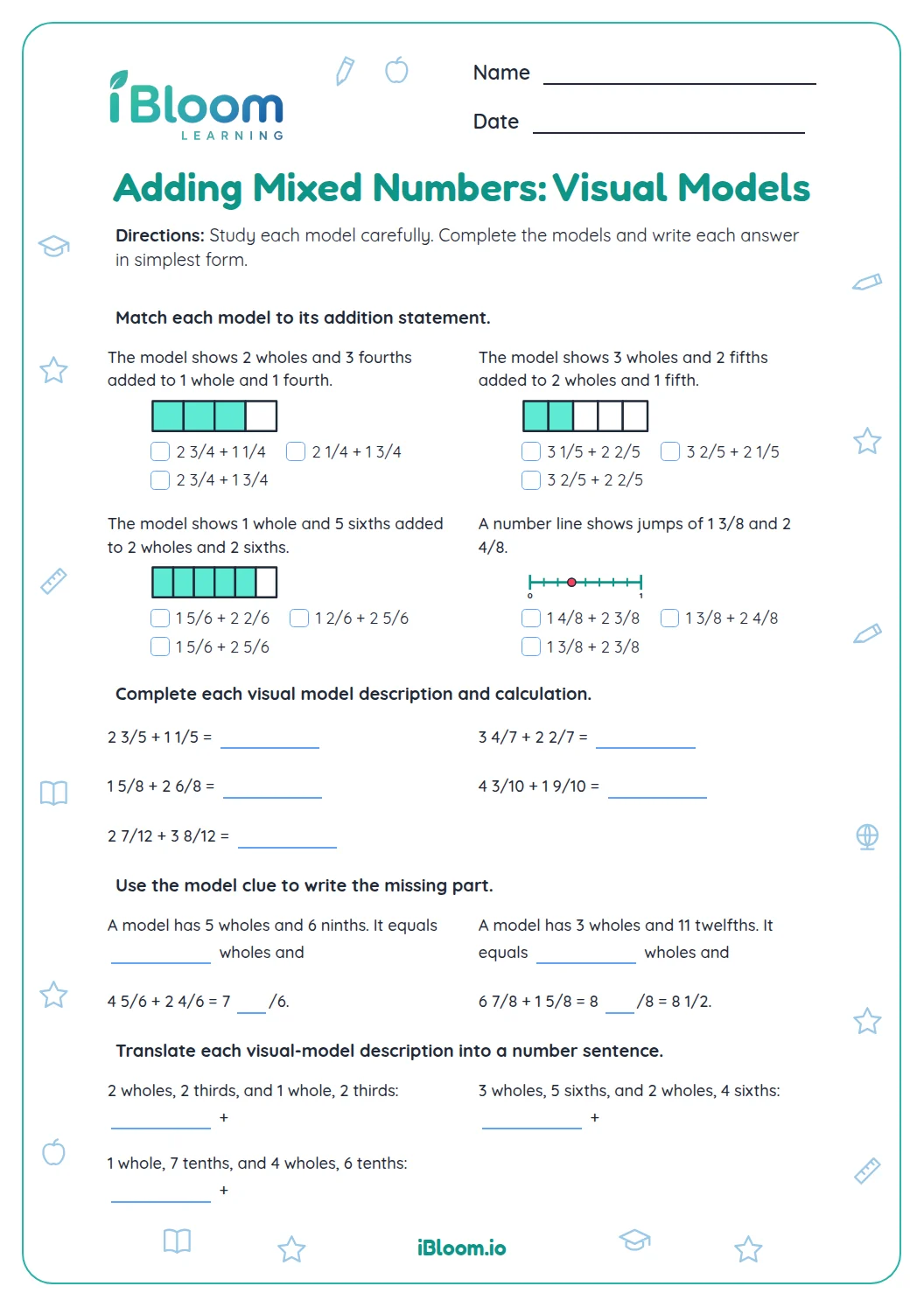
This independent practice page focuses on adding mixed numbers whose fractional parts have like denominators. Students solve direct equations first, then use the same skill in situations about length, recipes, and quantities. Several sums require regrouping a fractional total of one or more wholes.
Aligned to 4.NF.B.3c
What does this worksheet practice?
Part A is a set of eight independent addition equations. Part B transfers the same calculation to short situations. In both parts, denominators stay the same, and some answers need renaming as mixed numbers or whole numbers.
- Part A: 8 mixed-number sums
- Part B: 8 word problems
- Denominators include 4, 5, 6, 7, 8, 9, 10, and 12
When should I regroup?
After adding numerators, check whether the fraction is at least one whole. Convert groups of equal parts into wholes, then add those wholes to the whole-number sum. Reduce the final fraction when possible.
- 12 5/6 + 3 4/6
- 2Add whole numbers: 2 + 3 = 5.
- 3Add the fractions: 5/6 + 4/6 = 9/6 = 1 1/2.
- 4Combine: 5 + 1 1/2 = 6 1/2.
How do I set up a word problem?
Find the two amounts that are being combined. Write an addition equation using those quantities, then solve it just as in Part A. Include the unit from the question in the final response.
How to use this worksheet
- 1For Part A, add the whole numbers and fractional parts separately.
- 2Regroup any fraction equal to or greater than one whole.
- 3For Part B, underline the two amounts that are combined and write an equation.
- 4Reduce the final fraction when possible and include the requested unit.
- 5Check by estimating whether the total is between the expected whole numbers.
Common mistakes and quick fixes
The mistake
Adding the denominators.
The fix
For like denominators, the size of the parts stays the same; add only the numerators.
The mistake
Leaving 9/6 in an answer.
The fix
Rename 9/6 as 1 3/6, then simplify to 1 1/2.
The mistake
Forgetting to add a regrouped whole.
The fix
After turning the fractional sum into a whole and a fraction, add that whole to the whole-number total.
Curriculum alignment
The problems practice adding mixed numbers that have like denominators.
Add and subtract mixed numbers with like denominators using equivalent fractions or properties.
On this sheet: The equations and word problems add mixed numbers with like denominators, including regrouping.
Show the official wordingHide the official wording
Add and subtract mixed numbers with like denominators, e.g., by replacing each mixed number with an equivalent fraction, and/or by using properties of operations and the relationship between addition and subtraction.
What to practice next
Make more practice
Further reading
Questions parents and teachers ask
Do I add the denominators when adding mixed numbers?
No. Keep the denominator the same because the fractional parts are the same size. Add the numerators, then simplify or regroup the fraction if the total is one whole or more. Keep the denominator the same because the fractional parts are the same size. Add the numerators, then simplify or regroup the fraction if the total reaches one whole.
What does regrouping mean here?
Regrouping means trading a fraction equal to or greater than one whole for a whole number plus any remaining fraction. Add that new whole to the whole-number part of the sum. Regrouping means trading a fraction equal to or greater than one whole for a whole number plus any remaining fraction. Add that whole to the whole-number sum.
Should the answer be simplified?
Yes. Write the fraction in simplest form when possible, and use a mixed number for a total greater than one. Include the unit in a word-problem answer when one is requested. Write the fraction in simplest form when possible, and use a mixed number for a total greater than one. Include the requested unit in a word problem.
What grade is this worksheet for?
This page is Grade 5 independent practice with mixed numbers and like denominators. It includes direct equations and short word problems that use the same addition skill. The practice is intended for Grade 5 and focuses on adding mixed numbers when both fractional parts already have like denominators.
Are the word problems different from the equations?
They use the same addition skill in short contexts involving quantities such as cups, miles, yards, and chapters. The situations ask learners to combine two amounts. The contexts use the same addition skill with cups, miles, yards, and chapters. Each situation asks learners to combine two stated amounts.
How many problems are included?
There are 16 problems: 8 equations and 8 word problems, followed by a separate answer key. Several sums require regrouping fractional parts into a whole. There are 16 problems: 8 equations and 8 word problems, followed by a separate answer key. Several sums require regrouping fractional parts into a whole.