



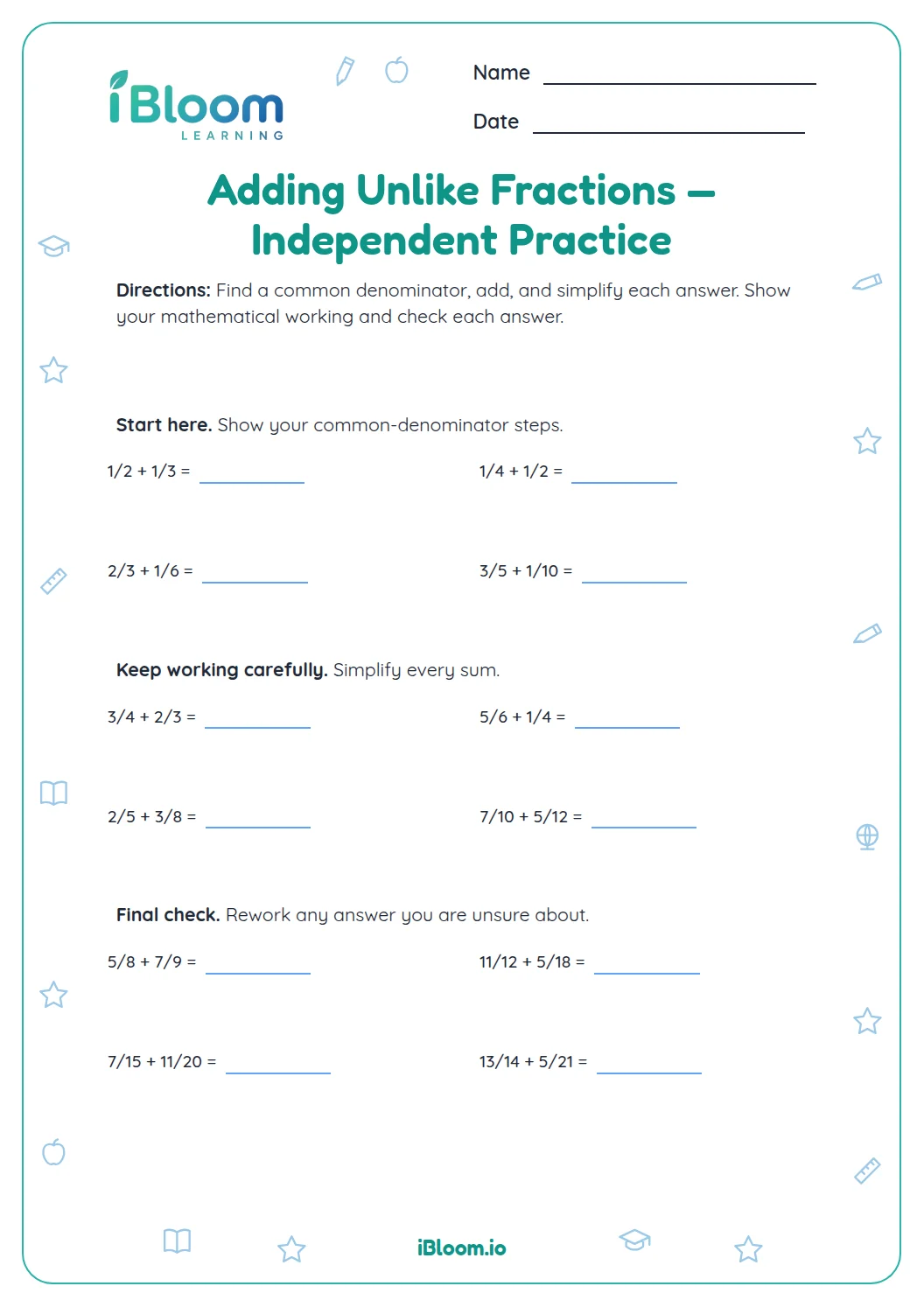

About this worksheet
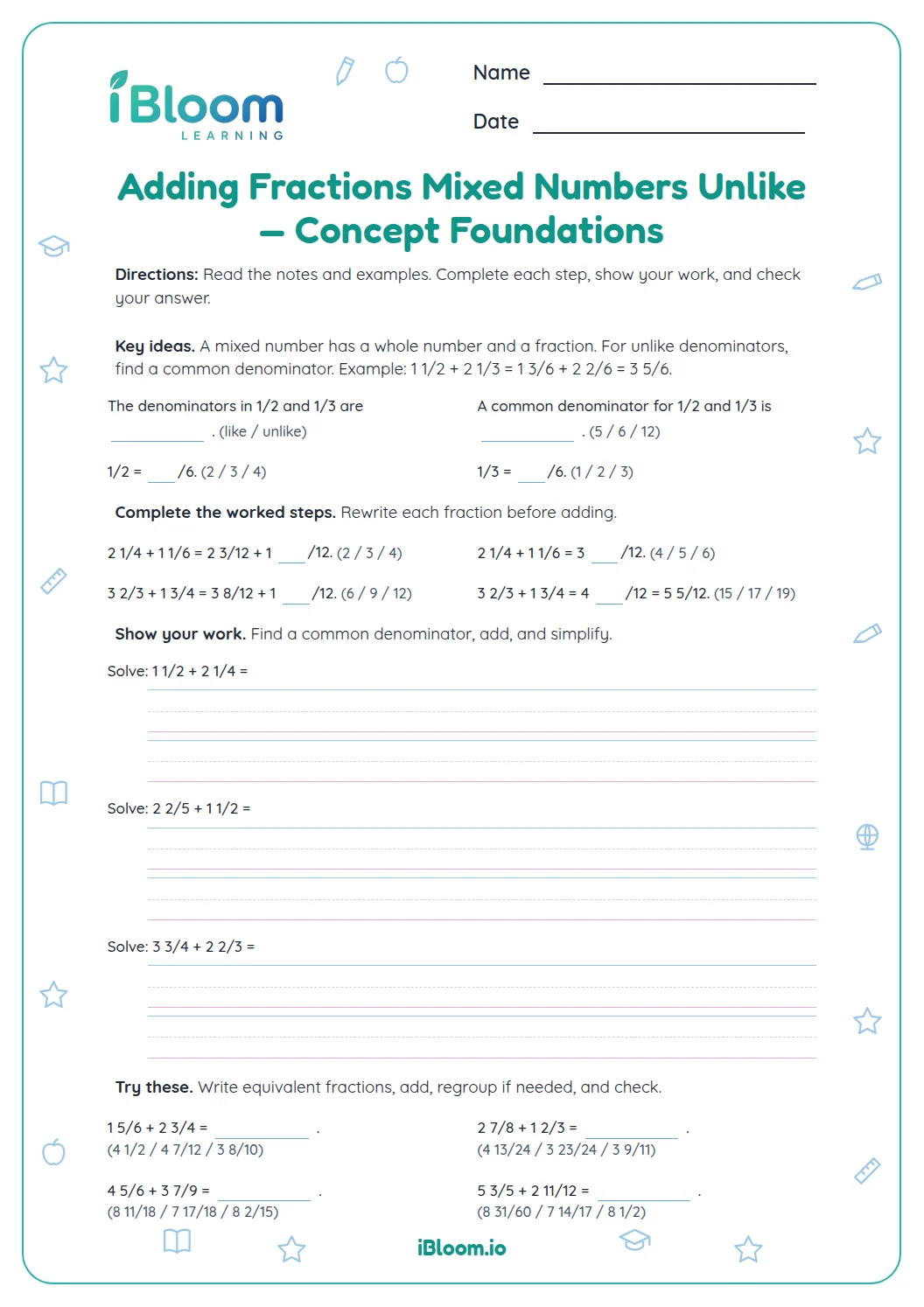
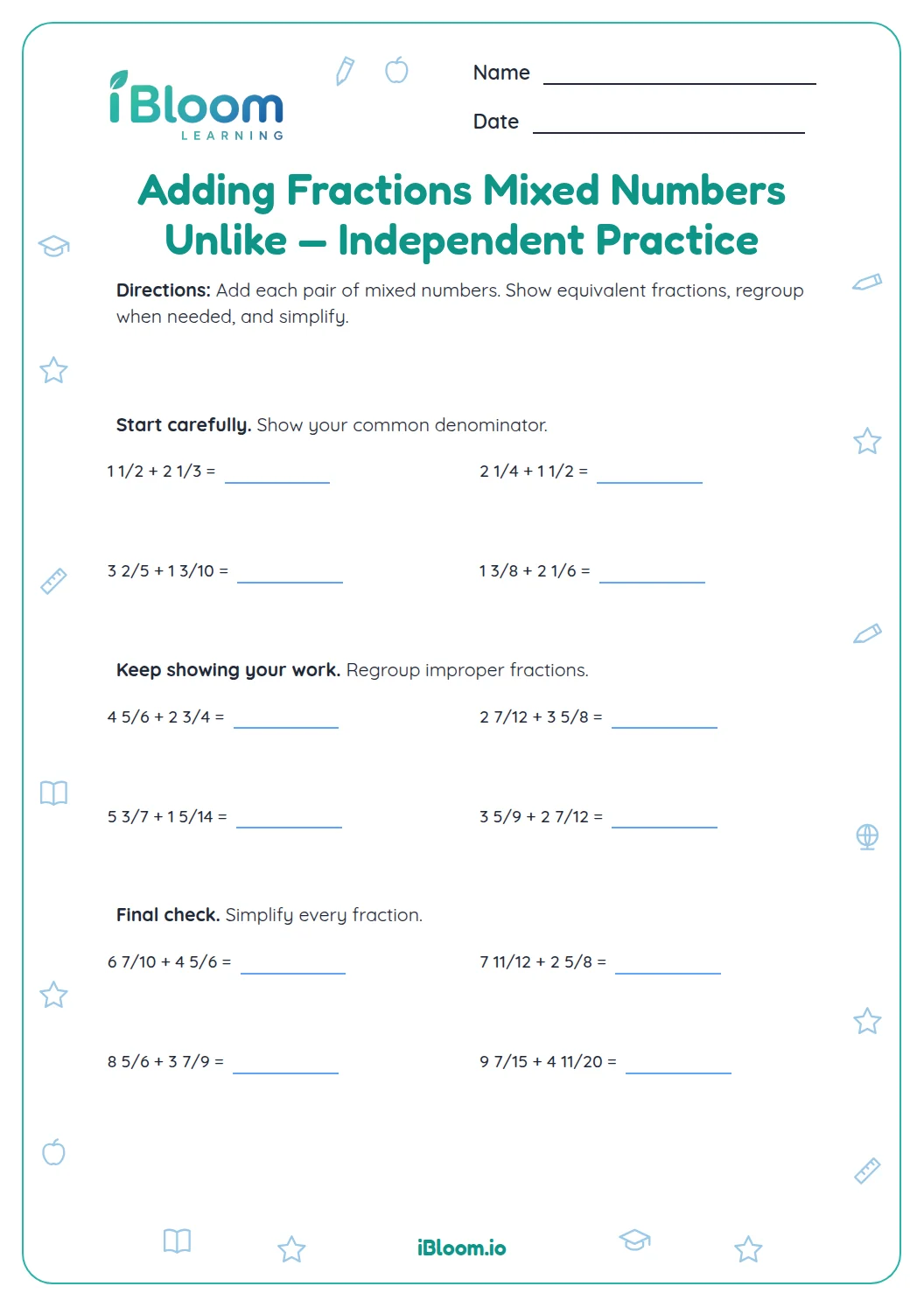
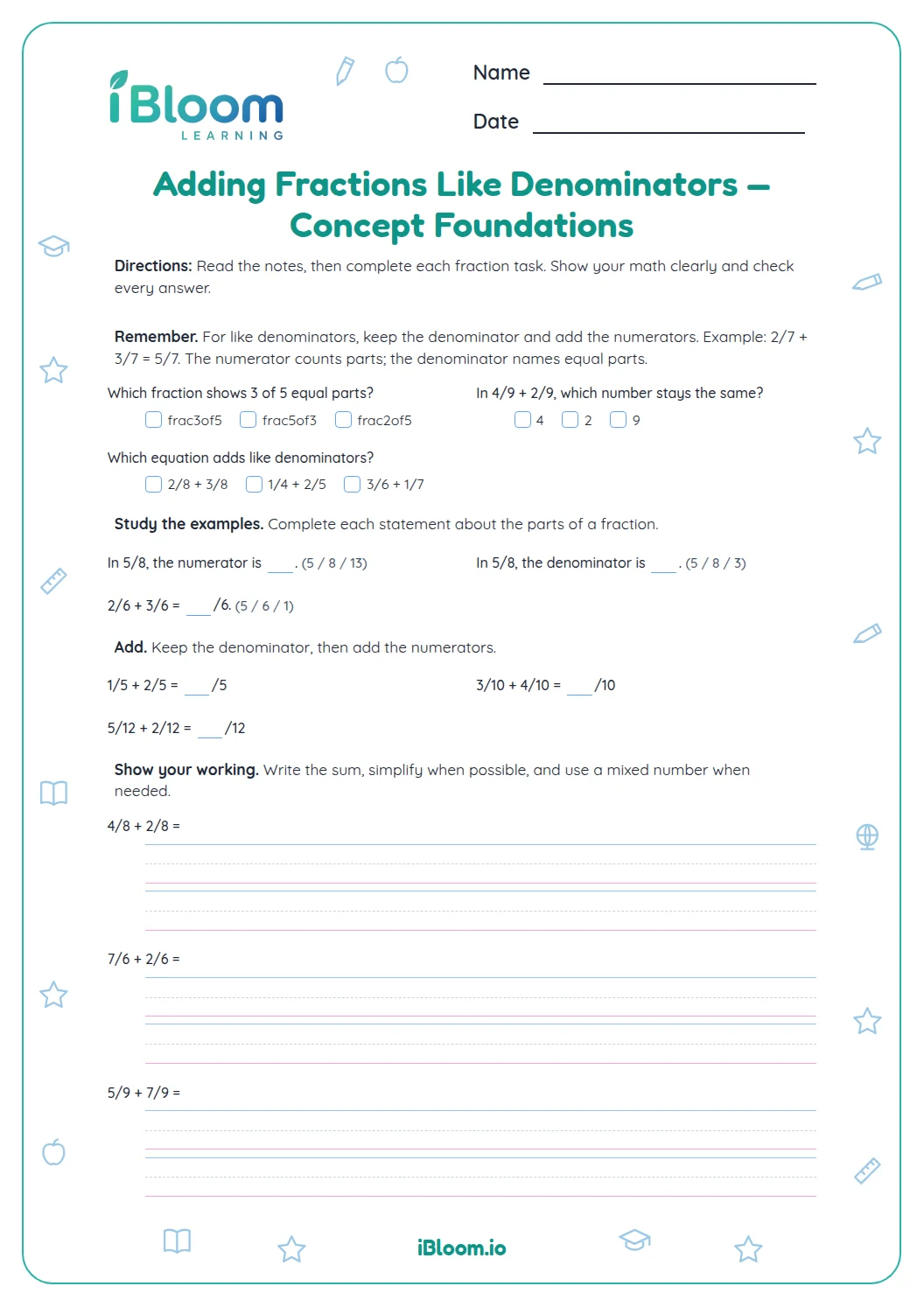
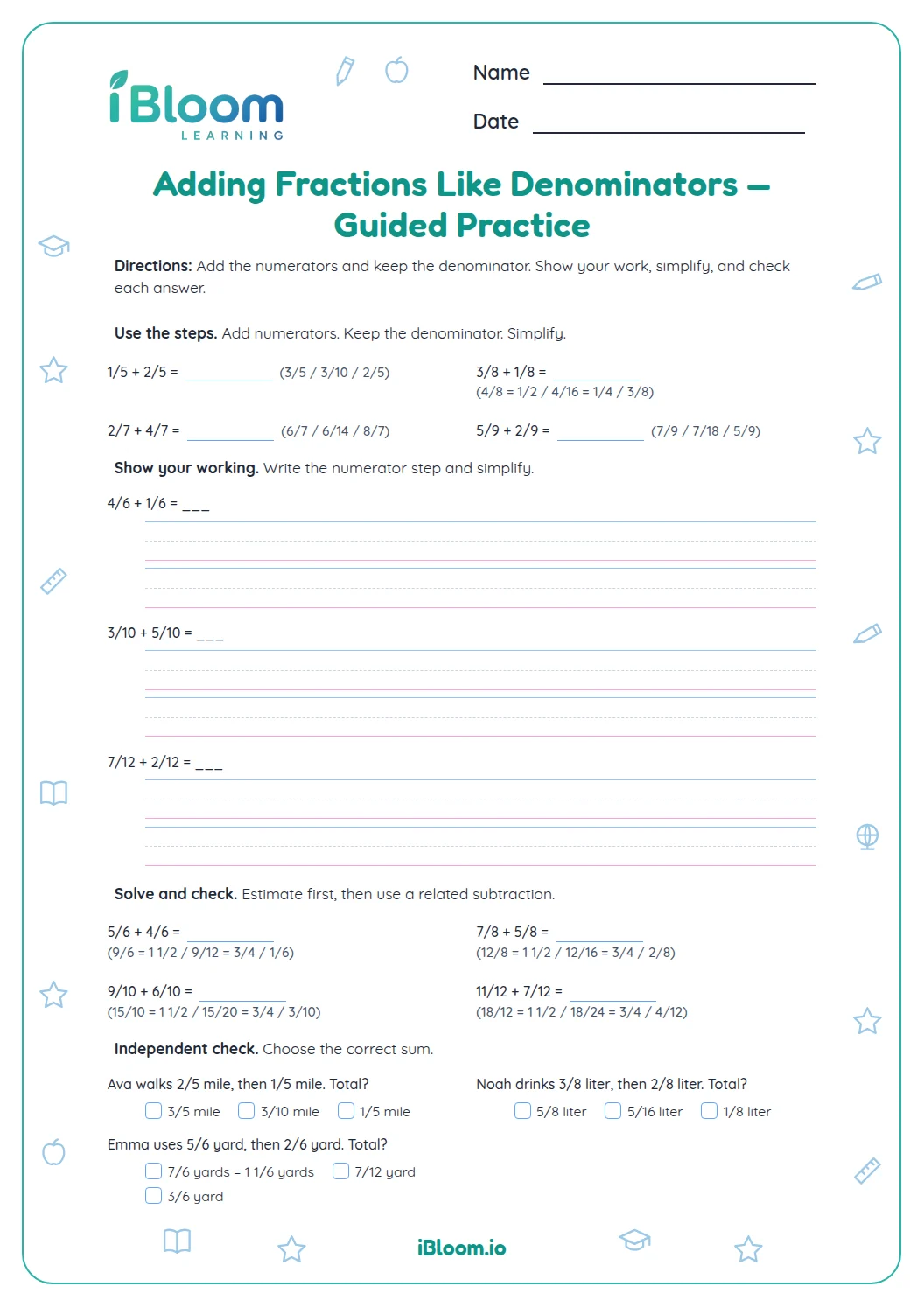
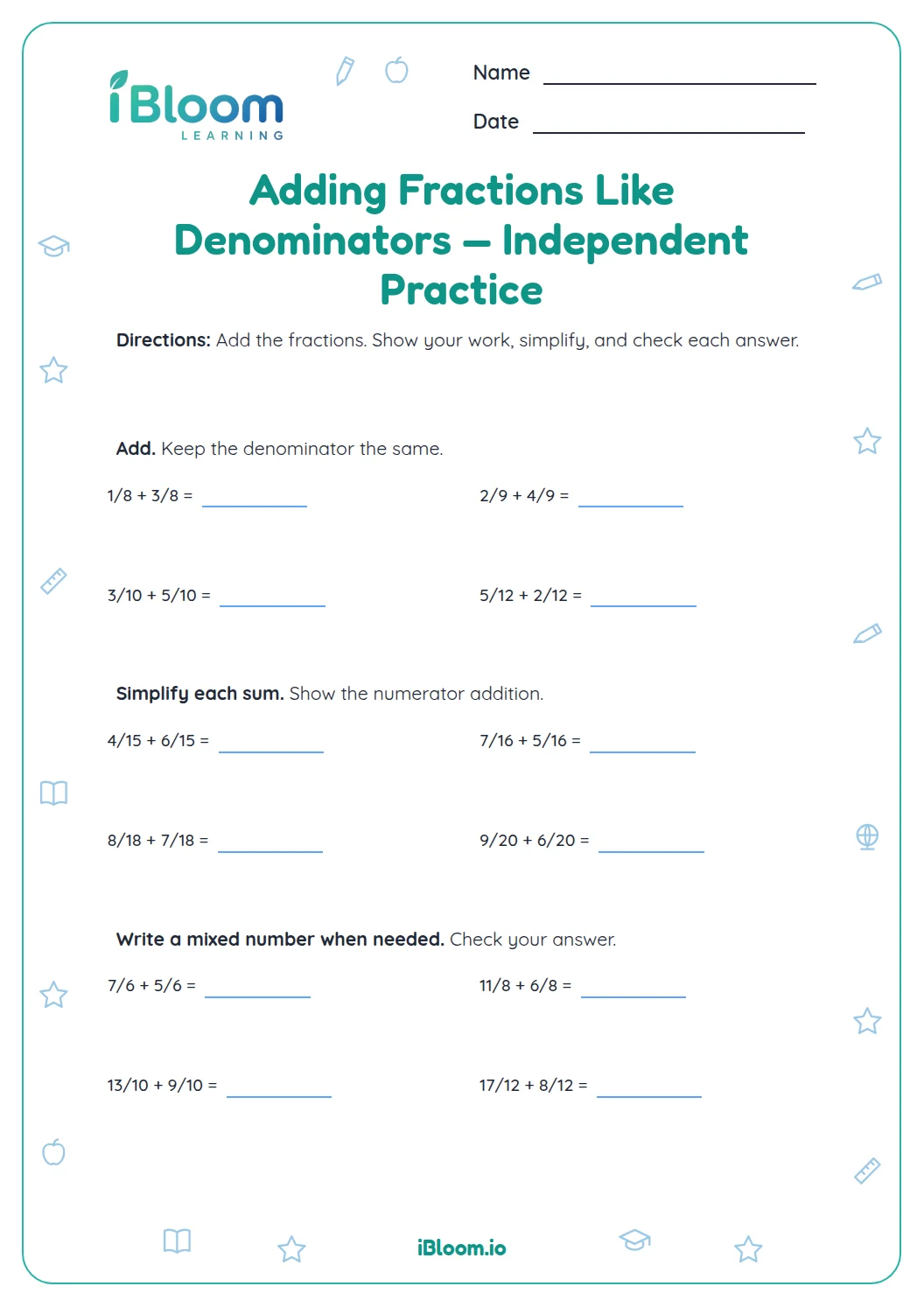
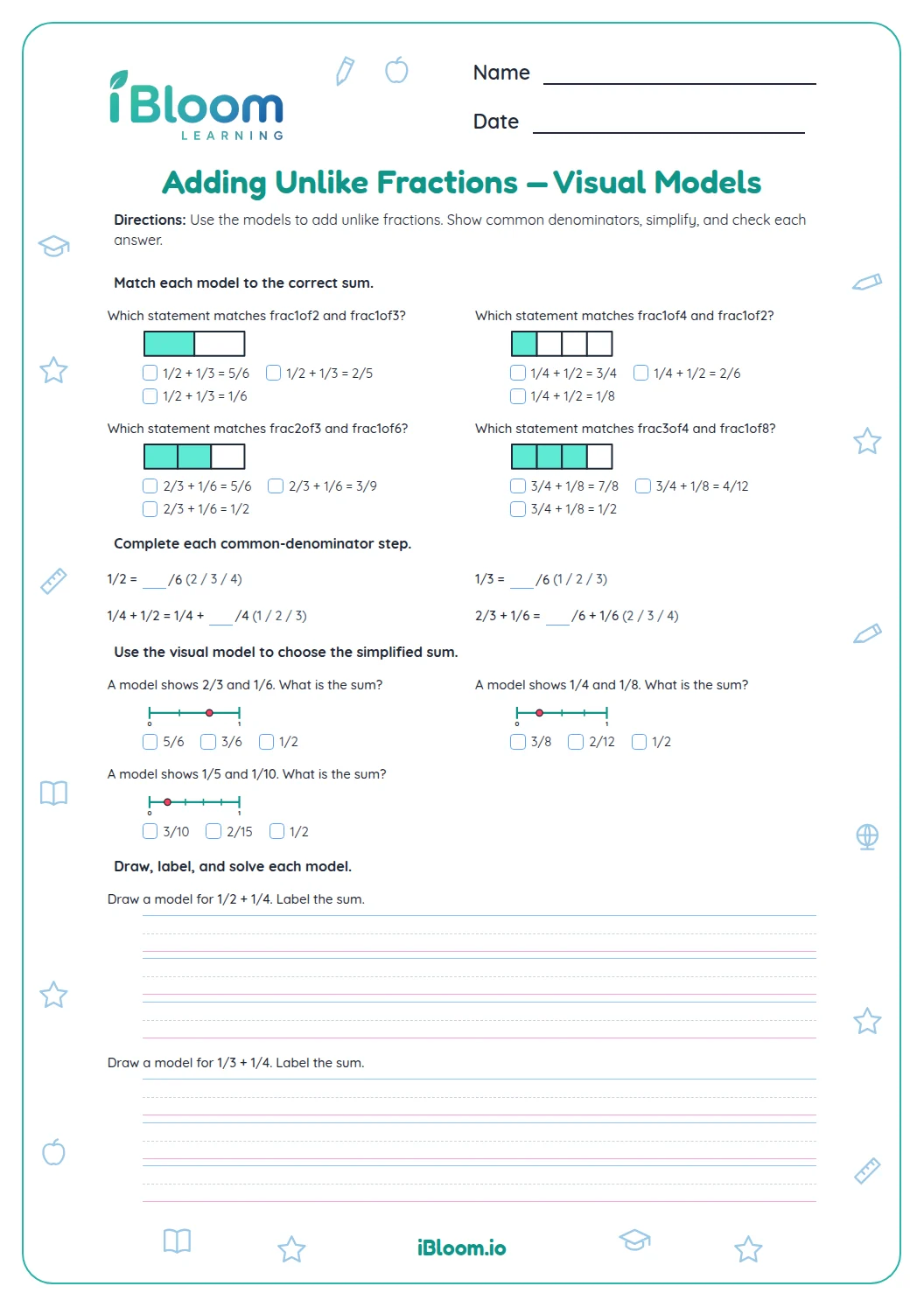
This free printable Grade 5 worksheet uses fraction bars to make common denominators visible. Part A has five equivalent-fraction blanks. Part B has eleven additions to mixed numbers. The first two addition questions include bars partitioned into common denominators; nine more ask children to solve independently. In the bar models, each bar represents one whole and colored parts show the starting amount. Children use the models for the first sums, then solve the final ones independently. The 16 questions practice Common Core 5.NF.A.1, and a separate answer key shows the equivalent numerators and simplified sums.
Aligned to 5.NF.A.1
What do the colored bars represent?
Each full bar is one whole. Colored sections show the first amount in an addition problem. The partition size is chosen so both fractional addends can be expressed in that unit. For example, a half becomes three sixths when a bar has six equal sections.
In Part A, children count colored sections to supply equivalent numerators. In Parts B and C, they keep the starting amount and add the second amount. They may mark extra sections on the printed bars and use the working area for the calculation.
How do you add 1 1/2 and 1/3?
Question 5 shows one full bar and three sixths of another bar. The whole stays whole. Rename the additional third as two sixths, then add those two parts to the three already colored.
- 11 1/2 = 1 3/6
- 21/3 = 2/6
- 31 3/6 + 2/6 = 1 5/6
- 4The sum is less than 2 because one sixth of the second bar remains empty.
What happens when the parts fill a bar?
Part C requires another whole in every sum. For 1 3/4 + 1/2, the half becomes two fourths. Three fourths plus two fourths is five fourths: one full bar and one fourth. Together with the starting whole, the answer is 2 1/4.
Keep the denominator as the size of the parts when combining them. Simplify the final fraction when possible; question 8 ends with three sixths, which is one half.
Connect the bars to the calculation
- 1Read the denominator as the number of equal sections in one bar.
- 2Complete Part A by counting colored sections.
- 3In Part B, identify the whole bars and fractional part of the first addend.
- 4Rename the second addend using the partition size in the bars.
- 5Add the parts and regroup any complete bar as another whole.
- 6Simplify the answer and compare its size with the starting amount.
Fraction-addition errors to revisit
The mistake
Adding 1/2 and 1/3 to get 2/5.
The fix
Rename them as 3/6 and 2/6; both now count sixth-sized parts.
The mistake
Dropping the starting whole in 1 1/2 + 1/3.
The fix
Count the full colored bar before adding the fractional pieces.
The mistake
Leaving 1 5/4 as the final answer.
The fix
Trade 4/4 for one whole, so 1 5/4 becomes 2 1/4.
Common Core alignment
Use equal-sized parts to add fractions and mixed numbers with unlike denominators.
On this sheet: The bars show common-sized parts for rewriting addends and combining them.
Show the official wordingHide the official wording
Add and subtract fractions with unlike denominators (including mixed numbers) by replacing given fractions with equivalent fractions in such a way as to produce an equivalent sum or difference of fractions with like denominators. For example, 2/3 + 5/4 = 8/12 + 15/12 = 23/12. (In general, a/b + c/d = (ad + bc)/bd.)
What to practice next
Make more practice
Further reading
Questions parents and teachers ask
What does one bar stand for?
In each bar model, one bar represents one whole. A fully colored bar counts as one, while the next bar shows a fractional amount. Count the equal sections within a single bar to read the denominator, then count its colored sections to read the numerator.
Why are the halves sometimes drawn in sixths?
Sixths let children combine a half and a third using equal-sized parts. In the first addition question, the half is drawn as three sixths. The third can then be counted as two more sixths. The partition changes the name of the fraction while preserving its value.
Do children color the bars themselves?
Children may mark additional sections as they add, but the bars already show the starting amounts. The task is to use those partitions to calculate and record each sum. When another whole is needed, children can sketch an extra bar in the working space.
Which answers need another whole?
Questions 10 through 16 need another whole because their fractional parts total at least one whole. For example, question 9 combines three fourths and two fourths, making five fourths. Four fourths form one whole, and one fourth remains.
Does the key use simplified answers?
Yes, the key gives each sum in simplest form. For question 9, adding one third to 2 1/6 gives 2 3/6, which simplifies to 2 1/2. You can acknowledge the correct equivalent sum, then ask the child to complete the simplification step.