


About this worksheet
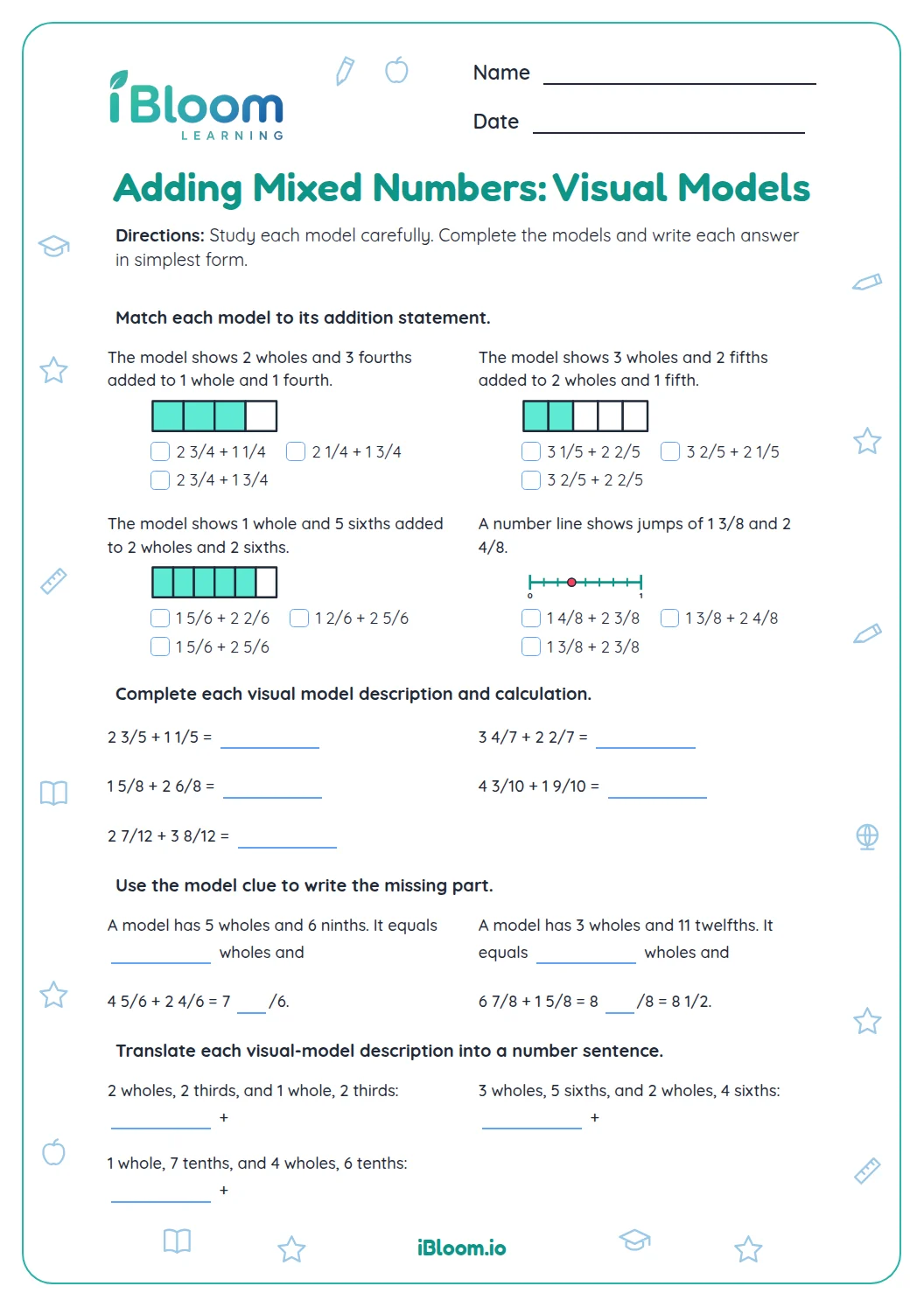
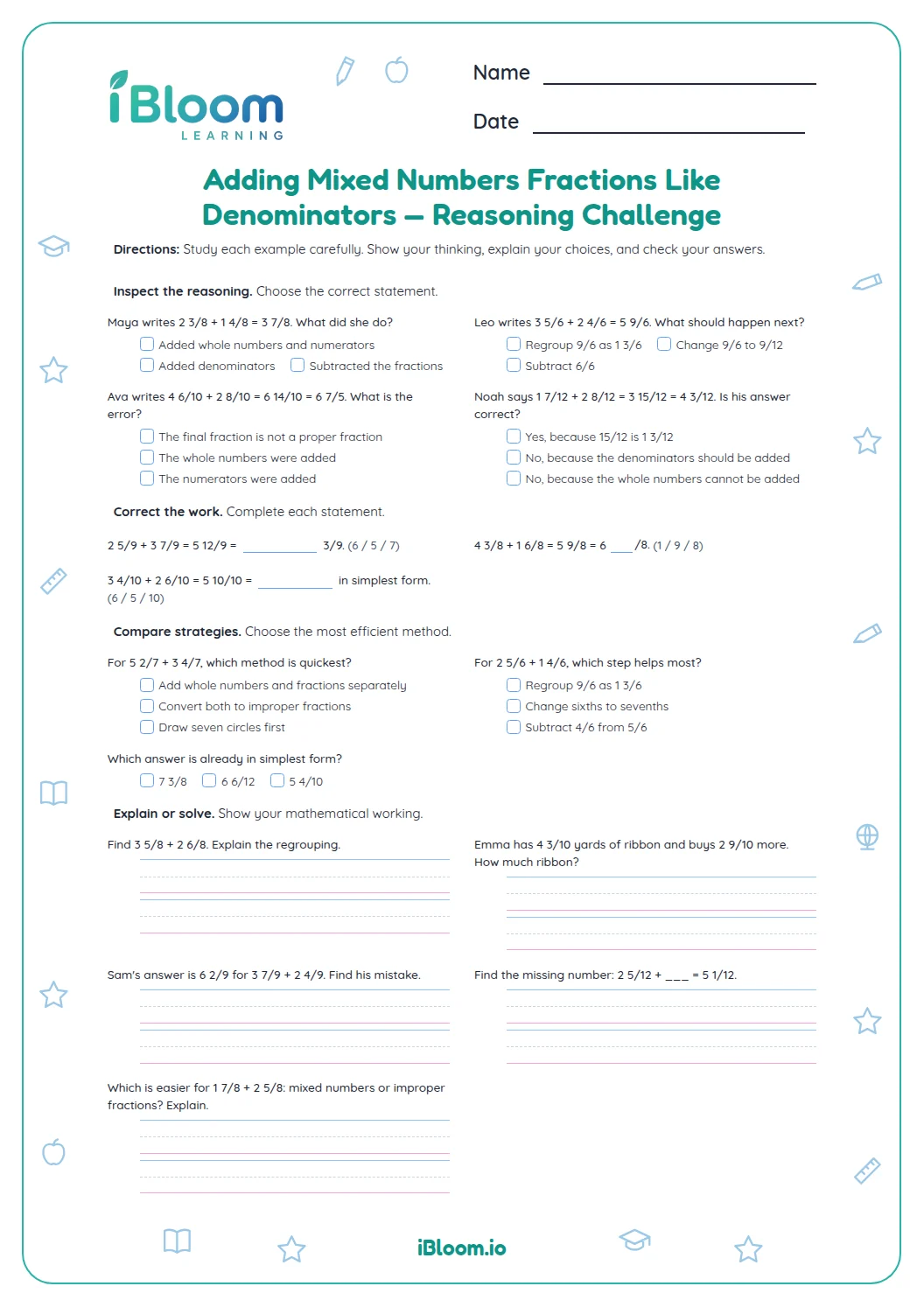
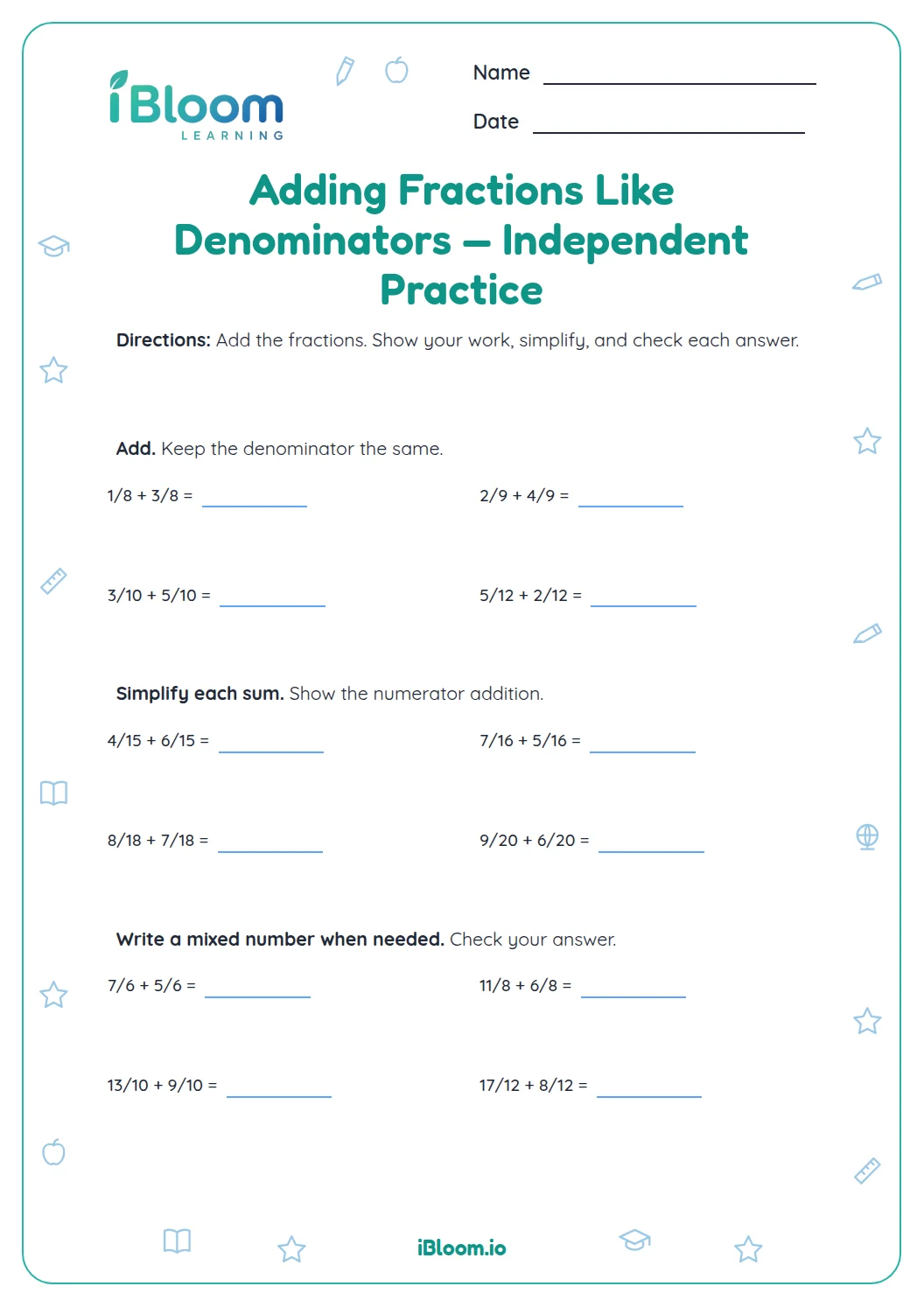
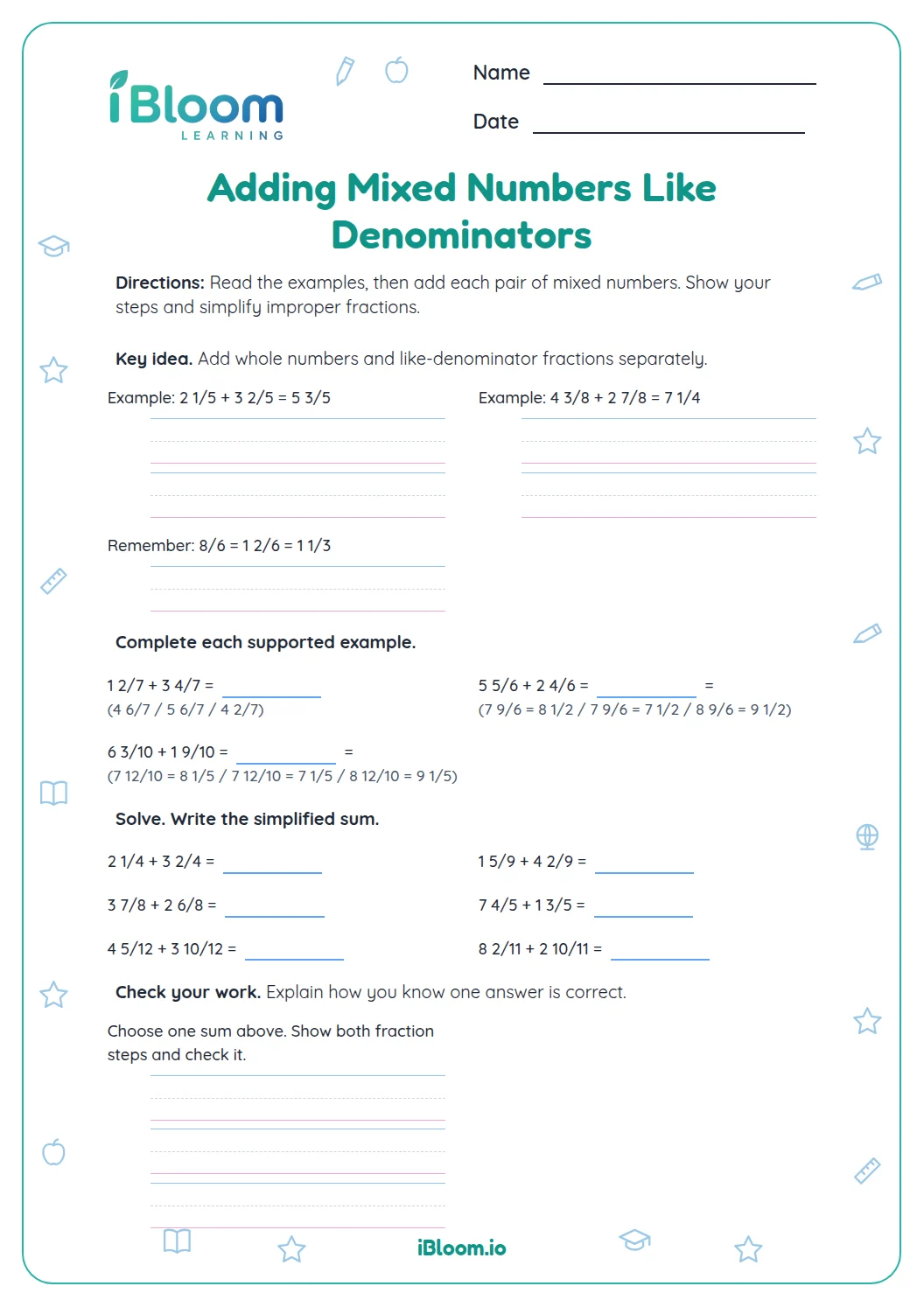
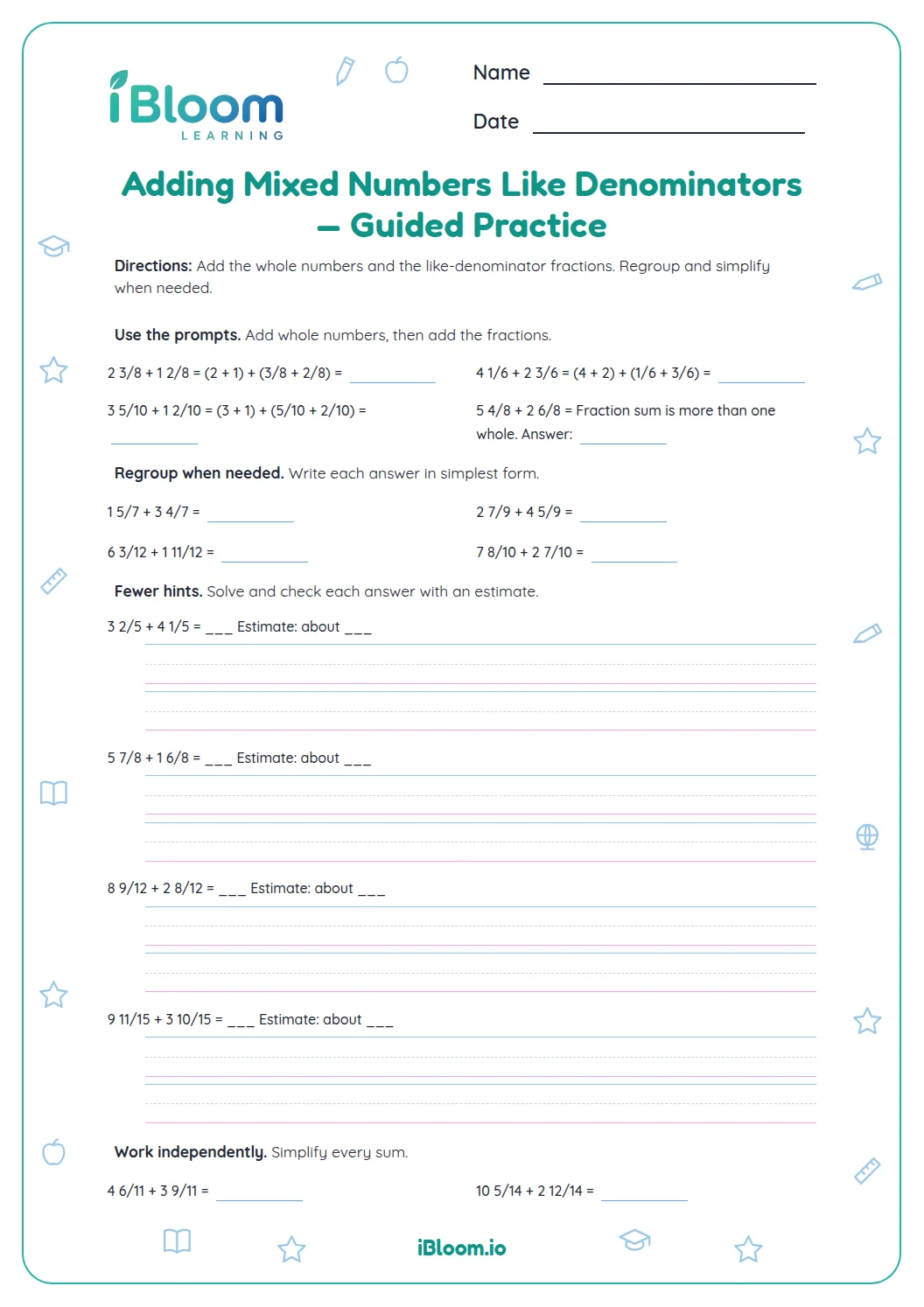
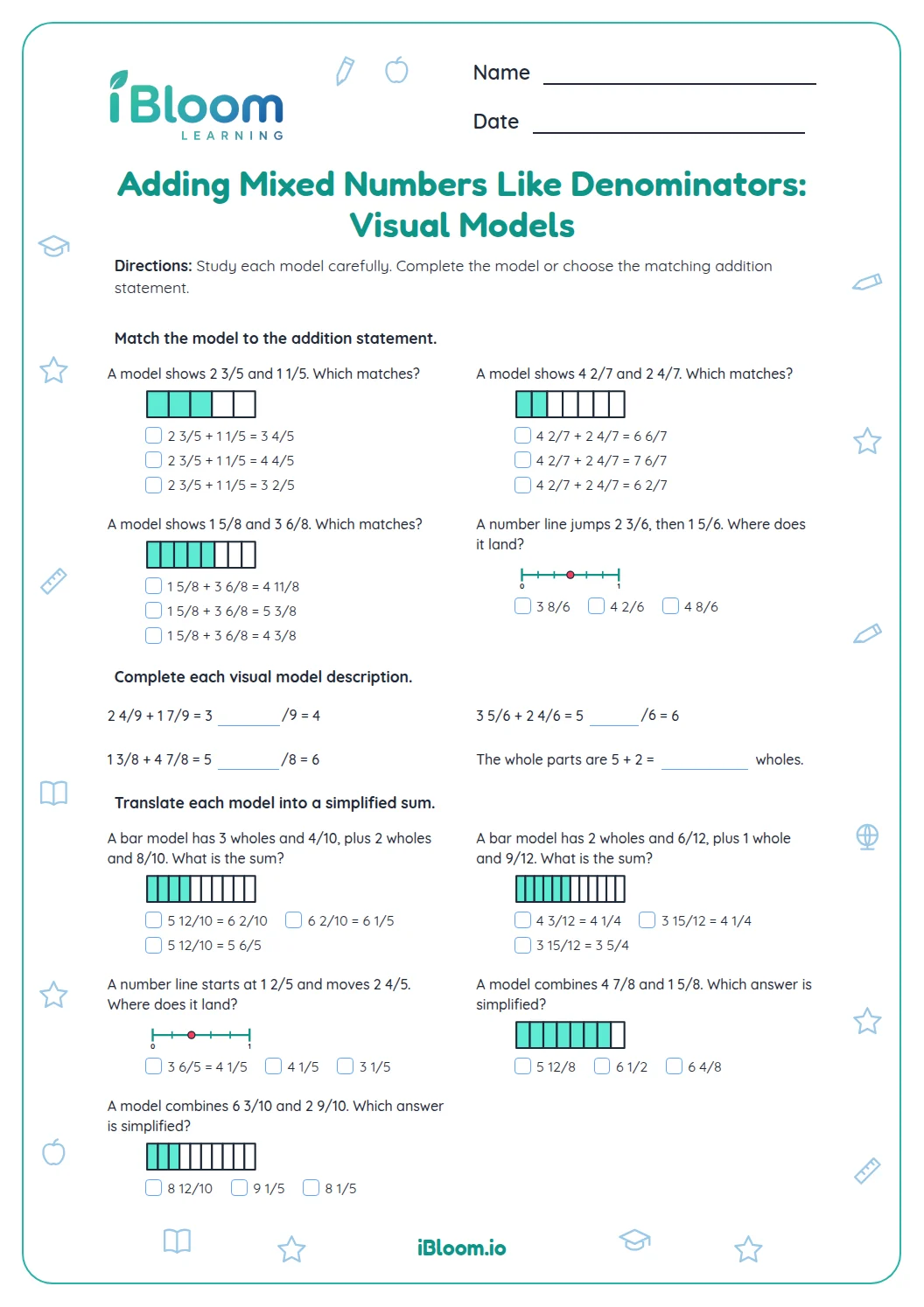
When the fractional parts have the same denominator, add their numerators and keep the denominator. For 2 3/8 + 1 6/8, add 3/8 + 6/8 = 9/8, then regroup 9/8 as 1 1/8. Add the whole numbers and the regrouped whole to get 4 1/8. This worksheet moves from short sums to distance, recipe, reading, and measurement contexts.
Aligned to 5.NF.A.1
How do you add mixed numbers with like denominators?
Add the whole-number parts, then add the numerators while keeping the shared denominator. In question 1, 2/7 + 3/7 = 5/7, so the total is 3 5/7.
- 11 2/7 + 2 3/7
- 21 + 2 = 3; 2/7 + 3/7 = 5/7
- 3Total: 3 5/7
What changes when the fraction sum reaches one whole?
Trade one denominator’s worth of fractional parts for a whole. For question 3, 5/8 + 6/8 = 11/8 = 1 3/8; add that regrouped whole to the whole-number sum.
- Keep the denominator because the pieces are the same size.
- Simplify the remaining fraction when possible.
How do students use addition in the stories?
Part B asks for totals in miles, cups, and chapters; Part C adds capacities and lengths. Students choose addition from the story and include its stated unit in the answer.
How to use this worksheet
- 1Add the whole-number parts.
- 2Add the numerators and keep the shared denominator.
- 3If the numerator total reaches the denominator, regroup that fraction as one whole.
- 4Simplify any fraction that can be reduced.
- 5Estimate the total and check that each story answer includes its unit.
Common mistakes and quick fixes
The mistake
Adding denominators, as in 2/8 + 3/8 = 5/16.
The fix
The eighth-size pieces stay eighths; add only the numerators.
The mistake
Leaving 9/8 as the fractional part of a mixed-number answer.
The fix
Trade 8/8 for one whole and keep the leftover eighth.
The mistake
Adding the fractions but forgetting the whole-number parts.
The fix
Add whole numbers and fractional parts, then combine the totals.
Curriculum alignment
This worksheet practices the named skill through models, short responses, and independent application.
Add mixed numbers when their fractional parts already share a denominator.
On this sheet: Students add mixed numbers with like denominators, including regrouping and story totals.
Show the official wordingHide the official wording
Add and subtract fractions with unlike denominators (including mixed numbers) by replacing given fractions with equivalent fractions in such a way as to produce an equivalent sum or difference of fractions with like denominators.
What to practice next
Make more practice
Further reading
Questions parents and teachers ask
What does “like denominators” mean?
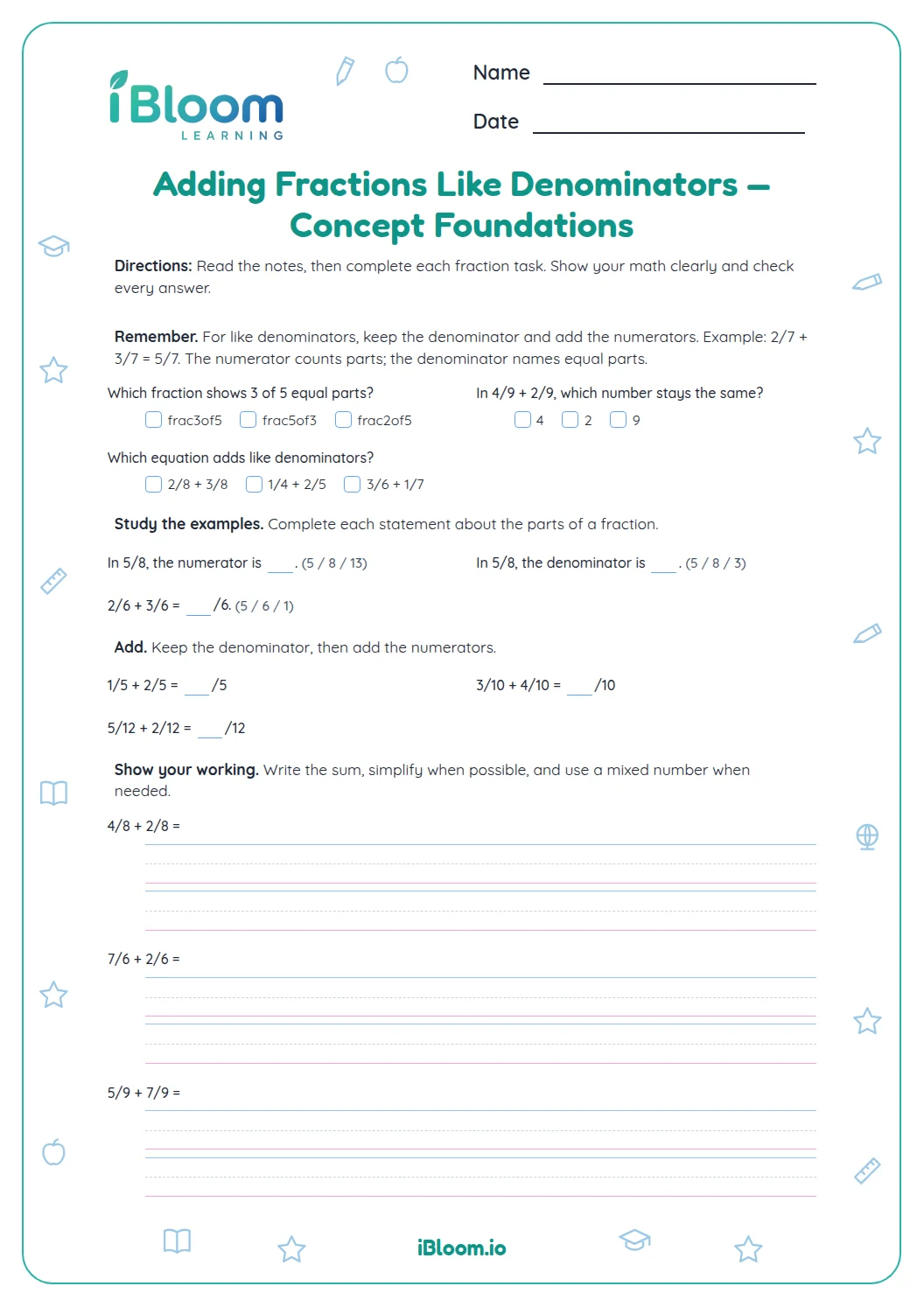
The fractions have the same denominator, so they name pieces of the same size. In 2/7 + 3/7, both fractions use sevenths. Add the numerators and keep 7 as the denominator. The examples keep the denominator the same throughout each sum.
How do students regroup a mixed-number sum?
When the numerator total equals or exceeds the denominator, trade one denominator’s worth of fractional parts for a whole. For example, 3/8 + 6/8 = 9/8 = 1 1/8. The examples keep the denominator the same throughout each sum. That check helps students see whether the total is a reasonable mixed number.
What is the answer to 2 5/8 + 3 6/8?
Add the whole numbers to get 5. Then 5/8 + 6/8 = 11/8, or 1 3/8. Combine those results for 6 3/8. The examples keep the denominator the same throughout each sum. That check helps students see whether the total is a reasonable mixed number.
Should students simplify their answers?
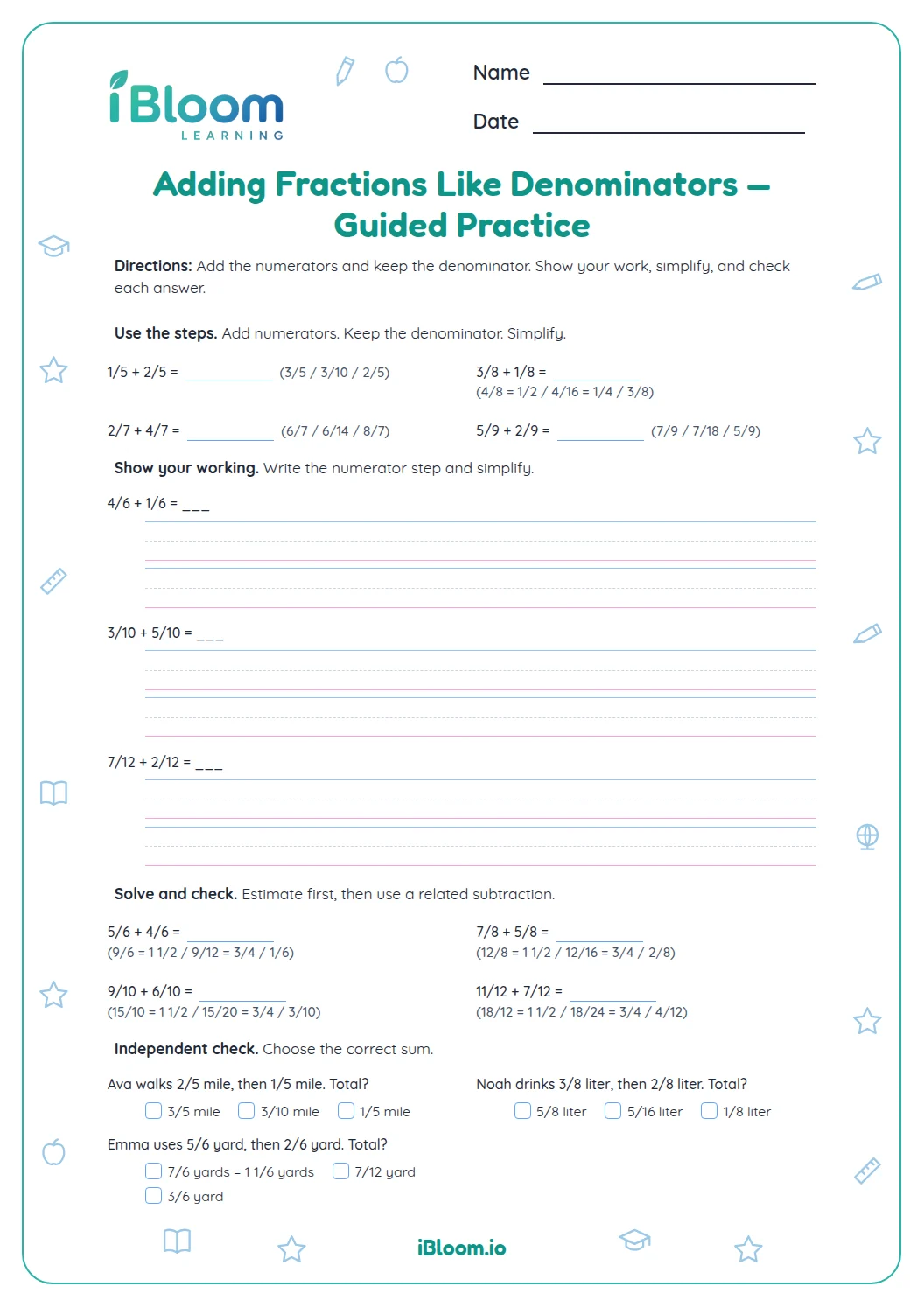
Yes, when the fractional part can be reduced. Keep the mixed number’s whole part, then divide the numerator and denominator by a common factor. The answer key shows simplified forms for the worksheet sums. The examples keep the denominator the same throughout each sum.
How should a student solve the story problems?
Identify both quantities, add them, and write the unit in the answer. A hiker who walks 2 3/5 miles and then 1 1/5 miles travels 3 4/5 miles altogether. The examples keep the denominator the same throughout each sum. That check helps students see whether the total is a reasonable mixed number.
Does the page include an answer key?
Yes. The key is separate from the two worksheet pages and lists each mixed-number sum. For story questions, it includes the total with the requested unit so an adult can check the response. The examples keep the denominator the same throughout each sum.