





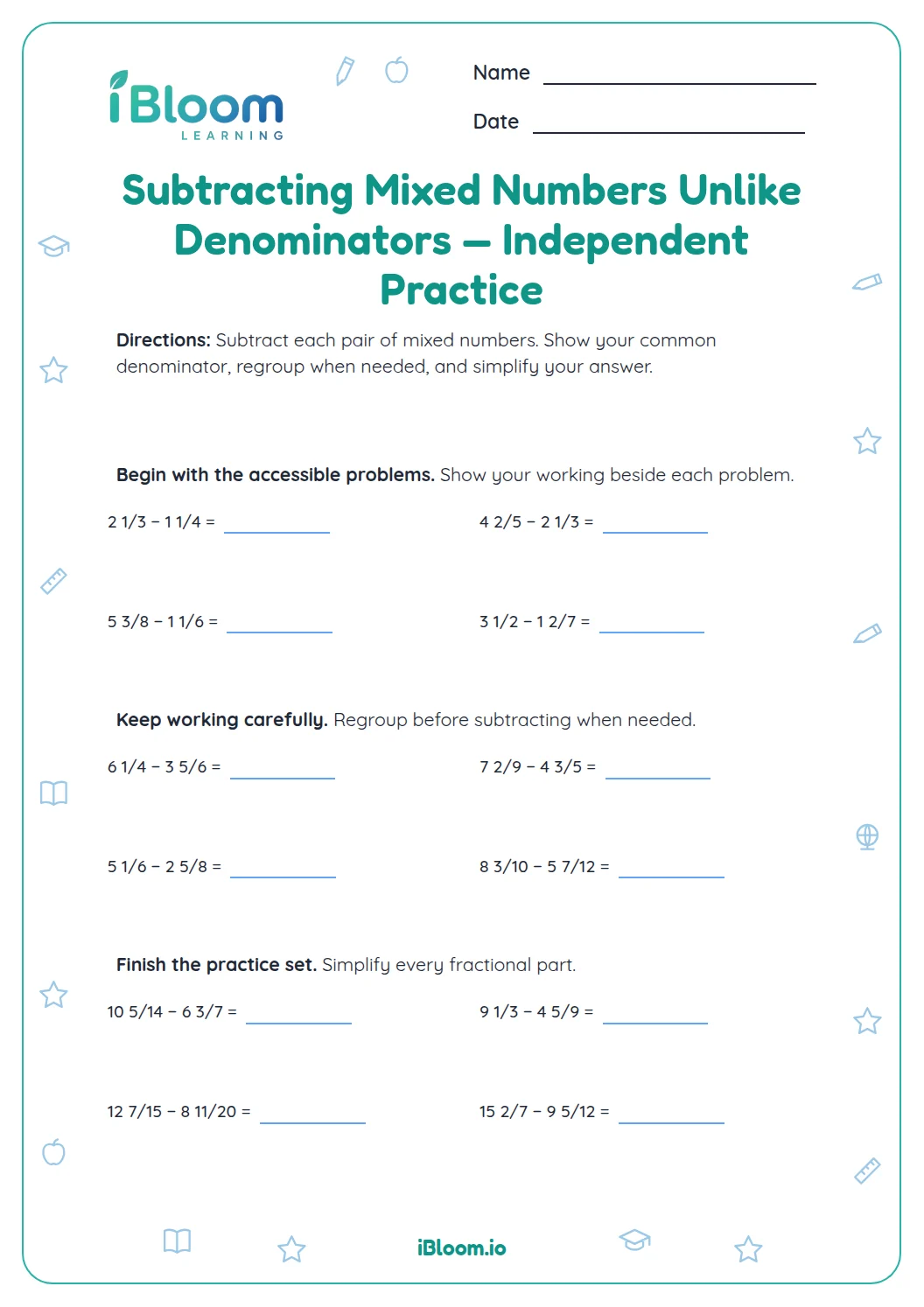


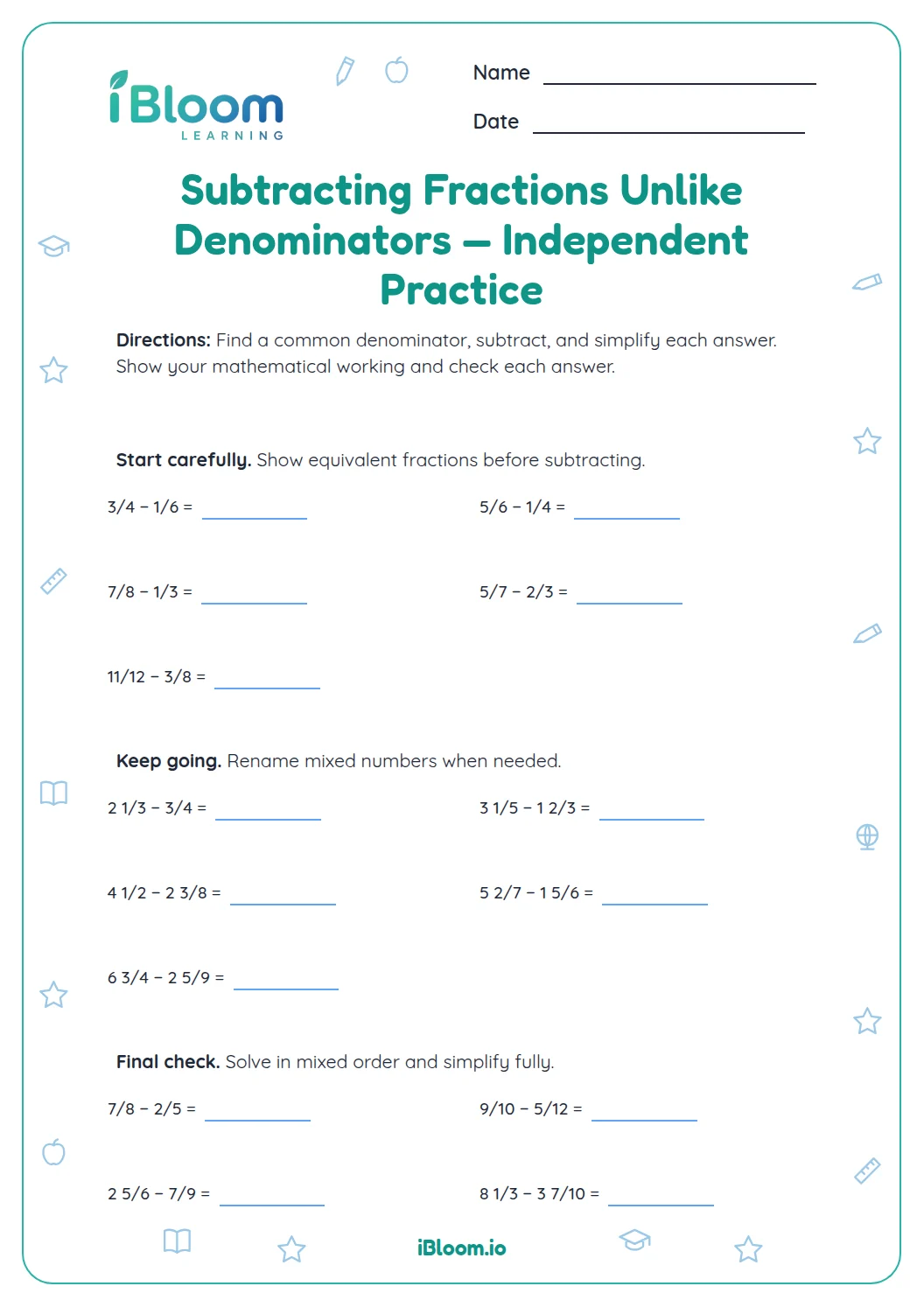
About this worksheet
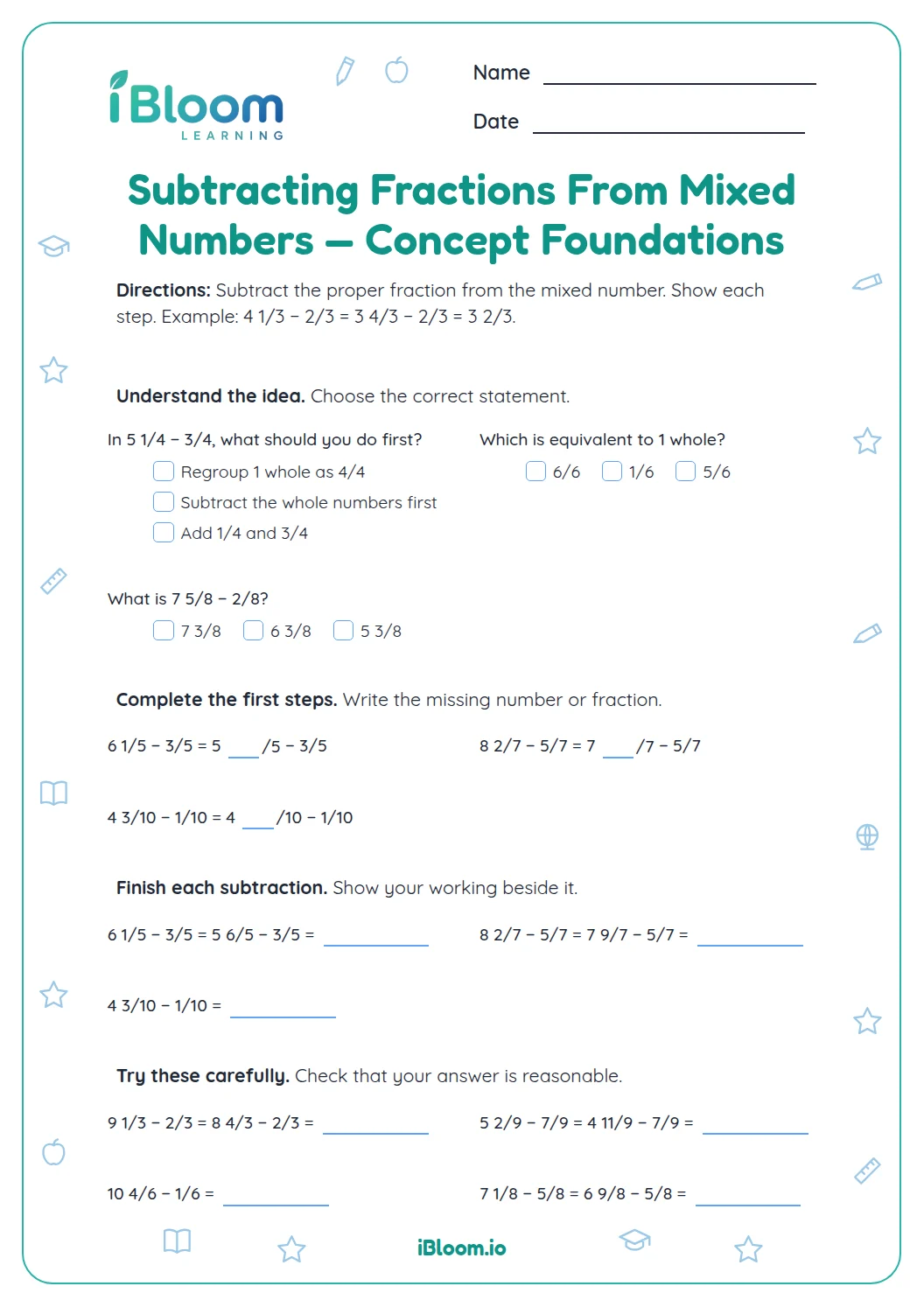
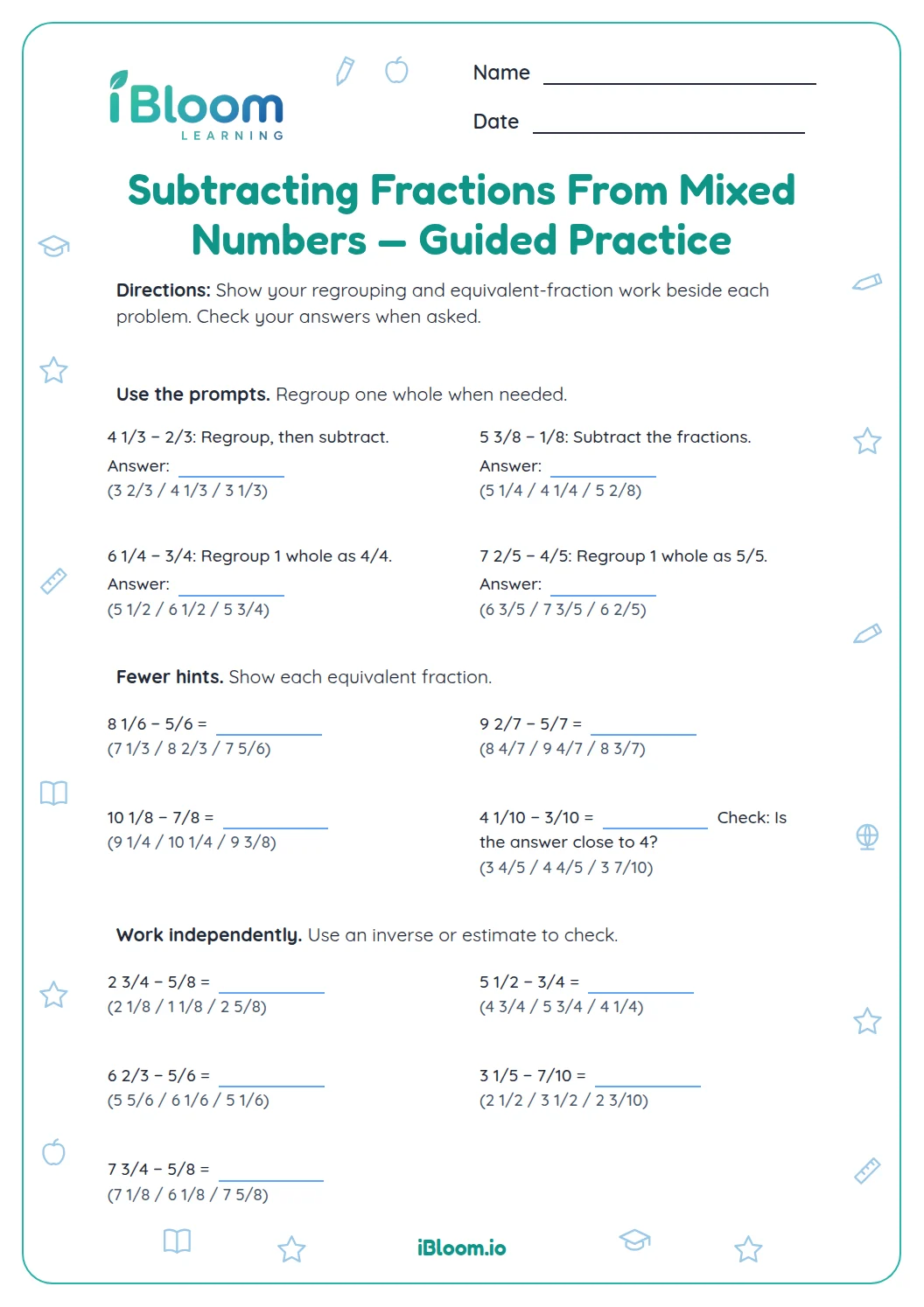
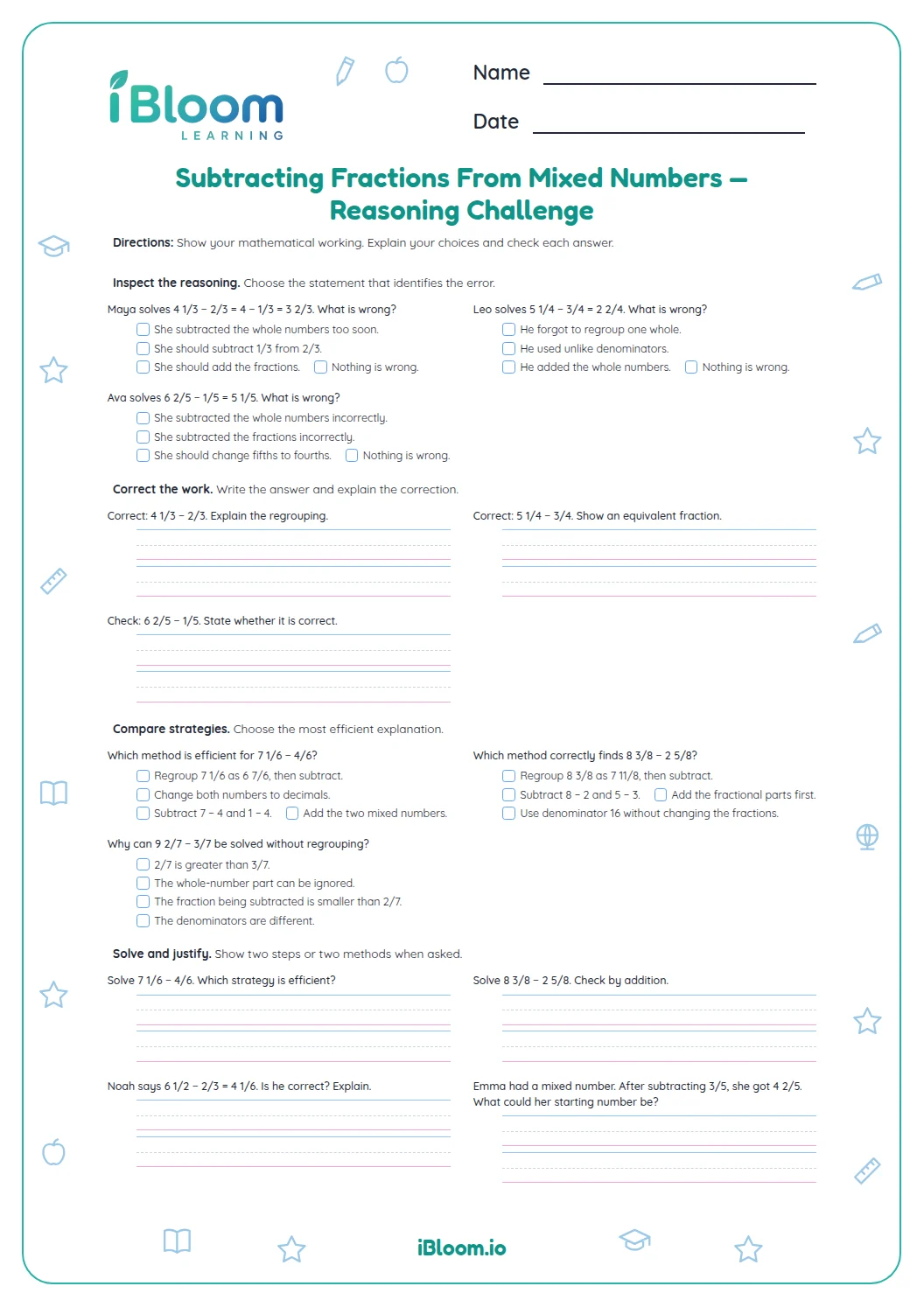
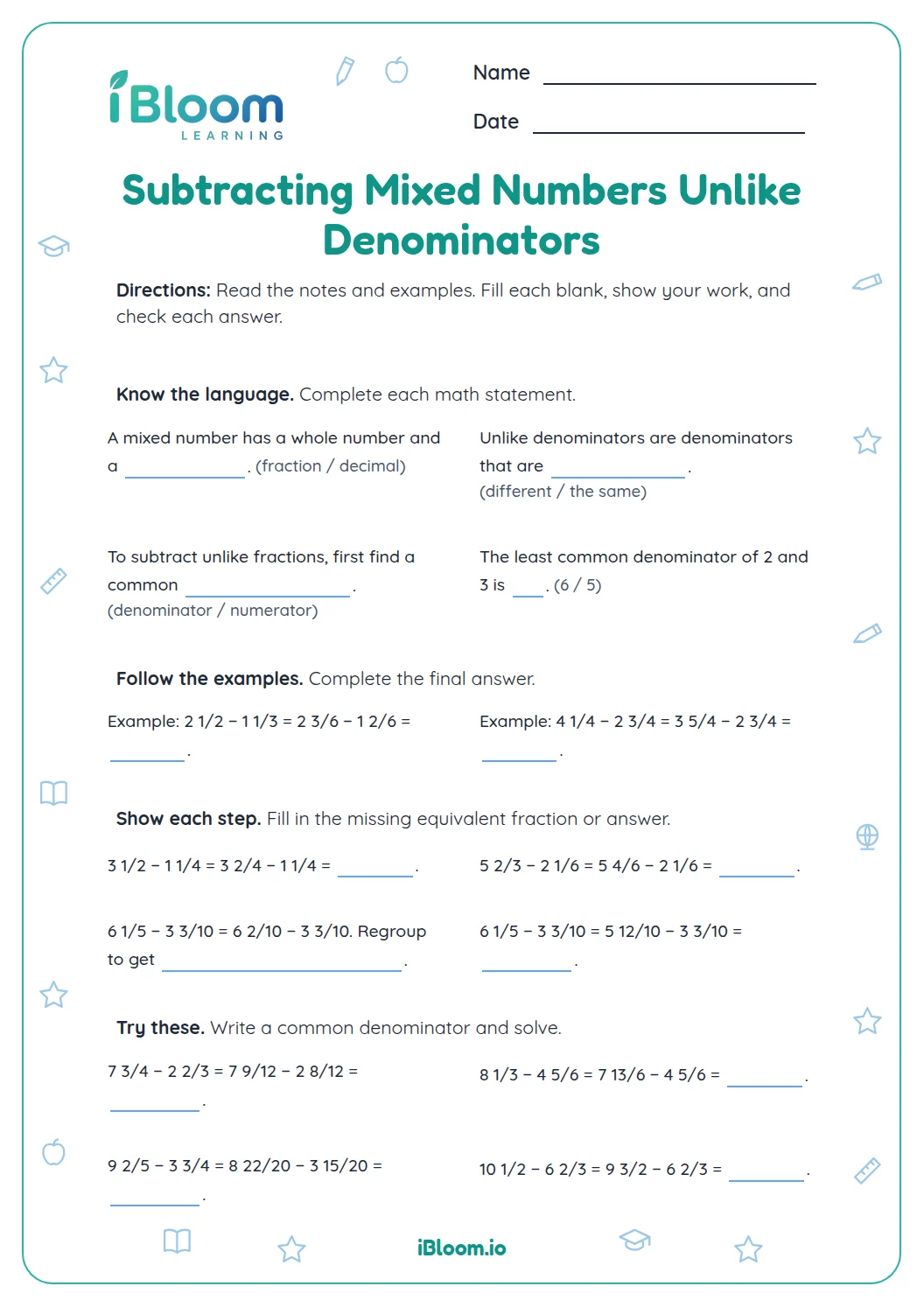
This Grade 5 worksheet uses shaded fraction models to practice subtracting a fraction from a mixed number. Six problems begin with like denominators, five focus on renaming, and five use unlike denominators. Each prompt has a model, and a separate answer key lists simplified results. It aligns with Common Core 5.NF.A.1.
Aligned to 5.NF.A.1
How do visual models help subtract from a mixed number?
This Grade 5 worksheet uses shaded fraction models to practice subtracting a fraction from a mixed number. Six problems begin with like denominators, five focus on renaming, and five use unlike denominators. Each prompt has a model, and a separate answer key lists simplified results. It aligns with Common Core 5.NF.A.1.
- 12 1/4 = 2 2/8
- 22 2/8 − 3/8 = 1 10/8 − 3/8
- 3= 1 7/8
What will learners practice?
Six models show like-denominator subtraction, five practice renaming, and five use equivalent fractions to subtract unlike parts.
How can I use the answer key?
Check each answer after the learner completes the page. For written responses, use the sample as a guide; other clear answers that meet the prompt are valid.
How to use this worksheet
- 1Read the shaded whole shapes and fractional parts.
- 2Check whether the denominators match.
- 3Rename with equivalent fractions if needed.
- 4Regroup one whole when the top fraction is too small.
- 5Simplify the final fraction or mixed number.
Common mistakes and quick fixes
The mistake
Subtracting denominators as well as numerators.
The fix
Rename to like denominators, then subtract only the numerators.
The mistake
Forgetting a whole when regrouping.
The fix
Rewrite one whole as a fraction with the same denominator.
The mistake
Leaving an equivalent but unsimplified answer.
The fix
Divide numerator and denominator by their common factor.
Common Core alignment
The models support fraction subtraction by making equivalent fractions and regrouping visible.
Add and subtract fractions by replacing them with equivalent fractions.
On this sheet:
Show the official wordingHide the official wording
Add and subtract fractions with unlike denominators (including mixed numbers) by replacing given fractions with equivalent fractions in such a way as to produce an equivalent sum or difference of fractions with like denominators. For example, 2/3 + 5/4 = 8/12 + 15/12 = 23/12. (In general, a/b + c/d = (ad + bc)/bd.)
What to practice next
Make more practice
Further reading
Questions parents and teachers ask
What does this worksheet practice?
It gives 16 shaded fraction models for subtracting a fraction from a mixed number. Learners work with like denominators, rename when needed, and use equivalent fractions for unlike denominators. The separate answer key lists simplified results for checking. The model and equation should name the same amount.
How do you solve 2 1/4 minus 3/8?
Rename 1/4 as 2/8, so 2 1/4 becomes 2 2/8. Regroup one whole as 8/8: 1 10/8 − 3/8 = 1 7/8. The model helps show why regrouping is needed before subtracting the fractional parts. Keep the denominator tied to the size of each part.
Why do the models show whole shapes and fractional parts?
The complete shapes represent the whole-number part, while the divided shape shows equal fractional parts. Together they show the amount being subtracted and what remains. Learners can connect those shaded amounts to the numbers in each expression. This also helps confirm the answer is reasonable.
What does “unlike parts” mean here?
The fractions have different denominators, such as fourths and eighths. Rewrite them as equivalent fractions with a shared denominator before subtracting. Then subtract the numerators while keeping the common denominator and simplify the result when possible. A common denominator makes the fractional units equal.
Should answers be simplified?
Yes. Write each result as a simplified mixed number when it is greater than one, or as a simplified fraction when the remaining amount is less than one. The answer key shows simplified results so learners can compare equivalent forms.
How should the answer key be used?
The key gives the simplified difference for each model. Ask the learner to point to the whole and fractional parts in the model and explain any renaming used. This connects the written calculation to the shaded amounts rather than checking a number alone.