







About this worksheet
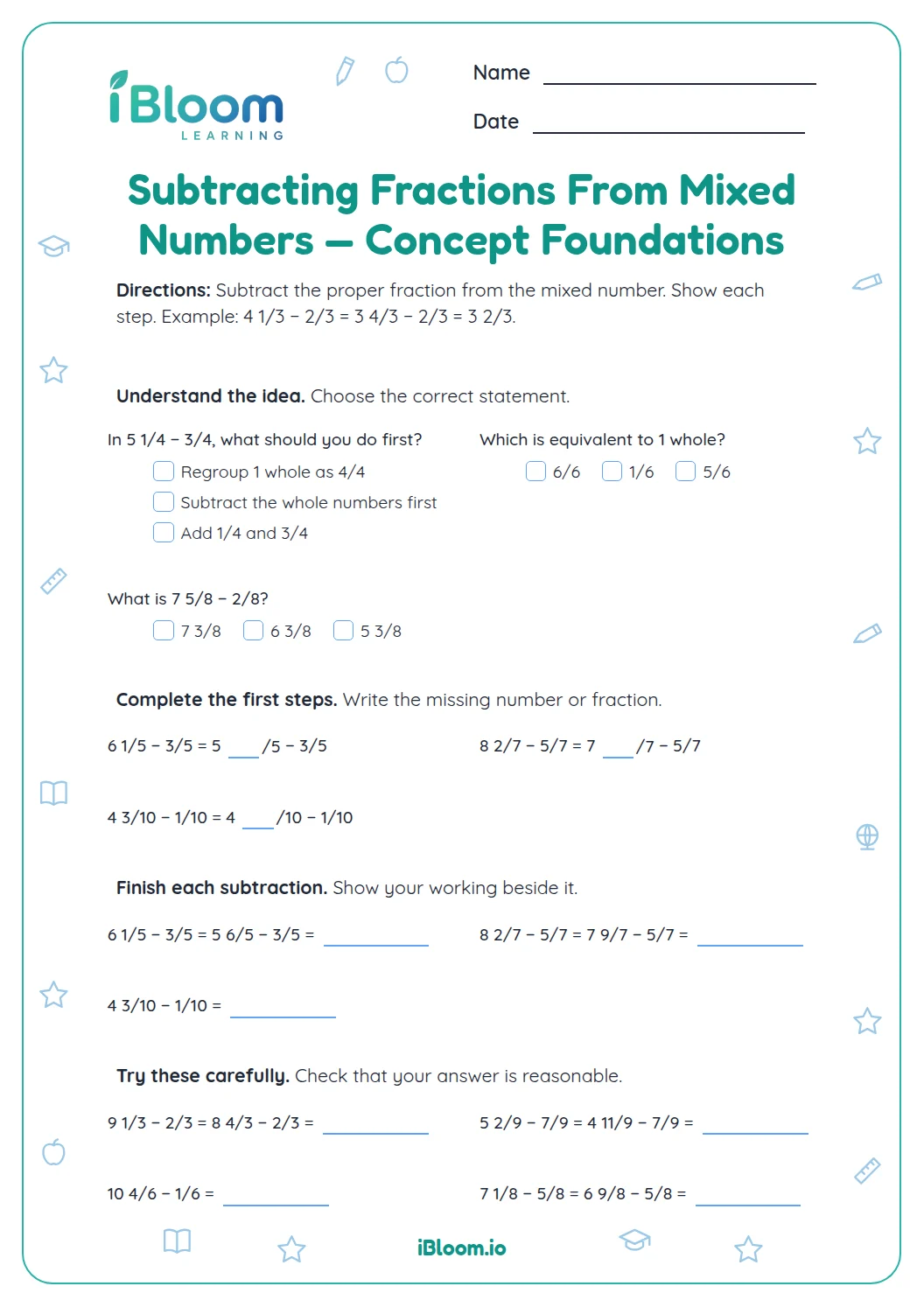
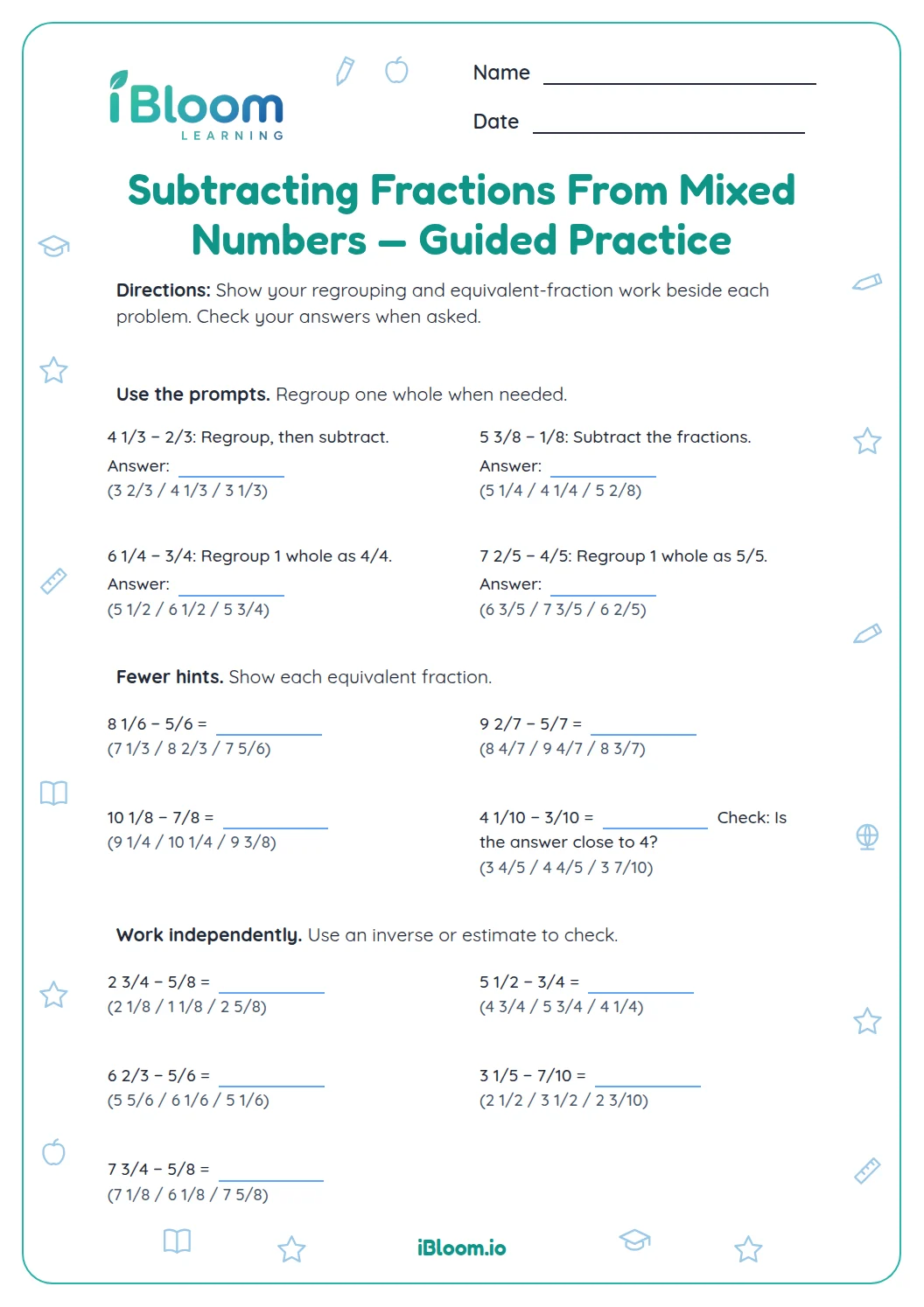
This free printable worksheet gives Grade 5 students focused practice subtracting mixed numbers with like denominators. The 14 questions move from subtraction without regrouping to problems where one whole must be renamed as equal fraction parts, then finish with four real-world questions. The work practices CCSS 4.NF.B.3.c, which names subtraction of mixed numbers with like denominators. A separate answer key is included for checking each calculation.
Aligned to 4.NF.B.3.c
What stays the same when the denominators match?
The fractional parts name pieces of the same size, so subtract their numerators and keep the denominator. Then subtract the whole-number parts. Simplify the fractional part when it can be reduced.
Question 1 is 3 5/8 − 1 2/8. Subtract 5/8 − 2/8 = 3/8 and 3 − 1 = 2, so the difference is 2 3/8.
- 13 5/8 − 1 2/8
- 25/8 − 2/8 = 3/8
- 33 − 1 = 2
- 4Difference: 2 3/8
When do you need to regroup a mixed number?
Regroup when the fraction you are subtracting is larger than the starting fraction. Trade 1 whole for the same number of fraction parts as the denominator. For question 6, 5 1/4 becomes 4 5/4. Then 5/4 − 3/4 = 2/4 and 4 − 2 = 2, giving 2 1/2.
The value stays the same during the trade: 5 1/4 and 4 5/4 are equal. Reduce 2/4 to 1/2 in the final answer.
How can subtraction answer a measurement story?
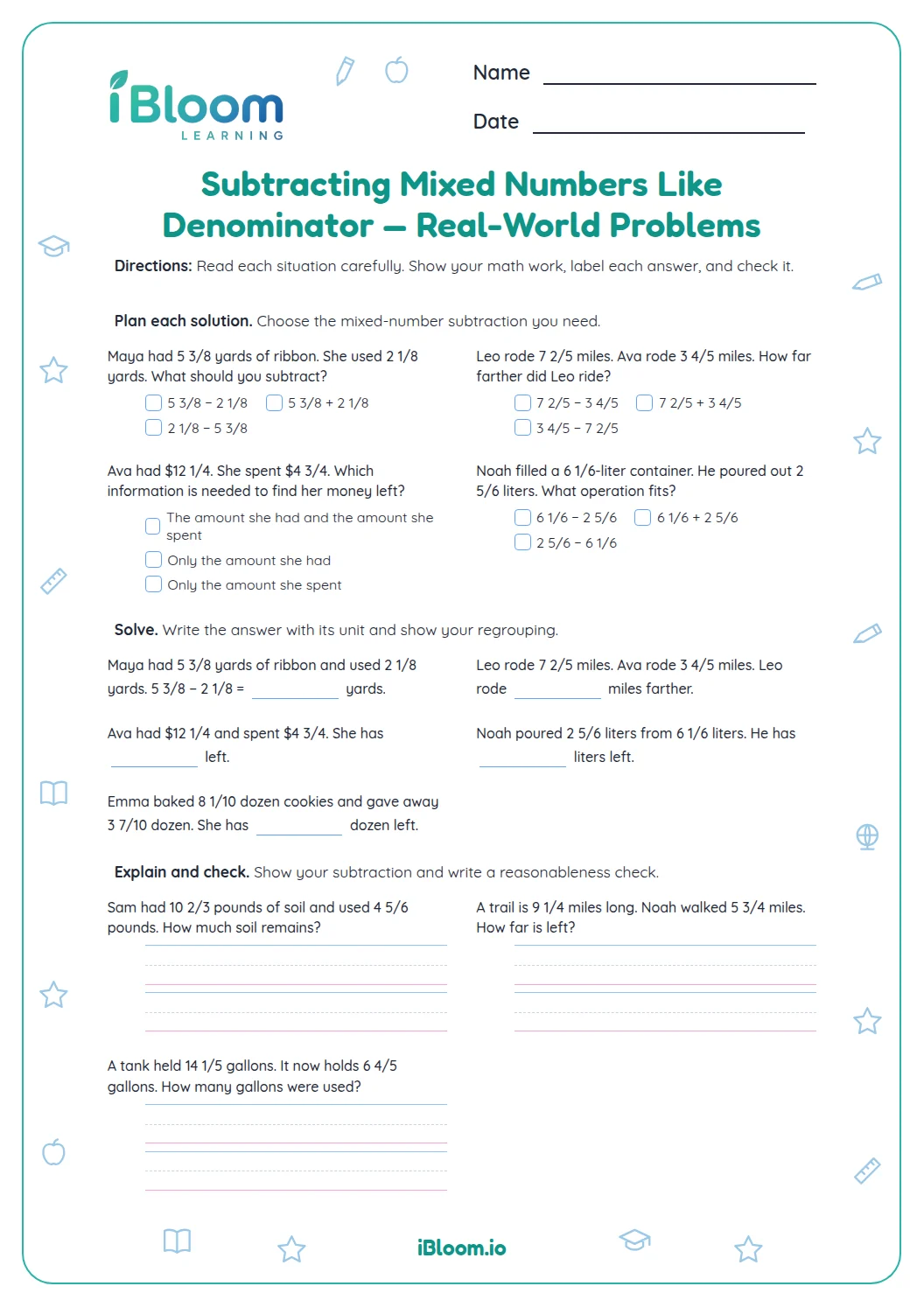
Identify the starting amount and the amount taken away, then subtract. Keep the unit from the story in the answer. In question 11, subtract 2 7/8 yards from 6 3/8 yards. Regroup 6 3/8 as 5 11/8; 11/8 − 7/8 = 4/8, and 5 − 2 = 3. The ribbon left is 3 1/2 yards.
What is included in the printable?
There are 14 questions in three parts across two worksheet pages, followed by two separate answer key pages. Part A has five examples without regrouping, Part B has five regrouping examples, and Part C has four word problems about lengths, distance and volume.
How to work through the sheet
- 1Read the denominators first and check that both fractional parts name equal-sized pieces.
- 2In Part A, subtract the fraction numerators and keep the denominator, then subtract the whole numbers.
- 3In Part B, when the first numerator is smaller, trade 1 whole for fraction parts equal to the denominator.
- 4Reduce the fraction in the difference when possible, such as changing 2/4 to 1/2.
- 5In Part C, write the starting amount minus the amount taken away, solve, and include the unit.
- 6Use the answer key to check both the regrouping and the final value.
Common mistakes and quick fixes
The mistake
Subtracting the smaller numerator from the larger one even when that reverses the order.
The fix
Regroup one whole first, then subtract the fraction parts in the order shown.
The mistake
Changing the denominator while subtracting, such as turning fifths into tenths without a reason.
The fix
Keep the common denominator; only the numerator changes when subtracting like fractions.
The mistake
Forgetting to reduce 4/8 or 2/4 in a mixed-number answer.
The fix
Check whether numerator and denominator share a factor, then write the equivalent simpler fraction.
Common Core alignment
This worksheet practices subtracting mixed numbers with like denominators.
Subtract mixed numbers with like denominators by using equivalent fractions or operation properties.
On this sheet: All 12 number problems and four story problems subtract mixed numbers with like denominators.
Show the official wordingHide the official wording
Add and subtract mixed numbers with like denominators, e.g., by replacing each mixed number with an equivalent fraction, and/or by using properties of operations and the relationship between addition and subtraction.
What to practice next
Make more practice
Further reading
Questions parents and teachers ask
How do you subtract mixed numbers with the same denominator?
Subtract the fractional numerators and keep the denominator, then subtract the whole numbers. If the first fraction is smaller, rename one whole as fraction parts before subtracting. The worksheet begins with five examples that do not need regrouping, then gives five where regrouping is needed.
What does regrouping mean in a mixed-number subtraction problem?
Regrouping means trading one whole for an equal number of fraction parts. In question 6, 5 1/4 becomes 4 5/4 because one whole equals 4/4. Then the fractional subtraction is possible: 5/4 − 3/4 = 2/4, which simplifies to 1/2.
Why does the denominator stay the same?
The denominator names the size of the pieces. When both numbers use fourths, subtracting fourths still gives fourths; only the number of pieces changes. For example, 5/4 − 3/4 = 2/4. The result can then be simplified to an equivalent fraction such as 1/2.
Do students need to simplify their answers?
Yes, simplify when the numerator and denominator have a common factor. For example, 4/8 reduces to 1/2 and 2/4 reduces to 1/2. Keep the original denominator while subtracting, then check the fractional part in the difference and write its simplest equivalent form.
What kinds of word problems are on the sheet?
Part C has four subtraction stories about ribbon length, a hiking trail, juice and a board. Each gives a starting mixed number and an amount removed. Students subtract the quantities and include the measurement unit in the answer.
Is an answer key included?
Yes. The printable includes two separate answer key pages for all 14 questions. It gives the simplified mixed-number differences and the units for the four story problems, so an adult or student can check each result and review any regrouping step.