





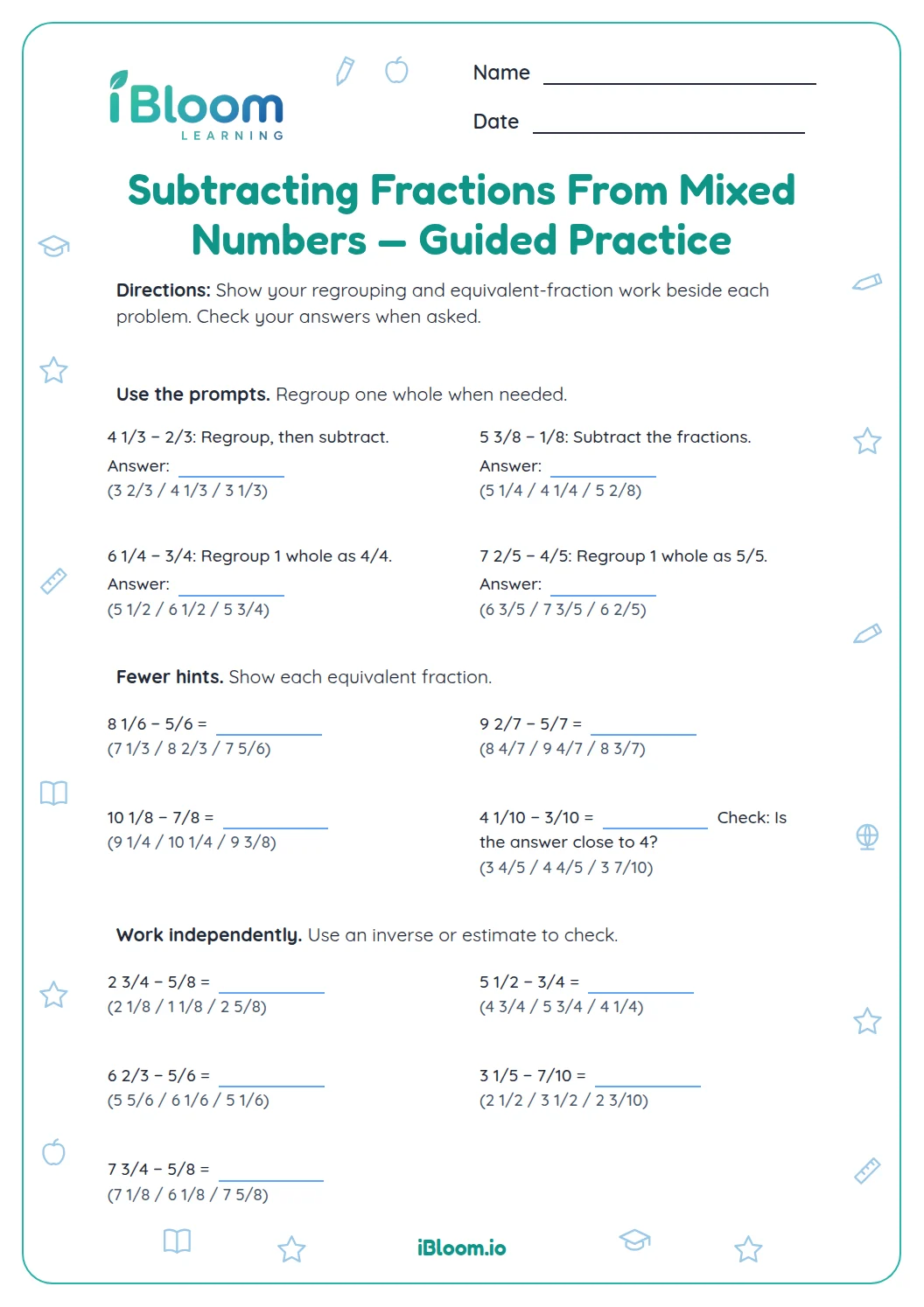

About this worksheet
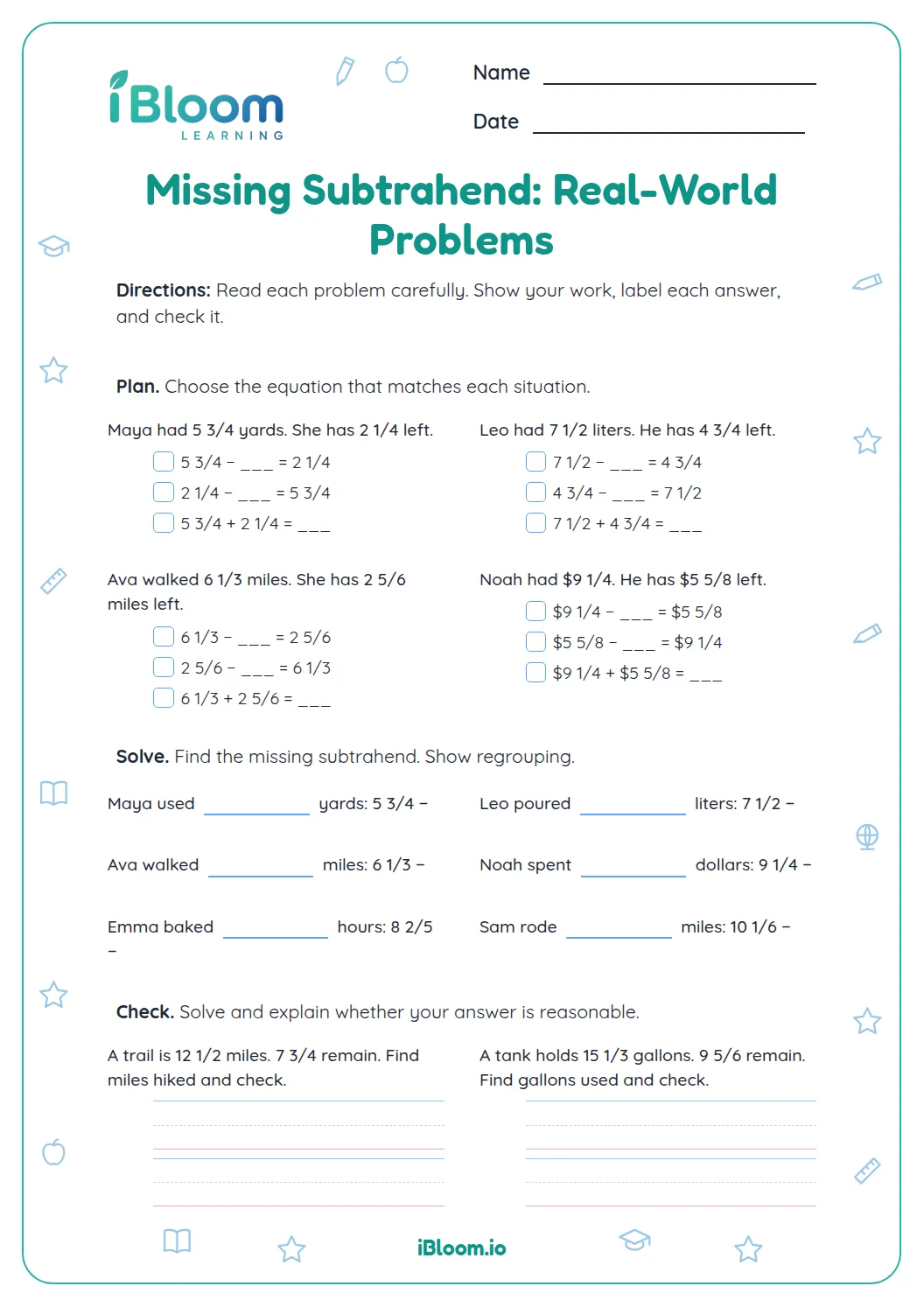
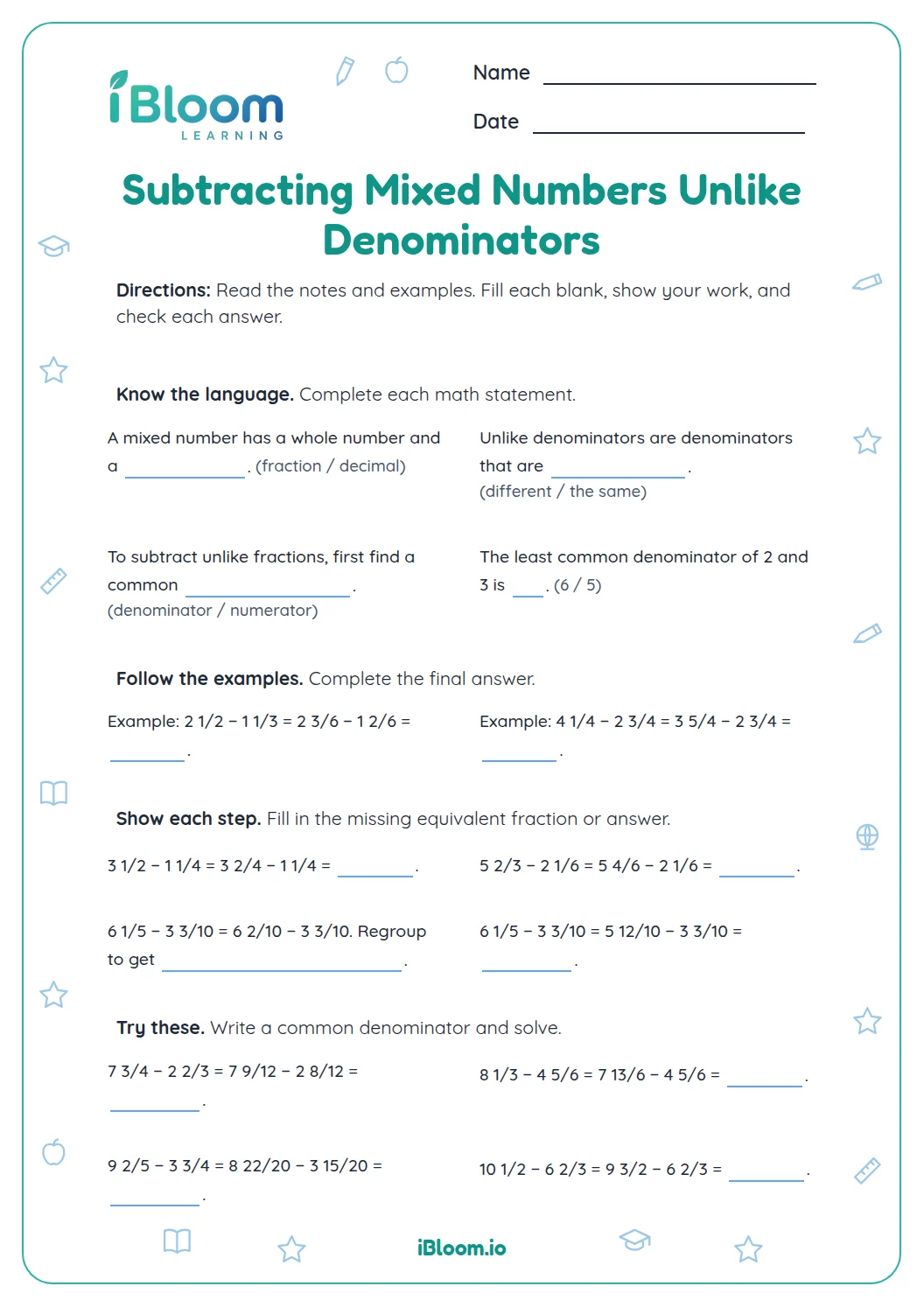
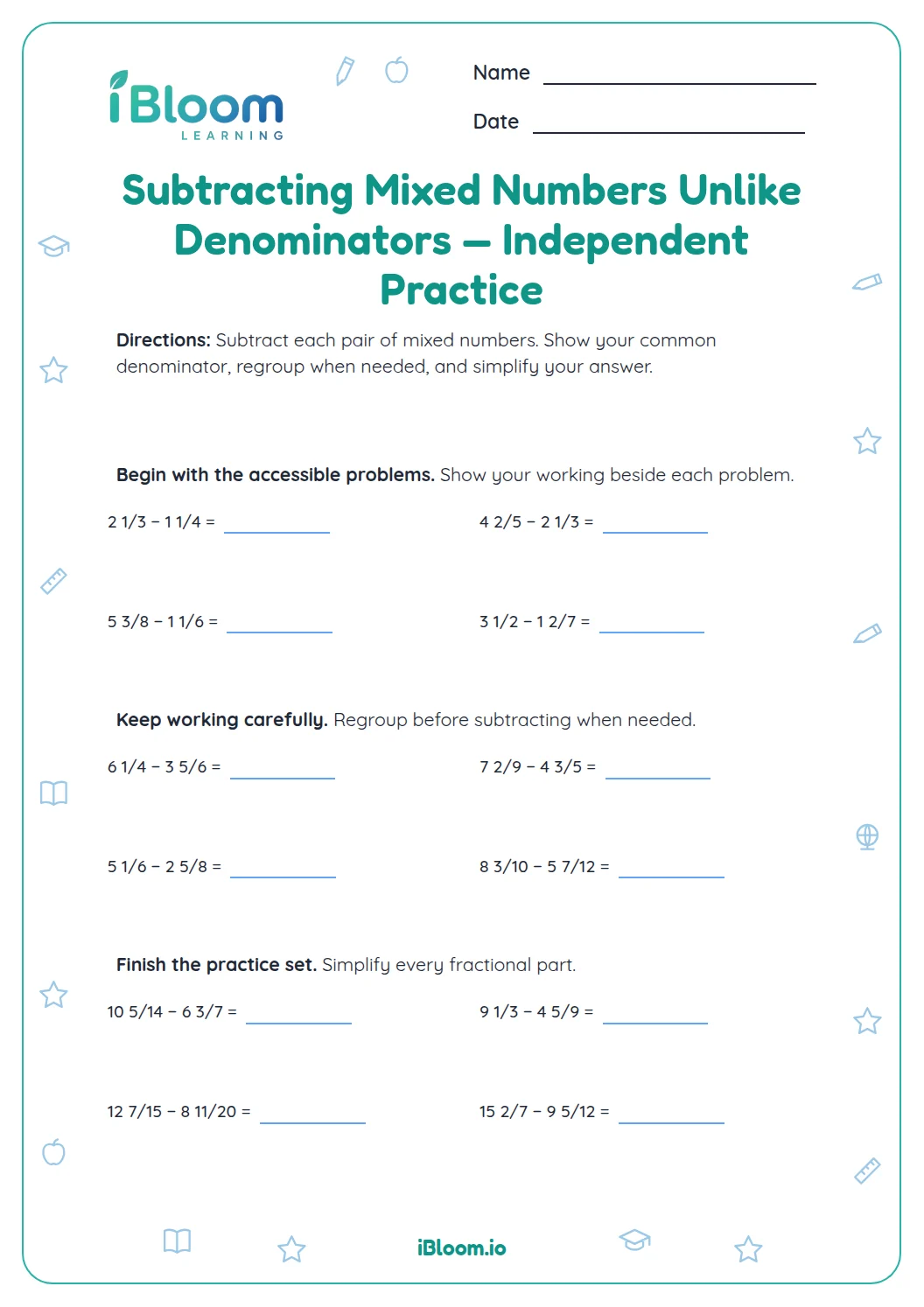
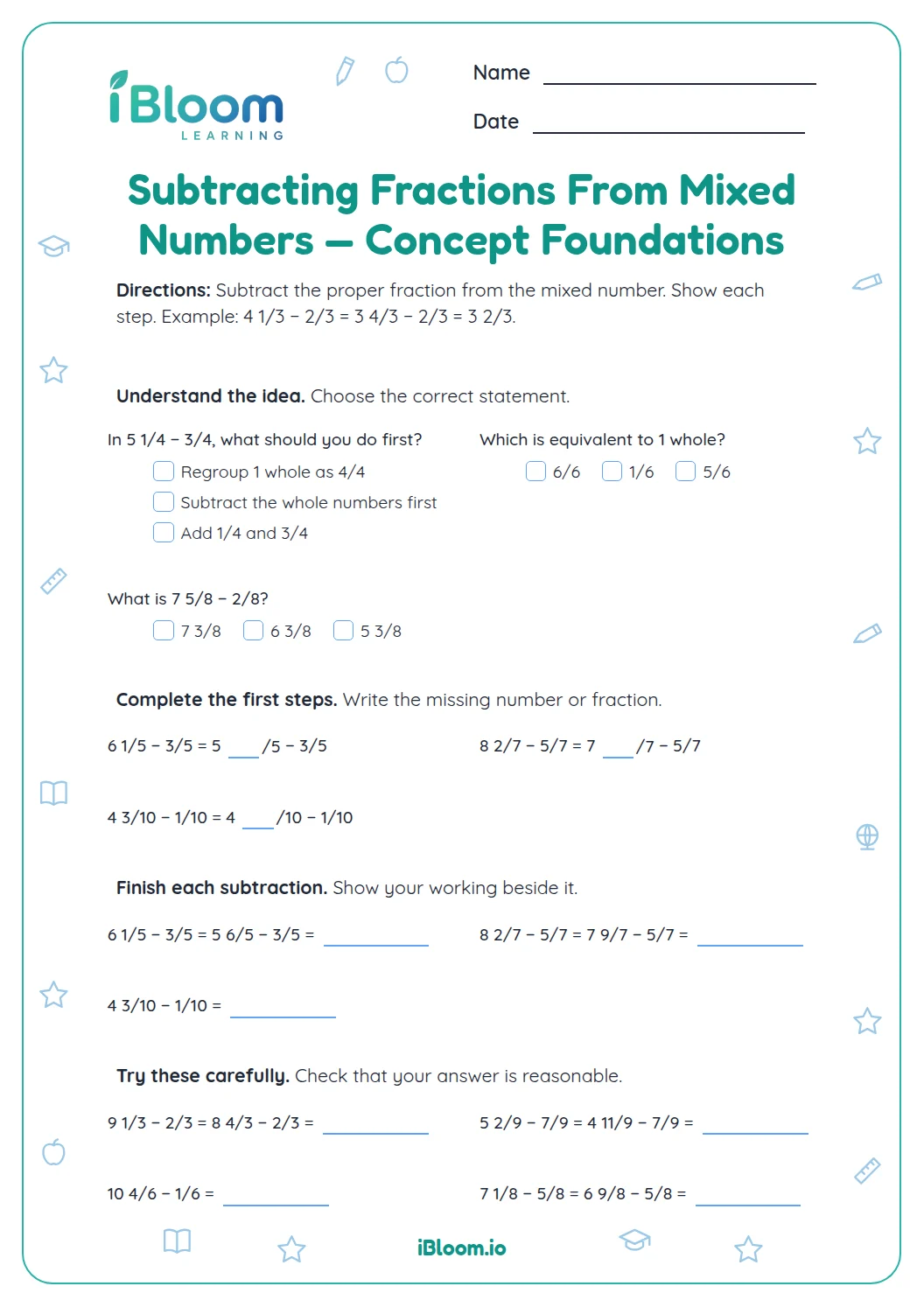
This Grade 5 worksheet gives students practice finding a missing subtrahend in mixed-number subtraction. Part A uses equations with familiar denominators; Part B applies the same relationship to measurement stories; Part C returns to equations with regrouping and unlike denominators. Students can check each result by adding the subtrahend to the difference. The practice aligns with CCSS 5.NF.A.1, which includes adding and subtracting fractions with unlike denominators and mixed numbers. A separate answer key shows the simplified answers.
Aligned to 5.NF.A.1
What will students practice?
The first part asks students to solve for the missing amount in subtraction equations. The story problems then connect the same relationship to lengths and amounts. The final equations include regrouping across mixed-number parts.
Answers are written in simplest form. Keep the whole number and fractional part together when reporting a mixed number.
- 13 1/4 − ___ = 1 3/4
- 2Subtract: 3 1/4 − 1 3/4 = 1 1/2
- 3Check: 1 1/2 + 1 3/4 = 3 1/4
How does subtraction reveal the missing amount?
In a subtraction equation, the first number is the total before something is taken away. The difference is what remains. The missing subtrahend is the amount removed, so subtract the remaining amount from the starting total.
For a story, identify the starting amount and the amount that remains or was used. Then write a subtraction equation before calculating.
How can students check each answer?
Add the answer to the difference. The sum should equal the starting mixed number. If the fractions have different denominators, rename them with a common denominator before adding or subtracting. Reduce the final fraction when possible.
How to solve the problems
- 1Read the equation or story and identify the starting amount and the difference.
- 2Subtract the difference from the starting amount to find the missing subtrahend.
- 3Rename fractions with a common denominator when needed.
- 4Regroup one whole as a fraction if the fractional part is too small to subtract.
- 5Simplify the answer and check by adding it to the difference.
Common mistakes and quick fixes
The mistake
Subtracting the starting amount from the difference.
The fix
The subtrahend is the amount removed: starting amount minus remaining difference.
The mistake
Subtracting numerators while leaving unlike denominators unchanged.
The fix
Rename both fractions with a common denominator first.
The mistake
Forgetting to regroup when the starting fraction is smaller.
The fix
Trade one whole for an equivalent fraction, then subtract.
Common Core alignment
This page practices fraction operations named in the Grade 5 Common Core standard.
Subtract mixed numbers by finding equivalent fractions with like denominators.
On this sheet: Parts A and C require subtracting mixed numbers with unlike denominators.
Show the official wordingHide the official wording
Add and subtract fractions with unlike denominators (including mixed numbers) by replacing given fractions with equivalent fractions in such a way as to produce an equivalent sum or difference of fractions with like denominators. For example, 2/3 + 5/4 = 8/12 + 15/12 = 23/12. (In general, a/b + c/d = (ad + bc)/bd.)
What to practice next
Make more practice
Further reading
Questions parents and teachers ask
What is a subtrahend?
The subtrahend is the number being subtracted. In 3 1/4 − ___ = 1 3/4, the blank is the subtrahend because it is the amount taken from 3 1/4 to leave 1 3/4. Students can find it by subtracting the difference from the starting number.
How can I check a missing-subtrahend answer?
Add the missing subtrahend to the difference. The sum should equal the starting number. For question 1, 1 1/2 + 1 3/4 equals 3 1/4, so the missing value checks. This addition check is useful after both equation problems and word problems.
Why do some answers use unlike denominators?
The problem may use fractions with different denominators, so students rename them as equivalent fractions with a shared denominator before subtracting. The final fraction is reduced when possible. This keeps the size of each fractional part consistent during the calculation.
When should a student regroup a mixed number?
Regroup when the fractional part of the starting number is smaller than the fractional part being subtracted. Trade one whole for an equivalent fraction, then subtract the fractional parts. The final answer may need to be simplified or written as a mixed number.
What does Part B ask students to do?
Part B has three measurement stories about lengths and amounts. Students identify the starting quantity and the quantity left or used, write a subtraction equation, and solve it. Units stay with the answer so each result matches the story.