








About this worksheet
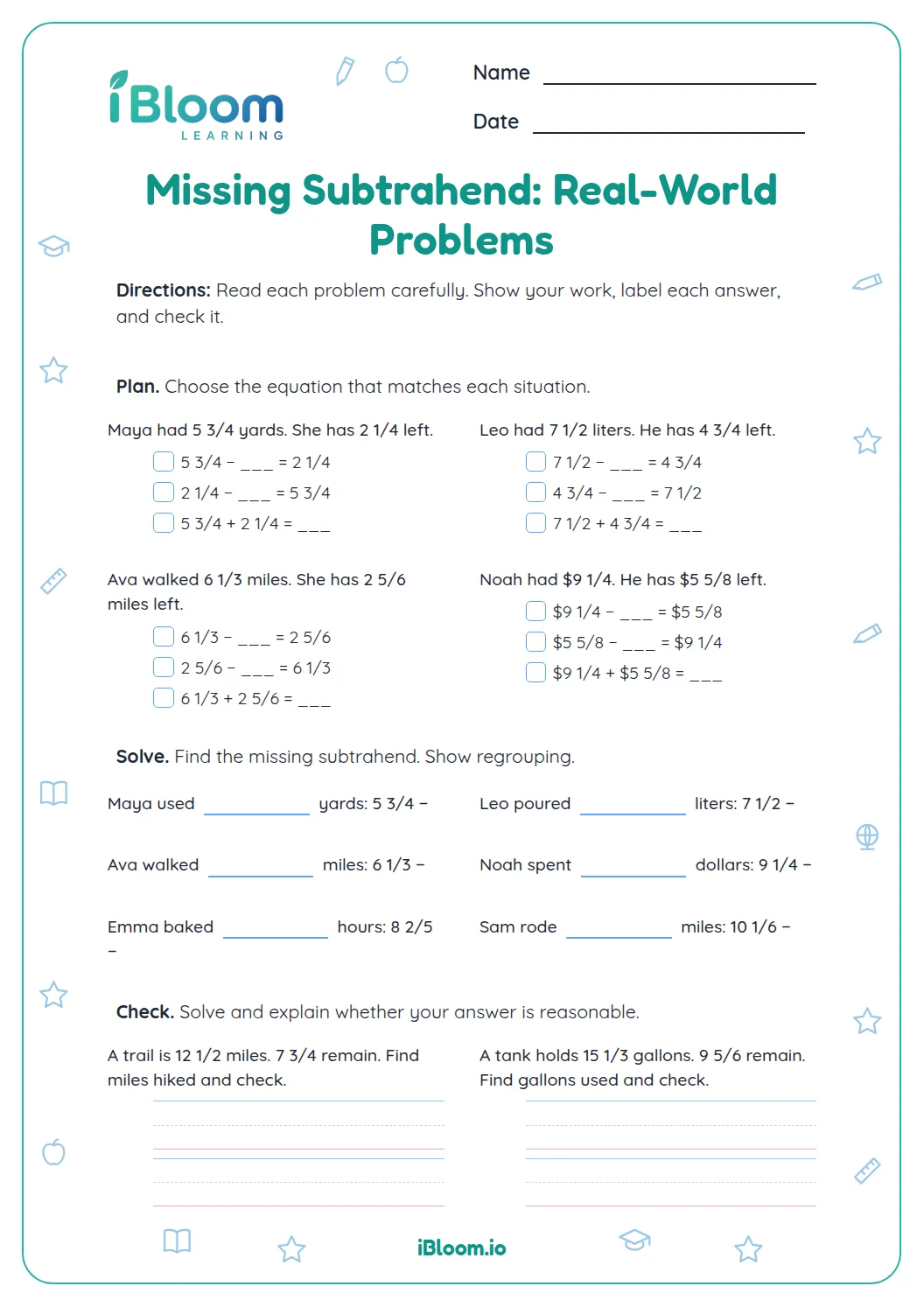
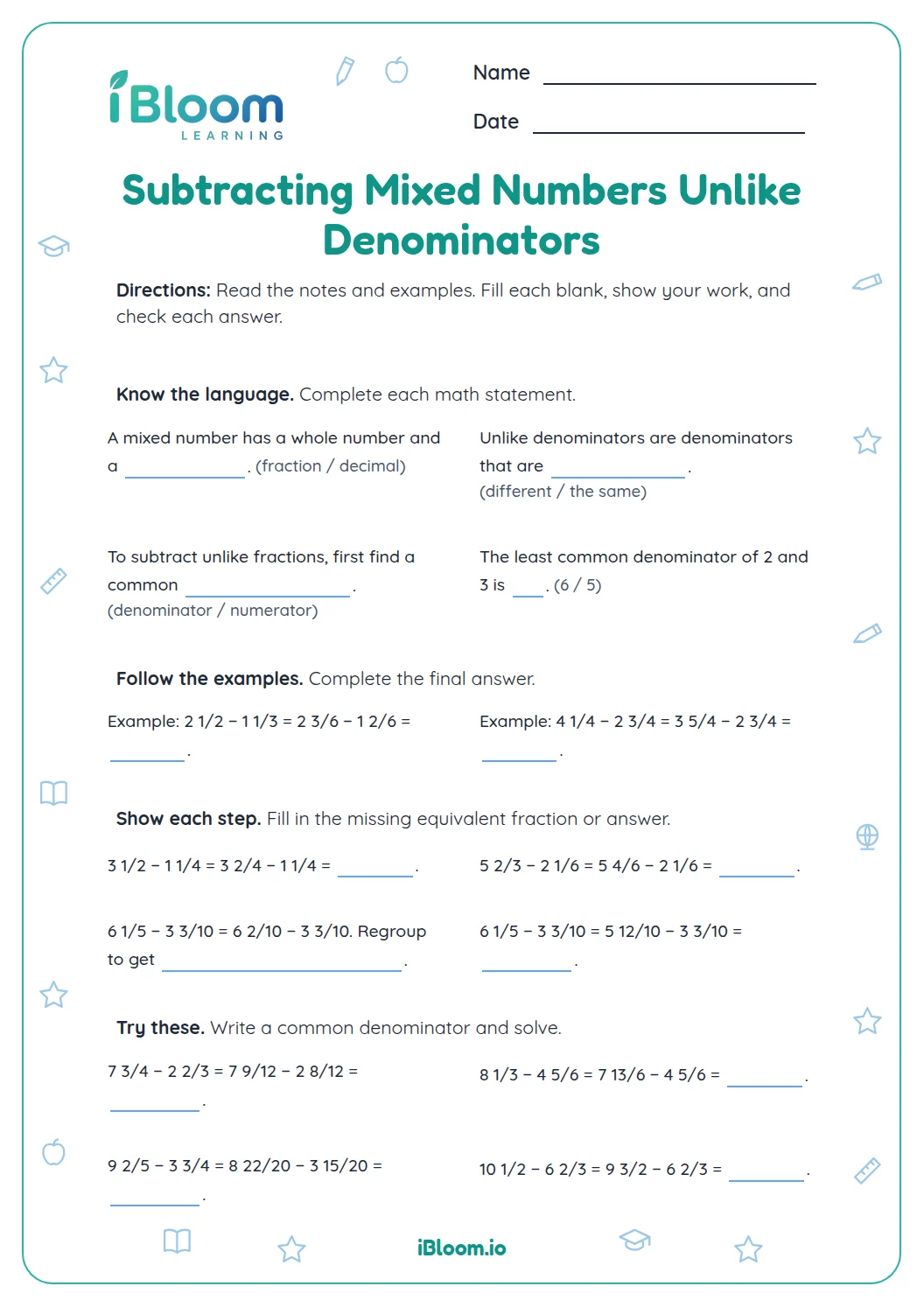
This free Grade 5 worksheet asks students to find the amount taken away in a mixed-number subtraction sentence. It starts with eight missing subtrahends, then asks students to choose a useful check, compare missing amounts, and diagnose a regrouping error. Two short explanations finish the challenge. The denominators include halves, thirds, fourths, sixths, eighths, tenths, and twelfths. Students practice equivalent fractions and mixed-number subtraction under Common Core 5.NF.A.1, with a separate answer key for all 12 questions.
Aligned to 5.NF.A.1
Which two amounts should students subtract?
In a − ___ = c, the blank is the amount removed. Subtract the amount left from the starting amount. For example, 6 3/4 − 2 1/4 = 4 1/2, so the missing subtrahend is 4 1/2.
- 16 3/4 − ___ = 2 1/4
- 26 3/4 − 2 1/4 = 4 1/2
- 3Check: 4 1/2 + 2 1/4 = 6 3/4
How does the sheet make students reason?
Part B asks students to choose an addition check, compare two unknown amounts with the same starting number, reject an answer larger than the start, and fix a regrouping mistake. These choices connect the arithmetic to the meaning of subtraction.
In question 8, the equation leaving 4 1/2 has a smaller amount removed than the equation leaving 4 1/4. Students can compare the amounts left before computing either missing number.
What should the two explanations include?
For a missing amount taken away, subtract the known amount left from the starting amount. Then add the missing amount to the amount left to check the equation.
Question 12 asks whether 3 3/4 fits 6 1/2 − ___ = 2 3/4. Adding 3 3/4 and 2 3/4 gives 6 1/2, so it does.
How to work through this sheet
- 1Read the equation as start − amount taken = amount left.
- 2Subtract the amount left from the starting amount to find the blank.
- 3Rename one whole when the fractional part of the start is too small.
- 4Add the missing subtrahend to the amount left to check the starting amount.
- 5For the choices, explain what the equations show before selecting an answer.
Mistakes to notice and how to help
The mistake
Adding the two visible numbers to fill the blank.
The fix
Find start minus amount left; add only to check the result.
The mistake
Regrouping a whole but leaving the original whole-number part unchanged.
The fix
Cross out one whole when adding one denominator to the numerator.
The mistake
Subtracting denominators along with numerators.
The fix
Rename the fractions with a common denominator, then subtract the counts of equal parts.
Common Core alignment
Use equivalent fractions to find and check missing mixed-number subtrahends.
On this sheet: Students subtract mixed numbers with unlike denominators and verify their results by addition.
Show the official wordingHide the official wording
Add and subtract fractions with unlike denominators (including mixed numbers) by replacing given fractions with equivalent fractions in such a way as to produce an equivalent sum or difference of fractions with like denominators. For example, 2/3 + 5/4 = 8/12 + 15/12 = 23/12. (In general, a/b + c/d = (ad + bc)/bd.)
What to practice next
Make more practice
Further reading
Questions parents and teachers ask
What does subtrahend mean?
The subtrahend is the number being taken away. In 6 3/4 − ___ = 2 1/4, it is the blank between the minus sign and the equals sign. Naming the starting amount and the amount left helps students identify what they need to find.
Must students regroup for every question?
No, regroup only when the fractional part of the starting amount is too small. Question 2 needs regrouping after halves become fourths. Question 1 can be solved directly. Comparing those two questions helps students decide when to exchange one whole for fractional parts.
Why include addition in a subtraction challenge?
Addition checks whether the missing amount and the amount left rebuild the start. In question 7, 2 3/4 + 4 1/2 must equal 7 1/4. This check tests the meaning of the blank as well as the arithmetic used to find it.
Can question 8 be answered without calculating both blanks?
Yes, students can compare what is left because both equations start at 8 3/4. Leaving 4 1/2 means taking away less than leaving 4 1/4. The first blank is therefore smaller. Students may calculate both amounts afterward to confirm their comparison.
What is included in the answer key?
The key gives all eight missing amounts, marks the four correct choices, and supplies model responses for the two explanation questions. Students can use it after attempting the challenge. For a wrong answer, have them add their proposed amount to the remainder and check the start.