





About this worksheet
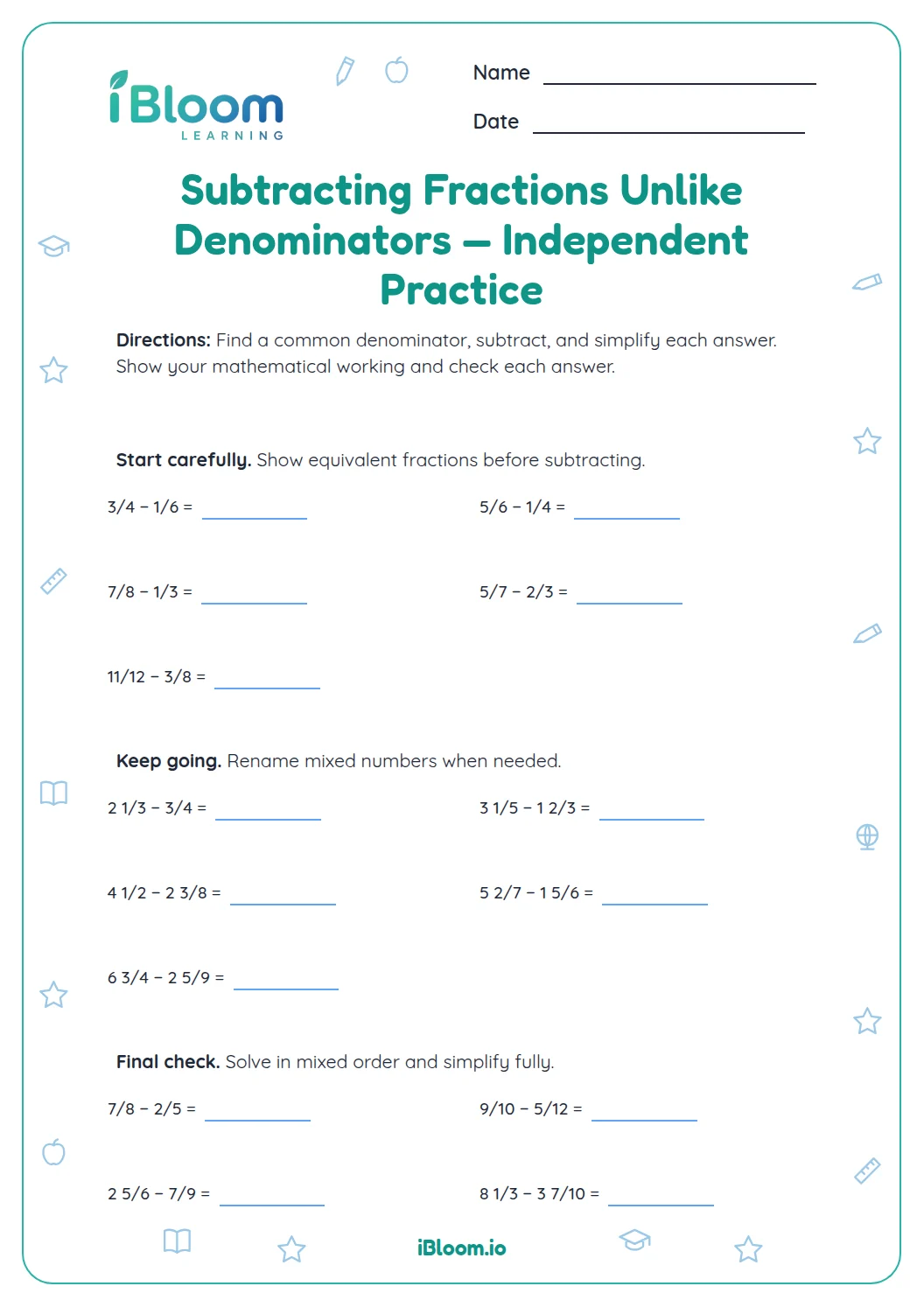
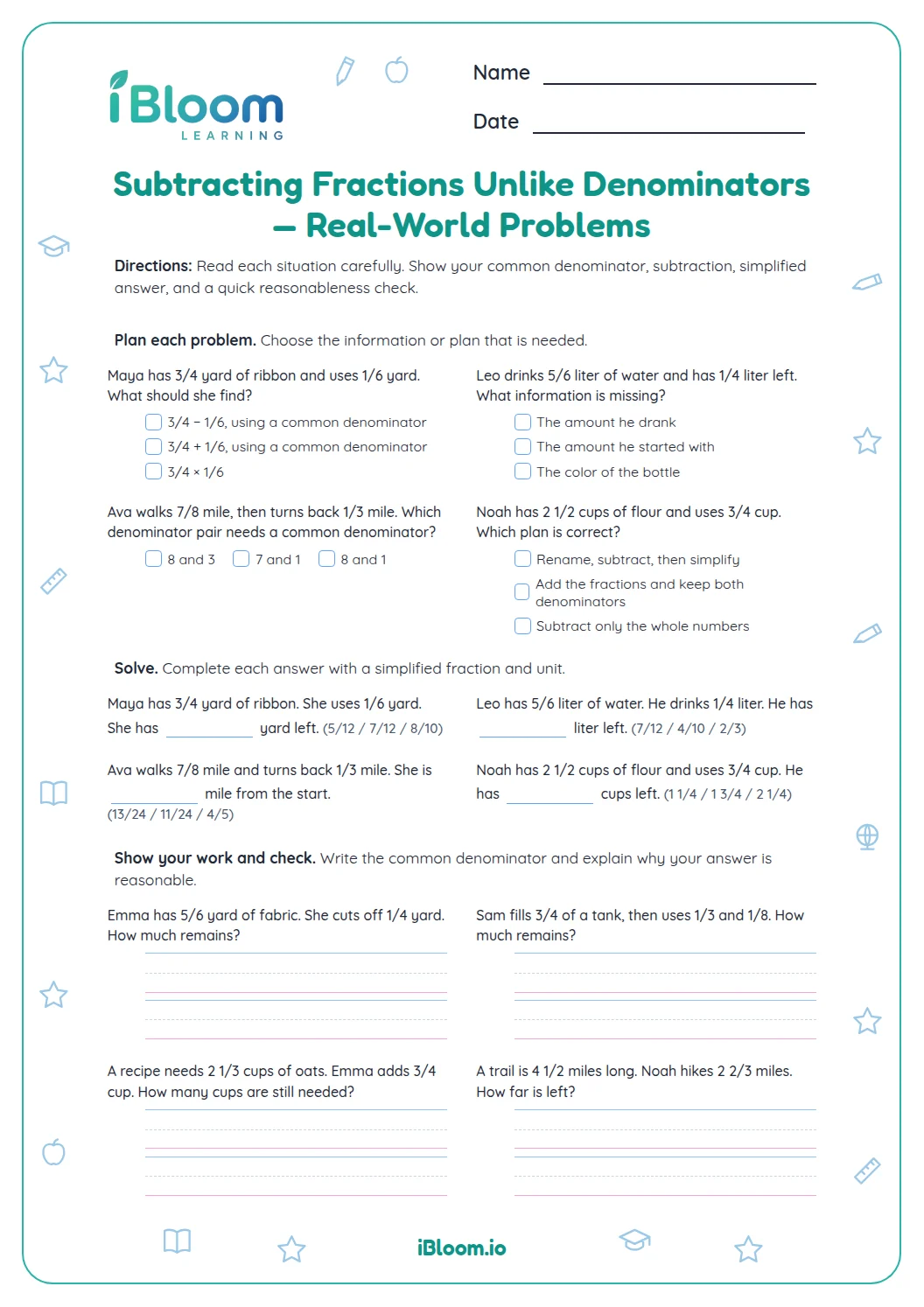
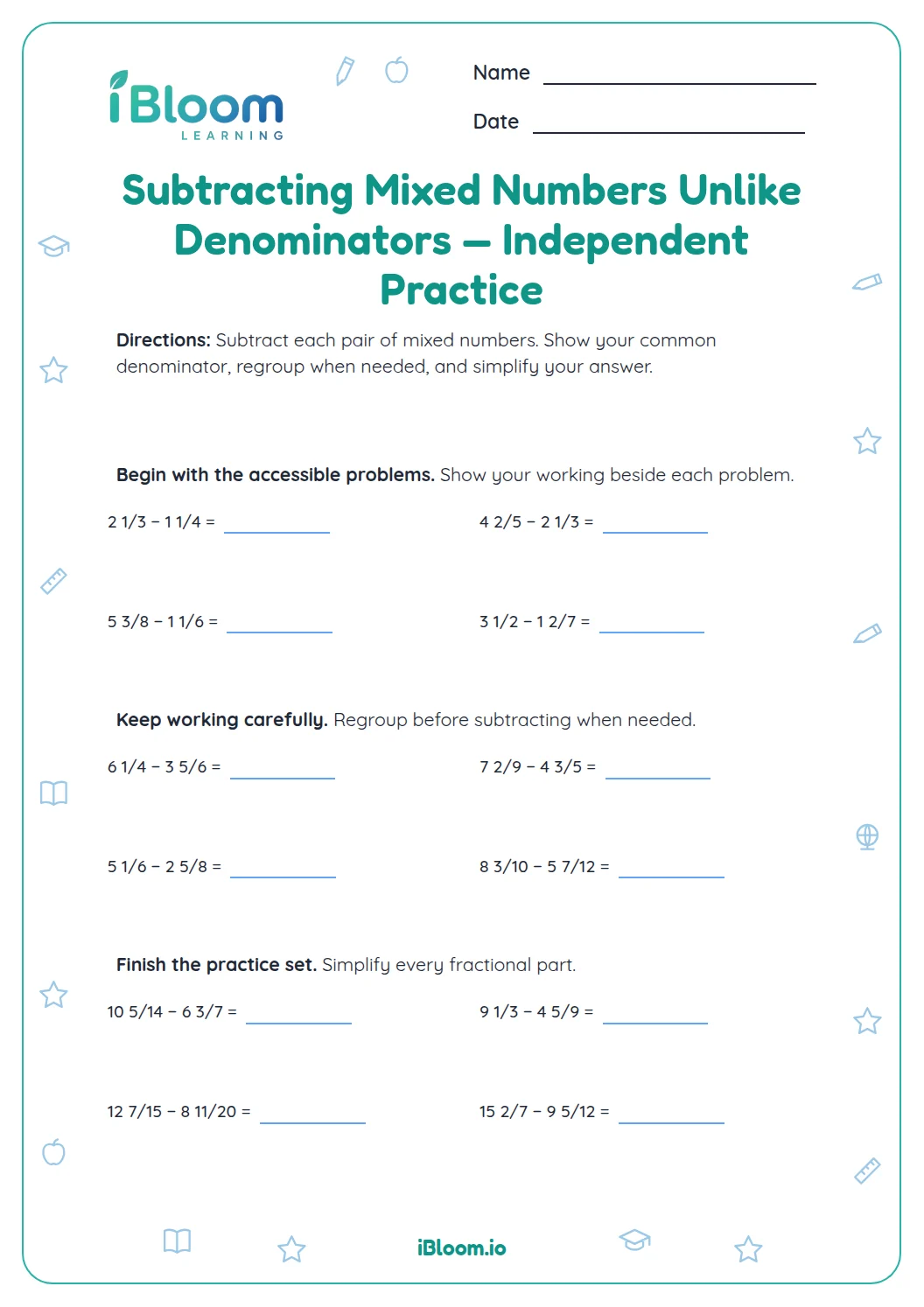
This Grade 5 worksheet introduces subtraction of fractions with unlike denominators. Children build equivalent fractions, subtract matching pieces, simplify results, analyze a common error and solve two measurement stories. A worked example starts with 2/3 − 1/6, showing how 2/3 becomes 4/6 before subtracting. The answer key includes the resulting fractions and sample explanations.
Aligned to 5.NF.A.1
Why do fractions need a common denominator?
The denominator names the size of the pieces. Before subtracting, rename fractions so both amounts use equal-sized pieces. For question 1, 2/3 becomes 4/6. Then subtract 1/6 from 4/6 to get 3/6.
- 12/3 = 4/6
- 24/6 − 1/6 = 3/6
- 3So 2/3 − 1/6 = 3/6.
When should you simplify the difference?
Once the pieces match, subtract the numerators and keep the common denominator. In question 6, 3/4 = 9/12 and 2/3 = 8/12, so the difference is 1/12. In other items, simplify if numerator and denominator share a factor.
How does fraction subtraction work in a story?
Identify the starting amount and the amount taken away. Question 12 starts with 7/8 yard and cuts away 1/4 yard. Rename 1/4 as 2/8, subtract, and label the remaining length in yards.
How to use this worksheet
- 1Find a common denominator that both fractions can use.
- 2Rename each fraction without changing its value.
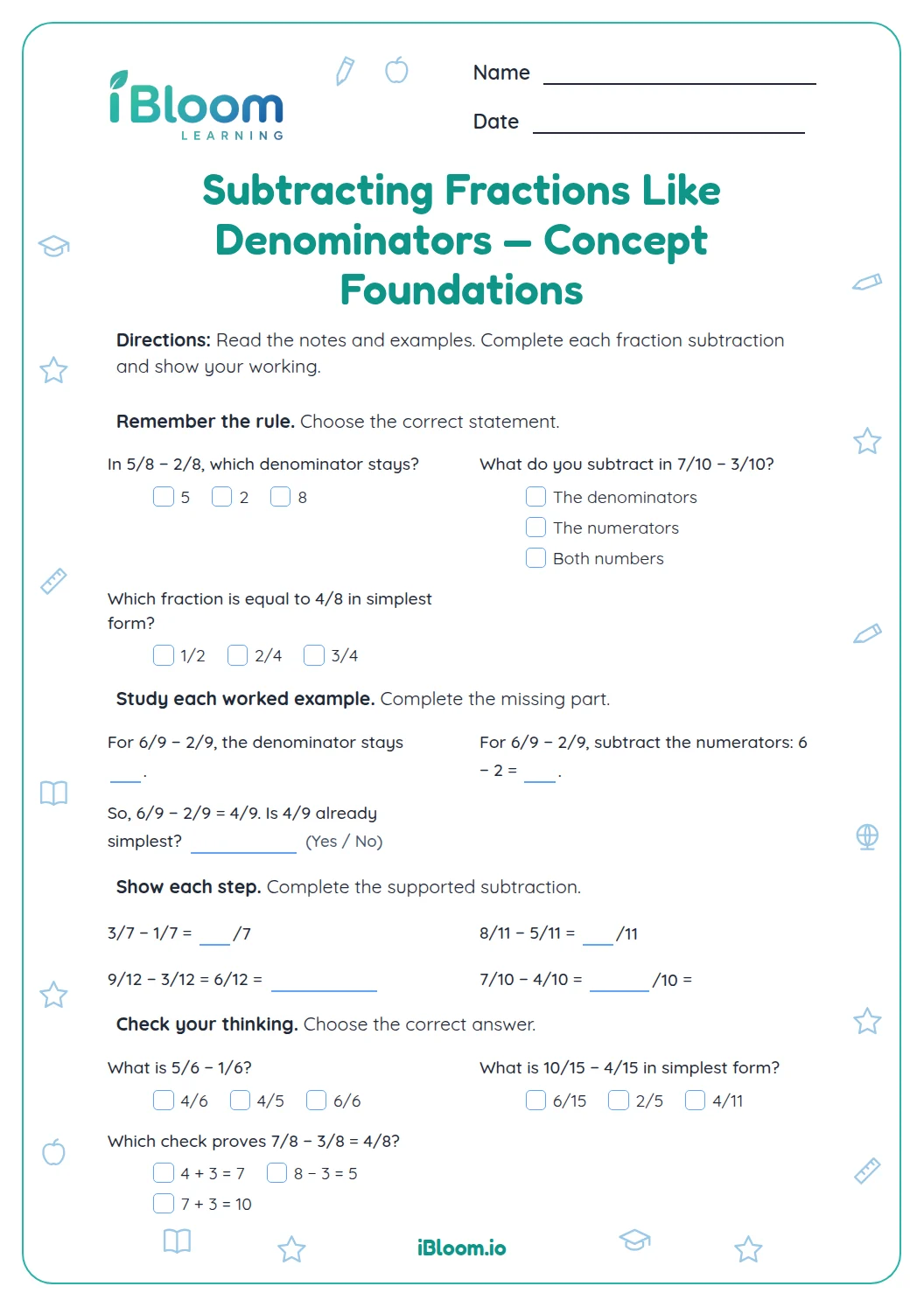
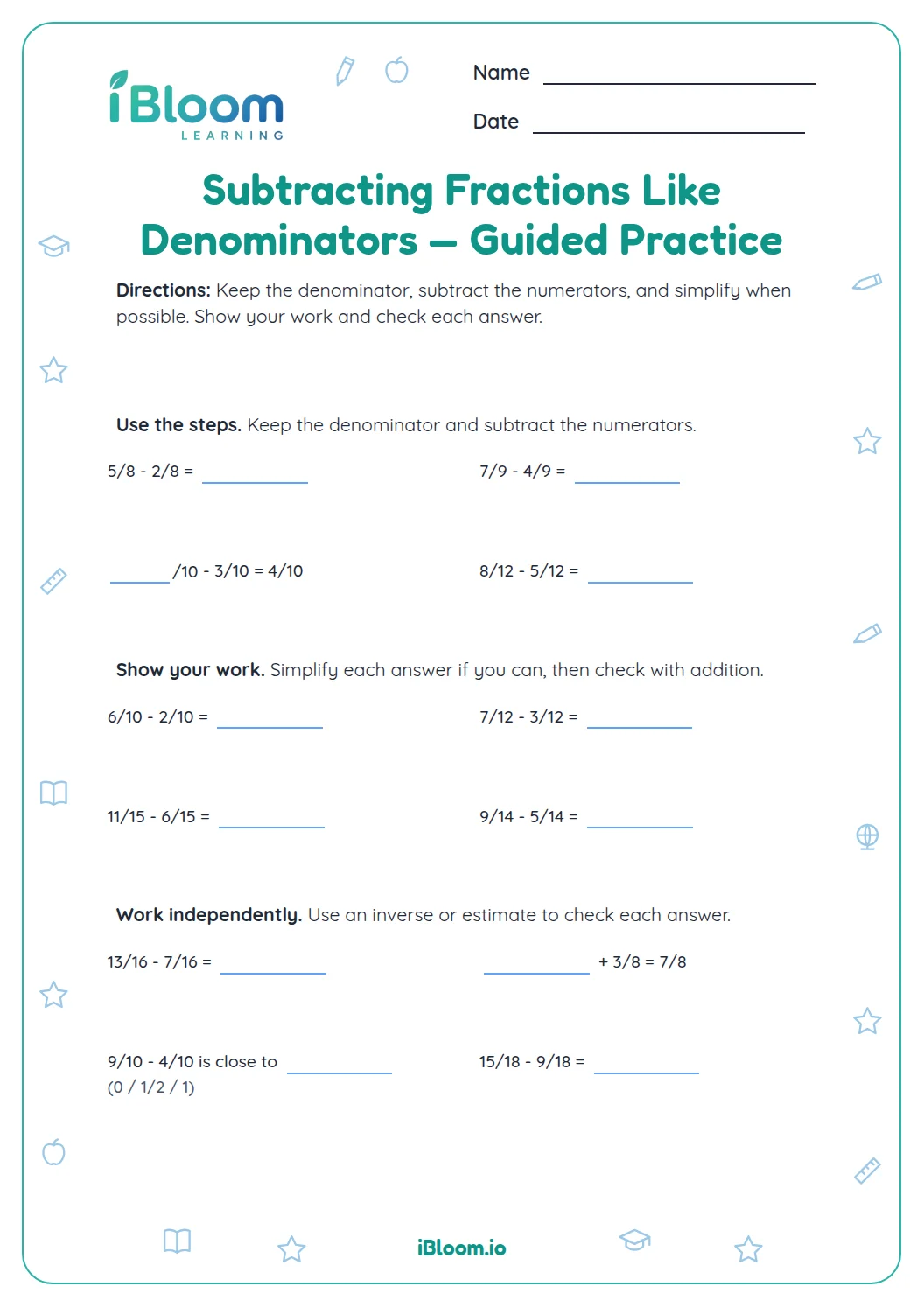
- 3Subtract the numerators and keep the denominator.
- 4Simplify the result when possible.
- 5Check that the difference is smaller than the starting fraction.
Common mistakes and quick fixes
The mistake
Subtracting denominators as well as numerators.
The fix
Rename the fractions first, then subtract only equal-sized pieces.
The mistake
Using a common denominator but changing only one fraction.
The fix
Multiply the numerator and denominator by the same number.
The mistake
Forgetting to simplify.
The fix
Look for a number that divides both numerator and denominator.
Common Core alignment
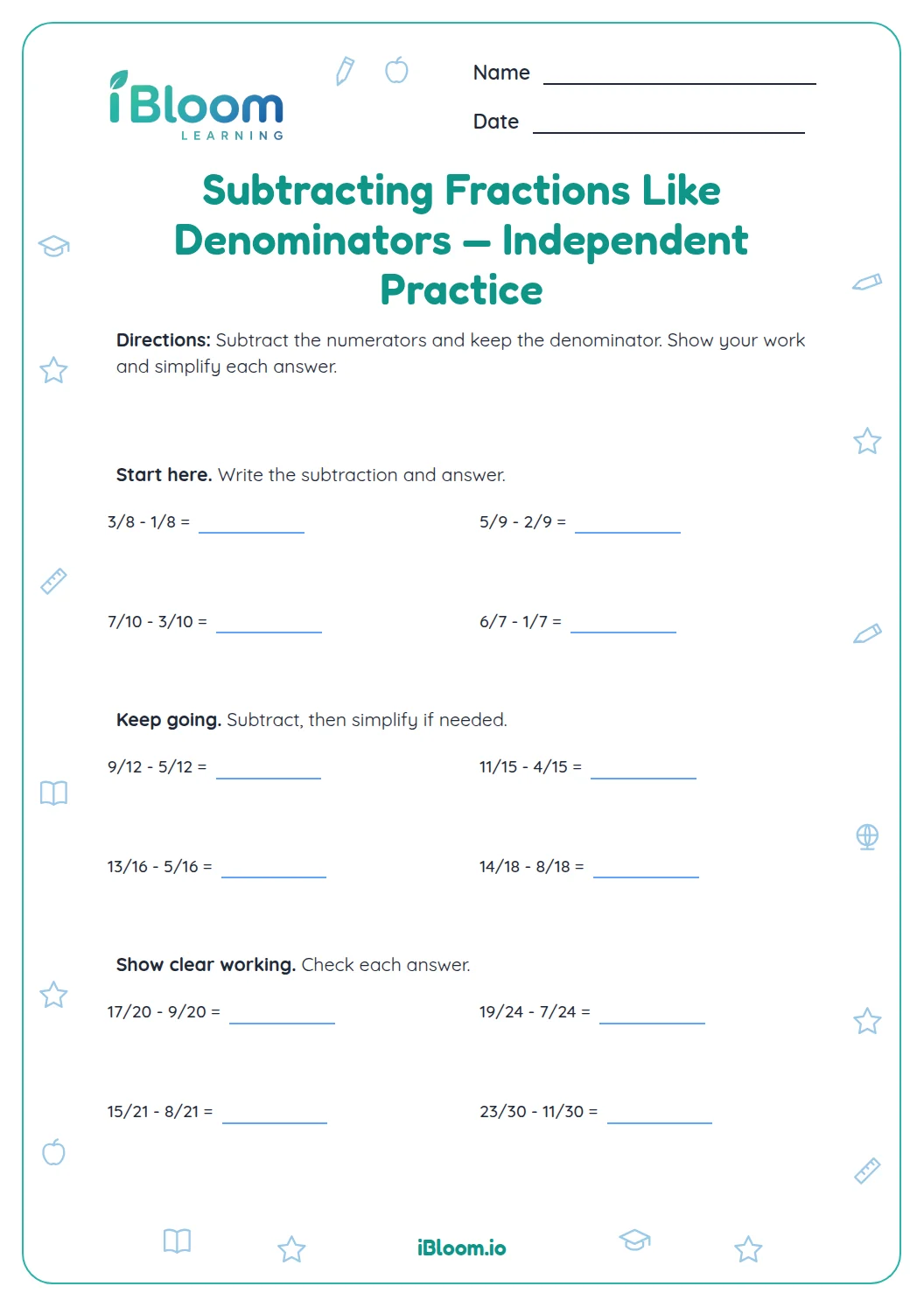
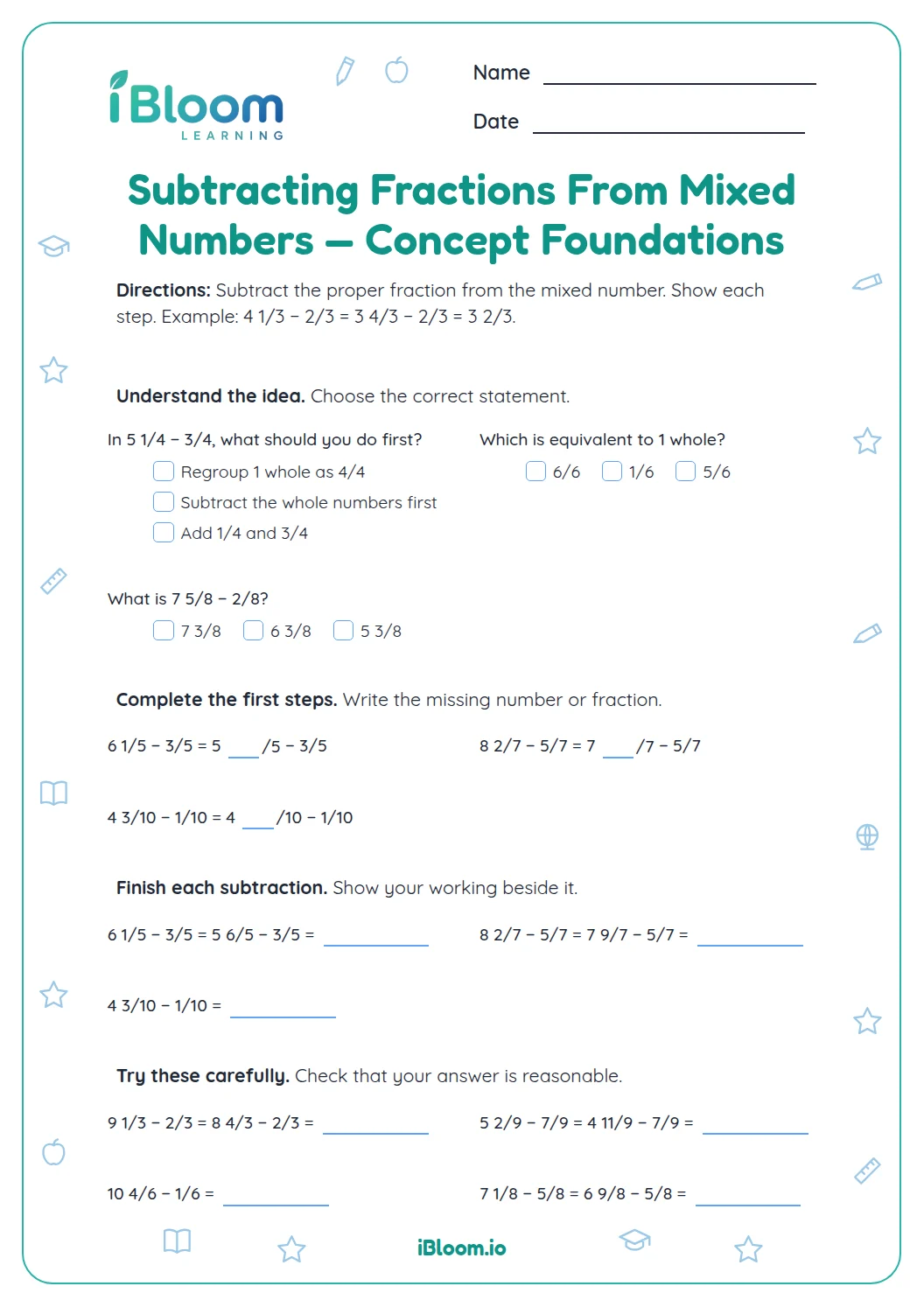
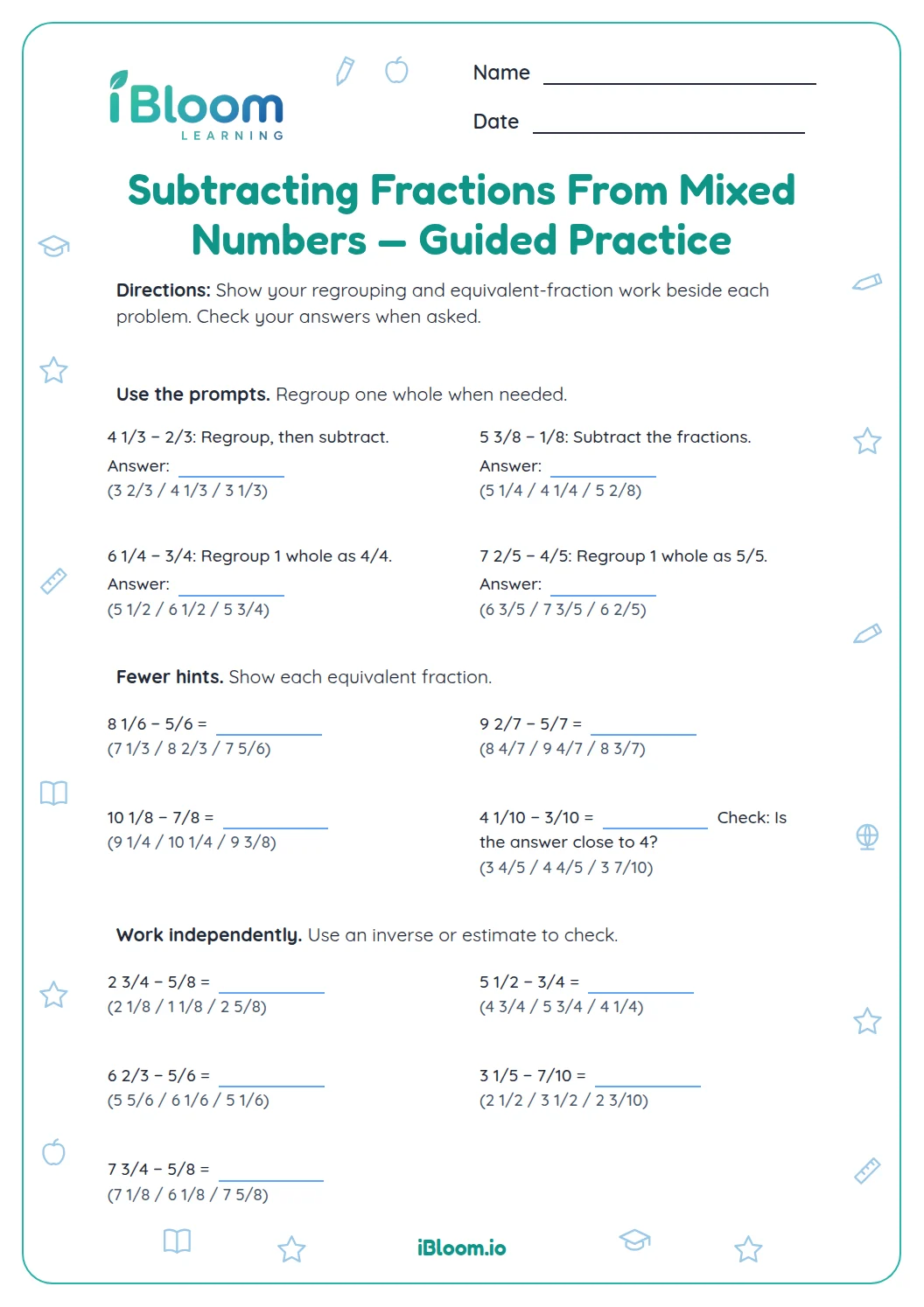
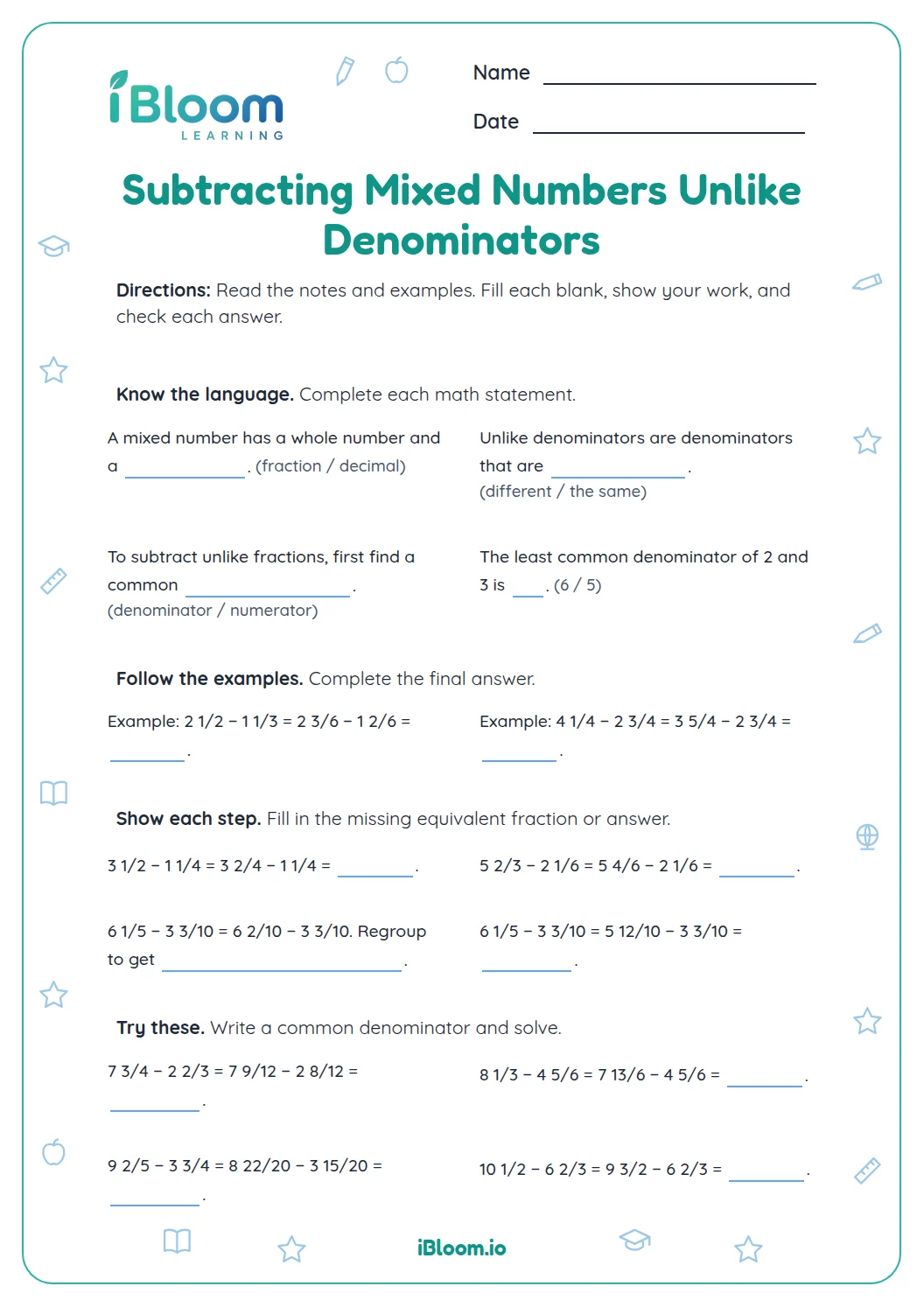
This worksheet practices the standard through its printed questions.
Subtract unlike fractions by making equivalent fractions with like denominators.
On this sheet: Add and subtract fractions with unlike denominators (including mixed numbers) by replacing given fractions with equivalent fractions in such a way as to produce an equivalent sum or difference of fractions with like denominators. (5.NF.A.1)
Show the official wordingHide the official wording
Add and subtract fractions with unlike denominators (including mixed numbers) by replacing given fractions with equivalent fractions in such a way as to produce an equivalent sum or difference of fractions with like denominators.
What to practice next
Make more practice
Further reading
Questions parents and teachers ask
Why is 2/3 rewritten as 4/6?
The numerator and denominator are both multiplied by 2, so the value stays the same. Since sixths match the 1/6 being subtracted, 4/6 − 1/6 = 3/6. The worksheet gives several chances to practice finding this shared piece size. This helps connect the written steps to the size of each fractional part.
How do you subtract 3/4 − 1/2?
Rename 1/2 as 2/4 so both fractions use fourths. Then subtract the numerators: 3/4 − 2/4 = 1/4. The denominators describe the size of the pieces and stay the same once the pieces match. This helps connect the written steps to the size of each fractional part.
When should my child simplify?
Simplify after subtracting if the numerator and denominator share a common factor. For example, 3/6 can be written as 1/2. Some worksheet answers are already in simplest form, while others invite the child to show equivalent fractions along the way.
What does a common denominator mean?
It is a denominator that both fractions can be rewritten with. For 3/4 and 2/3, twelfths work: 3/4 = 9/12 and 2/3 = 8/12. Those equivalent fractions now count the same size pieces, so subtraction is straightforward. This helps connect the written steps to the size of each fractional part.
How can a child check a subtraction answer?
The difference should be less than the amount you started with when subtracting a positive fraction. The child can also add the difference back to the fraction taken away and check whether the starting amount returns. This helps connect the written steps to the size of each fractional part.
Does the worksheet include story problems?
Yes. Two questions use familiar measures: a ribbon measured in yards and juice measured in liters. The child writes an equation, finds a common denominator and includes the remaining unit in the answer. This helps connect the written steps to the size of each fractional part.