




About this worksheet
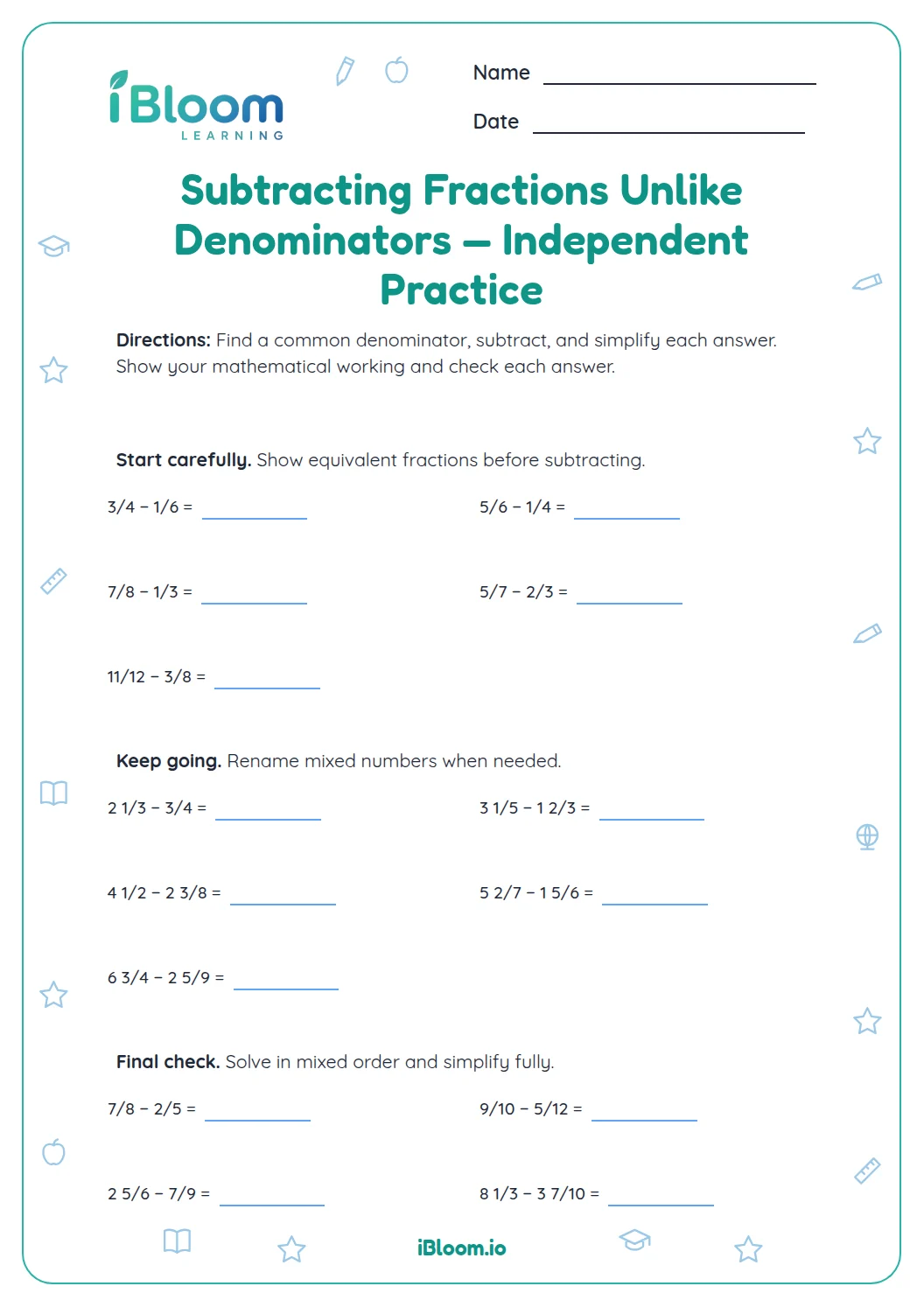
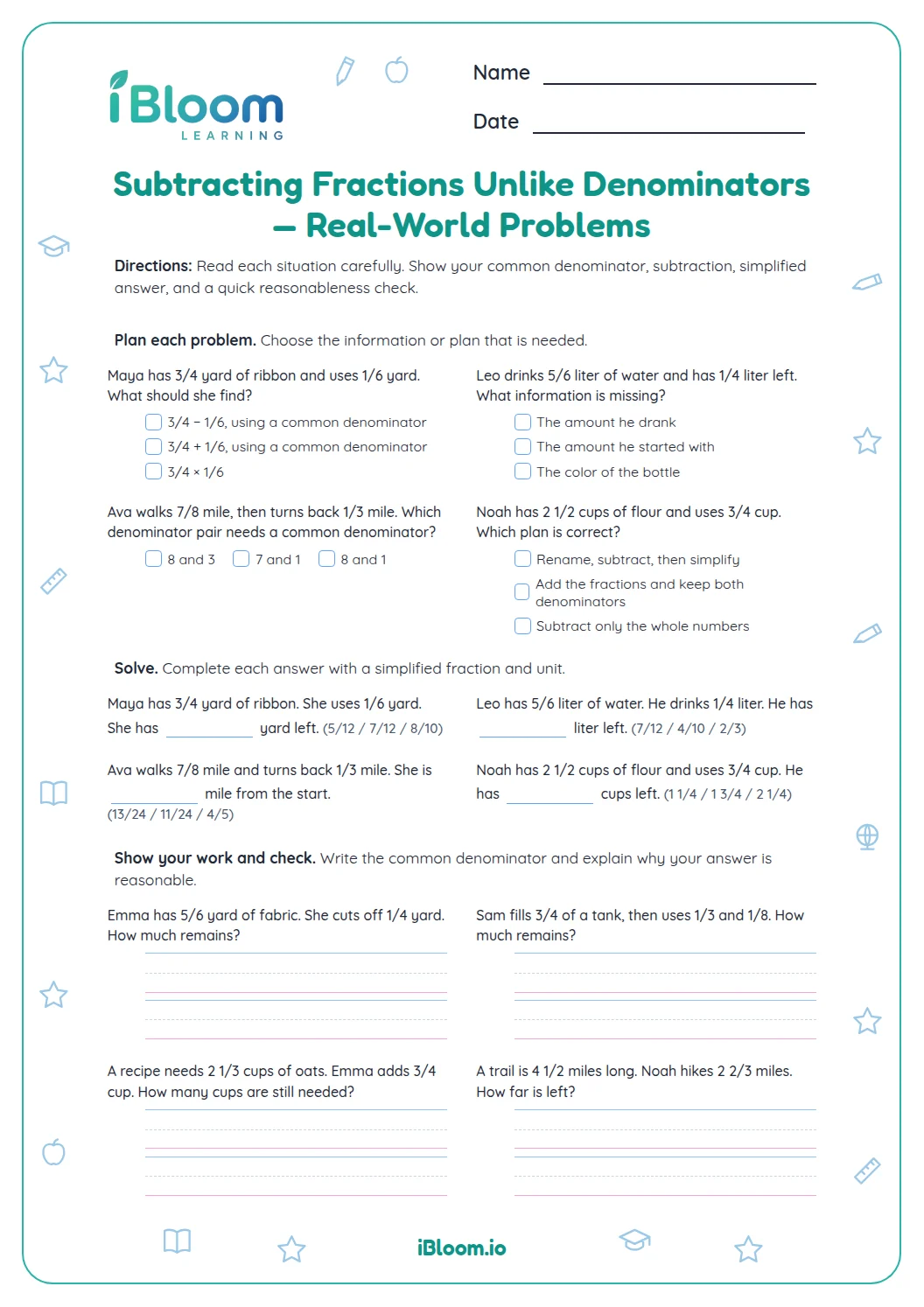
This Grade 5 worksheet practices subtraction of fractions with unlike denominators. Six calculations build fluency; five multiple-choice reasoning items check denominator choices and common errors; two word problems apply subtraction; and one written response explains why equivalent fractions are needed. The separate answer key includes concise models. It practices CCSS 5.NF.A.1.
Aligned to 5.NF.A.1
Why do fractions need a common denominator before subtracting?
The denominator names the size of the parts. You can subtract the numerators only after both fractions use parts of the same size. For 3/4 − 1/6, twelfths work because 3/4 = 9/12 and 1/6 = 2/12.
- 13/4 − 1/6
- 23/4 = 9/12 and 1/6 = 2/12
- 39/12 − 2/12 = 7/12
How can a student check an answer?
Compare the difference with the starting fraction: subtracting a positive amount should make the value smaller. Then add the answer to the amount taken away. In question 1, 7/12 + 1/6 = 7/12 + 2/12 = 9/12, which is 3/4.
What kinds of problems are included?
The 14 questions progress from six direct differences to denominator reasoning and two error checks, then two short situations and a final explanation. In the ribbon problem, 5/6 − 1/4 = 10/12 − 3/12 = 7/12 yard.
How to use this worksheet at home or in class
- 1For each equation, list a common denominator before changing either fraction.
- 2Write equivalent fractions with that denominator.
- 3Subtract numerators and keep the denominator.
- 4Reduce the result if numerator and denominator share a factor.
- 5In the error questions, identify the denominator mistake before recalculating.
- 6Check word-problem answers by adding back the amount removed.
Common mistakes and quick fixes
The mistake
Subtracting denominators as well as numerators.
The fix
Rename both fractions with a common denominator first; then subtract only the numerators.
The mistake
Using an incorrect equivalent fraction, such as 3/4 = 3/12.
The fix
Multiply numerator and denominator by the same factor: 3/4 = 9/12.
The mistake
Leaving a reducible result like 6/12.
The fix
Find a common factor and divide both parts by it.
Common Core alignment
This worksheet practices the skill described below.
Add and subtract fractions with unlike denominators by using equivalent fractions.
On this sheet: Every item asks children to rename fractions with a common denominator before subtracting.
Show the official wordingHide the official wording
Add and subtract fractions with unlike denominators (including mixed numbers) by replacing given fractions with equivalent fractions in such a way as to produce an equivalent sum or difference of fractions with like denominators. For example, 2/3 + 5/4 = 8/12 + 15/12 = 23/12. (In general, a/b + c/d = (ad + bc)/bd).
What to practice next
Make more practice
Further reading
Questions parents and teachers ask
Why must the denominators match before subtraction?
The denominator names the size of each fractional part. Rename both fractions as equivalent fractions with a common denominator, then subtract the numerators and keep that denominator. For example, 3/4 − 1/6 becomes 9/12 − 2/12, which equals 7/12.
Does this worksheet include word problems?
Yes. One problem starts with 5/6 yard of ribbon and removes 1/4 yard; the other starts with 3/4 liter and pours out 1/6 liter. Students find how much remains in each situation and can show the common-denominator steps in the answer space.
Should students simplify every answer?
Simplify a result when its numerator and denominator share a factor. For example, 6/12 reduces to 1/2. Several answers on this sheet are already in simplest form, including 7/12 and 13/24. The key gives a simplified result for each calculation.
What is the answer to question 1?
Question 1 is 3/4 − 1/6. Rename 3/4 as 9/12 and 1/6 as 2/12; then subtract 9/12 − 2/12 to get 7/12. This calculation is also the worked example on the written page. Use this common-denominator method to check the later calculations too.
How many questions are on the printable?
There are 14 questions: six fraction calculations, five multiple-choice reasoning items, two word problems, and one written explanation. They appear in four parts, followed by a separate three-page answer key. The problems use unlike denominators throughout. The key also gives a model explanation for reviewing the final response.