




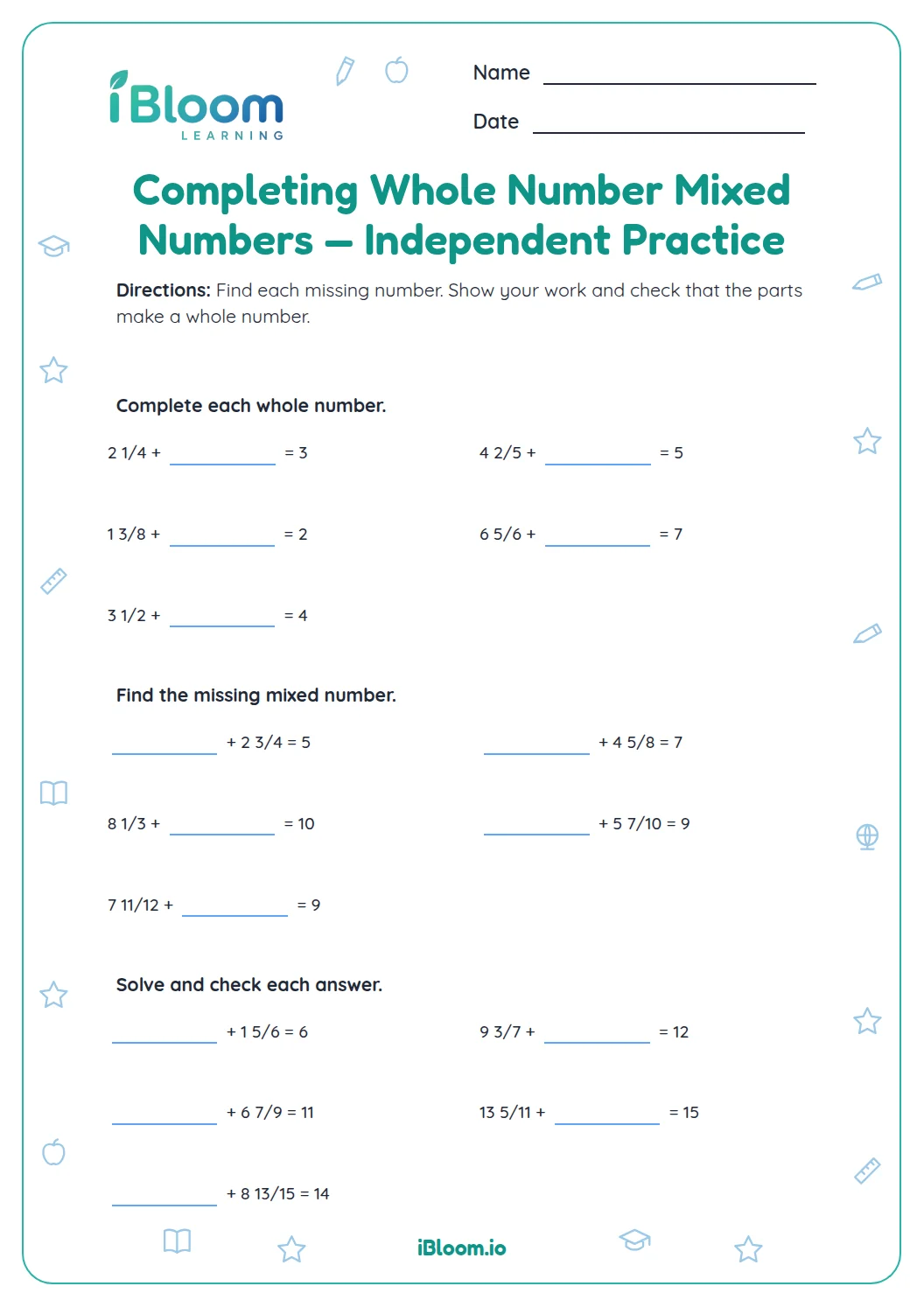
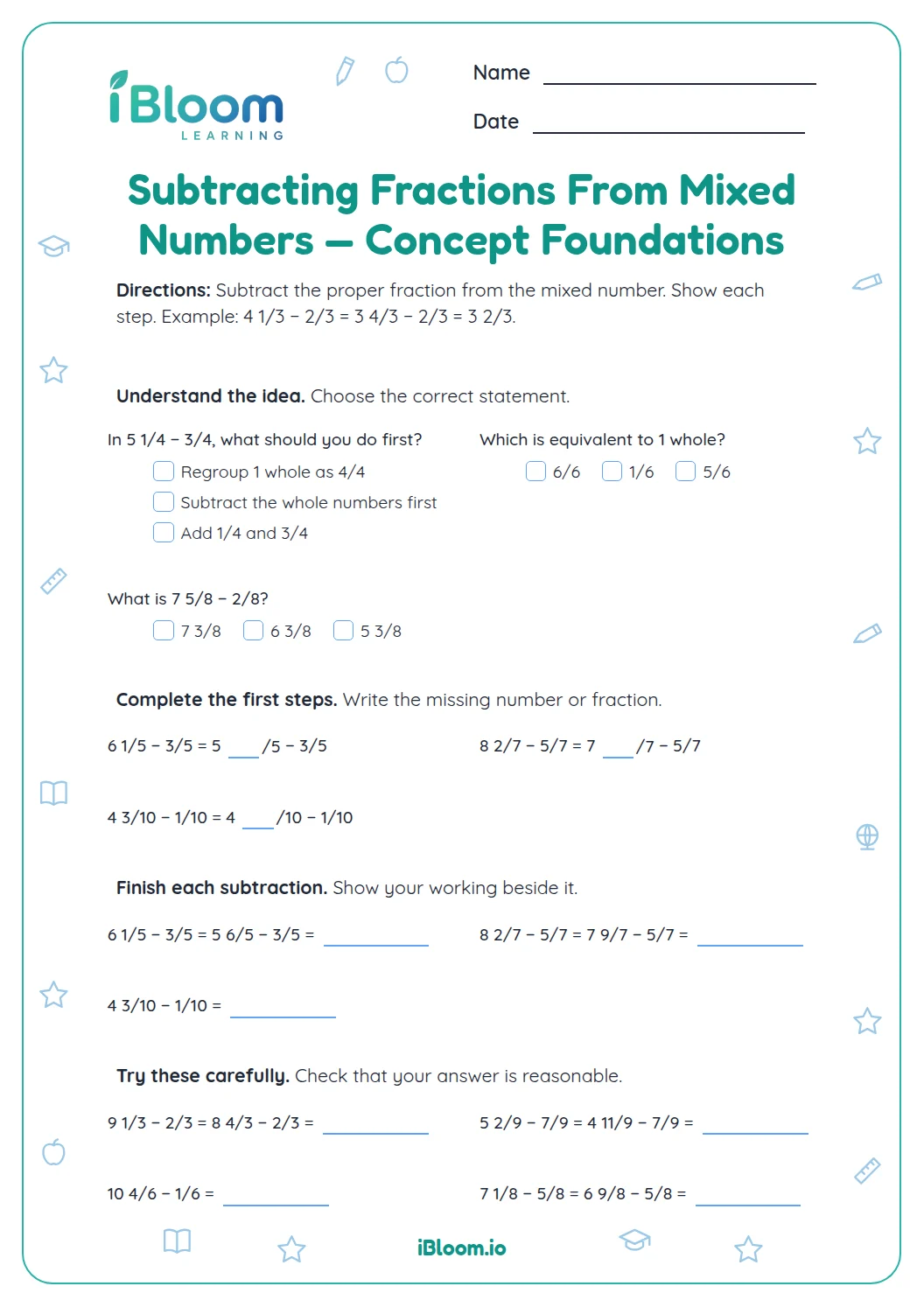
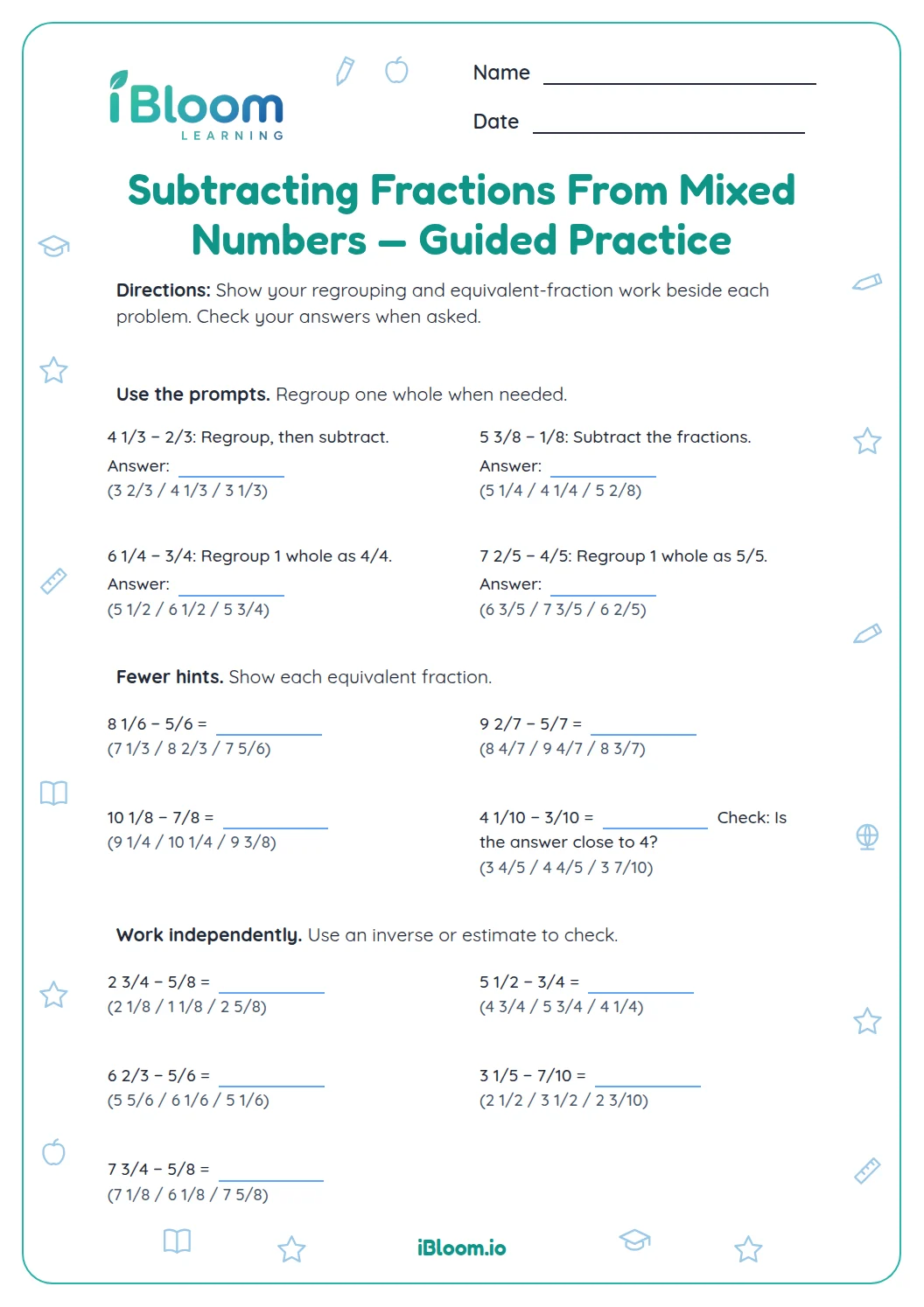

About this worksheet
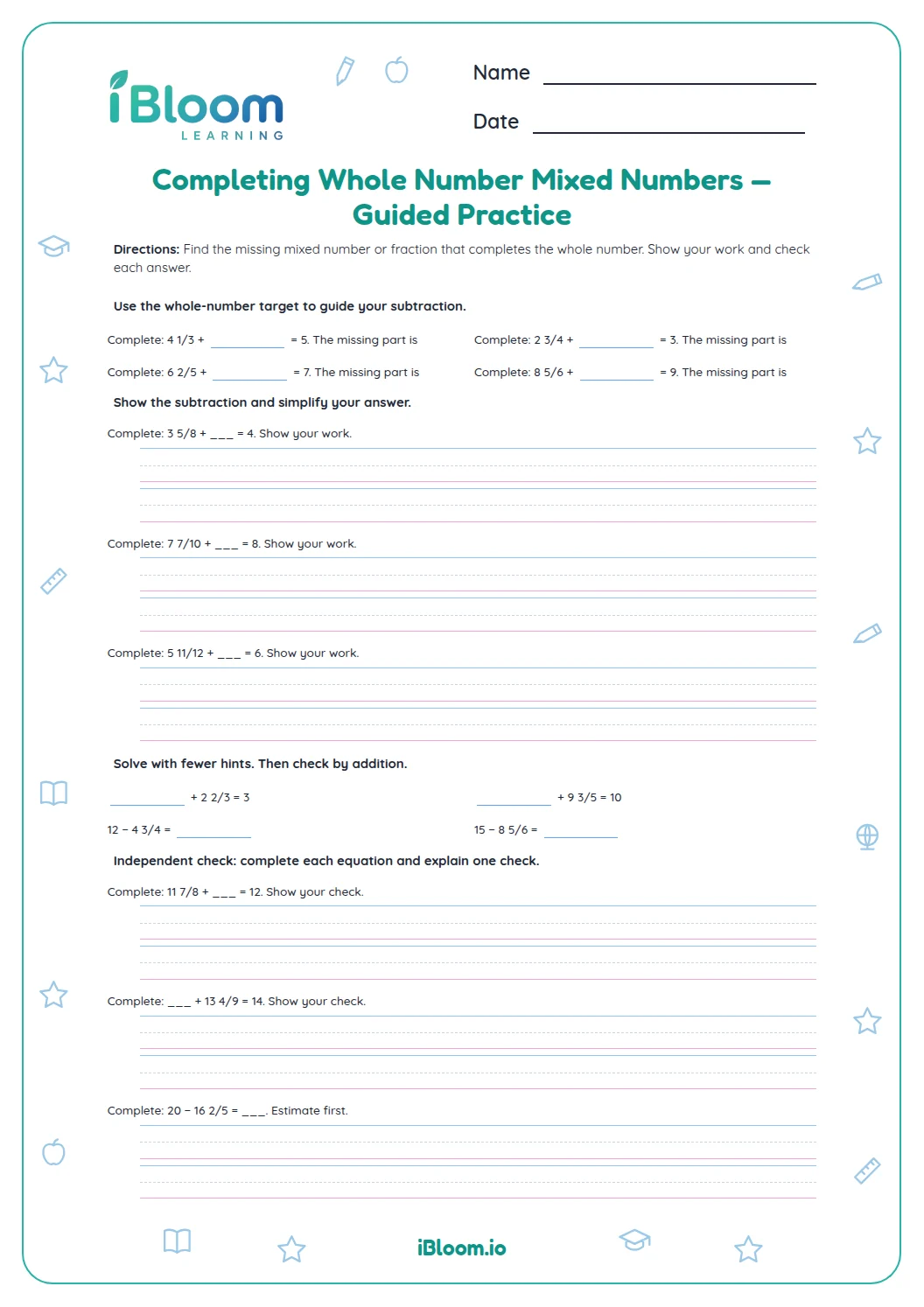
This Grade 5 printable guides students through 14 subtractions of fractions from whole numbers. Part A gives four renaming hints; Part B has six problems for subtracting and checking by addition; Part C has four independent problems with estimation. A separate two-page answer key gives the simplified results. The work practices equivalent fractions and common denominators in subtraction.
Aligned to 5.NF.A.1
Why does one whole become 4/4?
Four fourths fill one whole. Replacing one whole with 4/4 changes its form without changing its value. In question 1, the printed hint rewrites 3 as 2 + 4/4, leaving two untouched wholes.
The fraction being subtracted tells you which equal parts to use. For thirds, trade one whole for 3/3; for eighths, trade it for 8/8.
How does the hint help with 3 − 1/4?
Keep the untouched wholes and subtract the fractional parts. For 3 − 1/4, rename 3 as 2 + 4/4; then 4/4 − 1/4 = 3/4, so the result is 2 3/4. Add 1/4 back to check.
- 13 − 1/4
- 2Rename: 3 = 2 + 4/4.
- 3Subtract: 4/4 − 1/4 = 3/4.
- 4Keep the 2 wholes: 2 3/4.
- 5Check: 2 3/4 + 1/4 = 3.
Which answers need simplification?
Question 8 gives 9 6/10, which simplifies to 9 3/5. After subtraction, check whether the numerator and denominator share a factor.
How can students estimate the last four answers?
Round the fraction being subtracted to 0 or 1 to estimate. In question 14, 5/12 is close to 0, so 22 − 5/12 is close to 22; the exact result is 21 7/12.
How to use this worksheet
- 1Read the first hint and explain why 3 and 2 + 4/4 have equal value.
- 2Solve question 1 together, keeping the two untouched wholes.
- 3Finish Part A using each printed renaming hint.
- 4Solve Part B in the grids and check by adding the removed fraction back.
- 5Estimate before solving each Part C problem, then compare the exact result with the estimate.
- 6Use the key to check simplified differences and review the student’s written steps.
Mistakes to notice and how to help
The mistake
Keeping all the original wholes, such as 3 − 1/4 = 3 3/4.
The fix
Trading one whole for 4/4 leaves two untouched wholes, so the answer is 2 3/4.
The mistake
Subtracting the denominator, as in 4/4 − 1/4 = 3/0.
The fix
The pieces stay fourths. Subtract their counts, not their size.
The mistake
Stopping at 9 6/10 in question 8.
The fix
Divide the numerator and denominator of 6/10 by 2 to write 9 3/5.
Common Core alignment
Rename whole numbers as equivalent fractions with the denominator needed for subtraction.
On this sheet: Students replace whole-number amounts with equivalent fractional amounts to subtract using a common denominator.
Show the official wordingHide the official wording
Add and subtract fractions with unlike denominators (including mixed numbers) by replacing given fractions with equivalent fractions in such a way as to produce an equivalent sum or difference of fractions with like denominators. For example, 2/3 + 5/4 = 8/12 + 15/12 = 23/12. (In general, a/b + c/d = (ad + bc)/bd.)
What to practice next
Make more practice
Further reading
Questions parents and teachers ask
What makes this a guided-practice worksheet?
The sheet moves through three parts. Four questions show the renaming hint, six invite students to subtract and check by addition, and four are independent problems that begin with an estimate. All 14 practice subtracting a fraction from a whole number.
Why do we subtract one from the whole-number part?
One whole is traded for fractional parts, so there is one fewer untouched whole. For 3 − 1/4, three wholes become two wholes and four fourths. After removing one fourth, two wholes and three fourths remain. The correct answer is 2 3/4, which is less than 3.
Can my child use improper fractions instead?
Yes, rewriting the starting number as an improper fraction is valid. For question 1, write 3 as 12/4, then calculate 12/4 − 1/4 = 11/4. Convert the result to 2 3/4. Compare this with the printed hint to see how both methods preserve the same quantity.
Which answers need to be simplified?
Question 3 gives 6 6/8 before simplification, which becomes 6 3/4. Question 8 gives 9 6/10, which becomes 9 3/5. Ask students to check the fractional part of every result for a common factor and divide both numbers by that factor when simplifying.
How can we check the subtraction answers?
Add the removed fraction back to the result and check that it equals the starting whole number. For question 1, 2 3/4 + 1/4 equals 3 because the fourths make one whole. The key gives exact simplified differences; use the grids to inspect the student’s addition checks too.
What estimates work for Part C?
Rounding each fraction to 0 or 1 gives estimates of 12, 14, 19 and 24 for questions 9 through 12. Students then find the exact differences in their grids. Accept another reasonable estimate if the student explains it and checks that the exact answer is close.