





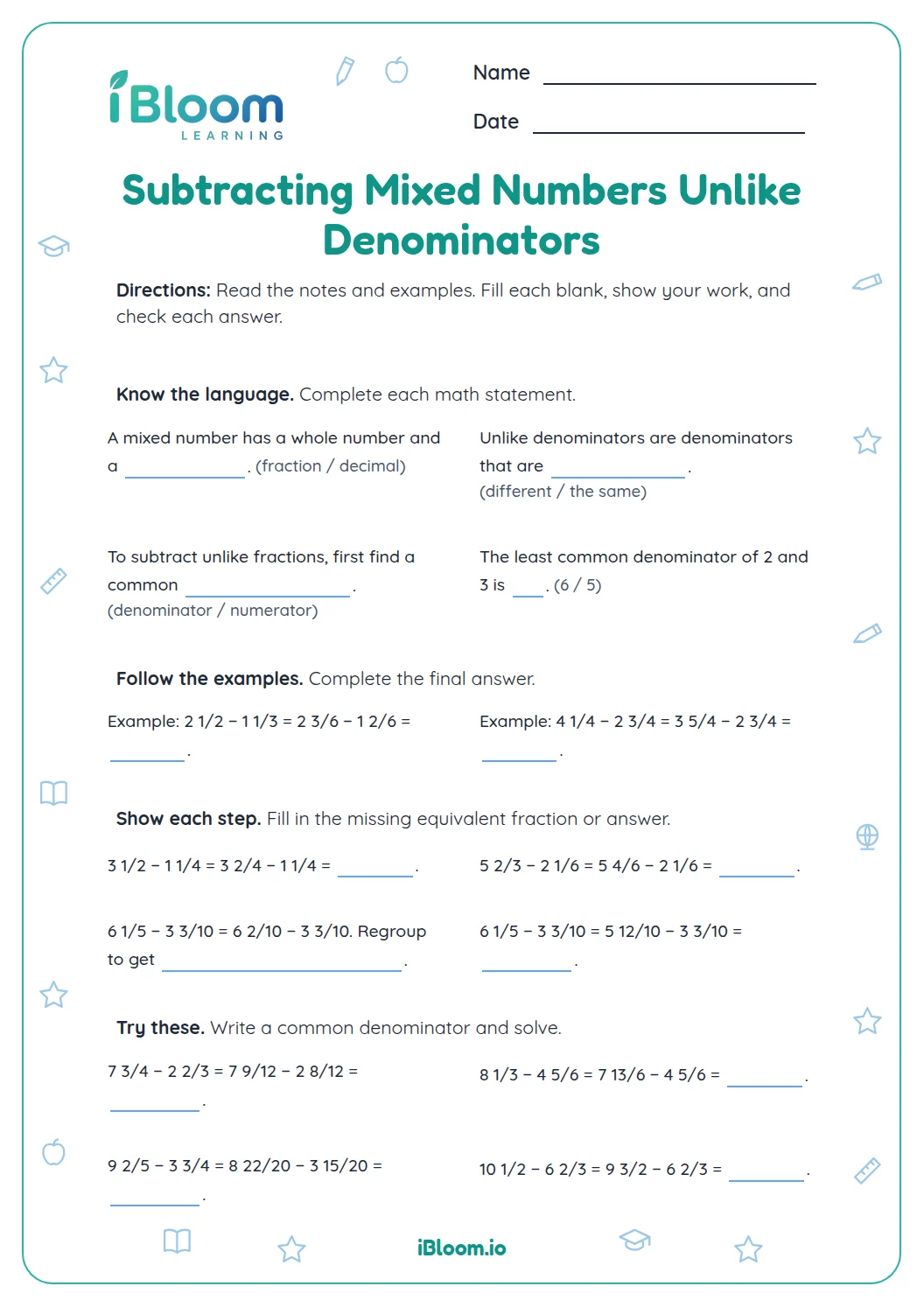

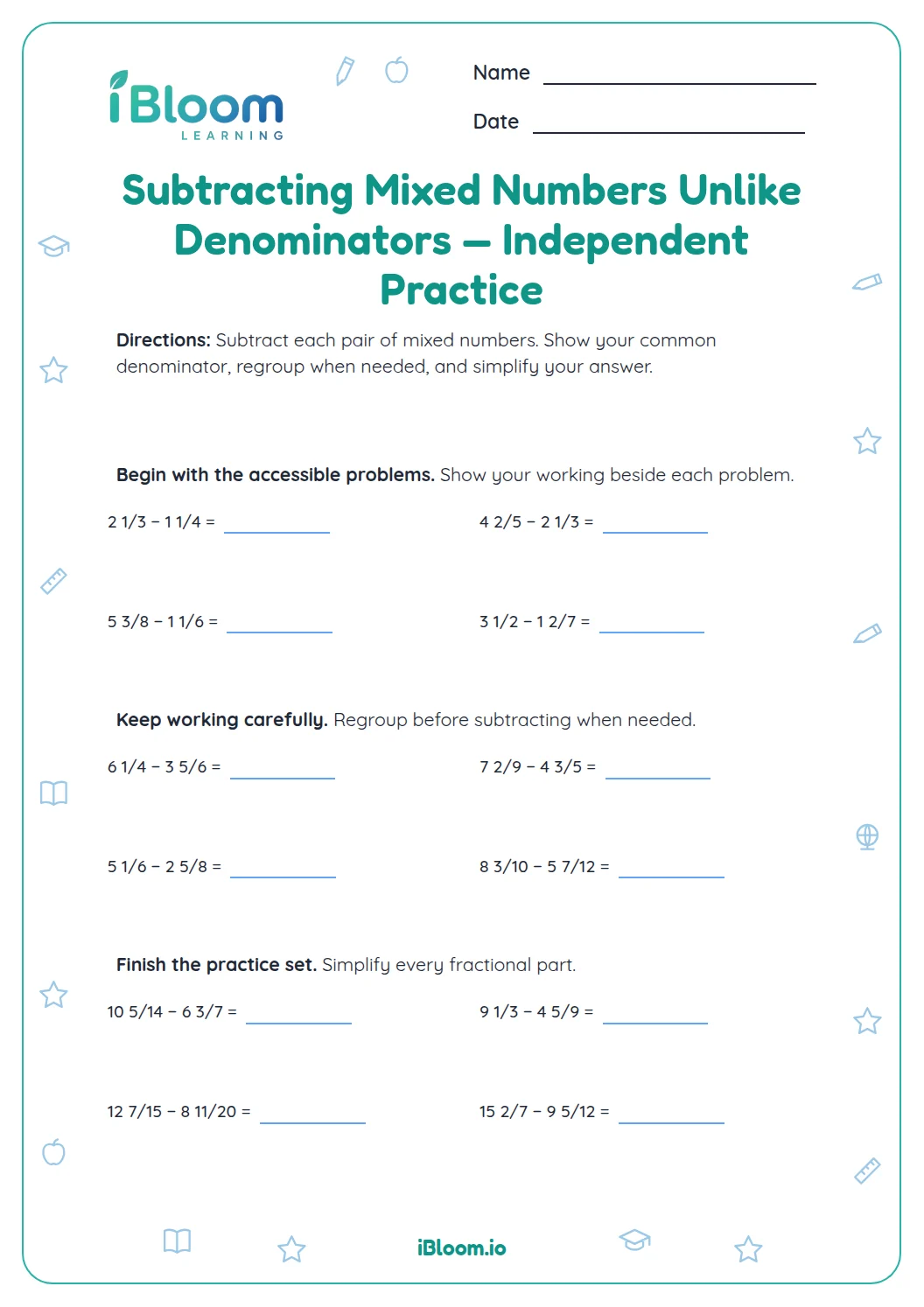
About this worksheet
This free printable Grade 5 worksheet asks students to explain and check subtraction of fractions from whole numbers. Four missing-number equations lead into four reasoning questions about equivalent expressions and the size of a difference. Two word problems and four error checks complete the review. The practice supports Common Core 4.NF.B.3.a and 4.NF.B.3.c through separating fractional parts, renaming wholes and connecting addition with subtraction. Fractions include fourths, fifths, sixths, sevenths, eighths and twelfths. The separate answer key gives simplified results and sample explanations for all four incorrect student solutions.
Aligned to 4.NF.B.3.a and 4.NF.B.3.c
Why do you rename exactly one whole?
Every fraction being subtracted on this sheet is less than one. Renaming one whole supplies enough fractional parts to subtract while leaving the other wholes intact. For eighths, one whole becomes 8/8; for twelfths, it becomes 12/12.
Question 4 also needs simplification: 6 − 9/12 = 5 3/12 = 5 1/4. Divide the numerator and denominator of 3/12 by 3; the five whole units stay the same.
- 1Question 1: 3 − 5/8
- 23 = 2 + 8/8
- 38/8 − 5/8 = 3/8
- 4Keep the 2 wholes: 2 3/8.
How can students check the size of a difference?
Subtracting a positive fraction smaller than one puts the answer between the starting whole number and the whole number just before it. That makes 5 − 11/12 greater than 4 but less than 5.
When the starting number stays the same, subtracting less leaves more. In question 5, taking away 2/7 from 4 leaves more than taking away 5/7. Students can decide that before calculating either exact answer.
How do students check common subtraction errors?
Part D asks students to find corrected differences and name the renaming error. Mia, Leo, Ari and Ben each show a different subtraction mistake.
Leo keeps the fraction removed instead of finding the fraction remaining. From 4/4, removing 3/4 leaves 1/4. Have students name both amounts aloud: three fourths removed, one fourth left.
How to use this worksheet
- 1Ask students to state how many fractional parts make one whole.
- 2Complete the four missing-number equations and check them by addition.
- 3Use size and equivalence to choose the four Part B answers.
- 4Write an equation for each word problem, keeping the unit throughout.
- 5Correct Mia’s and Leo’s solutions and explain the specific error in each.
- 6Compare all four corrected solutions with the key and check that each result is sensible.
Mistakes to discuss and fix
The mistake
Writing 4 − 3/8 = 4 5/8.
The fix
Renaming one of the four wholes as 8/8 leaves only three whole units: 3 5/8.
The mistake
Writing 2 − 3/4 = 1 3/4.
The fix
Find the part remaining: 4/4 − 3/4 = 1/4, so the result is 1 1/4.
The mistake
Choosing 4 − 5/7 as greater because 5 is larger than 2.
The fix
Compare the amount removed. Taking away the smaller fraction, 2/7, leaves the greater result.
Common Core alignment
Subtract fractional parts from whole units and reason about what remains.
On this sheet: Students separate fractional parts from whole units, compare the amounts left and correct subtraction errors.
Show the official wordingHide the official wording
Understand addition and subtraction of fractions as joining and separating parts referring to the same whole.
Rename whole units as fractional parts and use addition to check subtraction.
On this sheet: Renaming a whole produces matching fractional units; missing-value tasks and the ribbon story connect addition with subtraction.
Show the official wordingHide the official wording
Add and subtract mixed numbers with like denominators, e.g., by replacing each mixed number with an equivalent fraction, and/or by using properties of operations and the relationship between addition and subtraction.
What to practice next
Make more practice
Further reading
Questions parents and teachers ask
Why does the whole-number part go down by one?
One whole is exchanged for fractional parts, so it is no longer counted among the whole units. In question 1, three becomes two wholes and eight eighths. Subtracting five eighths leaves two wholes and three eighths. Keeping three wholes as well would count the exchanged whole twice.
How do students find a missing fraction?
Subtract the stated result from the starting whole number, or find the fraction that completes the last whole. In question 2, four minus an unknown fraction equals three and two fifths. Three fifths must have been removed, since two fifths plus three fifths completes one whole.
Can comparison questions be answered without full subtraction?
Yes, the size relationships can determine the answer. In question 5, both expressions start with four, but one removes two sevenths and the other removes five sevenths. Removing less leaves more. Ask students to explain that relationship first, then calculate both differences if they want an additional check.
What should the two explanations include?
Each correction should state the right difference and explain the renaming step. For example, Mia’s 4 5/8 is too large because one whole must become 8/8, leaving three whole units. Students may phrase the explanation differently if the computation and reason are clear.
How does the ribbon problem connect addition and subtraction?
The ribbon problem gives the removed piece and what remains, so students add them to recover the original length. Four and one sixth yards plus five sixths yard equals five yards. They can verify that by subtracting five sixths from five and getting the stated remaining length.