






About this worksheet
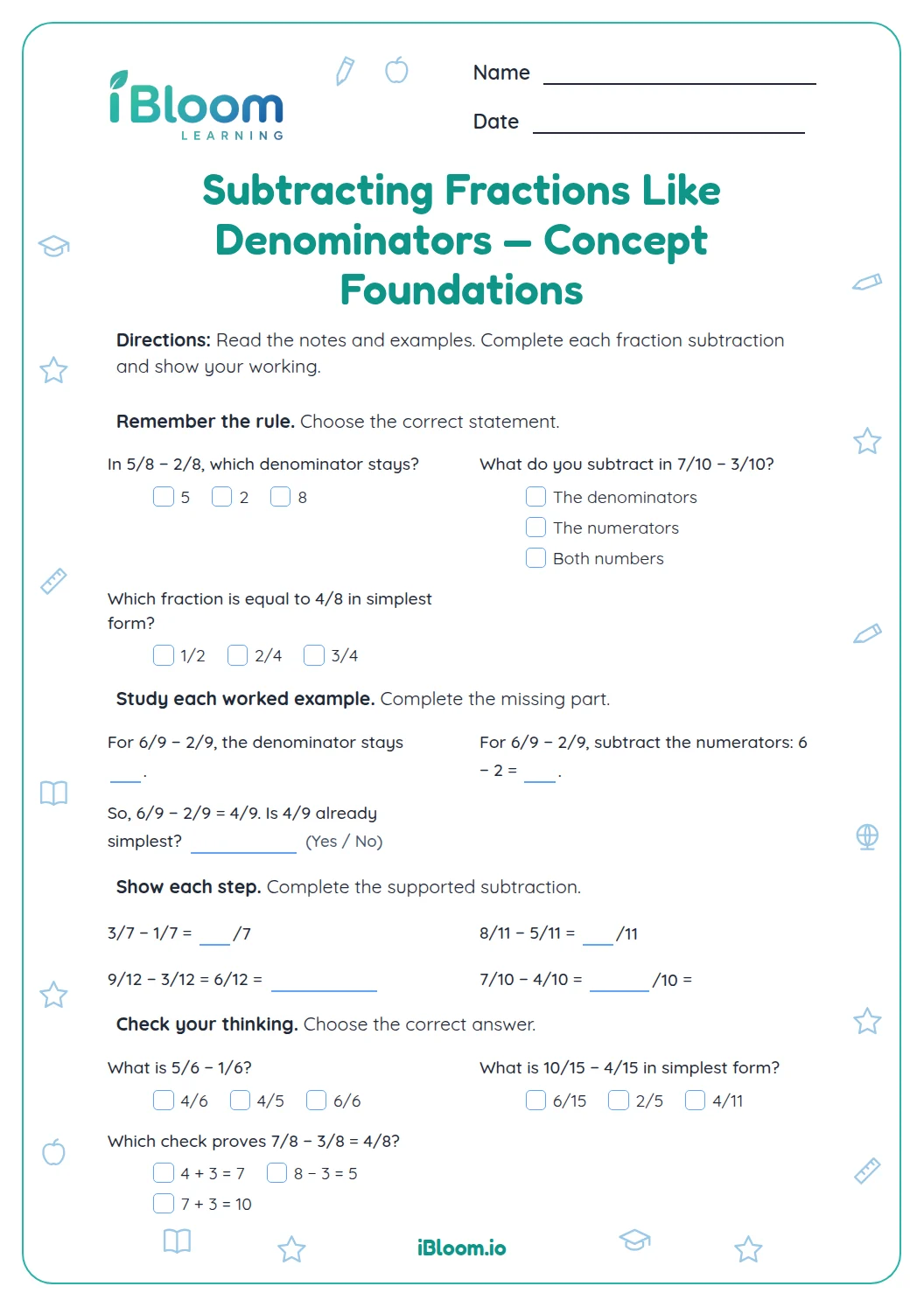
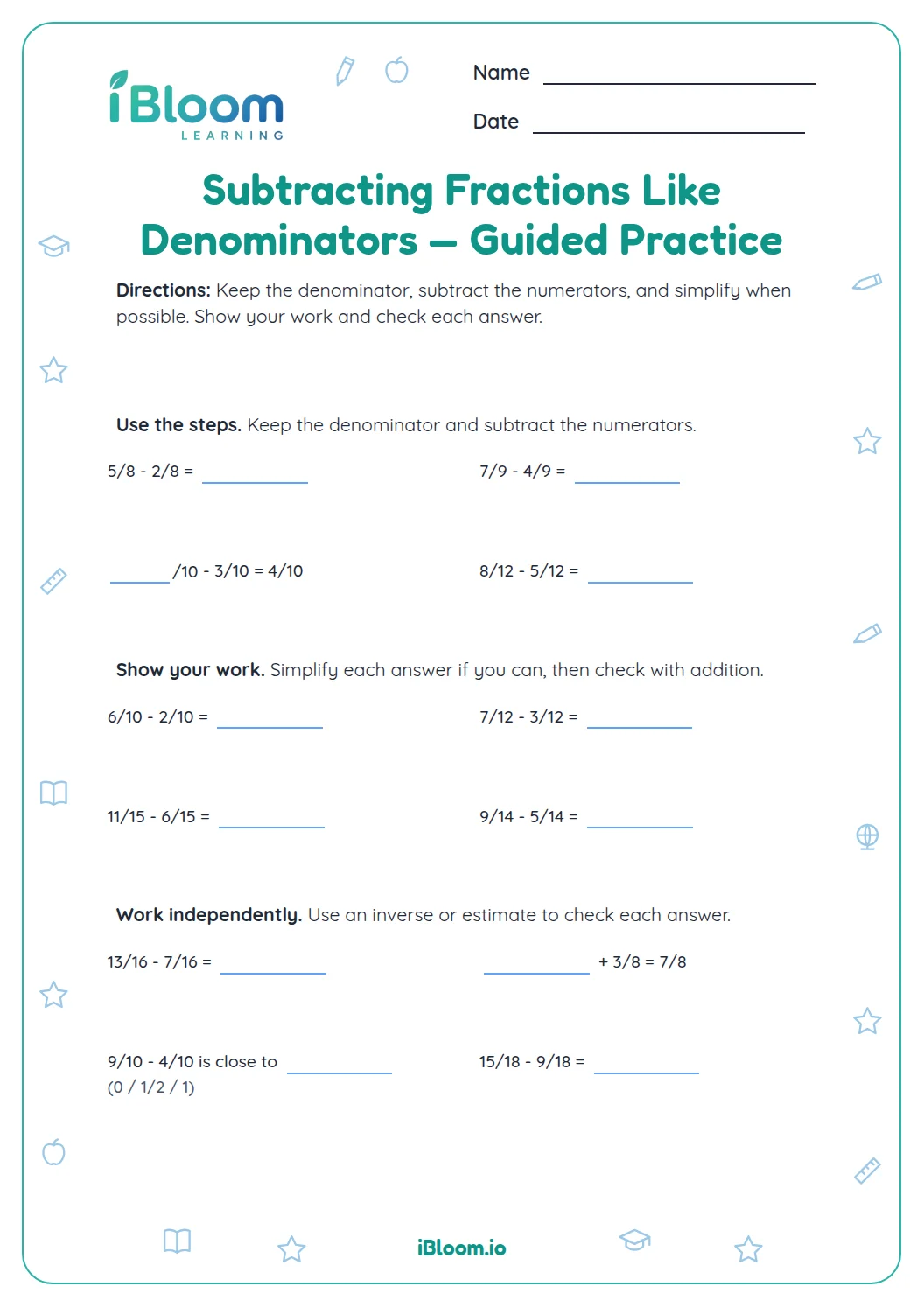
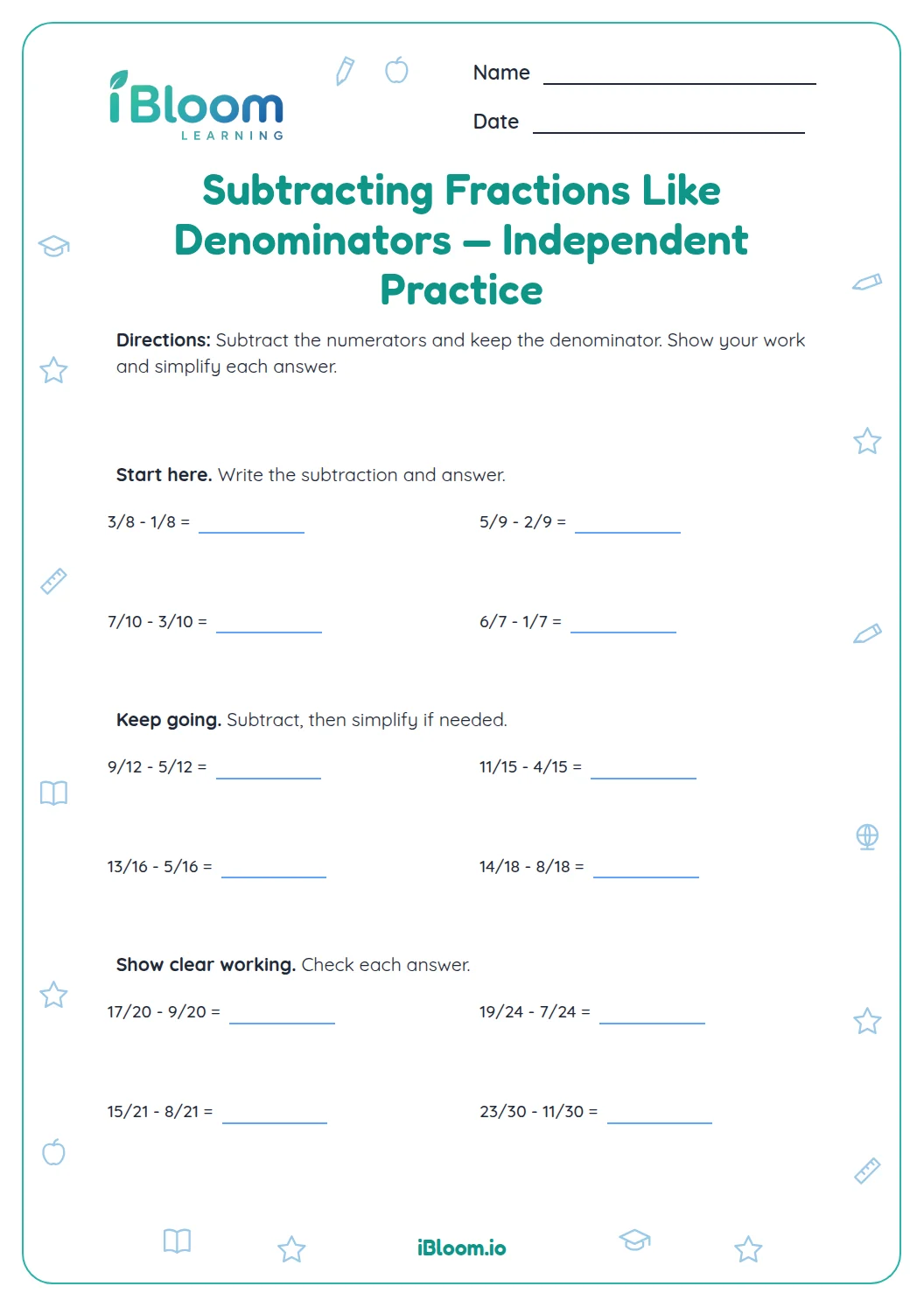
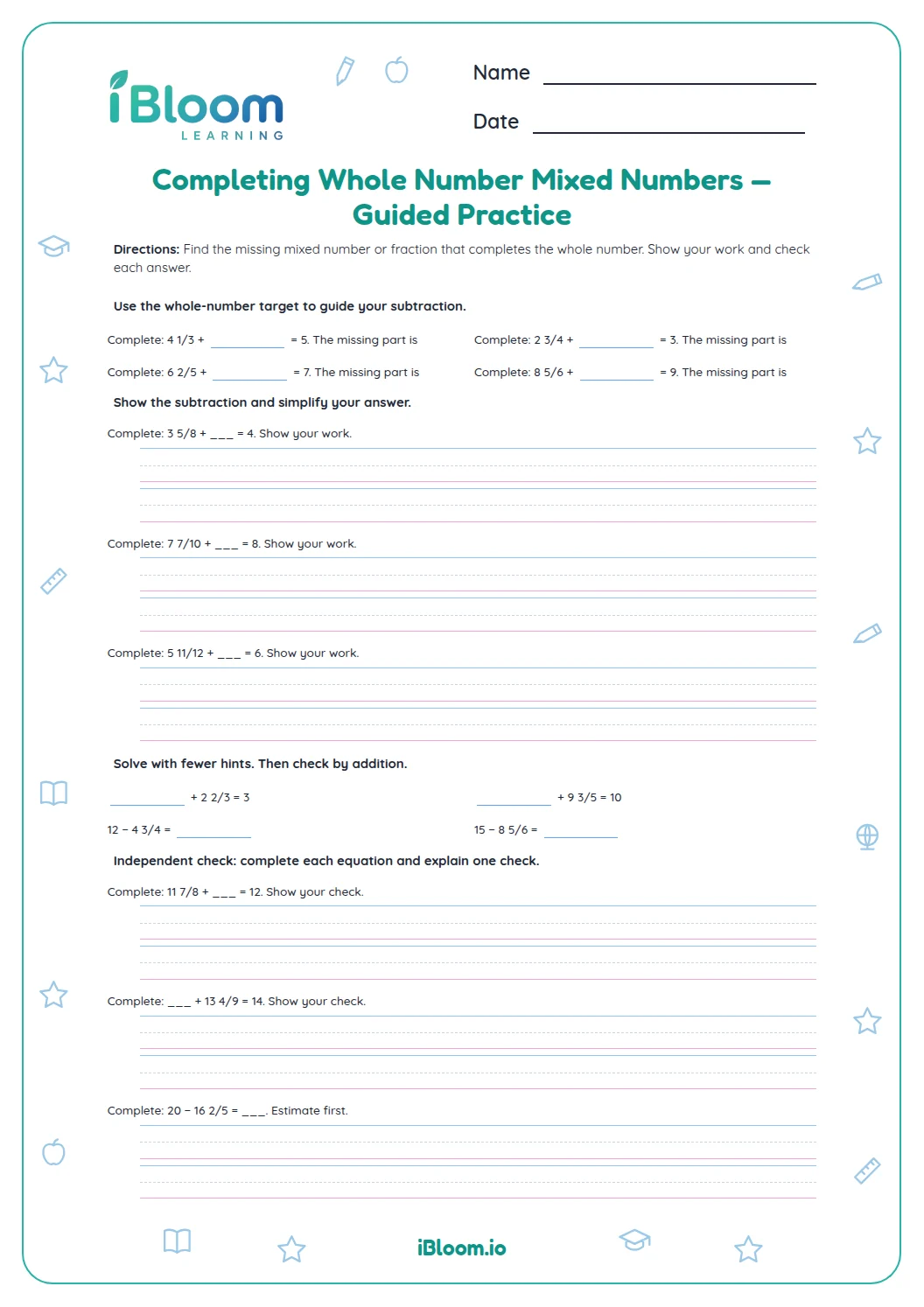
This free Grade 5 worksheet makes subtracting fractions from whole numbers visible. Part A has four bar models: the white pieces have been removed, and children write the shaded amount left. Part B and Part C build from two guided examples to independent equations and an error check. The 14 questions use thirds, fourths, fifths, sixths, eighths and tenths. Separating equal parts from wholes practices Common Core 4.NF.B.3a. A separate answer key gives the simplified fractions and mixed numbers.
Aligned to 4.NF.B.3a
What do the shaded bars mean?
In Part A, shaded pieces represent what remains. White pieces in the last bar represent the amount taken away. Each complete bar is one whole, and all pieces within a question have the same size. Count the complete shaded bars before counting the remaining pieces.
Question 2 starts with 2 and removes 3/4. One complete bar stays shaded, and one of the four pieces in the other bar stays shaded.
- 12 − 3/4
- 2Rename 2 as 1 + 4/4.
- 3Subtract: 4/4 − 3/4 = 1/4.
- 4Keep the other whole: 1 + 1/4 = 1 1/4.
How do you subtract without a model?
Part B begins with two familiar whole-number subtraction equations. Part C continues with compact practice and asks children to correct Ben’s error. For 4 − 7/8, rename 4 as 3 + 8/8, then subtract 7/8 to get 3 1/8.
Which answers need simplifying?
Question 8 is 3 − 4/10. Rename one whole as 10/10; the result is 2 6/10, or 2 3/5. Add 4/10 back to check that the sum is 3.
How to use this worksheet
- 1Review one whole as equal parts matching the fraction being subtracted.
- 2For Part A, identify the white pieces removed and count the shaded pieces left.
- 3Include each complete shaded bar when writing a mixed number.
- 4In Parts B and C, rename one whole when needed, subtract, and simplify.
- 5Correct Ben’s subtraction in the final question.
- 6Add the removed fraction back to check the result.
Mistakes to check together
The mistake
Writing 3/4 for question 2 because three pieces are white.
The fix
White means removed; count the shaded whole and shaded fourth to get 1 1/4.
The mistake
Writing 2 1/4 for 2 − 3/4.
The fix
One of the two wholes became fraction pieces, so only one complete whole remains.
The mistake
Keeping an unsimplified answer such as 2 6/10.
The fix
Rename 6/10 as 3/5, so the simplest answer is 2 3/5.
Common Core alignment
Subtract fractions by taking equal parts away from the same whole.
On this sheet: Bar models show the fraction removed and the amount left; number lines show equal backward steps.
Show the official wordingHide the official wording
Understand addition and subtraction of fractions as joining and separating parts referring to the same whole.
What to practice next
Make more practice
Further reading
Questions parents and teachers ask
What do the white pieces in Part A show?
They show the fraction removed from the starting whole number. In question 2, three white fourths have been taken away, leaving one shaded fourth and one complete shaded bar. Children write the shaded amount that remains. Reading both colors connects the model to the subtraction equation.
How can children subtract without a bar?
Rename one whole as equal fraction parts, then subtract the parts. For 4 − 7/8, write 4 as 3 + 8/8. Subtract 7/8 from 8/8 and keep the three whole units, giving 3 1/8. Ask children to say what happened to one whole before calculating.
Should children simplify the answers?
Yes, the directions ask for simplest form. In question 8, subtracting four tenths from three leaves two wholes and six tenths. Six tenths equals three fifths, so the final answer is 2 3/5. Add four tenths back to check.
How can a whole number be renamed as a fraction?
Use equal parts that match the fraction being subtracted. For question 2, one whole is four fourths, so two wholes can be written as eight fourths. Then 8/4 − 3/4 = 5/4, which is 1 1/4. Keeping one whole separate is another way to reach the same answer.
What is included in the answer key?
The separate key gives all fourteen differences in simplest form. It covers four shaded-bar questions, nine compact subtraction equations and one error correction. Have children add the removed fraction back to each answer and check that they reach the starting whole number.