





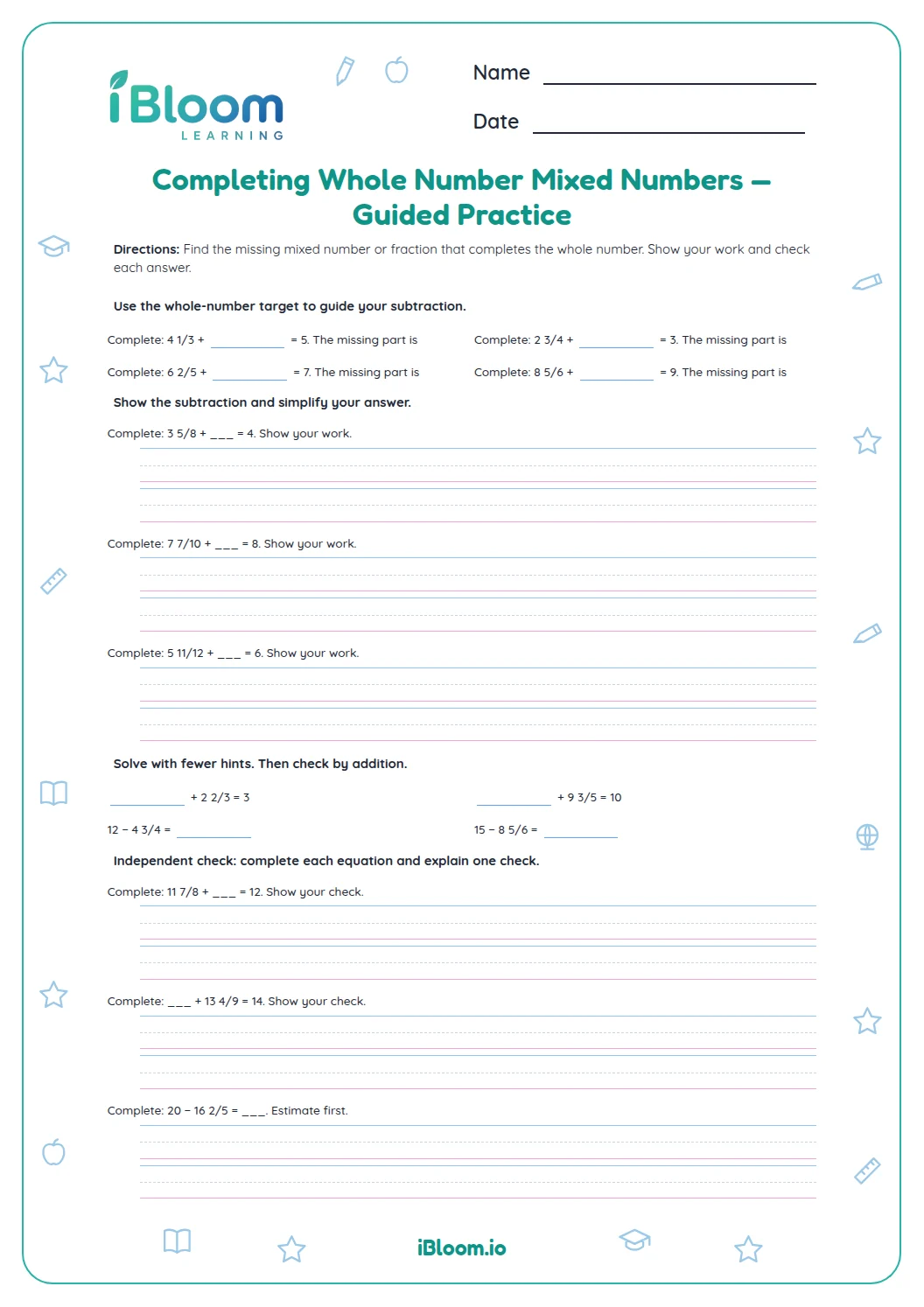

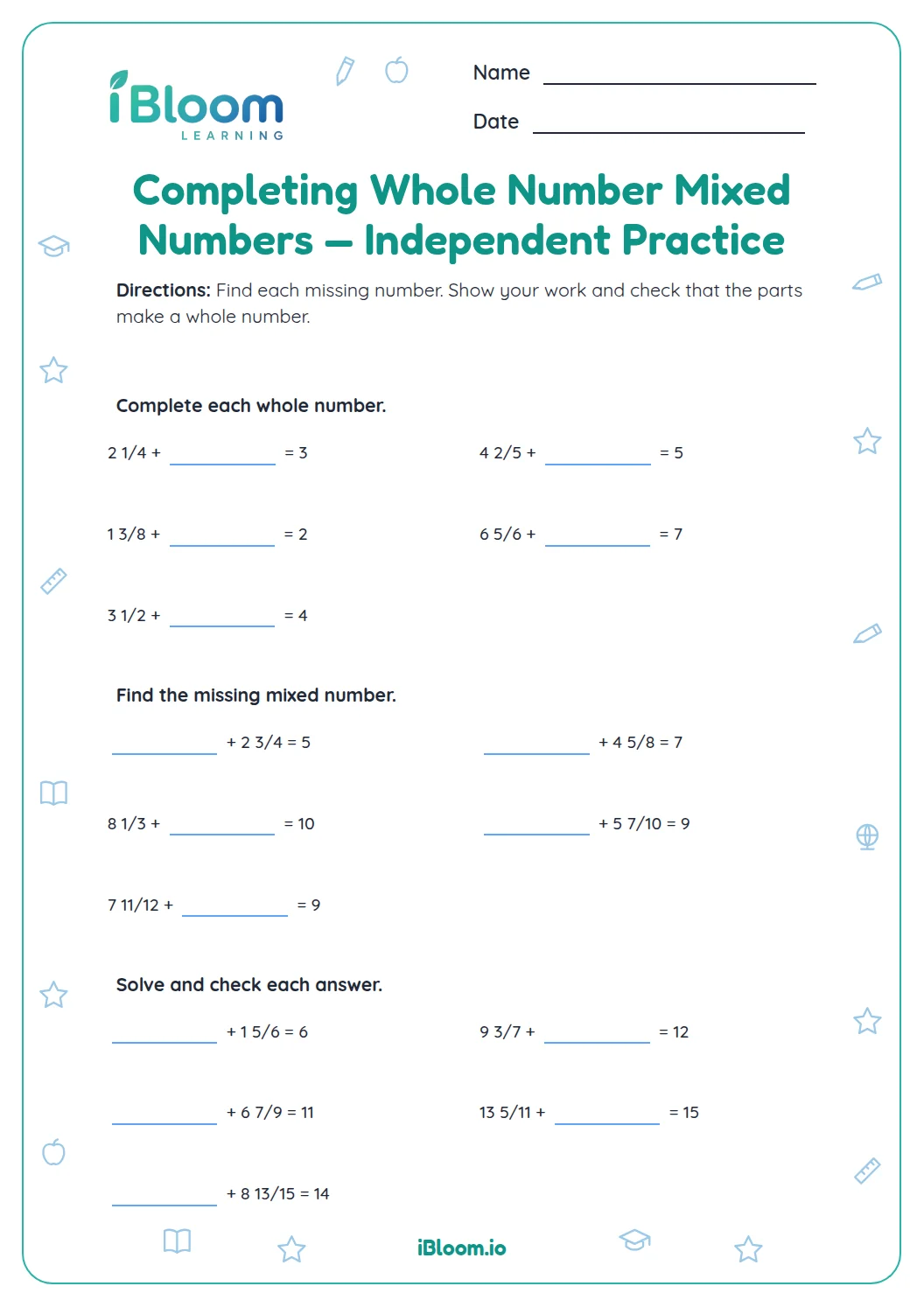
About this worksheet
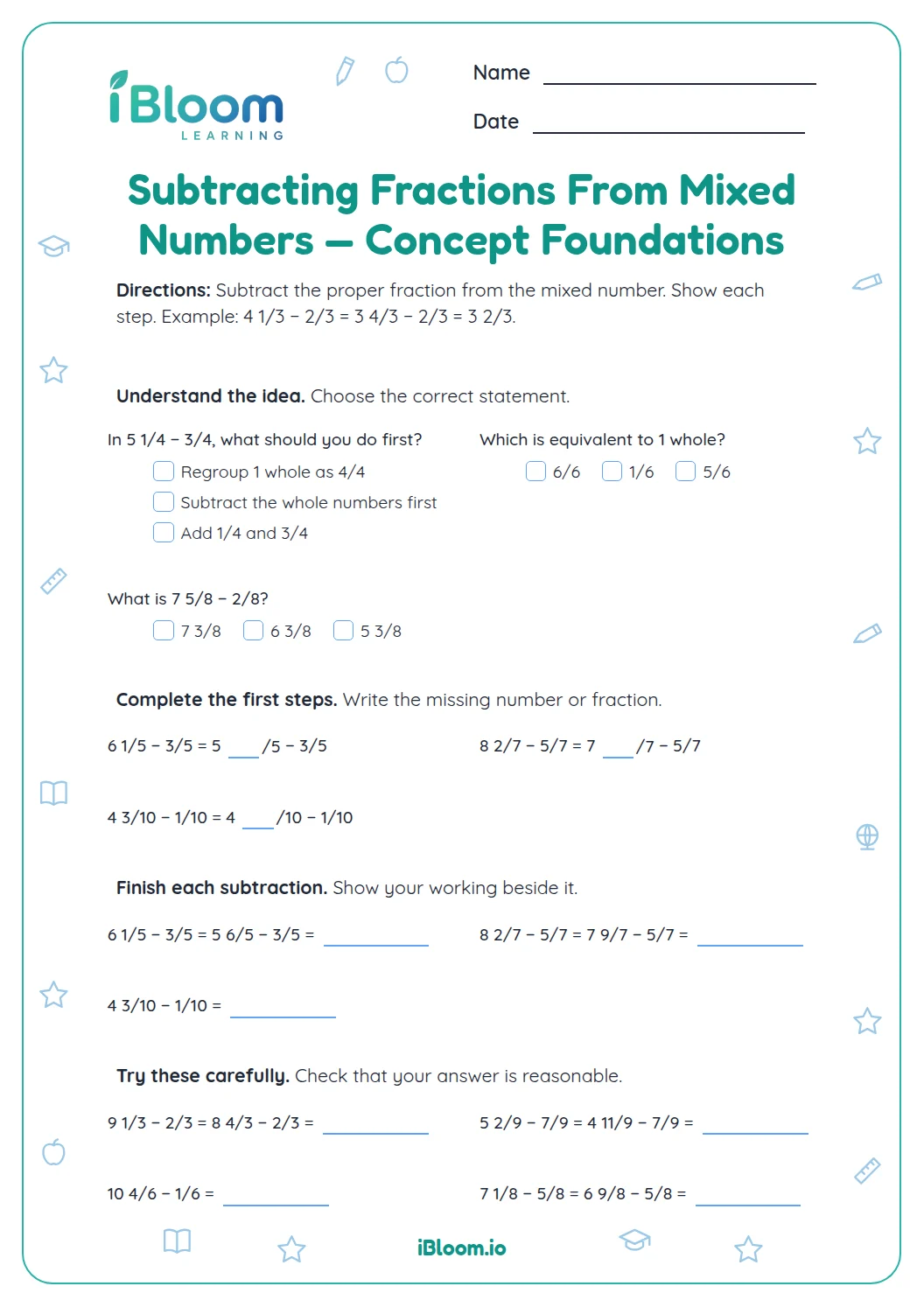
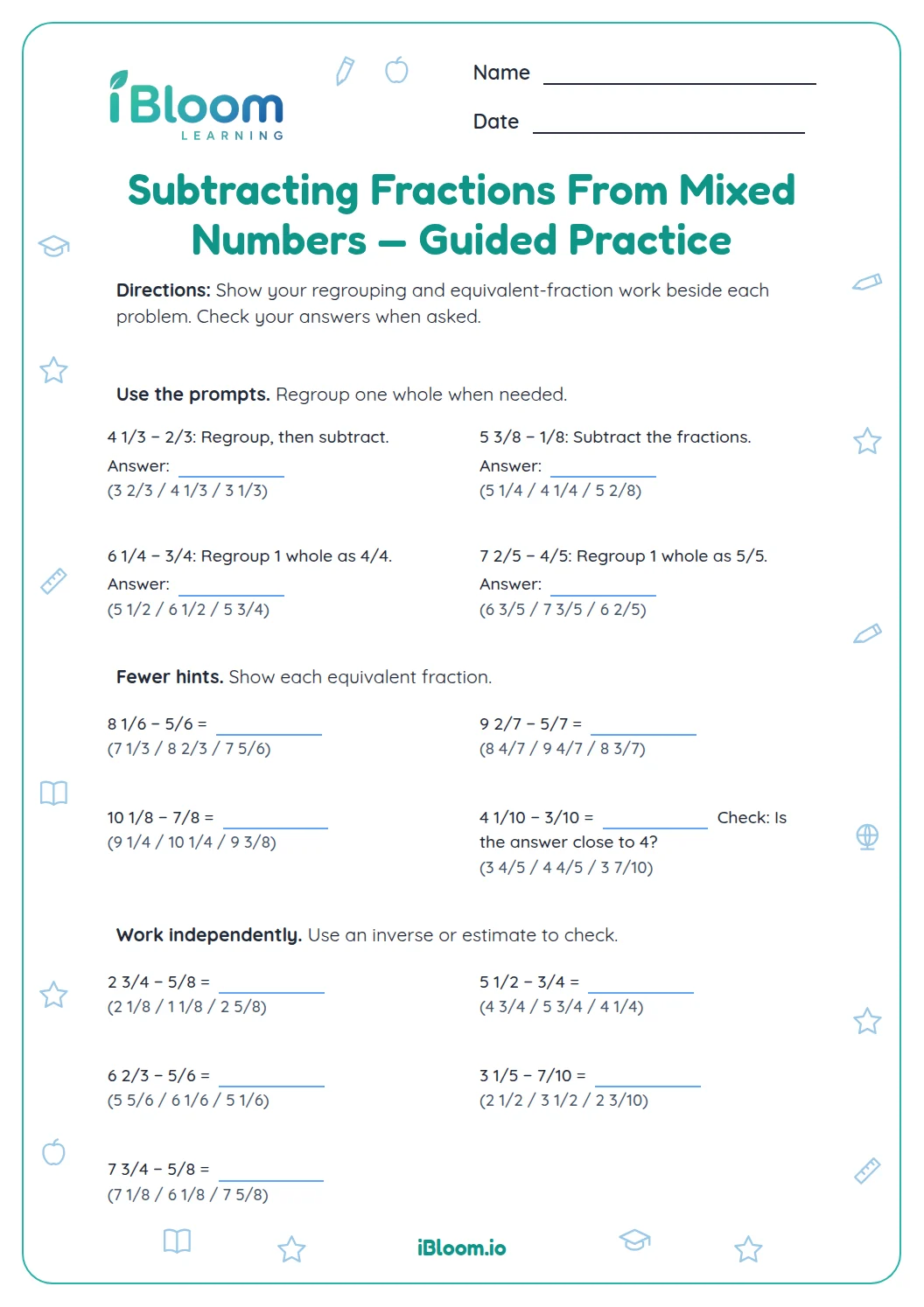
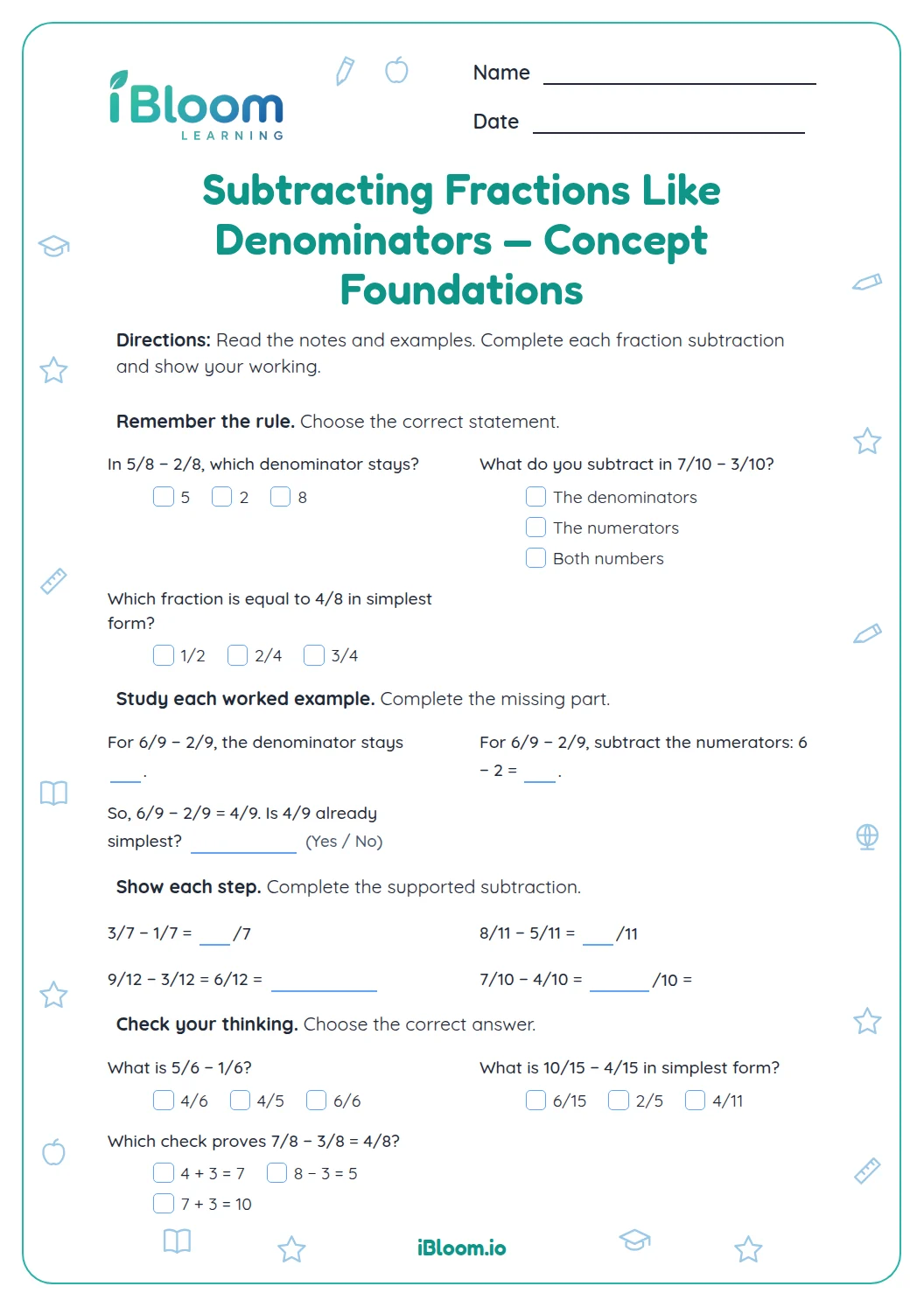
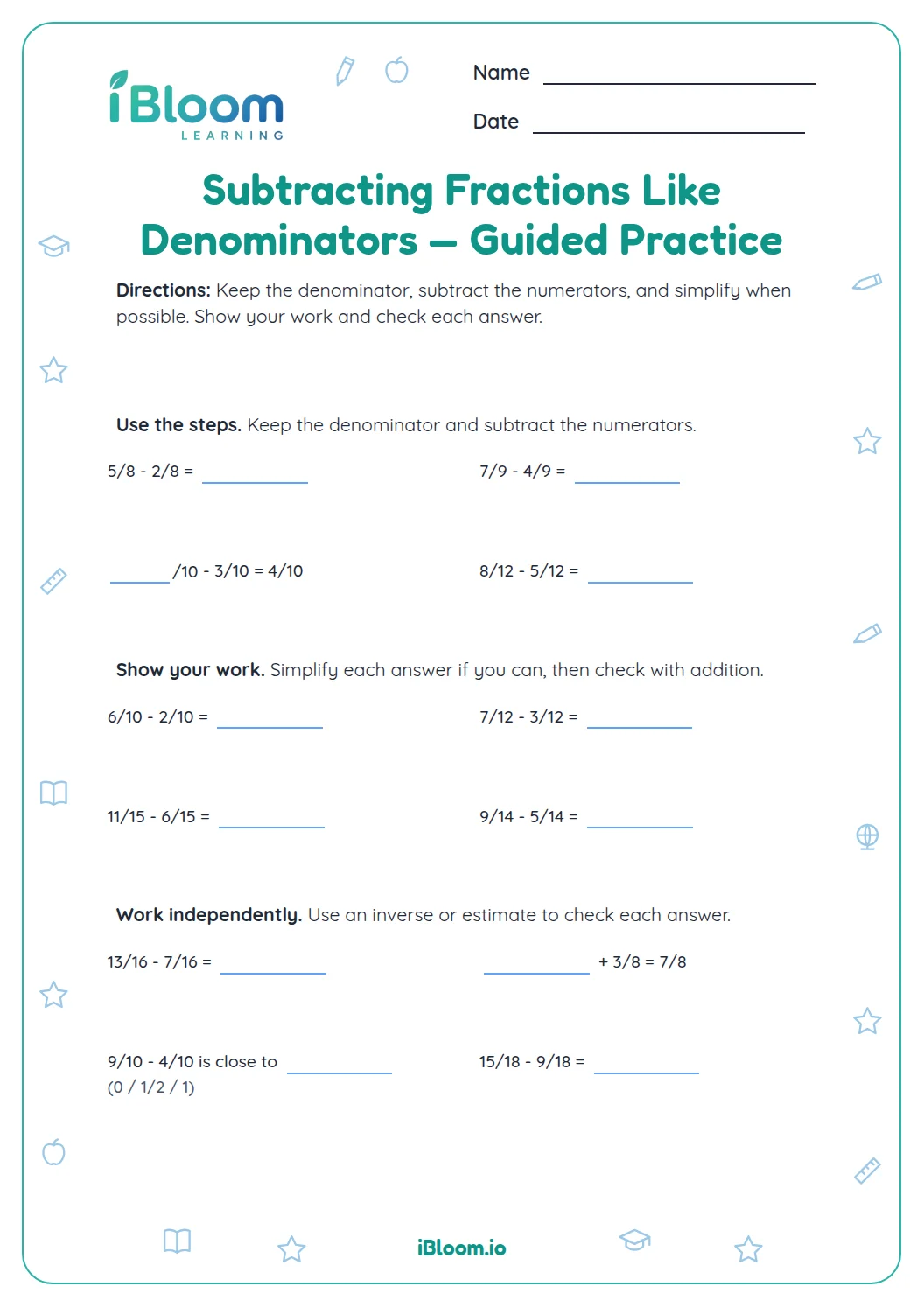
This Grade 5 worksheet gives 14 practice questions for subtracting a fraction from a whole number. Students first identify an equivalent regrouping, complete the subtraction step, and solve independently with mixed-number answers. The examples keep the denominator as the size of the fractional parts and align with 5.NF.A.1.
Aligned to 5.NF.A.1
Why do I rename one whole?
A whole can be written as a fraction when numerator and denominator are equal. For fifths, one whole is 5/5. Taking one whole from 5 leaves 4 wholes, so 5 = 4 + 5/5.
- 15 − 2/5 = 4 + (5/5 − 2/5)
- 2= 4 3/5
How can I check the result?
Add the fraction that was subtracted to the mixed-number answer. For 5 − 2/5 = 4 3/5, add 2/5 back: 4 3/5 + 2/5 = 5. The difference should also be less than the starting whole number.
Should I simplify the fraction?
Keep the denominator as the size of the parts while subtracting. When the result can be renamed as a simpler equivalent fraction, the answer key may show that equivalent form; check that it has the same value.
How to use this worksheet
- 1Read the denominator to see the size of the fractional parts.
- 2Rename one whole as the same number of fractional parts.
- 3Subtract the numerator and combine the result with the whole units left.
- 4Check by adding the fraction back to the mixed-number answer.
Common mistakes and quick fixes
The mistake
Subtracting the numerator from the whole number and keeping the fraction, such as 5 − 2/5 = 3 2/5.
The fix
Rename 5 as 4 + 5/5 first. Then subtract 2/5 from 5/5 to get 3/5.
The mistake
Renaming 5 as 4 + 1/5 instead of 4 + 5/5.
The fix
The fraction used to rename one whole must equal one. With fifths, that is 5/5.
The mistake
Changing the denominator while subtracting like-sized parts.
The fix
Keep the denominator; subtract only the numerators after the parts have the same size.
Common Core alignment
This Grade 5 worksheet practices the grade-level skill described by the Common Core standards below.
Add and subtract fractions with unlike denominators by replacing with equivalent fractions.
On this sheet: Students rewrite a whole as a mixed number with denominator-sized fraction parts before subtracting.
Show the official wordingHide the official wording
Add and subtract fractions with unlike denominators (including mixed numbers) by replacing given fractions with equivalent fractions in such a way as to produce an equivalent sum or difference of fractions with like denominators.
What to practice next
Make more practice
Further reading
Questions parents and teachers ask
Why does 5 become 4 5/5?
One of the five wholes is renamed as 5/5. Four wholes remain, and 5/5 equals one whole, so the value stays five. This gives fraction parts with denominator 5 that can be subtracted from 2/5. The regrouped fraction is equivalent to one whole, so the amount has not changed.
Why must the denominator match?
The fraction parts must have the same size to subtract their numerators. In 5 − 2/5, rename one whole as 5/5. Then both pieces are fifths, so subtract 2 fifths from 5 fifths and keep the denominator.Equivalent fractions keep the same value while showing the same-sized pieces needed for subtraction.
How do I subtract the numerator?
After regrouping, subtract the numerator from the equivalent fraction. For 5 − 2/5, calculate 5/5 − 2/5 = 3/5, then combine that fraction with the 4 whole units that remain. The result is 4 3/5. For example, the whole part is four, and the leftover part is three fifths.
How can I check the result?
Add the fraction that was subtracted to the mixed-number answer. For 5 − 2/5 = 4 3/5, adding 2/5 returns 5. The difference should also be less than the starting whole number, because a positive amount was taken away.
Why is the answer less than the whole number?
The fraction is being taken away, so the result must be smaller than the starting whole number. For example, subtracting 2/5 from 5 leaves 4 3/5. Add 2/5 back to that result to check that it returns to 5.
What should I do if the fraction is already a unit fraction?
Use the same regrouping step. Rename one whole as a fraction with the denominator shown, then subtract the numerator. For example, 3 − 1/2 becomes 2 + (2/2 − 1/2), or 2 1/2. The answer key shows the completed results.