


About this worksheet
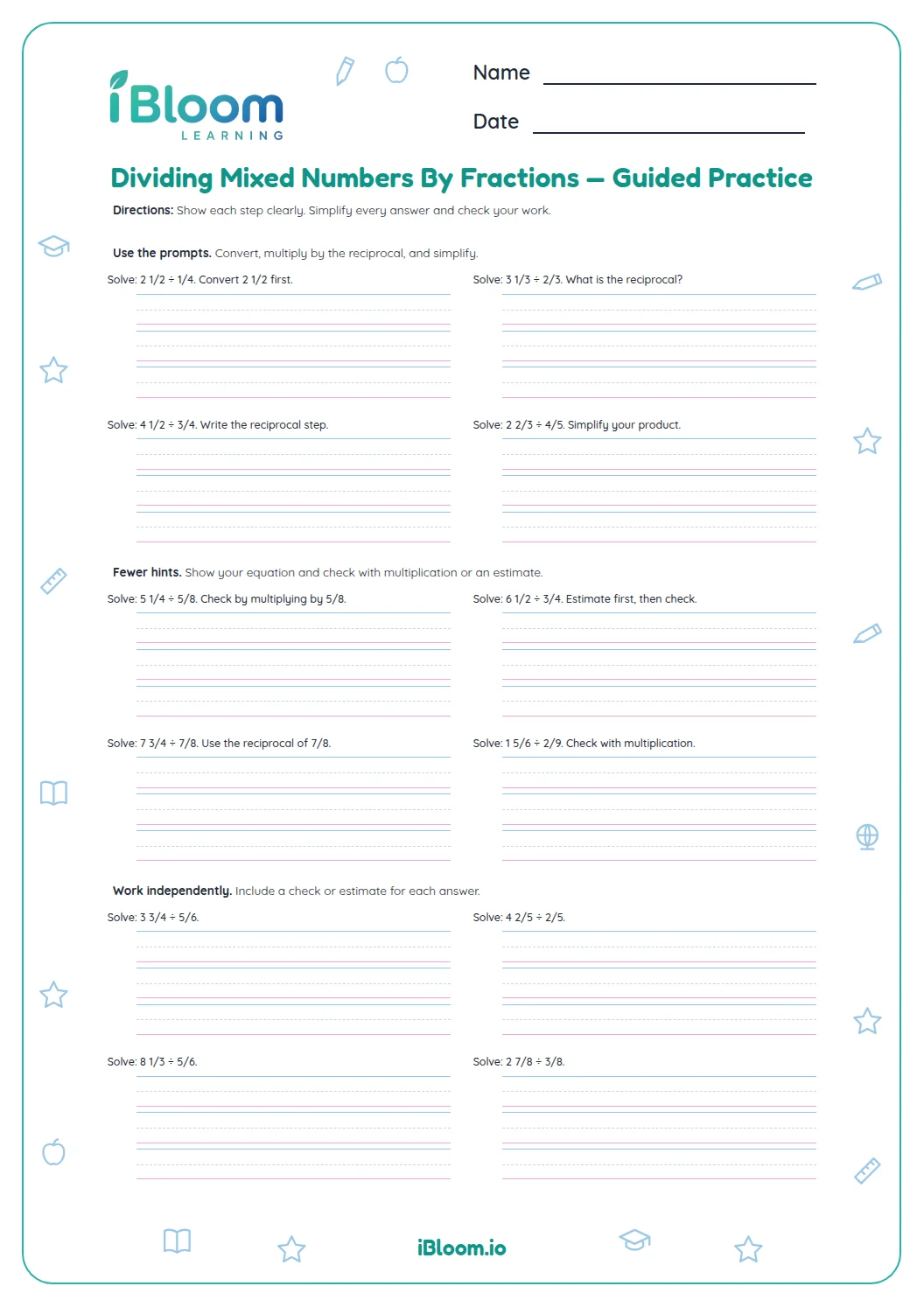
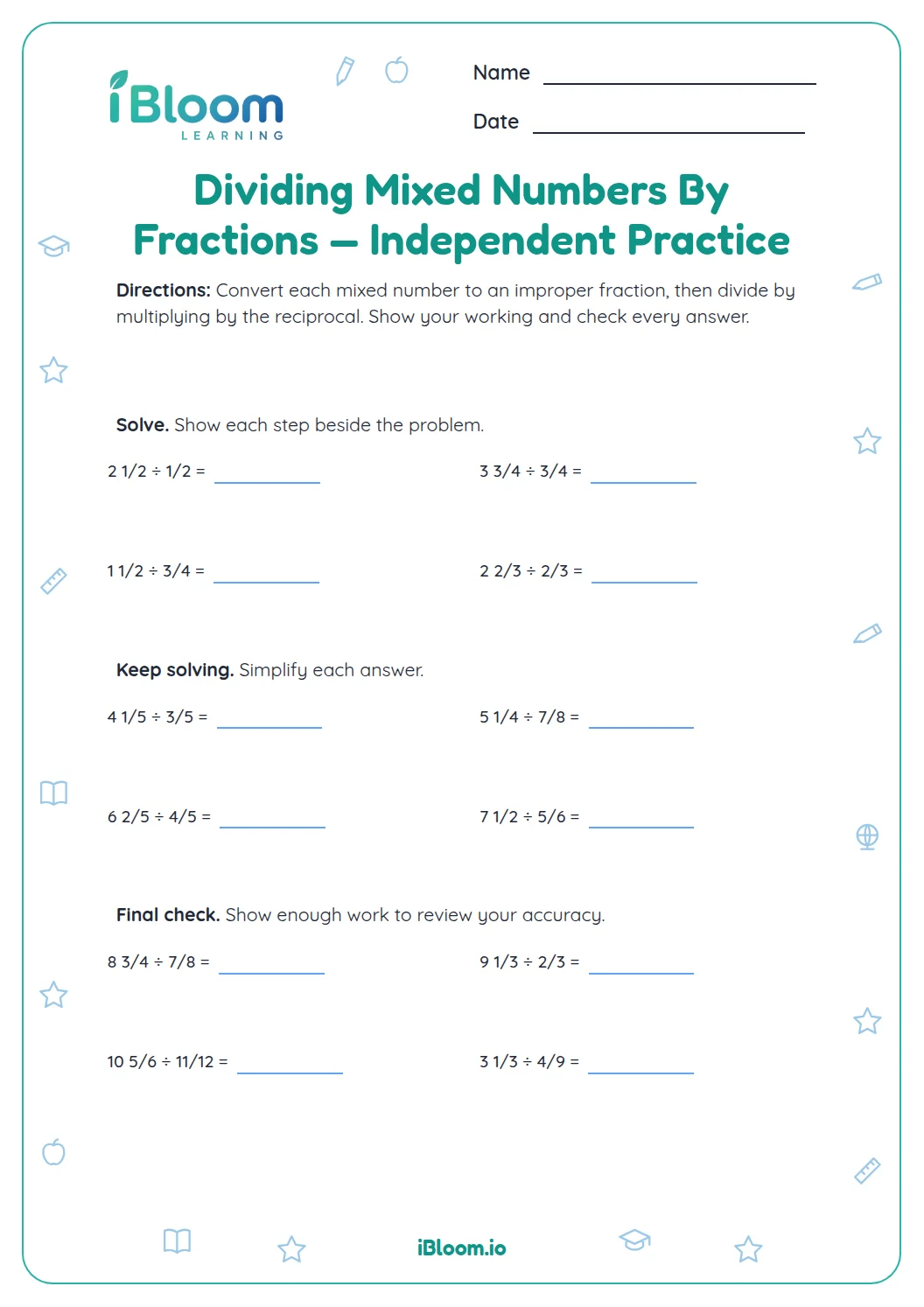
This Grade 5 worksheet practices dividing a mixed-number amount into fractional groups. Learners find how many batches, pieces, servings, or sections fit in a total, then label the quotient with its unit. The problems include kitchen, ribbon, distance, and measurement contexts, with room to show the division and check by multiplication. A separate answer key is included.
What does the quotient count?
A division question asks how many groups of a certain size fit in the total. In question 1, five half-cup scoops make 2 1/2 cups, so the quotient counts batches.
Keep the unit in mind: the answer is a number of batches, glasses, pieces, or sections, not another amount of the starting ingredient.
- 12 1/2 ÷ 1/2
- 2There are five half-cup groups in 2 1/2 cups.
- 3Answer: 5 batches
How can a quotient be checked?
Multiply the number of groups by the size of one group. For question 3, six cups at 1/4 liter each use 6 × 1/4 = 1 1/2 liters. That matches the jug.
A fractional group size can produce a whole-number count larger than the total amount. This makes sense when each group is smaller than one whole unit.
What is included in the practice?
There are 16 contextual problems in two parts. The first situations use familiar halves, fourths, and thirds; later items use varied fractional amounts and ask learners to keep the units clear.
How to use this worksheet
- 1Read the unit and the total before choosing an operation.
- 2Ask what one group contains and what the question wants to count.
- 3Write total ÷ group size in the equations space.
- 4Estimate whether several small groups or only a few large groups should fit.
- 5Multiply quotient by group size to check the total.
- 6Write the answer with the unit the question asks for.
Common slips and quick fixes
The mistake
Dividing the total by the number of groups
The fix
Use the group size as the divisor, then check by multiplying groups × size.
The mistake
Leaving off the context unit
The fix
Name what the quotient counts, such as cups, batches, or sections.
The mistake
Accepting a quotient that does not rebuild the total
The fix
Multiply the proposed number of groups by the group size and compare with the starting amount.
What to practice next
Further reading
Questions parents and teachers ask
What does the quotient mean in these problems?
It tells how many groups of the stated size fit in the total. For example, 2 1/2 cups divided into 1/2-cup batches gives 5 batches. The unit names the groups, while the starting amount names what is being divided.
How can a student check a quotient?
Multiply the number of groups by the size of one group. Six cups of 1/4-liter portions use 6 × 1/4 = 1 1/2 liters. If the product matches the amount in the story, the quotient fits the context.
Why can the answer be greater than the starting amount?
A group can be smaller than one whole unit. For example, a 4 2/5-meter cord contains eleven pieces that are each 2/5 meter long. The quotient counts those small pieces, so it can be larger than 4 2/5.
Should children write units with their answers?
Yes. The prompts ask for batches, pieces, cups, stages, or another countable group. Writing “5 pieces” makes clear what the quotient counts and helps distinguish it from the length or weight of the original amount. A clear unit also helps children explain what their answer counts in the situation.
What is included in the answer key?
The separate key gives the number of groups for all 16 situations. Students can write a division sentence, solve, then check whether multiplying the group count by the group size returns the total in the prompt. It is organized across three printable pages for both practice and checking.