





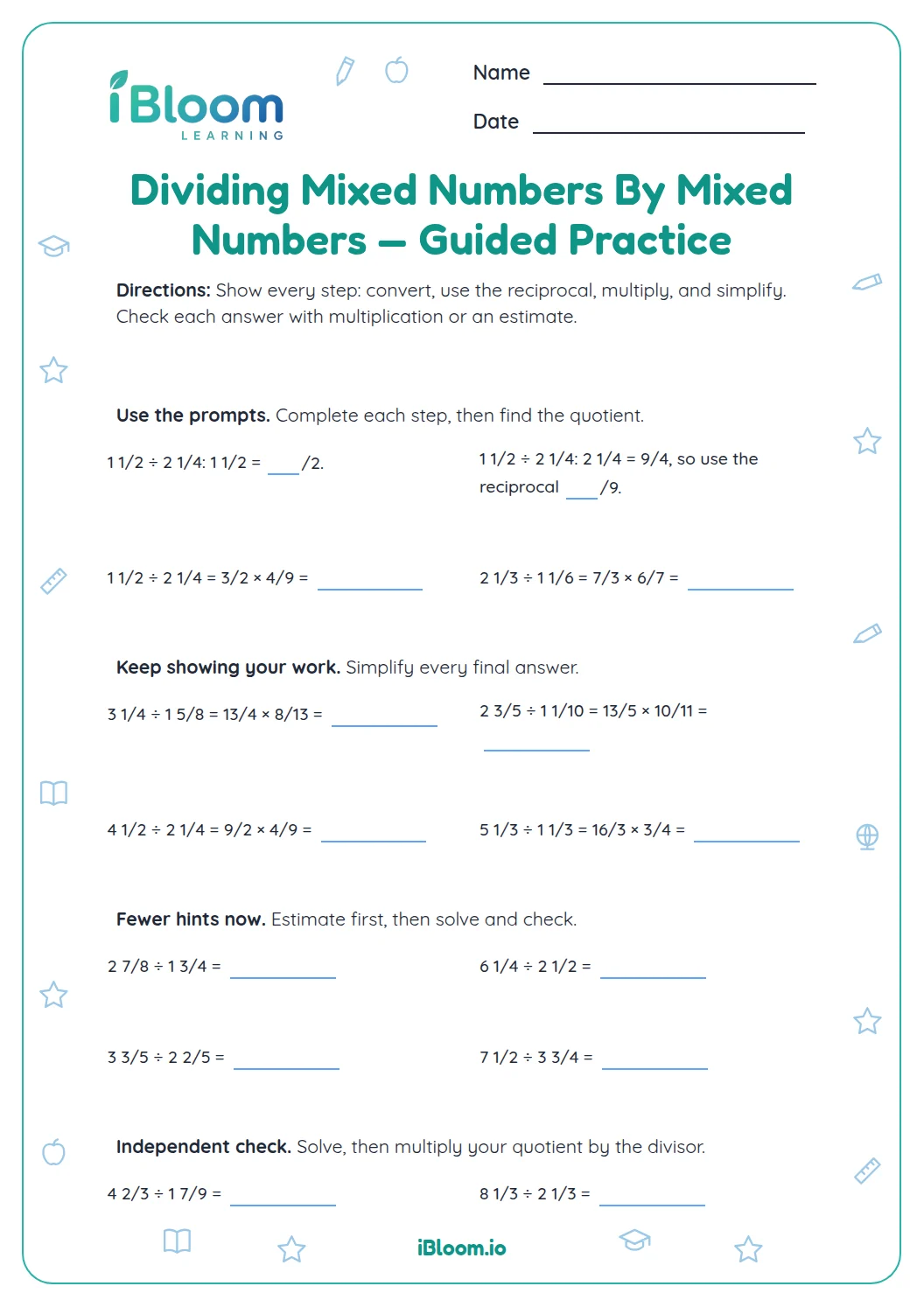

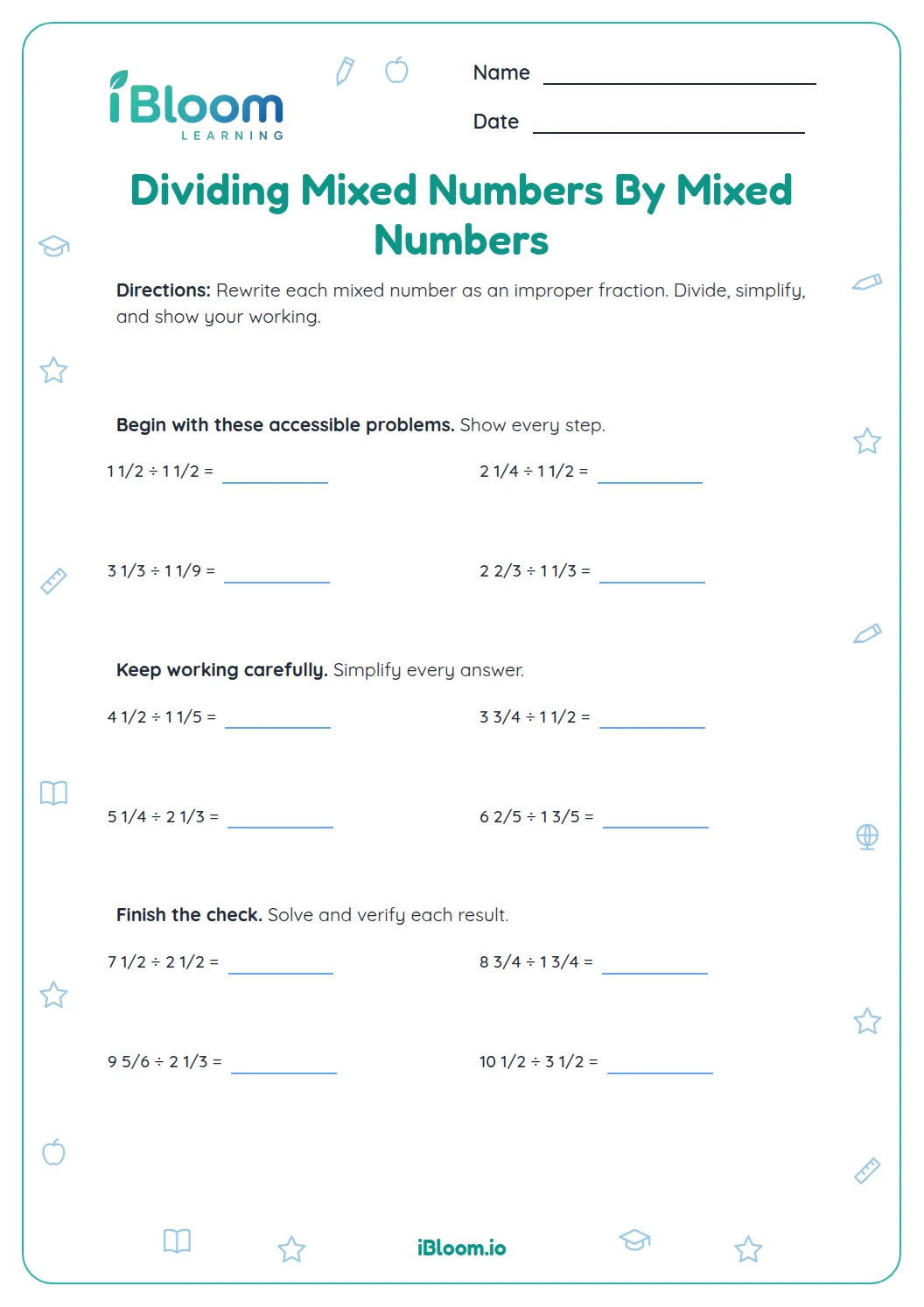
About this worksheet
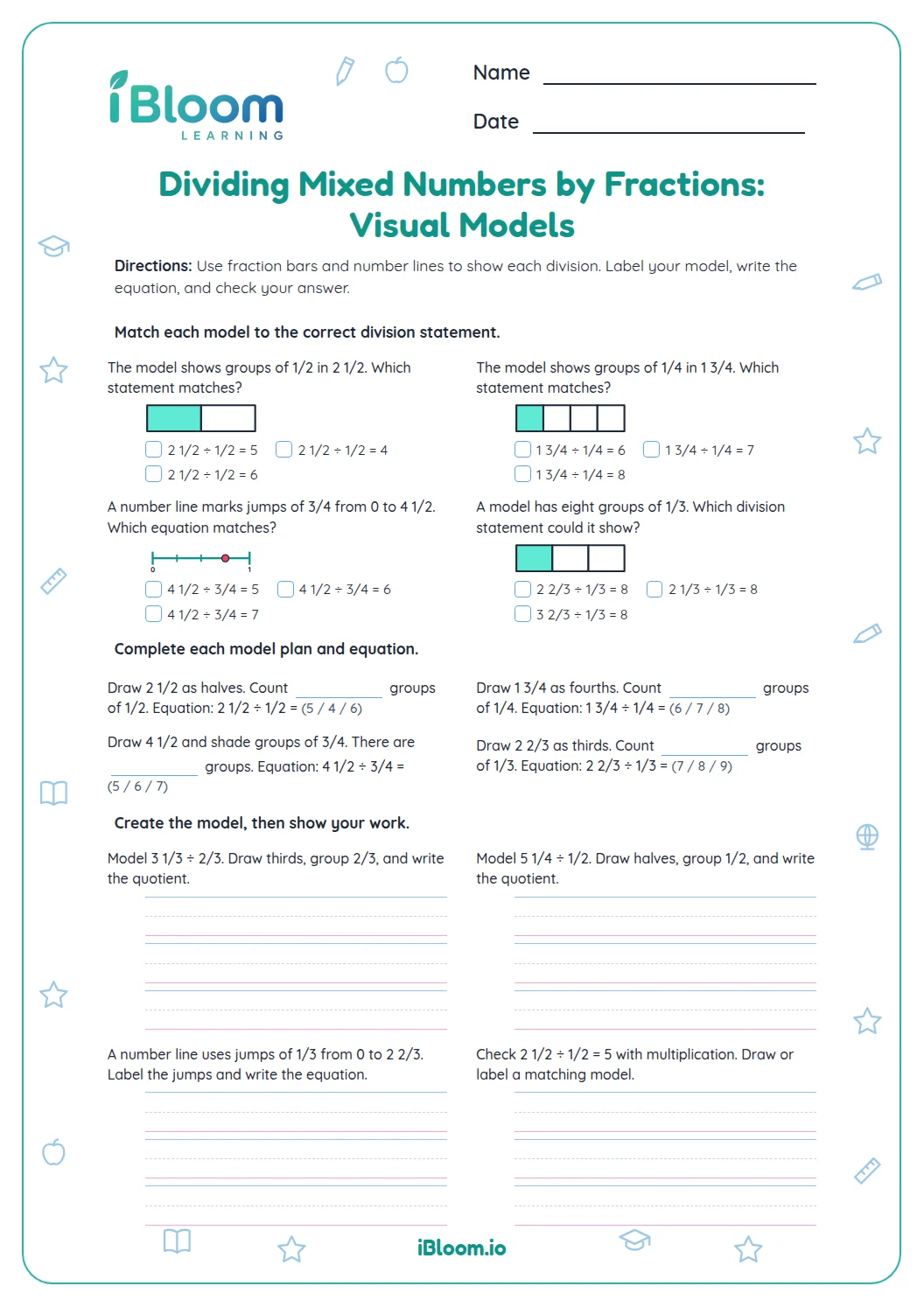
This free printable worksheet gives Grade 5 students ten ways to see mixed-number division. Part A uses shaded bars to count halves, fourths, and thirds. Part B uses number lines to group equal intervals, ending with two problems whose quotients include part of a group. Students connect each drawing to a division equation instead of using a rule without a model. The practice addresses Common Core 6.NS.A.1, interpreting and computing fraction quotients with visual models. A separate answer key gives all ten quotients.
Aligned to 6.NS.A.1
What does each shaded bar represent?
Each complete bar represents one whole. All bars in a question use the same-size pieces. In Part A, the divisor is one piece, so the number of shaded pieces is also the number of groups. Unshaded pieces are outside the starting amount.
Ask students to name the unit before counting: halves, fourths, or thirds. This keeps the answer connected to the size of the divisor.
How do number-line intervals become groups?
In Part B, a group can cover more than one small interval. For question 7, each interval is 1/4 and each group is 3/4, so three small intervals make one jump. Students can mark arcs above the line to track the groups.
- 12 1/4 ÷ 3/4
- 22 1/4 = 9/4
- 3Nine fourths make three groups of three fourths.
- 42 1/4 ÷ 3/4 = 3
How should students count part of a group?
Question 10 has ten fourth-size intervals to put into groups of three. Three complete groups use nine intervals. The last interval is one third of a three-interval group, so the quotient is 3 1/3.
The leftover length and the leftover fraction of a group have different meanings. Have students point to a complete group before naming the fraction of a group that remains.
How to use this worksheet
- 1Read the first equation and name the size of one shaded piece.
- 2Count only the shaded pieces in Part A and record each quotient.
- 3For Part B, count how many small intervals belong to one divisor-size jump.
- 4Mark equal jumps from zero to the endpoint, then count the jumps.
- 5For the final two questions, compare the leftover interval with one complete group.
- 6Multiply each quotient by its divisor to check the original mixed number.
Mistakes to discuss
The mistake
Counting unshaded pieces in a bar.
The fix
Count only the shaded starting amount; the last bar may be partly empty.
The mistake
Counting every tick mark as a group.
The fix
Count spaces between ticks, then combine enough spaces to make the divisor.
The mistake
Writing 3 1/4 for question 10.
The fix
The leftover 1/4 is one third of a 3/4-size group, so write 3 1/3.
Common Core alignment
Interpret division by a fraction as counting groups in a mixed-number amount.
On this sheet: The bars and number lines represent mixed-number amounts to divide into fraction-size groups.
Show the official wordingHide the official wording
Interpret and compute quotients of fractions, and solve word problems involving division of fractions by fractions, e.g., by using visual fraction models and equations to represent the problem.
What to practice next
Make more practice
Further reading
Questions parents and teachers ask
What should students know before using these models?
Students should be able to read mixed numbers and identify equal halves, thirds, and fourths. They also need to count intervals on a number line. Begin with the shaded bars to connect the starting amount to pieces before combining several small intervals into a larger group.
Why can a quotient be larger than the starting number?
A quotient counts groups, and these groups are smaller than one whole. In question 1, one and a half wholes contain three half-size groups. Point to each shaded half while counting so that the number three has a clear unit: groups of one half.
Are all the answers whole numbers?
Eight answers are whole numbers, and the final two include a fraction of a group. Question 9 has three complete half-size groups plus half of another group. Question 10 has three complete three-fourths-size groups plus one third of another group. The key includes both mixed-number answers.
Should students draw on the number lines?
Yes, students can mark arcs or grouping brackets above the printed number lines. Start at zero and make each jump the size named by the divisor. The printed small intervals provide a measuring guide; children count their larger jumps to find the quotient for each equation.
How can I check an answer without recounting the model?
Multiply the quotient by the divisor to recover the starting mixed number. For question 7, three groups of three fourths make nine fourths, or two and one fourth. If the multiplication gives a different amount, return to the line and check the size of each group.