




About this worksheet
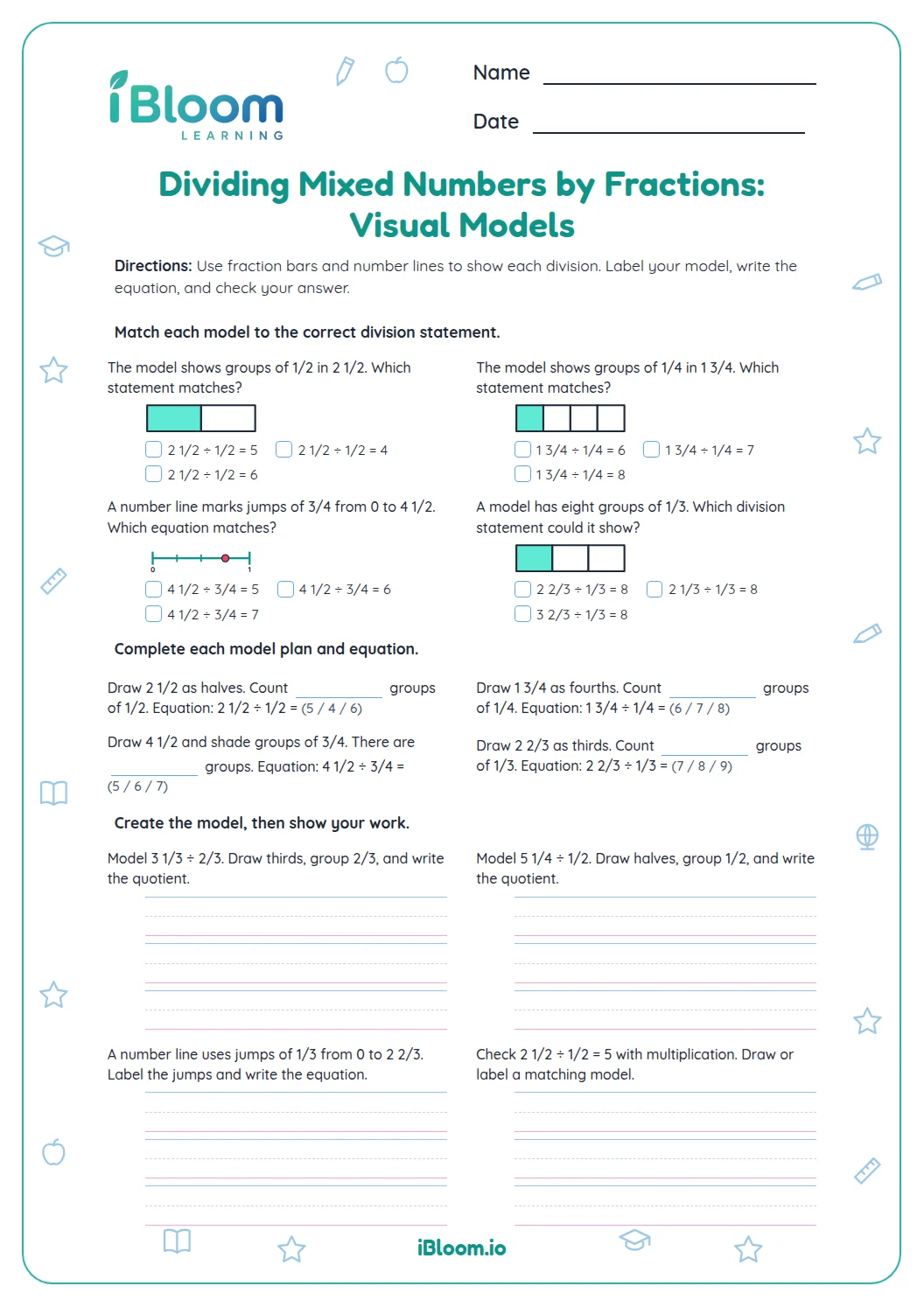
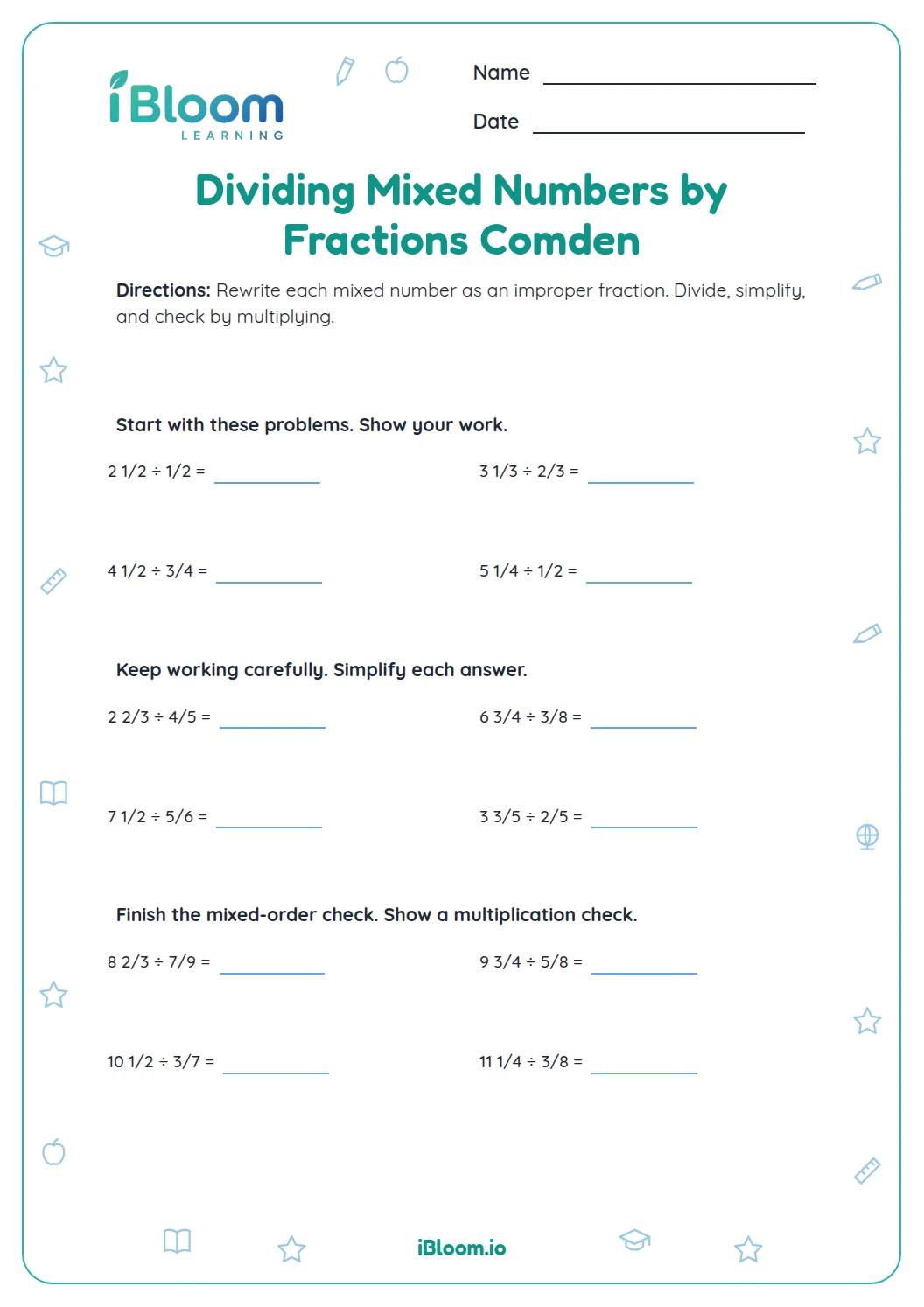
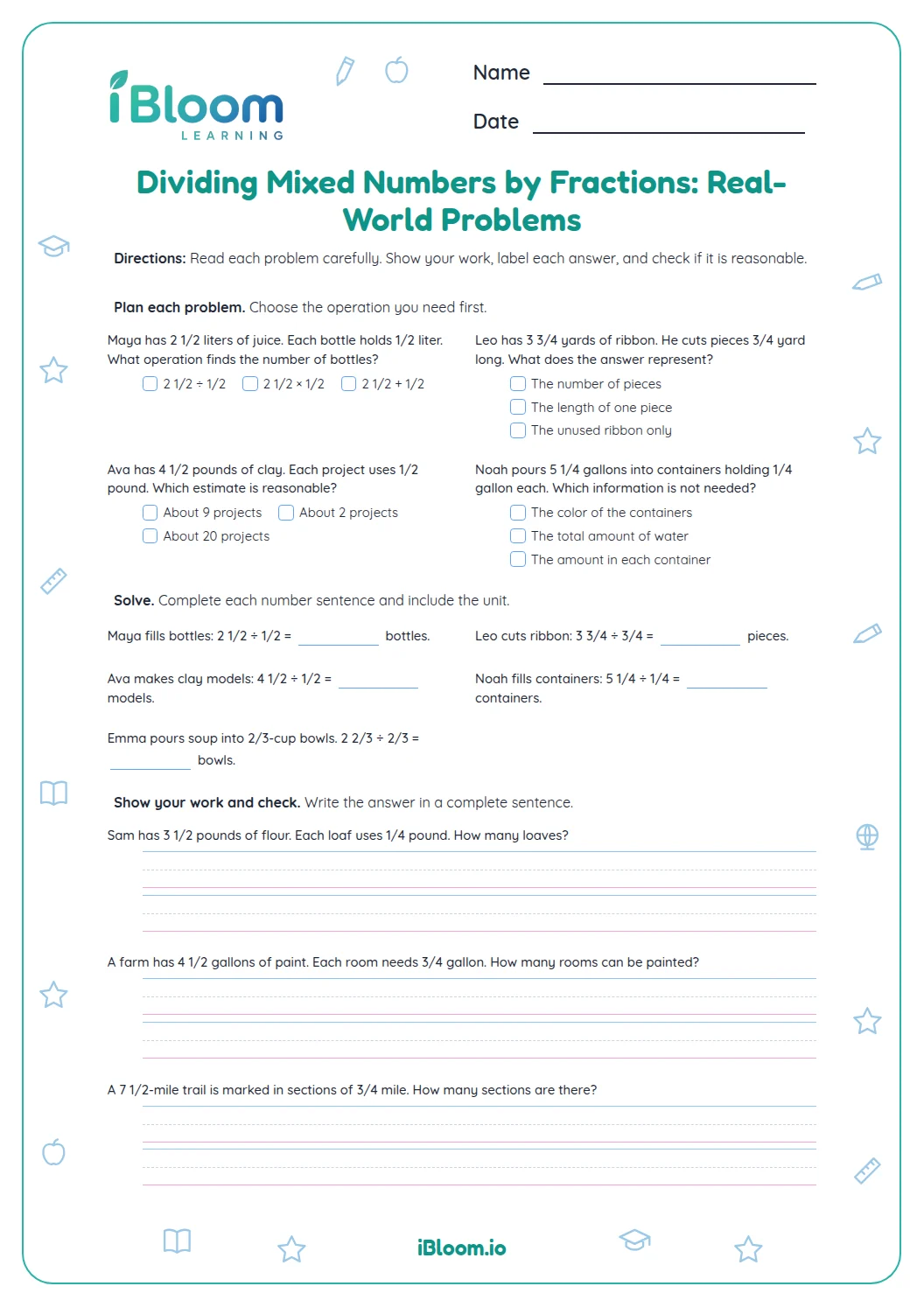
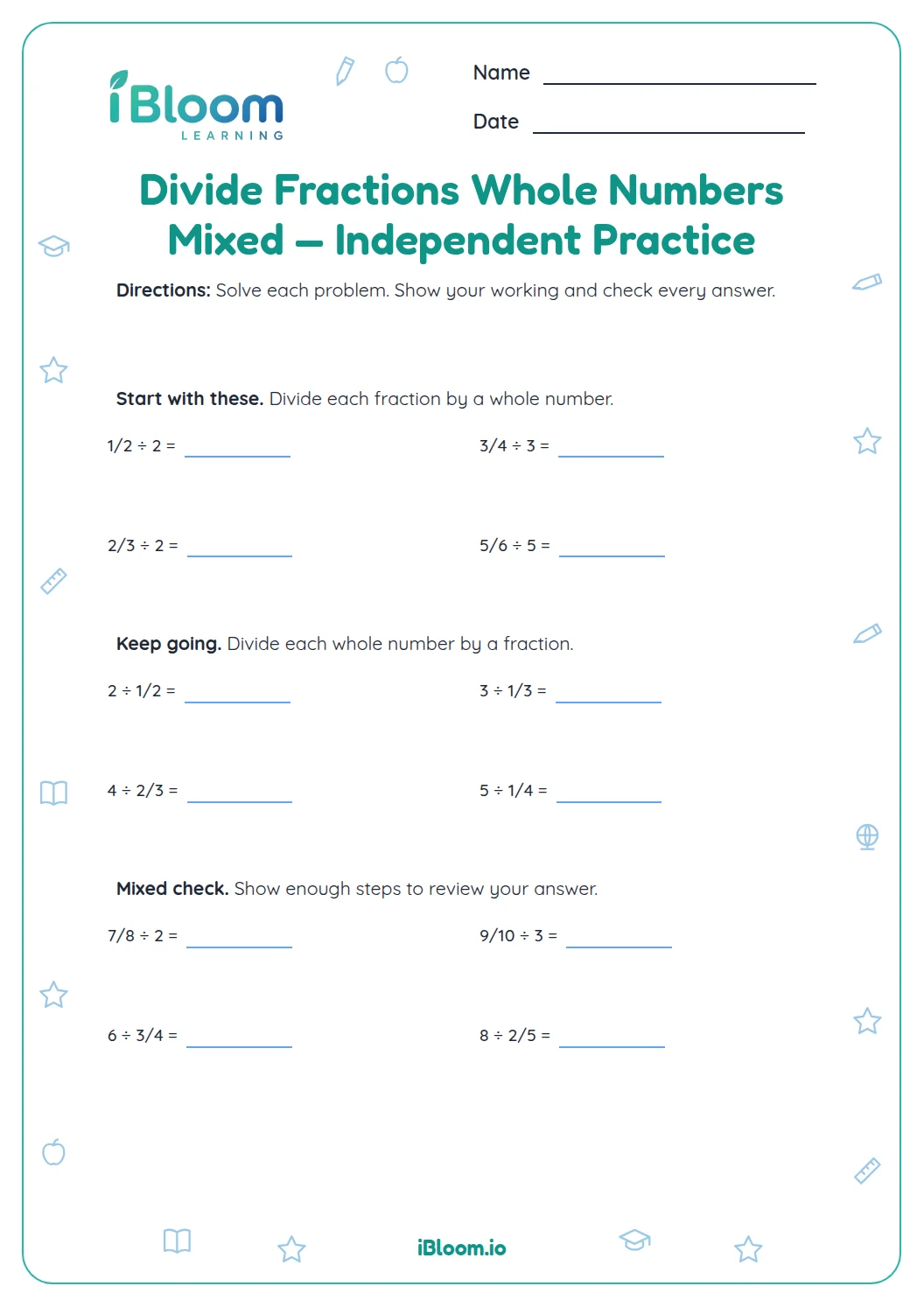
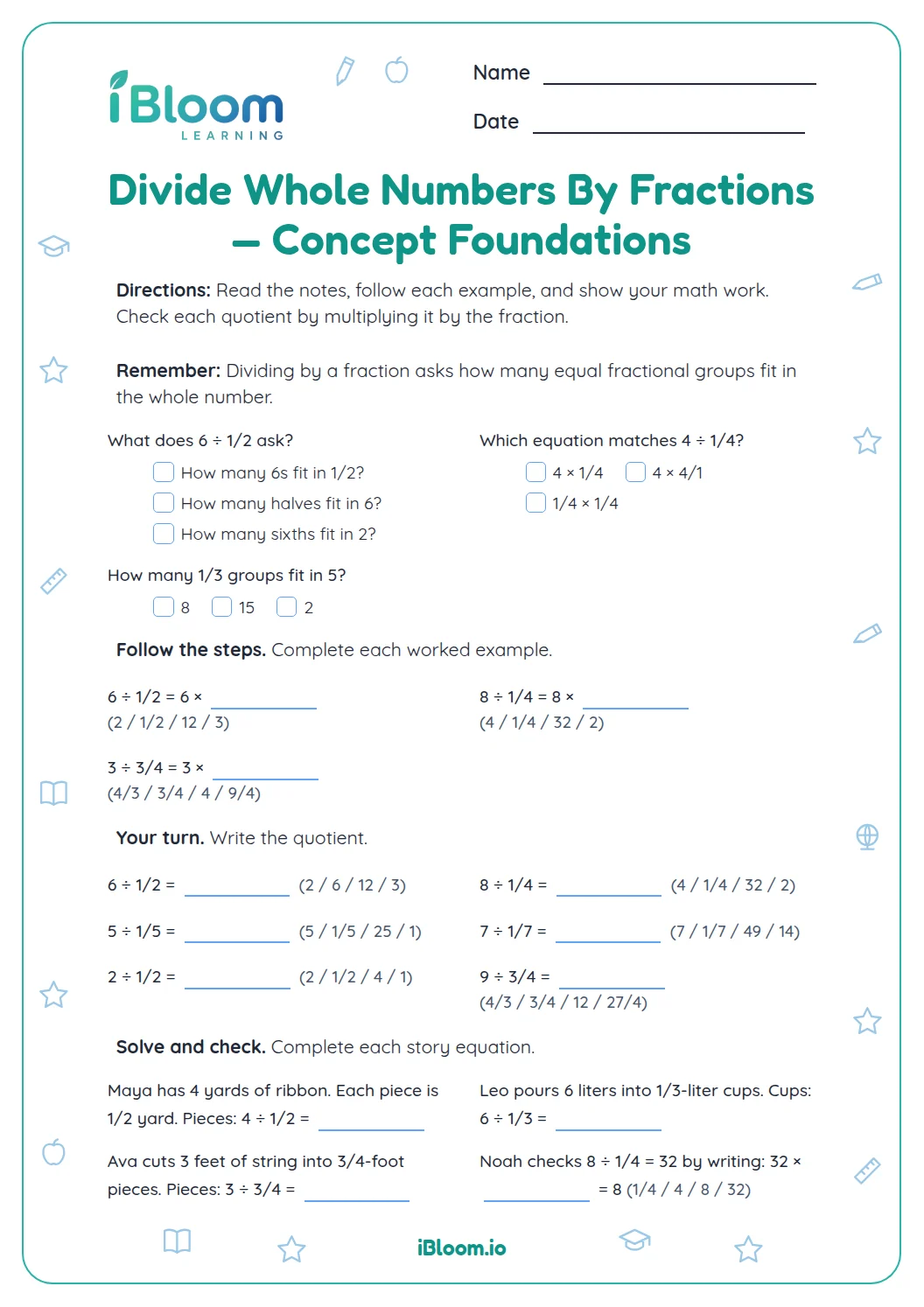
This free printable Grade 5 worksheet guides learners through dividing mixed numbers by fractions. It begins with mixed-number conversions, moves to quotient practice using reciprocals, and ends with multiplication checks. Fifteen questions and a separate answer key are included.
How do the guided steps work?
Convert the mixed number before dividing. For 3 1/3 ÷ 2/3, write 3 1/3 as 10/3, then multiply by 3/2: 10/3 × 3/2 = 5. To check, multiply 5 by the original divisor, 2/3, to return to 3 1/3.
- 13 1/3 ÷ 2/3 = ___
- 210/3 × 3/2 = 30/6 = 5.
- 3Check: 5 × 2/3 = 3 1/3.
How should the answers be checked?
The worksheet moves from conversion to quotient practice and then to checking. When a division answer is an improper fraction, simplify it and write a mixed number if the value is not whole.
What is included in the printable?
The two-page worksheet includes 15 questions and a separate answer key. The final five items ask learners to identify a true multiplication check for a quotient.
How to use the worksheet
- 1Read the directions and notice what each question asks.
- 2Work through one item at a time, showing or marking the reasoning where useful.
- 3Reread each response to make sure it answers the prompt.
- 4Use the separate answer key to check completed work.
- 5Return to missed items and correct them using the clue or method.
Common mistakes and quick fixes
The mistake
Taking the reciprocal of the mixed number instead of the divisor.
The fix
Convert the mixed number to an improper fraction; flip only the divisor.
The mistake
Multiplying by the original divisor.
The fix
Change ÷ to × and use the reciprocal of the divisor.
The mistake
Stopping before simplifying.
The fix
Reduce the fraction and express an improper quotient as a mixed number when appropriate.
What to practice next
Make more practice
Questions parents and teachers ask
How many questions are on this Grade 5 worksheet?
There are 15 questions across two worksheet pages: two conversions, eight quotient problems, and five multiplication checks. The sequence follows the method from converting a mixed number to checking the quotient. A separate answer key supports review after the work is complete.
Does the printable include an answer key?
Yes. The answer key is printed separately from the worksheet pages. It includes the improper-fraction conversions, simplified quotients, and multiplication checks, so learners can compare each step after completing the practice. Each key response matches the question’s form.
How can I support a learner who gets stuck?
Ask the learner to show the mixed number as an improper fraction first. Then check that division changed to multiplication and the divisor was flipped. Multiplying the quotient by the original divisor provides a useful check for the final answer.
Can learners complete the worksheet independently?
Learners who are familiar with the skill can try the questions independently and check their work afterward. An adult can read the directions or model how to approach one item, then let the learner continue at a comfortable pace.
What should learners do after checking the key?
For each missed item, return to the prompt and find the clue or method that leads to the correct response. Write in the correction and explain the step. This keeps checking connected to the skill practiced on the worksheet.