




About this worksheet
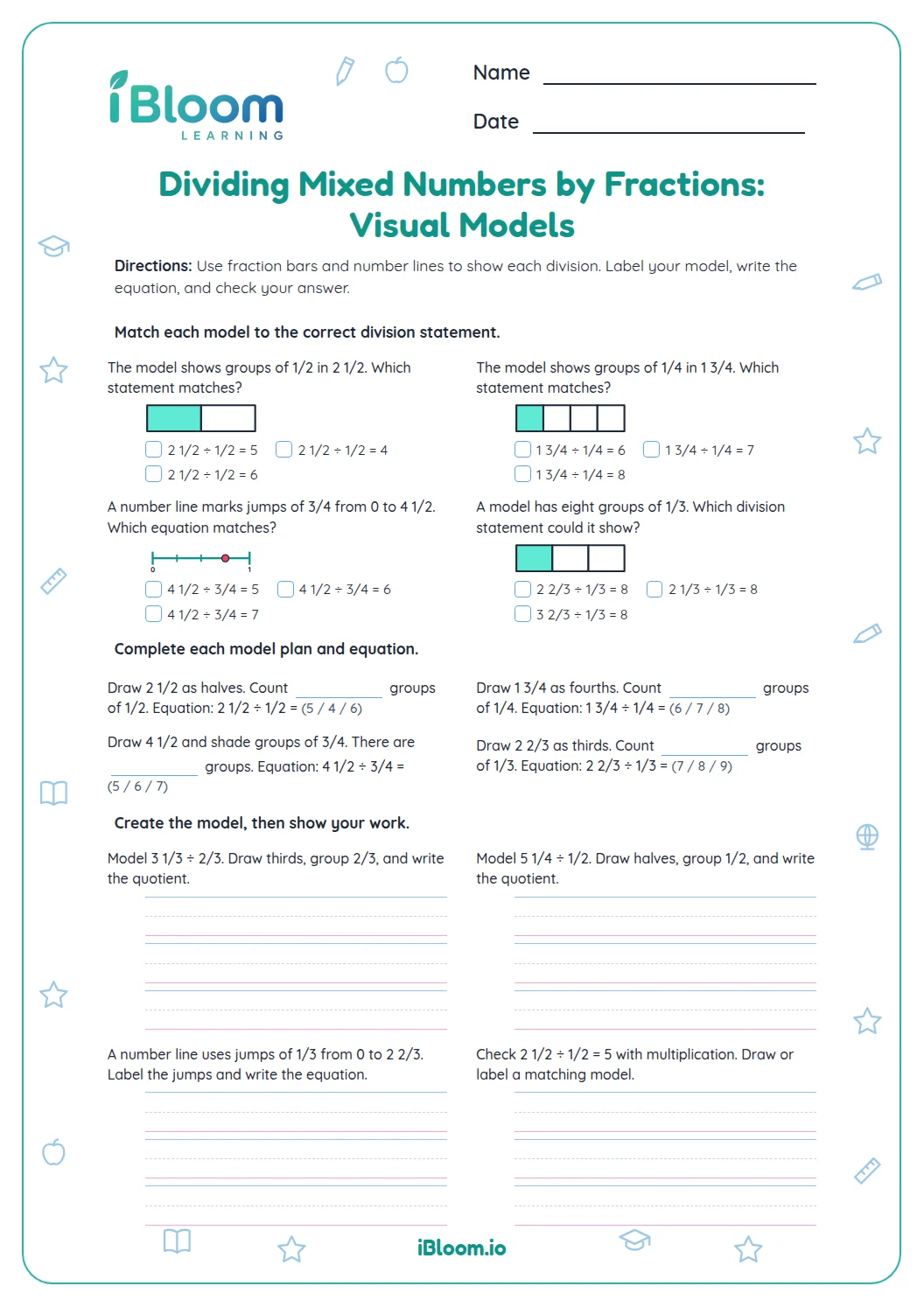
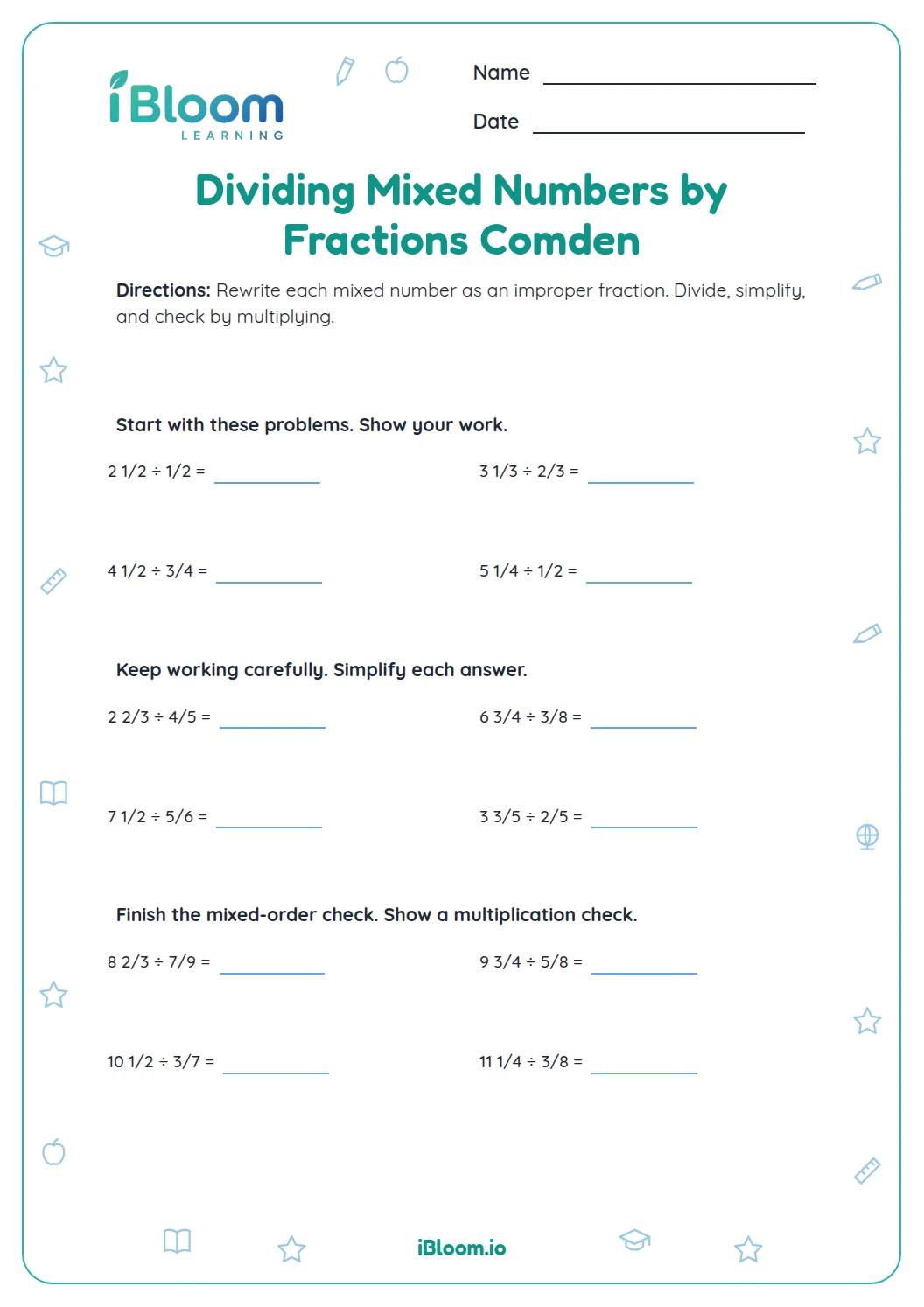
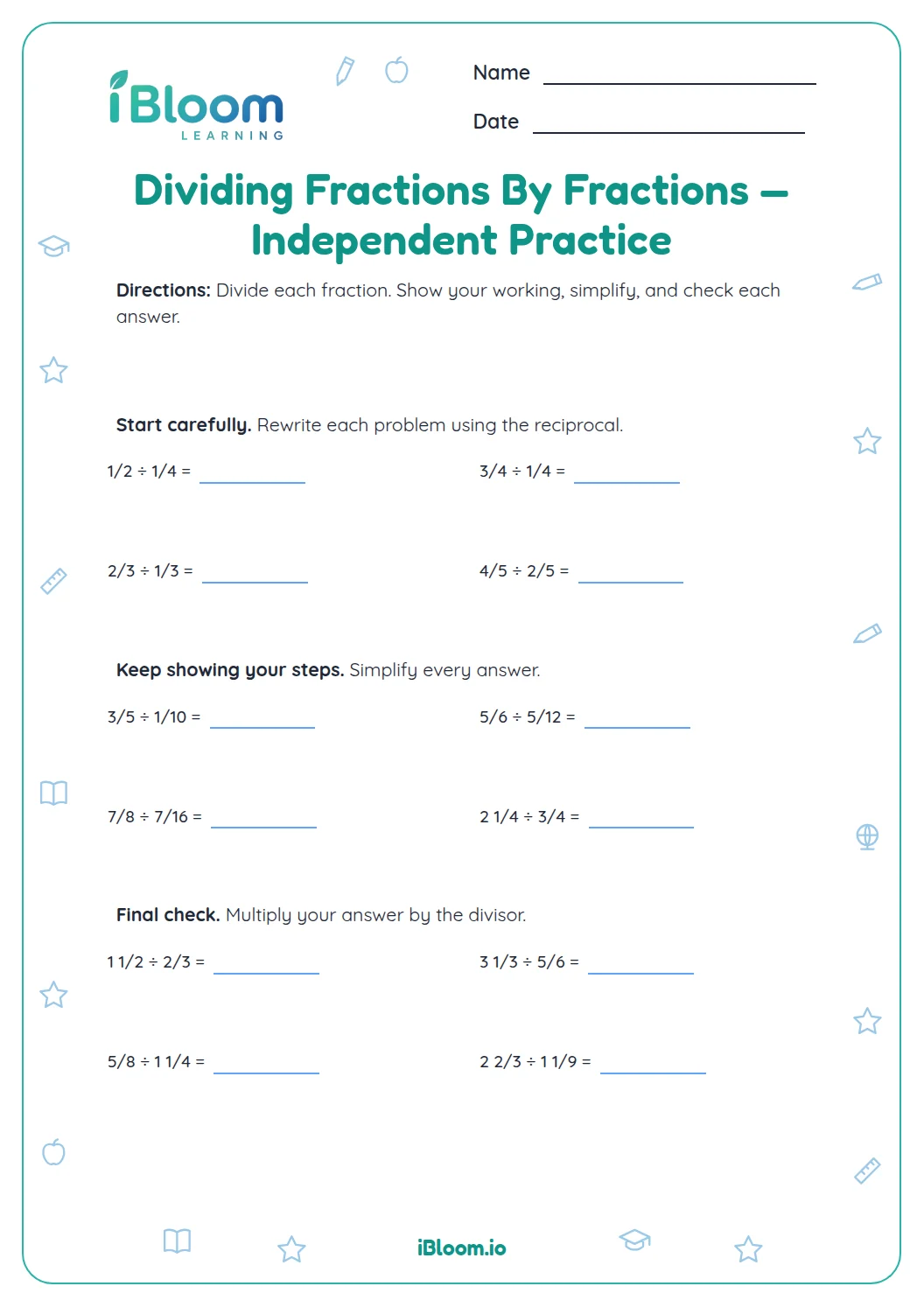
This worksheet introduces a reliable method for dividing mixed numbers by fractions. Students first convert mixed numbers to improper fractions, identify reciprocals, rewrite division as multiplication, solve equations, and use the method in two short contexts. Sixteen questions build from the component steps to complete calculations and explanations.
What does this worksheet practice?
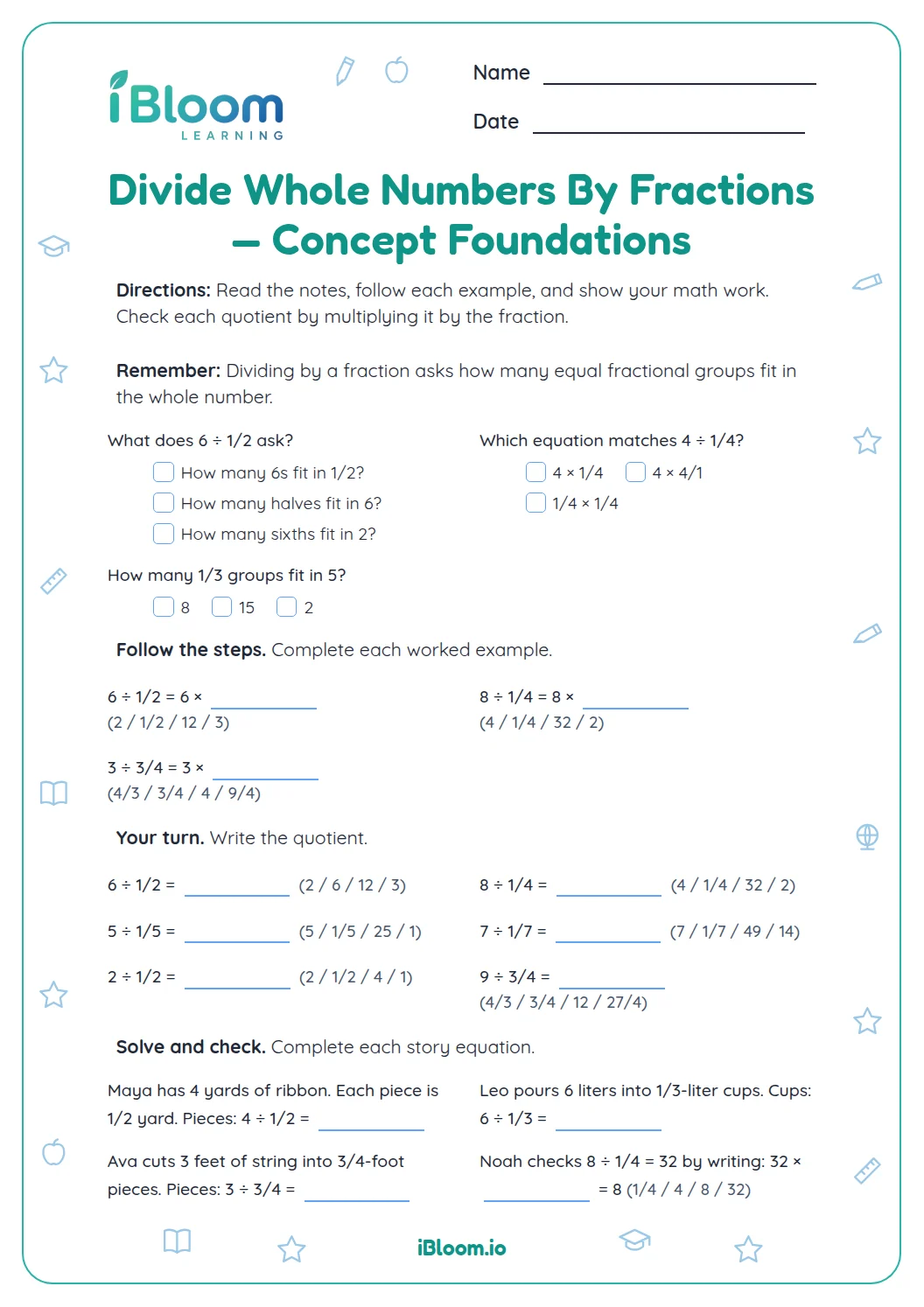
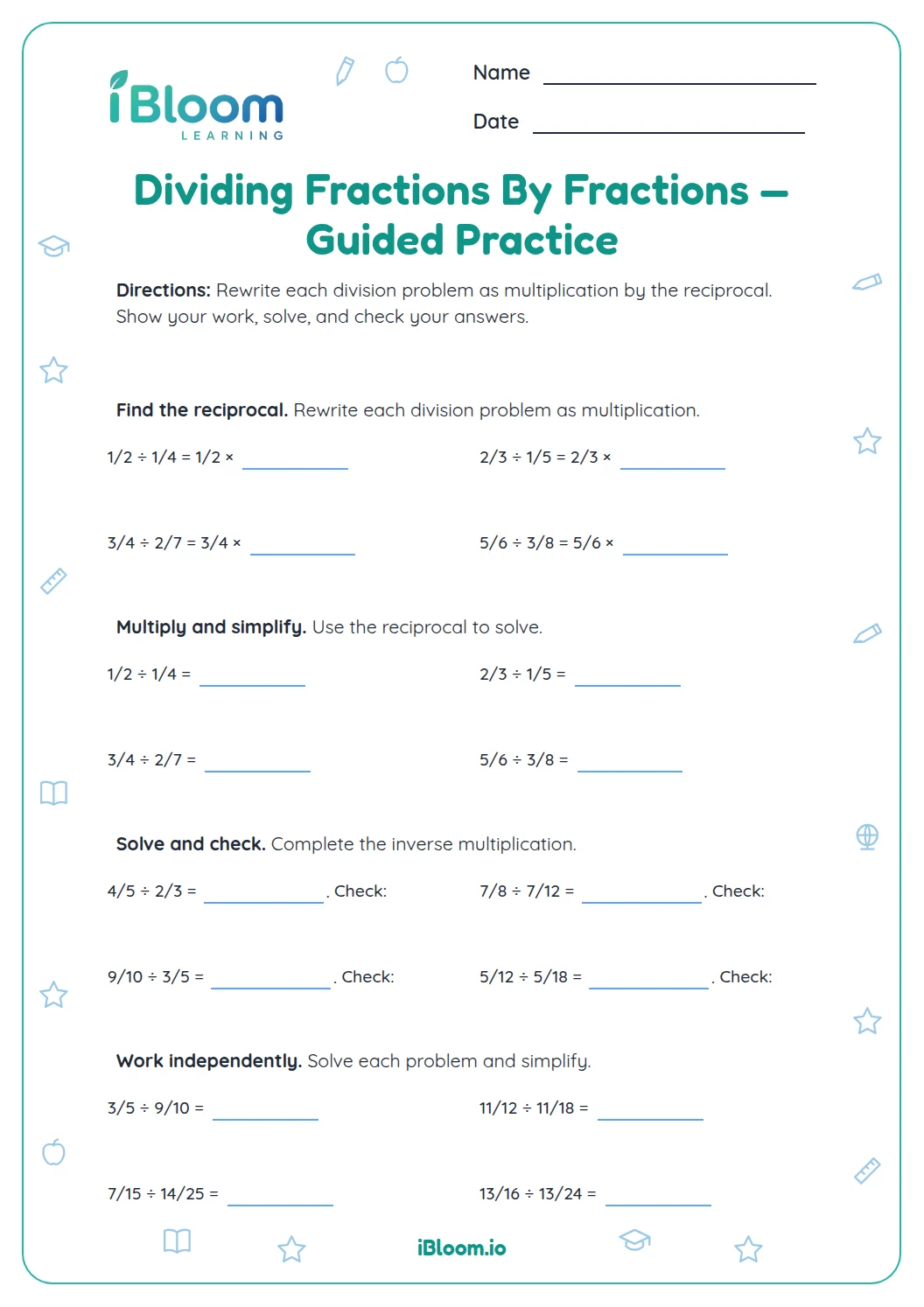
This concept-foundations worksheet builds fraction-division fluency from the component steps: converting a mixed number, finding a reciprocal, rewriting division as multiplication, and simplifying. Students then solve calculations and apply the method to two contexts.
- Complete each part in order.
- Use the key to check answers.
How do you divide a mixed number by a fraction?
Convert 2 1/3 to 7/3. Keep 7/3, change ÷ to ×, and use the reciprocal of 2/3, which is 3/2. The product is 21/6, or 3 1/2.
- 1What is 1 1/2 ÷ 1/4? → 6
How can a student check the work?
Multiply the quotient by the original divisor to check whether the product returns to the starting mixed number.
How to use this worksheet
- 1Convert the mixed number to an improper fraction.
- 2Keep the first fraction.
- 3Replace division with multiplication by the reciprocal.
- 4Multiply and simplify.
- 5Check the quotient with a quick estimate or multiplication.
Common mistakes and quick fixes
The mistake
Flipping the first fraction.
The fix
Keep the first fraction and flip only the divisor.
The mistake
Leaving a mixed number unchanged.
The fix
Convert it to an improper fraction before multiplying.
The mistake
Stopping at an improper fraction when a mixed number is clearer.
The fix
Simplify, then convert to a mixed number when needed.
What to practice next
Make more practice
Further reading
Questions parents and teachers ask
What are the steps for dividing a mixed number by a fraction?
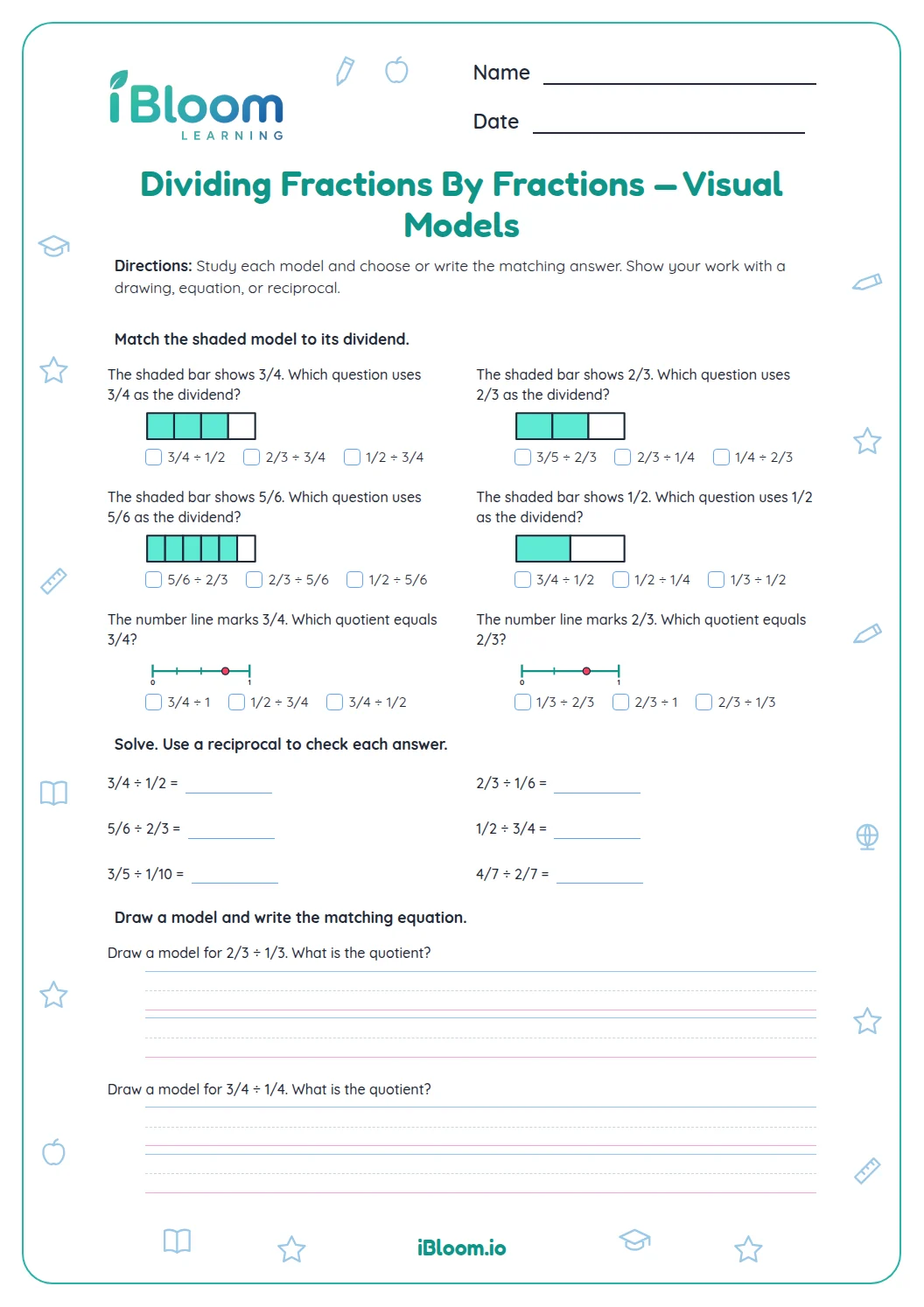
Rewrite the mixed number as an improper fraction. Keep that fraction, change division to multiplication, and flip the divisor to its reciprocal. Multiply the numerators and denominators, then simplify the quotient. The first items isolate each part of the method before full calculations begin.
Why do I use the reciprocal of the divisor?
Dividing by a nonzero fraction is equivalent to multiplying by its reciprocal. For example, dividing by 3/4 becomes multiplying by 4/3. The worksheet practices this rewrite before students solve the remaining calculations. The reciprocal keeps the product equivalent to the original division problem.
How can I check a quotient?
Multiply the quotient by the original divisor. If the product equals the starting mixed number, the division is consistent. One item asks students to explain why 2 1/4 ÷ 3/4 equals 3. Students can use the original divisor in a multiplication check.
What do the word problems ask?
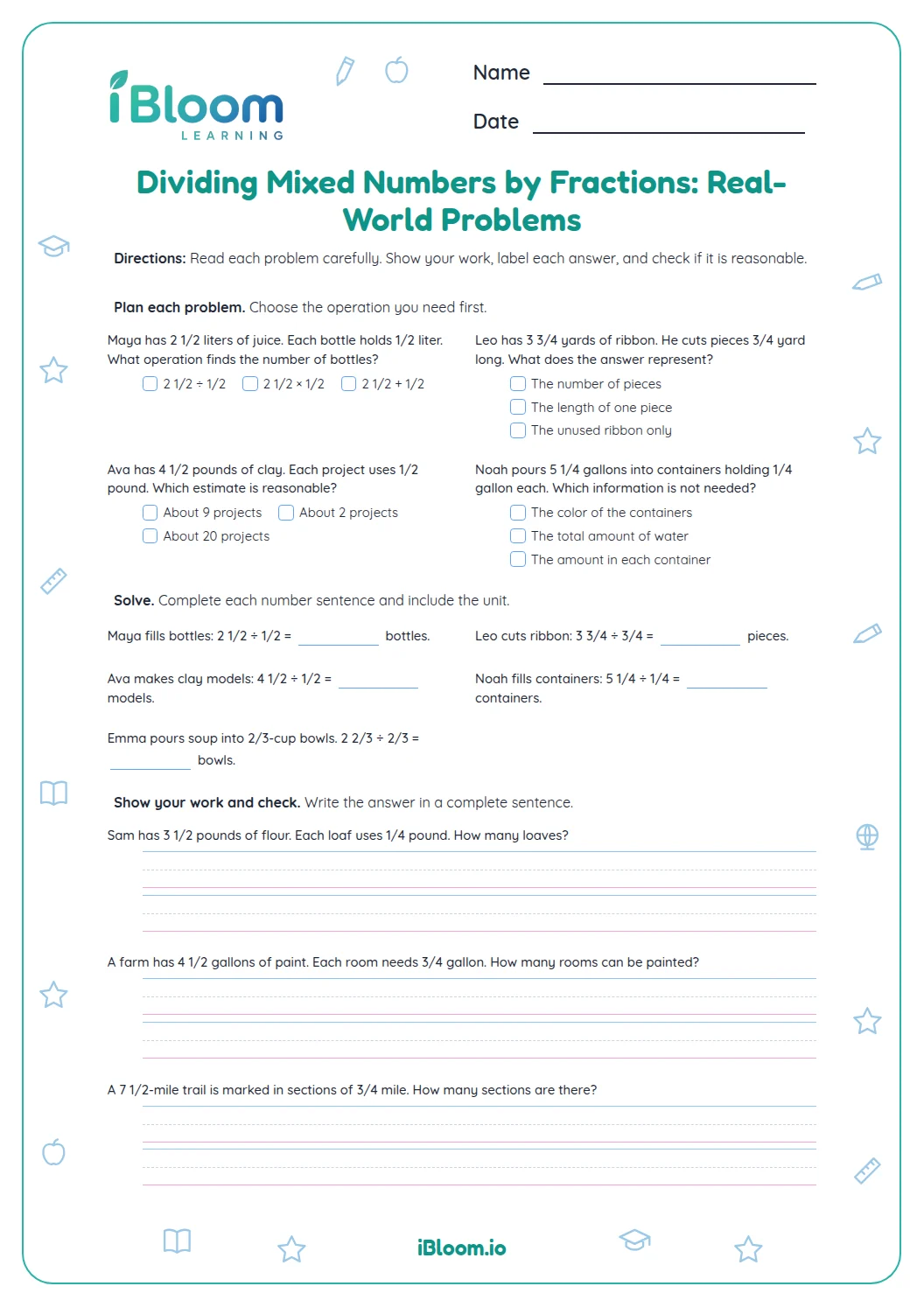
One asks how many half-foot pieces can be cut from a 2 1/2-foot ribbon. Another asks how many full 3/8-liter cups can be filled from 1 1/2 liters. Both answers are whole numbers. Both contexts ask how many equal-size portions fit in the starting amount.
What should I accept for simplified answers?
The answer key gives simplified whole-number or mixed-number results. Accept equivalent forms with the same value when the work is sound; for the cup problem, the answer must count full cups. The prompt’s word “full” tells students to report whole cups rather than a partial cup.