



About this worksheet
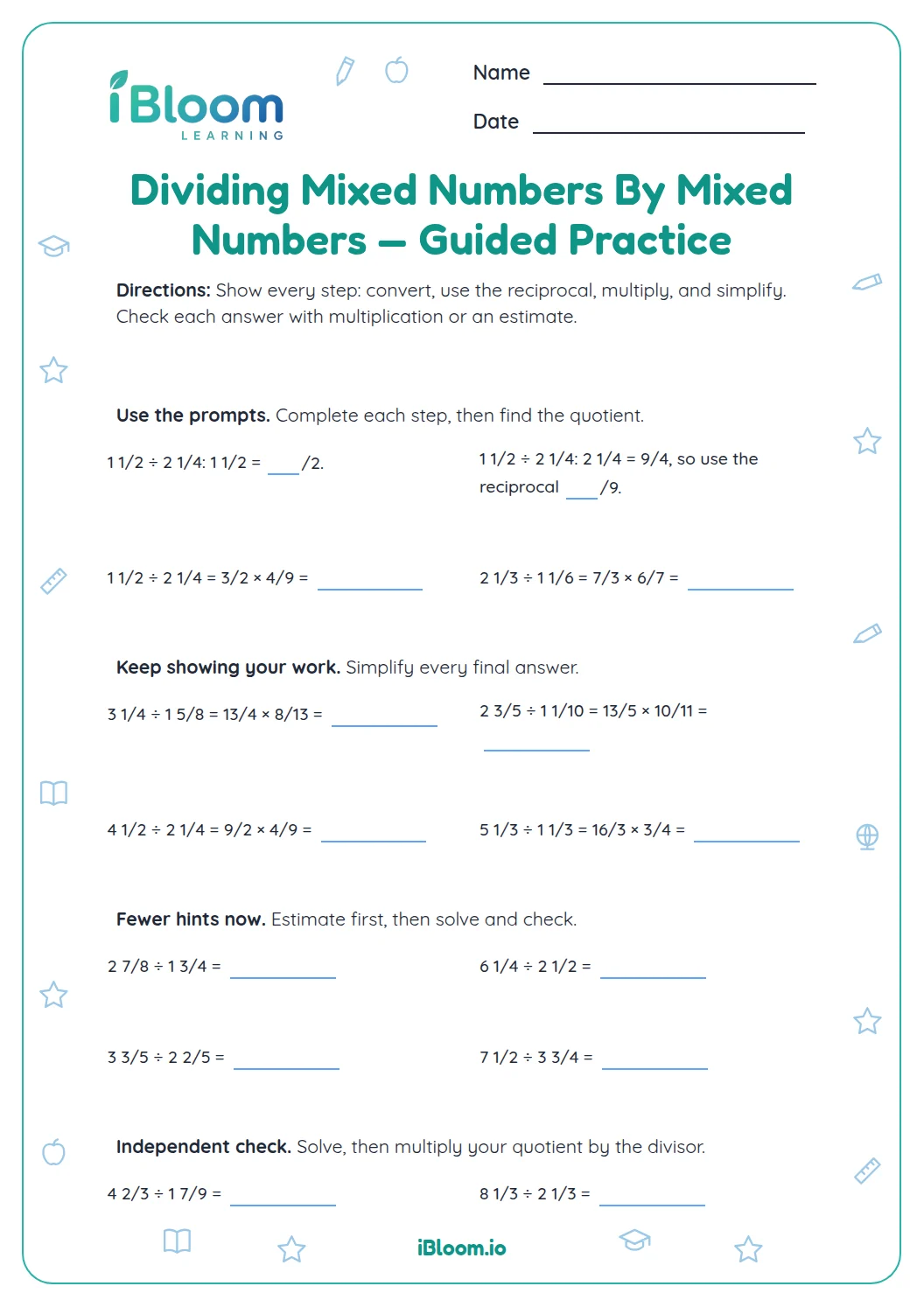
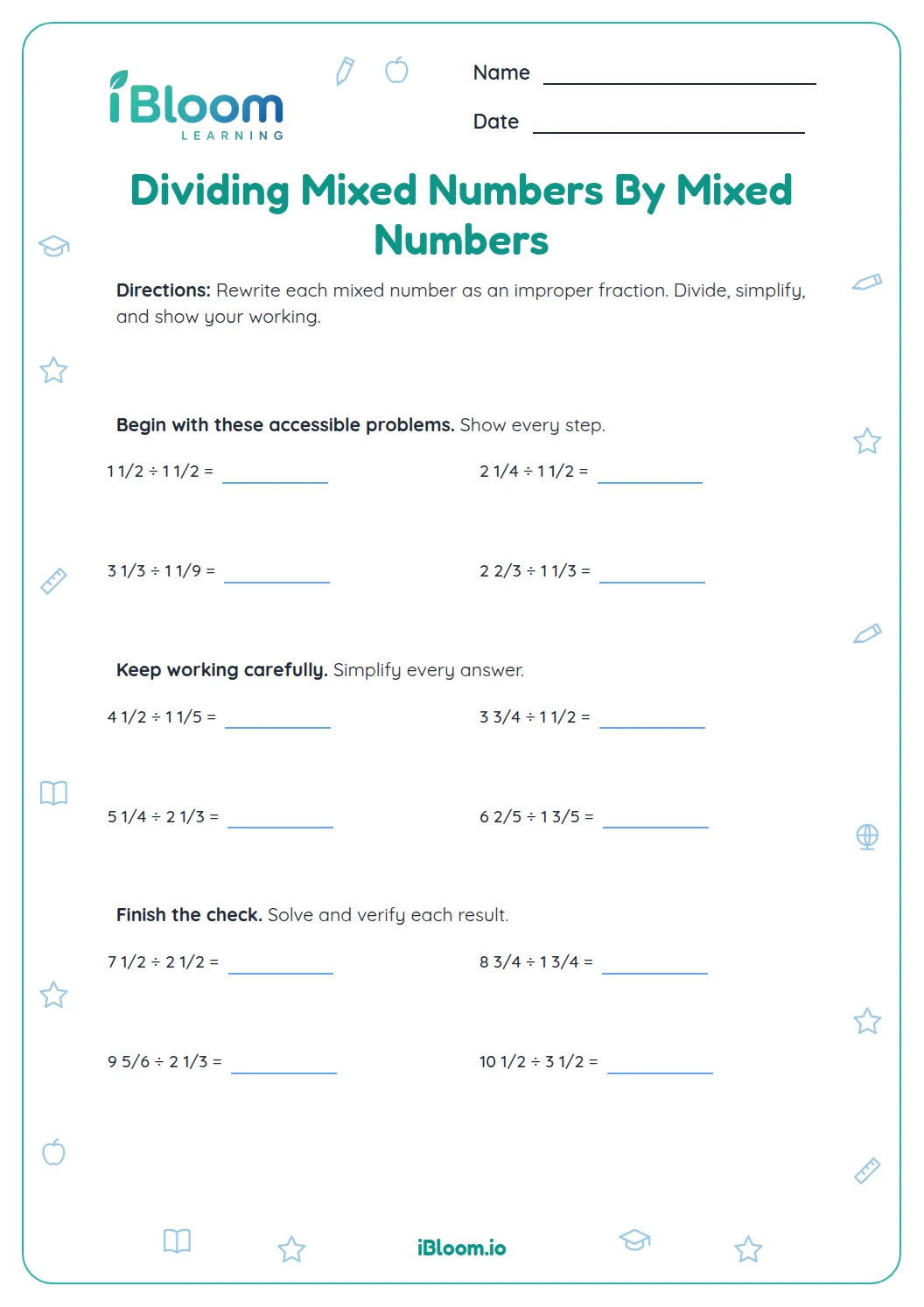
This Grade 5-labeled printable practices dividing mixed numbers in real-world settings. Learners identify the total amount and the size of one group, write a division equation, and interpret the quotient in context. The 14 problems include lengths, containers, batches, and portions; a separate key gives equations and answers.
Aligned to 6.NS.A.1
Choose the division?
Identify the total amount and the amount used for each group. Divide total by group size, then attach the unit named in the question.
Check a quotient?
Multiply the quotient by the group size. The product should equal the total amount.
Common Core alignment
This sheet uses equations and word problems to interpret quotients of fractions.
Compute fraction quotients and solve division word problems with fractions.
On this sheet: Each context asks learners to divide a mixed-number quantity by another fraction quantity and interpret the quotient.
Show the official wordingHide the official wording
Interpret and compute quotients of fractions, and solve word problems involving division of fractions by fractions, e.g., by using visual fraction models and equations to represent the problem.
What to practice next
Make more practice
Questions parents and teachers ask
How do I set up each division problem?
Find the total amount first, then identify the size of one group or portion. Divide the total by that group size. For example, 3 1/2 yards divided into 1/2-yard pieces asks how many half-yard pieces fit in the ribbon.
What does the quotient mean?
The quotient tells how many groups of the stated size fit in the total, or how many equal portions can be made. Keep the unit from the story in your answer when the question asks for it, and check that the result makes sense for the setting.
How can I check a quotient?
Multiply the quotient by the divisor. The product should equal the starting amount. For example, 3 1/2 yards divided by 1/2 yard is 7. Check by multiplying 7 by 1/2 to get 3 1/2 yards, the original total.
Are all the answers whole numbers?
The prompts are written so the answer represents a sensible number of groups or portions. Read the wording carefully: a question asking for stages or pieces expects complete groups. The answer key includes the unit and division equation to make the interpretation clear.
What is one example from the page?
For the ribbon problem, 3 1/2 yards is the total and 1/2 yard is the amount for each bow. Compute 3 1/2 ÷ 1/2 = 7, so the ribbon makes 7 bows. Multiply 7 by 1/2 to check.