





About this worksheet
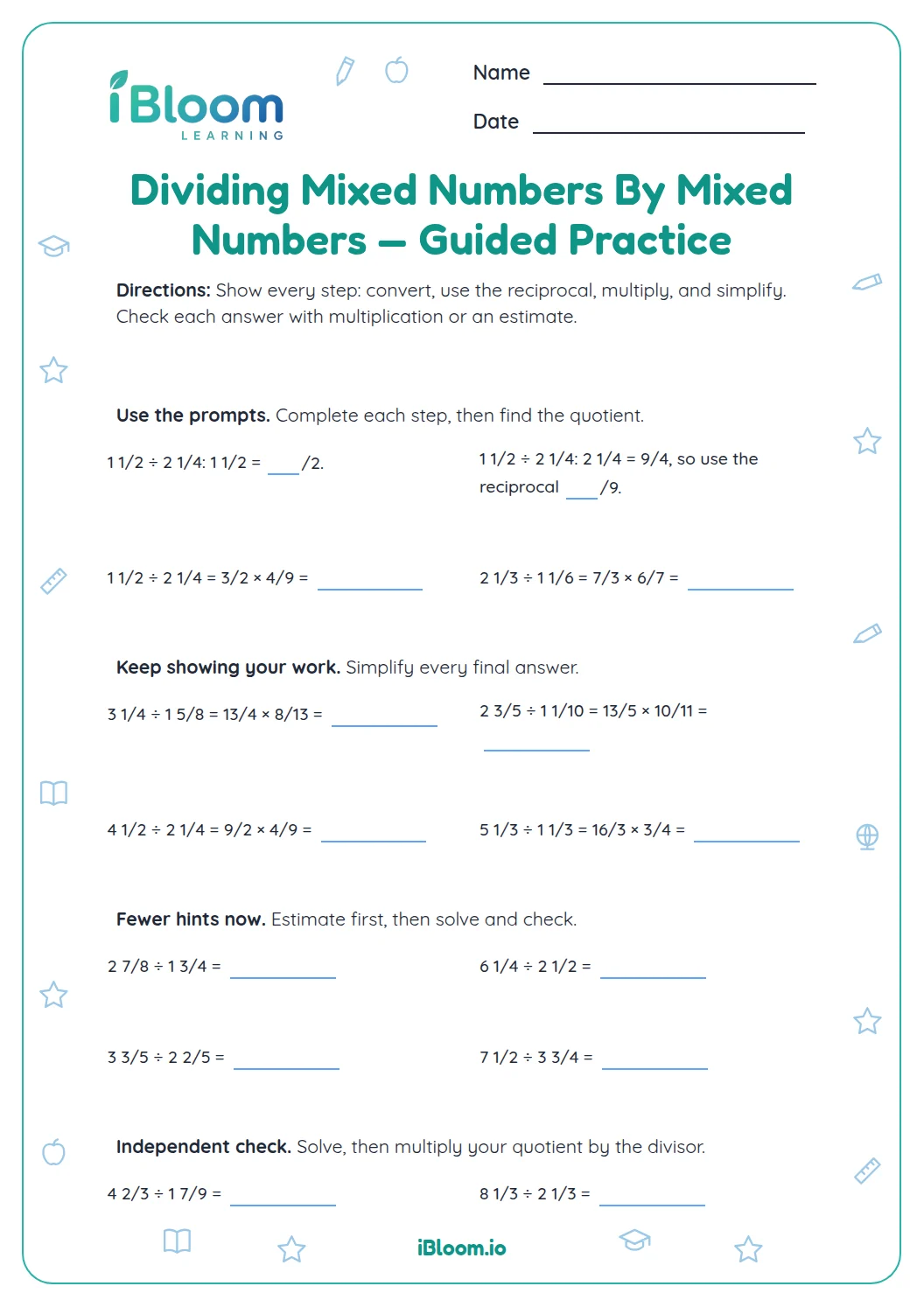
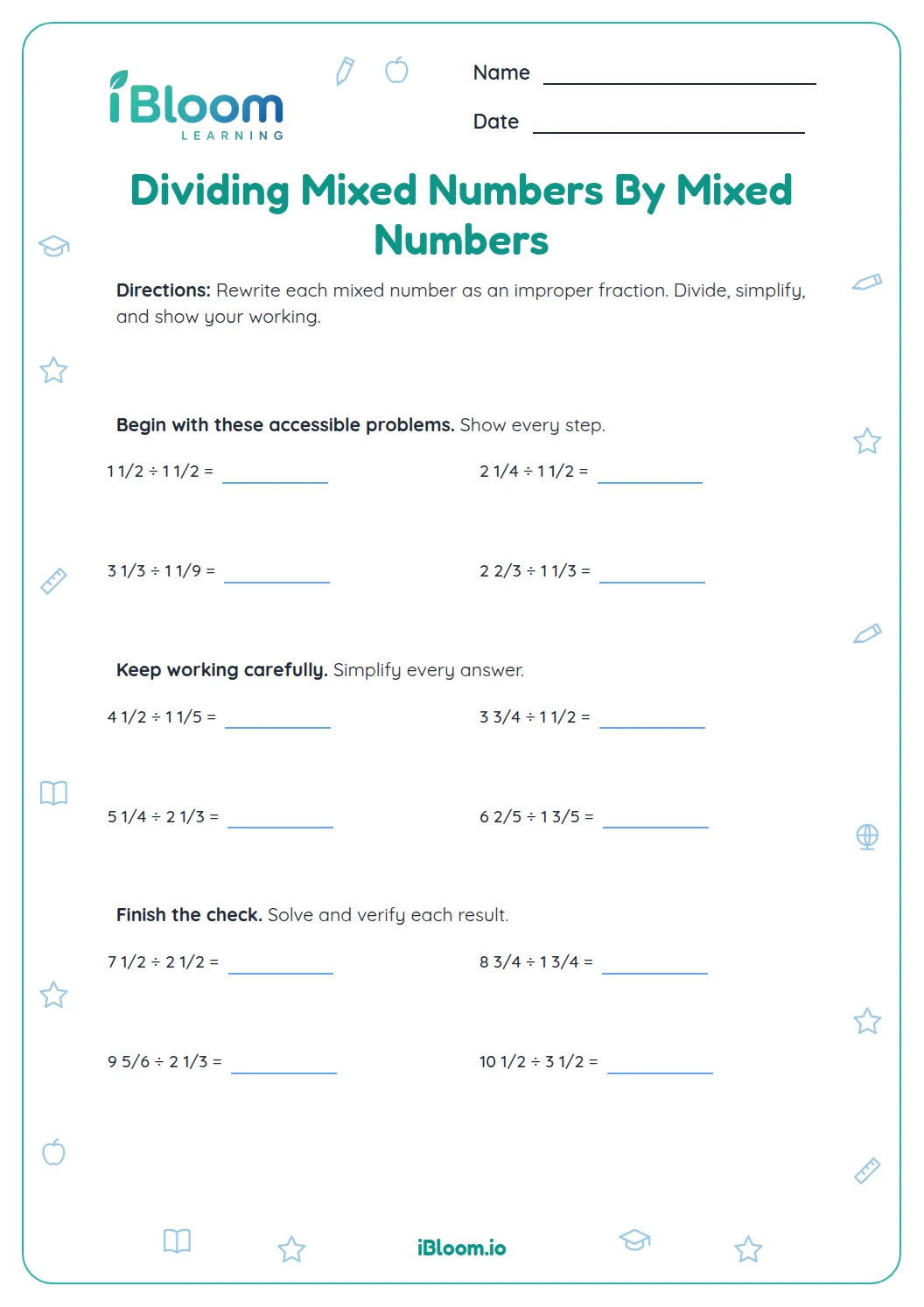
This printable gives Grade 5 learners a structured challenge with division of mixed numbers by mixed numbers. Learners find quotients, compare how divisor size changes the quotient, check reciprocal reasoning, and solve grouping problems. The 14 questions practice the fraction-division work described by CCSS 6.NS.A.1. A separate answer key supports independent checking.
Aligned to 6.NS.A.1
How can a mixed number become a fraction?
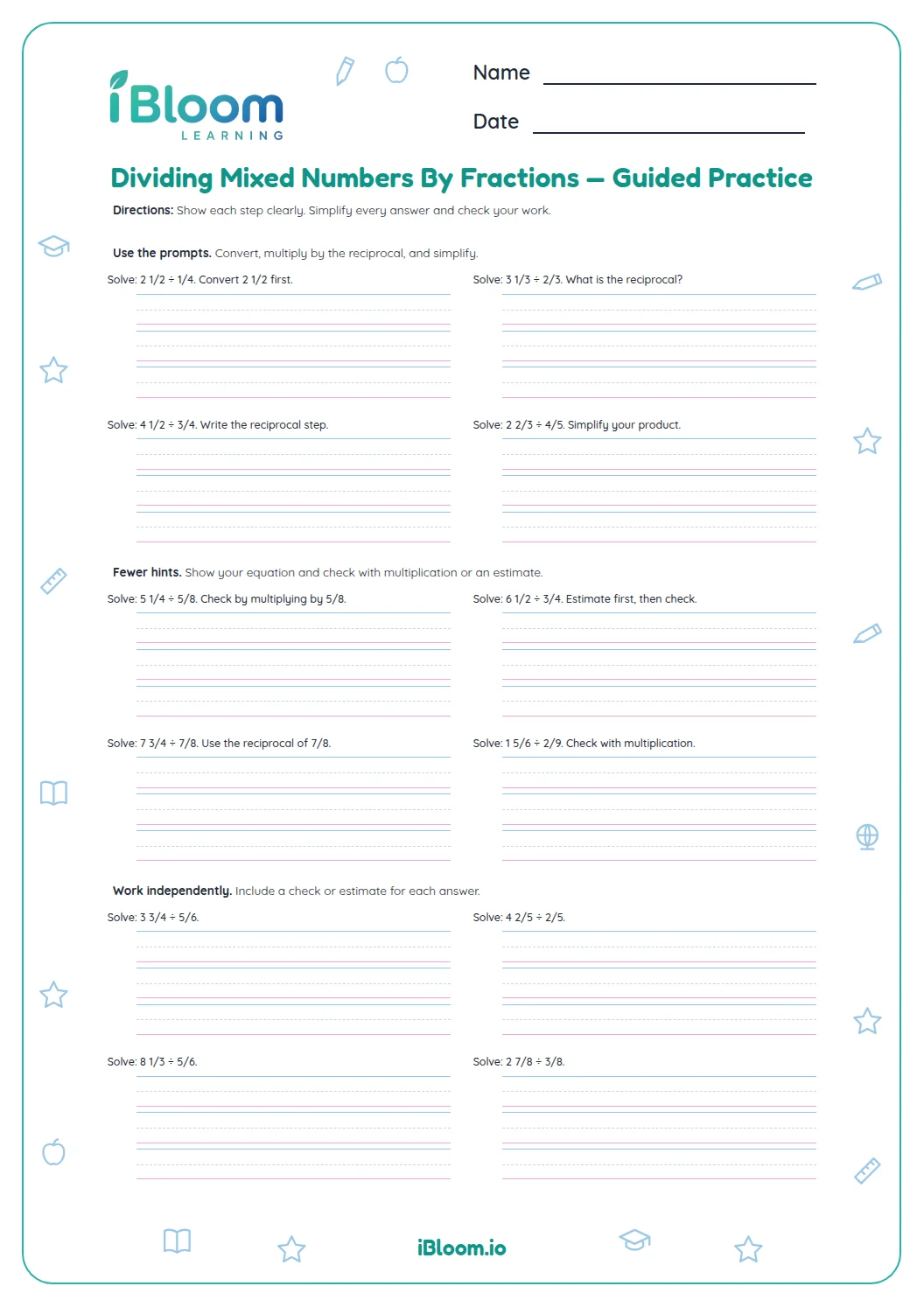
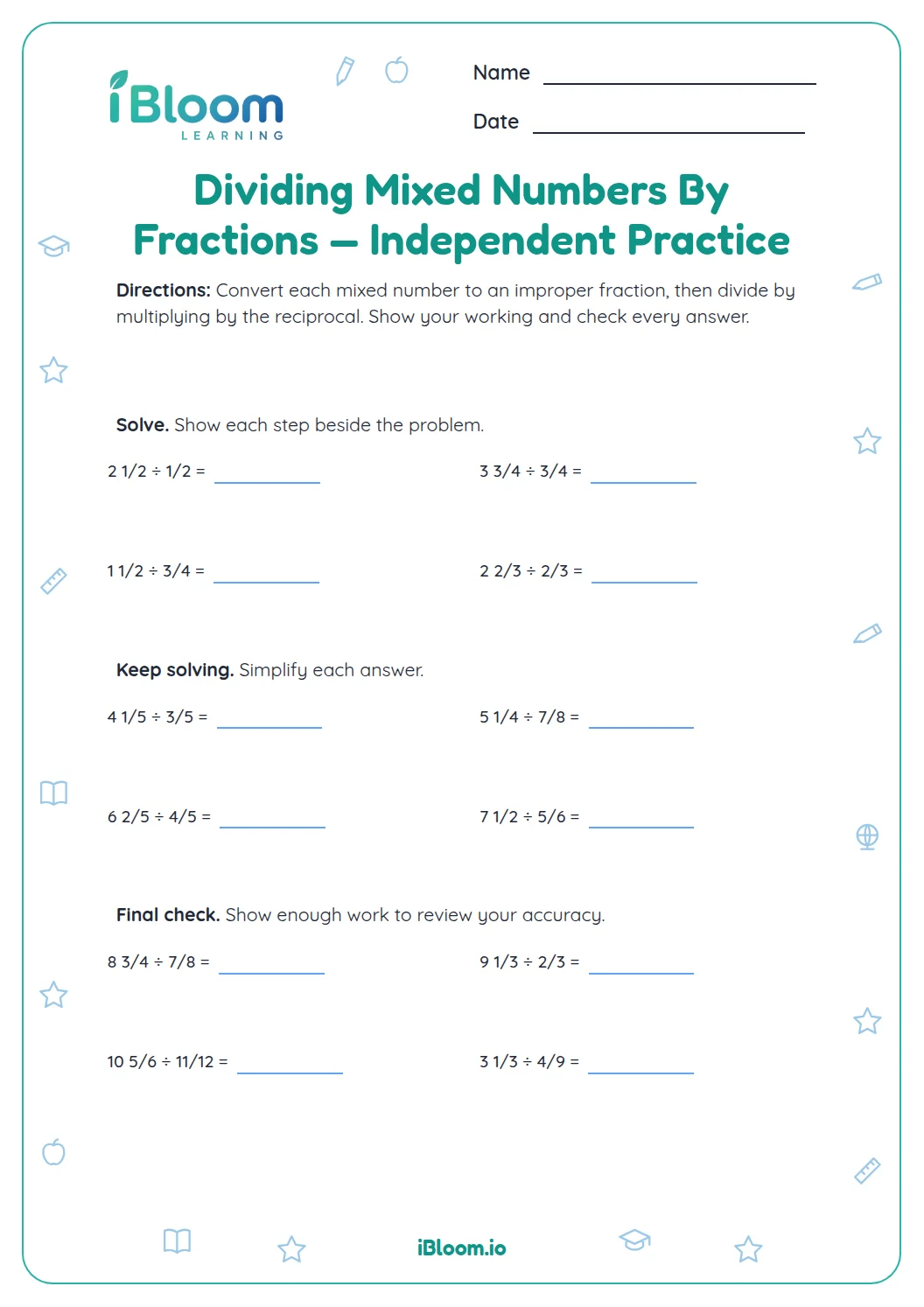
Multiply the whole number by the denominator and add the numerator. For example, 2 1/2 becomes 5/2. This makes the reciprocal step clear.
- 12 1/2 ÷ 1 1/4
- 25/2 ÷ 5/4
- 35/2 × 4/5 = 2
How do you know which fraction to flip?
Only the divisor is changed to its reciprocal. In question 5, the divisor 2 1/3 is 7/3, so its reciprocal is 3/7. The dividend 1 3/4 becomes 7/4 and stays as it is.
What does the quotient tell you?
A quotient counts how many divisor-sized groups fit into the dividend. Question 7 asks how many 2/3-yard pieces fit in 6 2/3 yards; 6 2/3 ÷ 2/3 = 10 pieces.
What will learners practice on the page?
The three parts move from evaluating quotients to explaining a method, then applying division to lengths, containers, and batches. The answer key gives concise results and sample reasoning.
How can I use this page?
- 1Change mixed numbers to improper fractions before dividing.
- 2Copy the divisor and invert the dividend; mark the divisor so only it is flipped.
- 3Check whether the quotient size fits the story: a longer length should make several smaller pieces.
What should learners check?
The mistake
Flipping both fractions.
The fix
Circle the divisor first, then write only its reciprocal.
The mistake
Forgetting the whole-number part while converting.
The fix
Multiply the whole by the denominator, then add the numerator.
The mistake
Stopping before interpreting a word-problem quotient.
The fix
Attach the count unit, such as pieces, batches, or bottles.
Common Core alignment
This worksheet practices the following Common Core skill.
Use fraction division to solve problems and explain what a quotient means.
On this sheet: The sheet divides mixed numbers by rewriting them as improper fractions and using reciprocals.
Show the official wordingHide the official wording
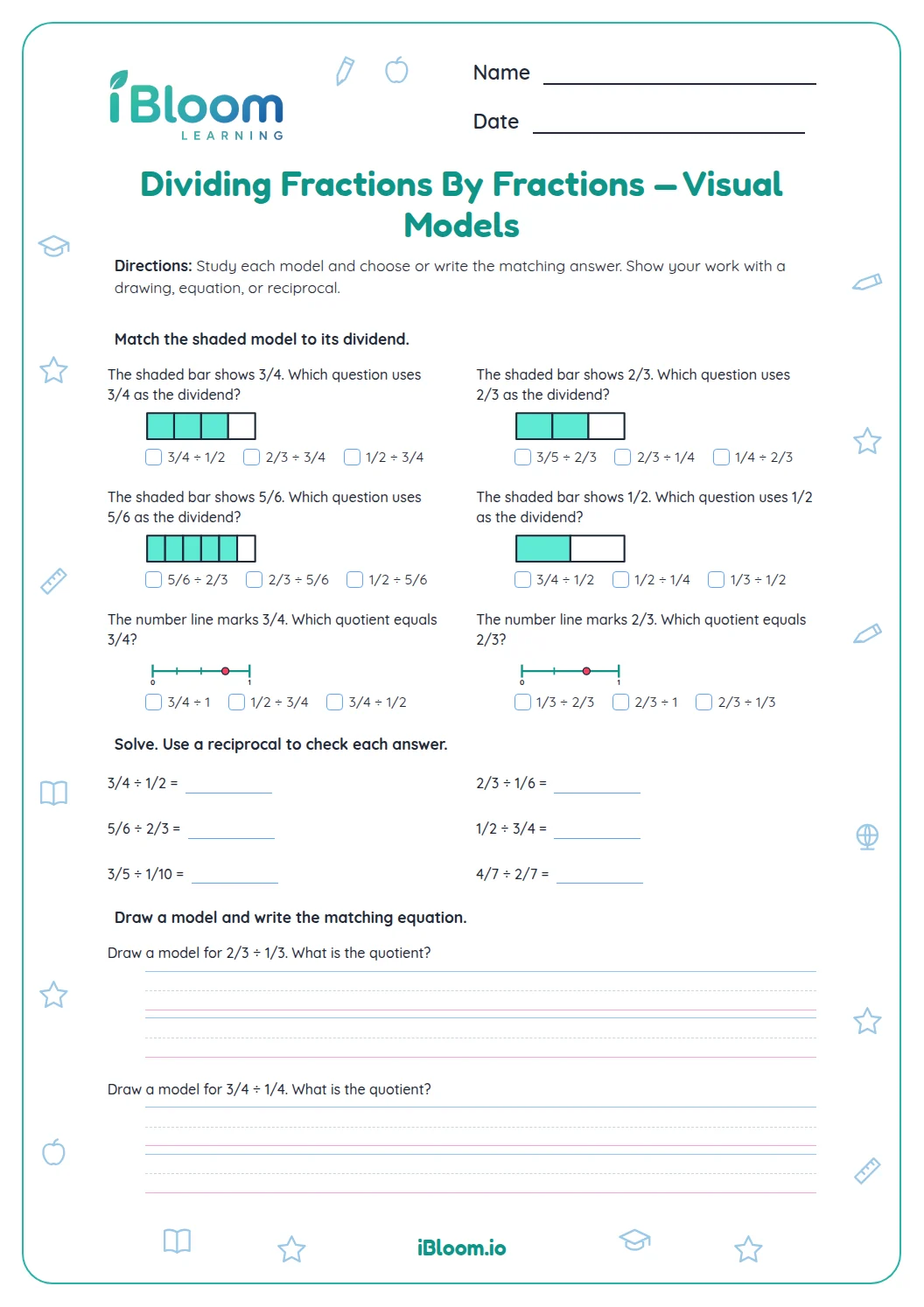
Interpret and compute quotients of fractions, and solve word problems involving division of fractions by fractions, e.g., by using visual fraction models and equations to represent the problem.
What to practice next
Make more practice
Further reading
Questions parents and teachers ask
What is the first step for dividing mixed numbers?
Rewrite each mixed number as an improper fraction. For example, 2 1/2 becomes 5/2 and 1 1/4 becomes 5/4. Then keep the dividend and multiply by the reciprocal of the divisor. Simplify the result and check the quotient against the sizes of the two numbers.
Why do learners use the reciprocal?
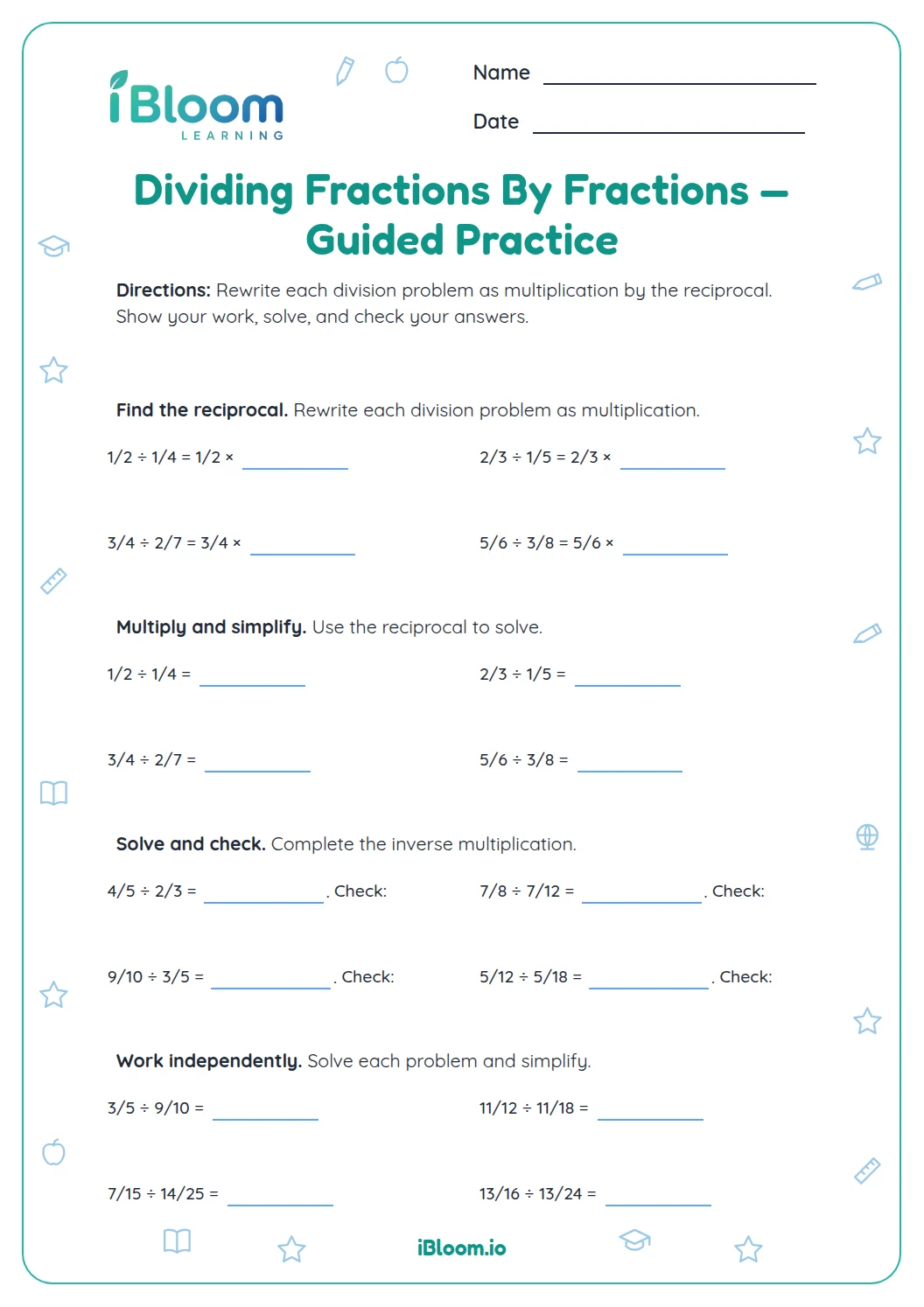
Division asks how many divisor-sized groups fit in the dividend. Multiplying by the divisor’s reciprocal gives an equivalent calculation. For question 1, 5/2 ÷ 5/4 becomes 5/2 × 4/5, which simplifies to 2. Learners can also multiply the quotient by the divisor to confirm the dividend.
What does question 5 ask learners to correct?
Ava changes both mixed numbers to improper fractions correctly, but she does not take the reciprocal of the divisor. Since 2 1/3 is 7/3, the multiplier should be 3/7. The corrected calculation is 7/4 × 3/7 = 3/4.
How can a learner check a quotient?
Multiply the quotient by the divisor and see whether the product returns to the dividend. For a context problem, check the unit and ask whether that many groups fit. Question 7 uses 6 2/3 yards and pieces of 2/3 yard, so 10 pieces is reasonable.
Does dividing always make a number smaller?
No. The result depends on the divisor. Dividing by a number greater than 1 makes a positive dividend smaller, while dividing by a positive number less than 1 can make it larger. The worksheet asks learners to compare divisor sizes and explain the resulting quotients.
Is an answer key included?
Yes. The printable includes a separate answer key with quotient results and short models for reasoning questions. Equivalent fraction work can look different, so learners can compare the value of their result and use multiplication to check it.