




About this worksheet
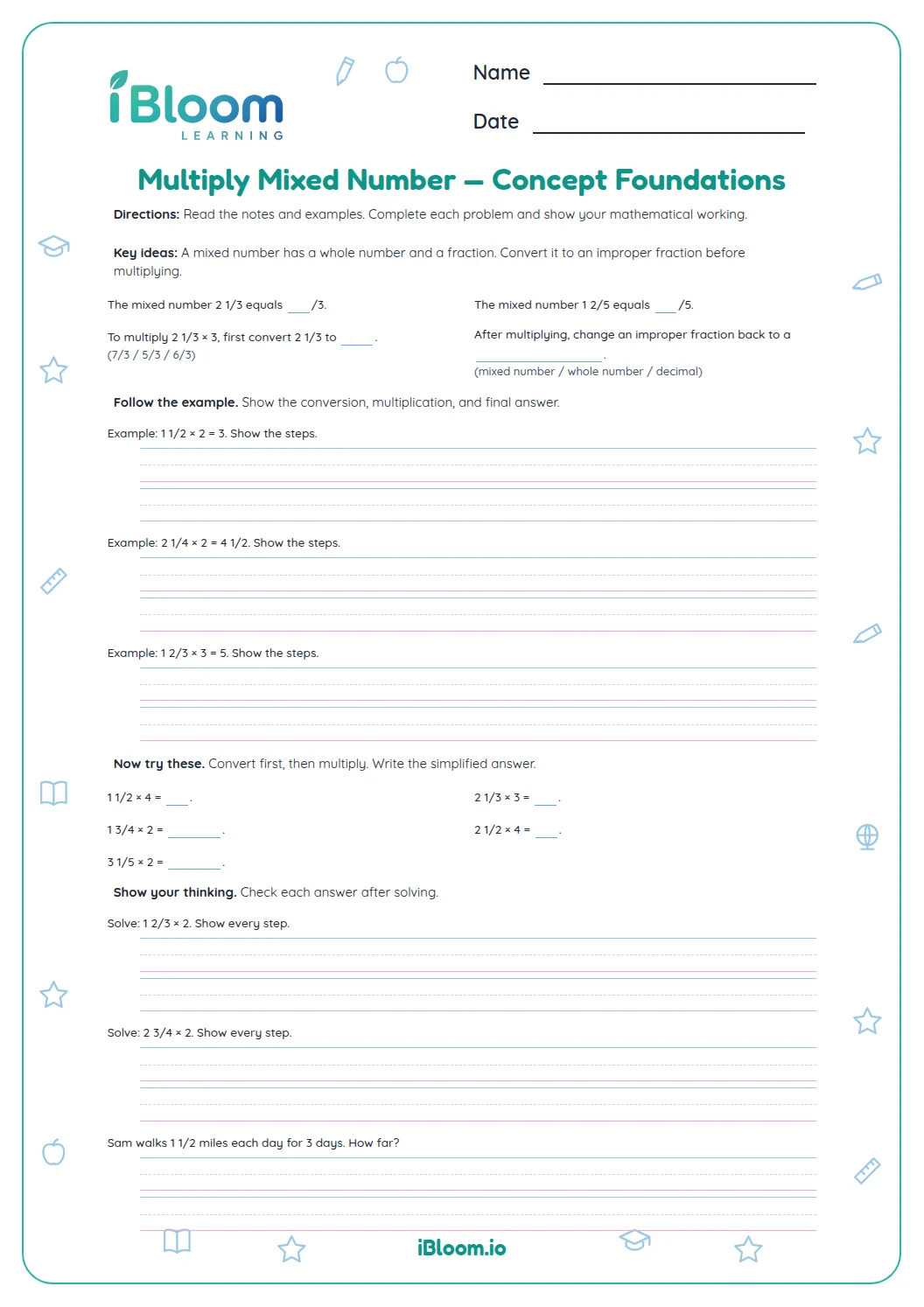
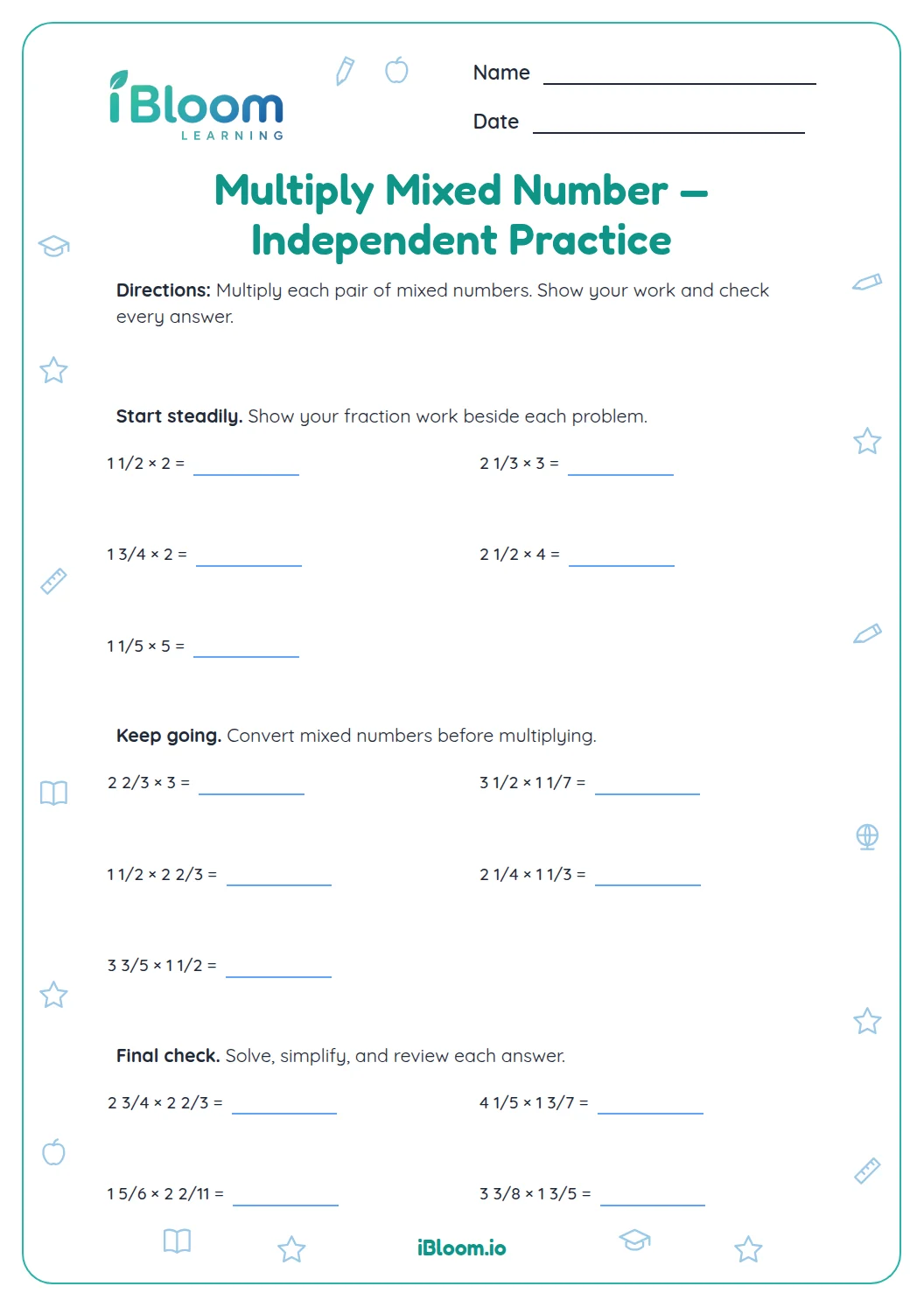
This Grade 5 worksheet gives students 14 problems multiplying a mixed number by a whole number. The three parts move from guided work to fewer hints and independent practice: convert the mixed number to an improper fraction, multiply, simplify, and estimate to check. A three-item bonus asks students to complete equivalent-fraction equations. The answer key shows the simplified products and bonus answers.
Aligned to 5.NF.B.4
What steps help multiply a mixed number?
Convert the mixed number to an improper fraction, multiply by the whole number, and simplify. Estimating first can help catch a product that is too small or too large.
How does the first set use the steps?
The first four products offer the most support. For 1 1/2 × 2, convert 1 1/2 to 3/2, multiply to get 6/2, and simplify to 3.
- 1Question 1: 1 1/2 × 2
- 2Convert: 1 1/2 = 3/2
- 3Multiply: 3/2 × 2 = 6/2 = 3
How does the practice become more independent?
The second set removes some of the guidance, and the last five mixed-number products are independent. A three-question bonus then asks students to complete equivalent-fraction equations. The key includes answers for all of these printed tasks.
How to use this worksheet
- 1Estimate the product before calculating.
- 2Convert the mixed number to an improper fraction.
- 3Multiply the numerator by the whole number.
- 4Keep the denominator, then simplify the fraction or mixed number.
- 5Compare the result with your estimate.
Mistakes to notice and how to help
The mistake
Multiplying the denominator by the whole number.
The fix
Multiply only the numerator; keep the denominator unchanged.
The mistake
Forgetting the whole-number part when converting.
The fix
Multiply the whole number by the denominator, then add the numerator.
The mistake
Leaving an improper fraction when it can be simplified.
The fix
Reduce the fraction or rewrite it as a mixed number, then check the estimate.
Common Core alignment
Multiply a mixed number by a whole number after converting it to an improper fraction.
On this sheet: Students multiply each mixed number after rewriting it as an improper fraction.
Show the official wordingHide the official wording
Apply and extend previous understandings of multiplication to multiply a fraction or whole number by a fraction.
What to practice next
Make more practice
Further reading
Questions parents and teachers ask
What should students know before starting?
This worksheet is for Grade 5 students practicing multiplication of mixed numbers by whole numbers. It starts with a guided set, then removes some hints before five independent products. Students can show conversion and multiplication steps in the work space and use an estimate to check.
How many multiplication problems are included?
The sheet prints seventeen tasks: fourteen products multiplying a mixed number by a whole number, followed by three equivalent-fraction bonus questions. The products are grouped into four guided examples, five problems with fewer hints, and five independent problems. The answer key shows every answer.
Can students simplify before multiplying?
First rewrite the mixed number as an improper fraction. Multiply its numerator by the whole number and keep the denominator. Then simplify or convert the result to a mixed number when needed. For example, 1 1/2 × 2 becomes 3/2 × 2 = 6/2 = 3.
How can students check whether a product is reasonable?
Estimate before multiplying, then compare the exact result with that estimate. For example, 1 1/2 × 2 should be close to 3 because 1 1/2 is already close to 1 1/2 and the whole-number factor doubles it. The estimate can reveal a missed whole-number part.
What does the answer key include?
The key gives simplified answers to all fourteen mixed-number products and answers to the three equivalent-fraction bonus questions. Students can compare one part at a time, then return to any missed item and check the step that led to the answer.