
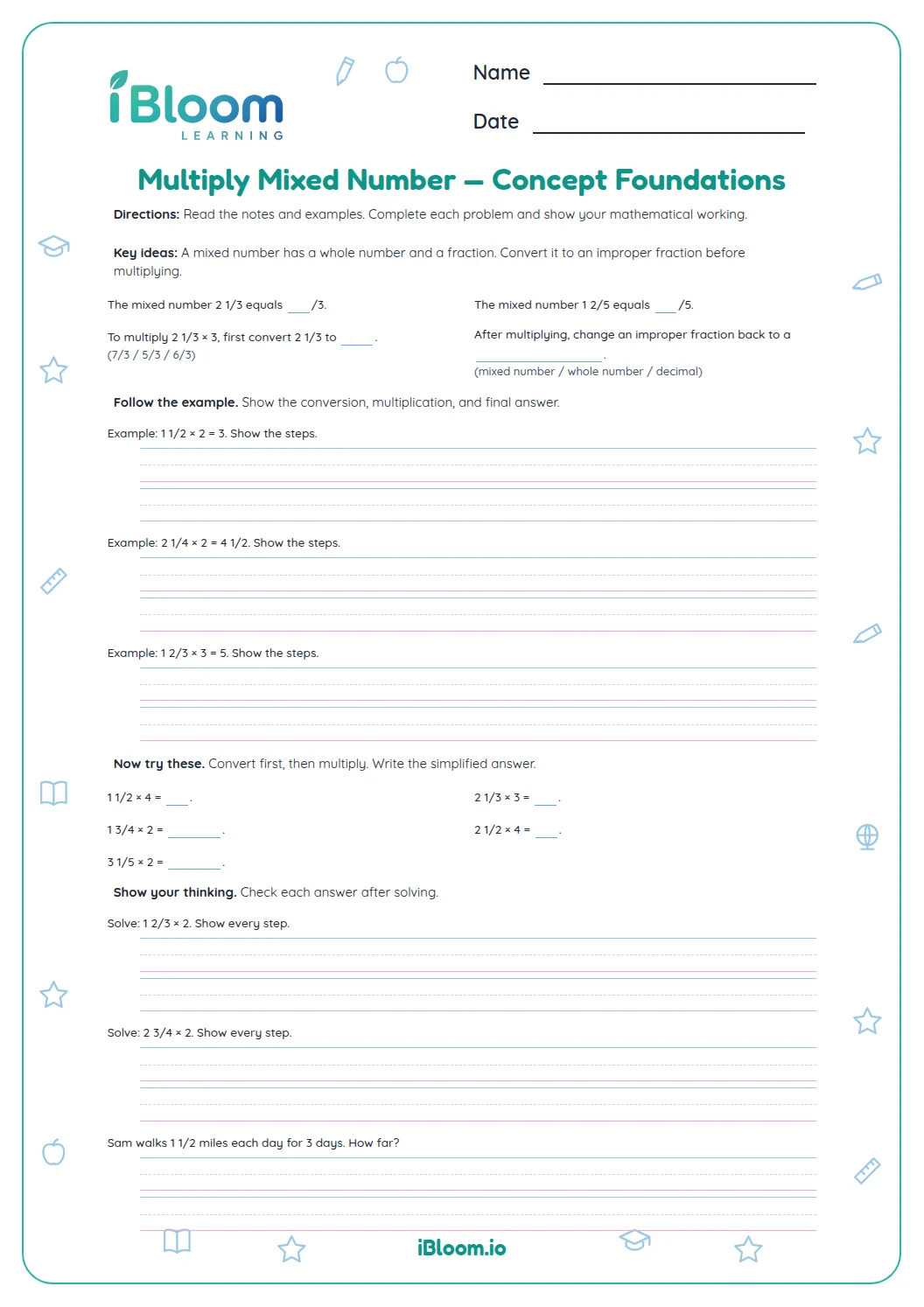

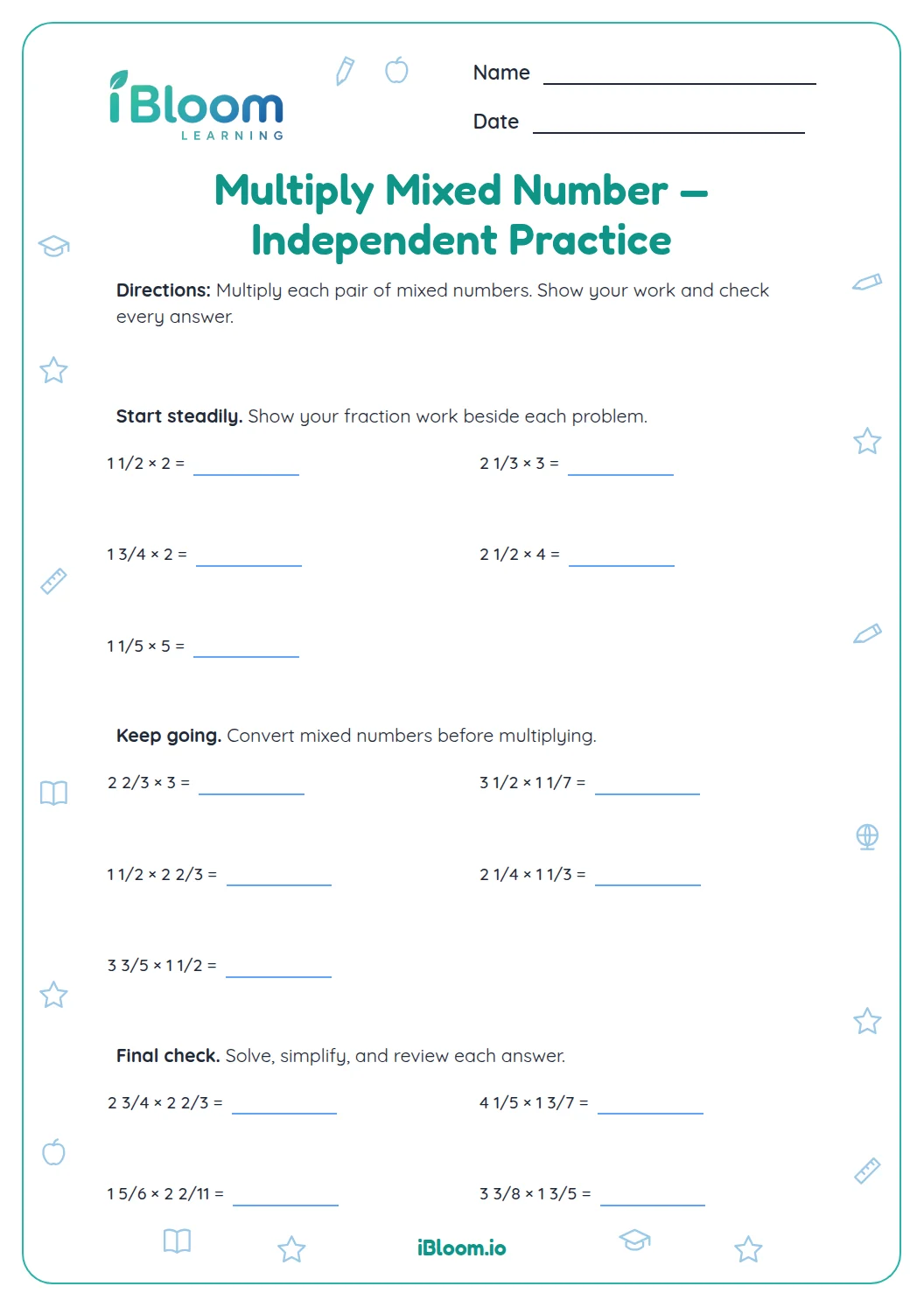
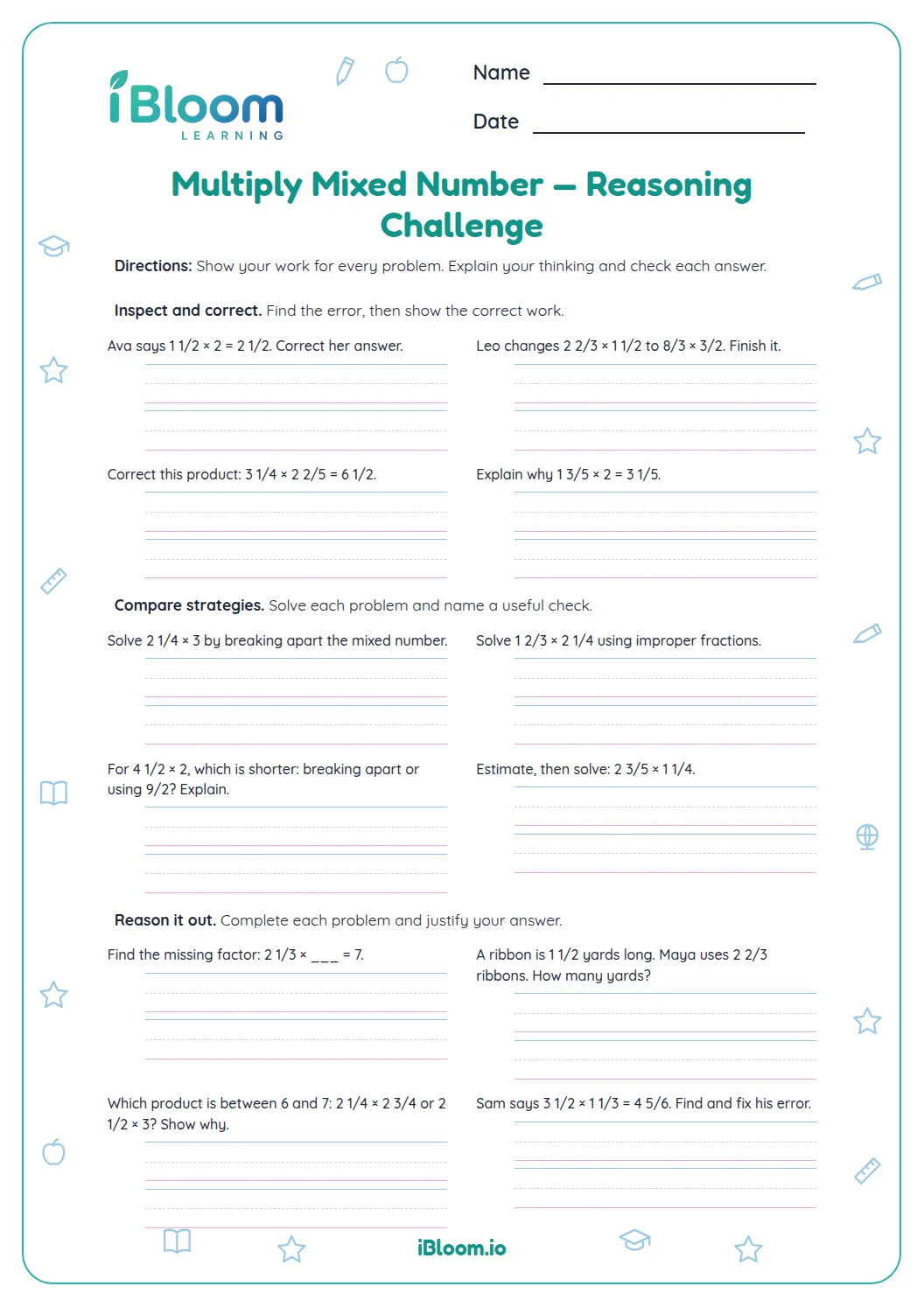
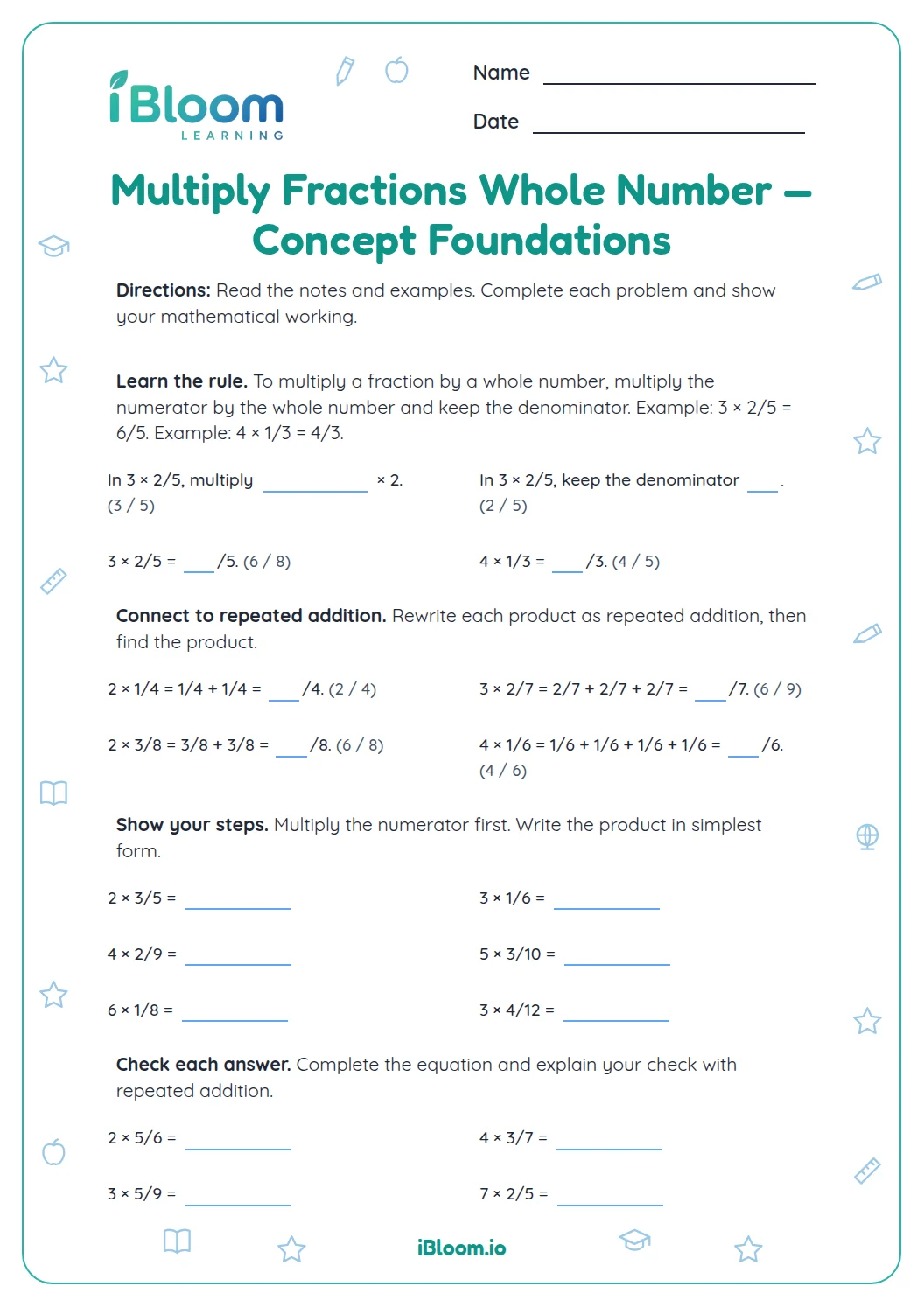


About this worksheet
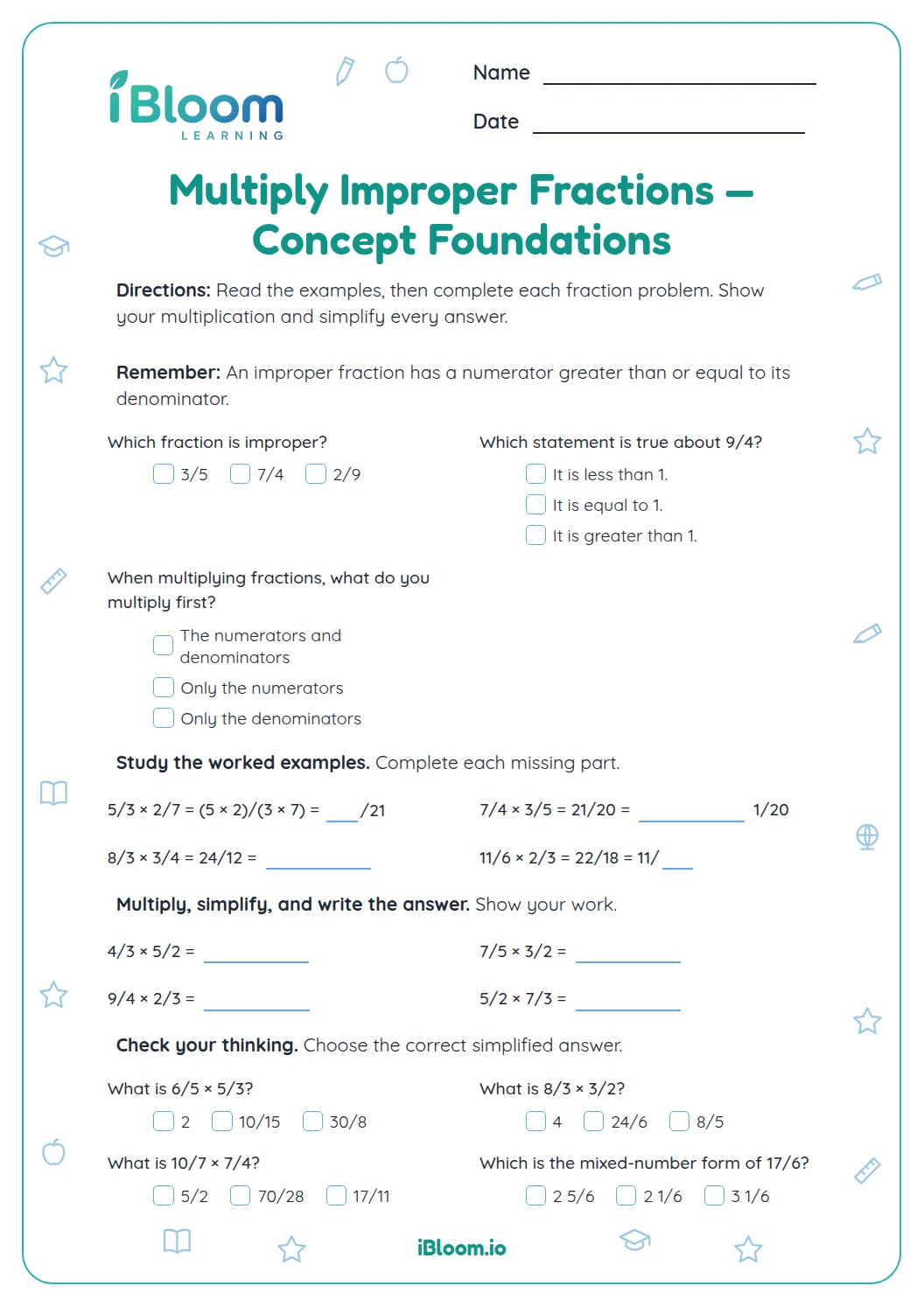
This free printable Grade 5 worksheet uses mixed-number multiplication to solve 14 everyday problems. Students begin with equal lengths and repeated amounts, then calculate fractional recipe batches and distances, find rectangular areas, and scale two more batches. Parts A, B and D have answer blanks; Part C has space for equations and working. The progression practices Common Core 5.NF.B.6: representing real-world fraction and mixed-number multiplication with equations. Students should be comfortable changing a mixed number into an improper fraction. A separate answer key gives simplified results; each prompt names the unit.
Aligned to 5.NF.B.6
Which quantities should students multiply?
In Part A, one amount is repeated a whole number of times. Three ribbons each measuring 2 1/2 feet give three equal groups of that length. Part B applies multiplication to fractional batches, loops or jugfuls.
Underline the amount for one batch or loop and circle the number of batches or loops. The unit in the question tells students how to label the product.
How does renaming a mixed number help?
Renaming puts the whole amount into equal fractional pieces. In question 7, 1 1/2 becomes 3/2 and 2 1/3 becomes 7/3. Both whole-number parts are included before any multiplication begins.
- 11 1/2 × 2 1/3 = 3/2 × 7/3
- 23/2 × 7/3 = 21/6 = 7/2
- 37/2 = 3 1/2
- 4The bread needs 3 1/2 cups of milk.
Why do the final answers use square units?
Part C gives a rectangle’s length and width. Multiplying those measurements finds the amount of surface covered, so the answer uses square feet or square inches. Question 12 gives 4 1/2 × 2 2/3 = 12 square inches. Part D returns to scaling recipes with fractional batches.
An estimate can catch a conversion error. The mat in question 11 is larger than a 2-foot by 1-foot rectangle but smaller than a 3-foot by 2-foot rectangle; its area of 3 3/4 square feet fits those bounds.
How can a recipe be scaled by part of a batch?
Part D returns to scaling recipes with fractional batches. Question 13 is 2 2/3 × 1 1/2 = 4 cups; simplify the product before writing it in the blank.
How to use this worksheet
- 1Read question 1 and identify the length of one ribbon and the number of ribbons.
- 2For Part C, write a multiplication equation, solve it, and add a quick estimate to check the result.
- 3Rename each mixed number by multiplying its whole part by the denominator and adding the numerator.
- 4Multiply the fractions, simplify, and change an improper fraction to a mixed number when needed.
- 5For Part C, add square to the unit; compare every result with an estimate before checking the key.
Mistakes to check together
The mistake
Renaming 2 1/3 as 3/3.
The fix
Two wholes contain six thirds; add one third to get 7/3.
The mistake
Multiplying only the whole parts and then only the fraction parts.
The fix
Convert both complete mixed numbers first so every part of each amount is included.
The mistake
Writing 3 3/4 feet for the mat’s area.
The fix
Length times width measures surface coverage; label that result 3 3/4 square feet.
Common Core alignment
Use multiplication equations to solve measurement, recipe and area problems with mixed numbers.
On this sheet: All 12 problems ask students to represent and solve real-world multiplication with mixed numbers.
Show the official wordingHide the official wording
Solve real world problems involving multiplication of fractions and mixed numbers, e.g., by using visual fraction models or equations to represent the problem.
What to practice next
Make more practice
Further reading
Questions parents and teachers ask
What does my child need to know before starting?
Your child should be able to rename a mixed number, multiply fractions and simplify a fraction. Try 1 1/2 = 3/2 aloud before starting. Part A then connects those skills to equal groups, while Parts B and C ask students to choose factors from measurement stories.
Why does the bread problem use 2 1/3 batches?
A fractional batch means making a scaled amount of a recipe. Two full batches and one third of another batch use 2 1/3 times the milk for one batch. Question 7 therefore asks for 1 1/2 × 2 1/3, which equals 3 1/2 cups.
Should answers be fractions or mixed numbers?
Use simplest form in each blank or answer box. In Parts B and C, include the unit in the working space. A whole-number result such as 7 is complete; 21/6 simplifies to 3 1/2. The key uses mixed numbers for nonwhole products greater than one, and each question names its unit.
How can I check the area problems?
Multiply the two side lengths and check the square unit. For question 12, 4 1/2 × 2 2/3 becomes 9/2 × 8/3 = 12. The sides are in inches, so the area is 12 square inches. A quick rectangle sketch can help explain the unit.
Does the key include the working?
The answer key gives the final simplified number for each problem, with the unit named in the prompt. Parts B and C provide space for equations and calculations. When an answer differs, compare the chosen factors first, then the mixed-number conversions, and finally the multiplication and simplification steps.