


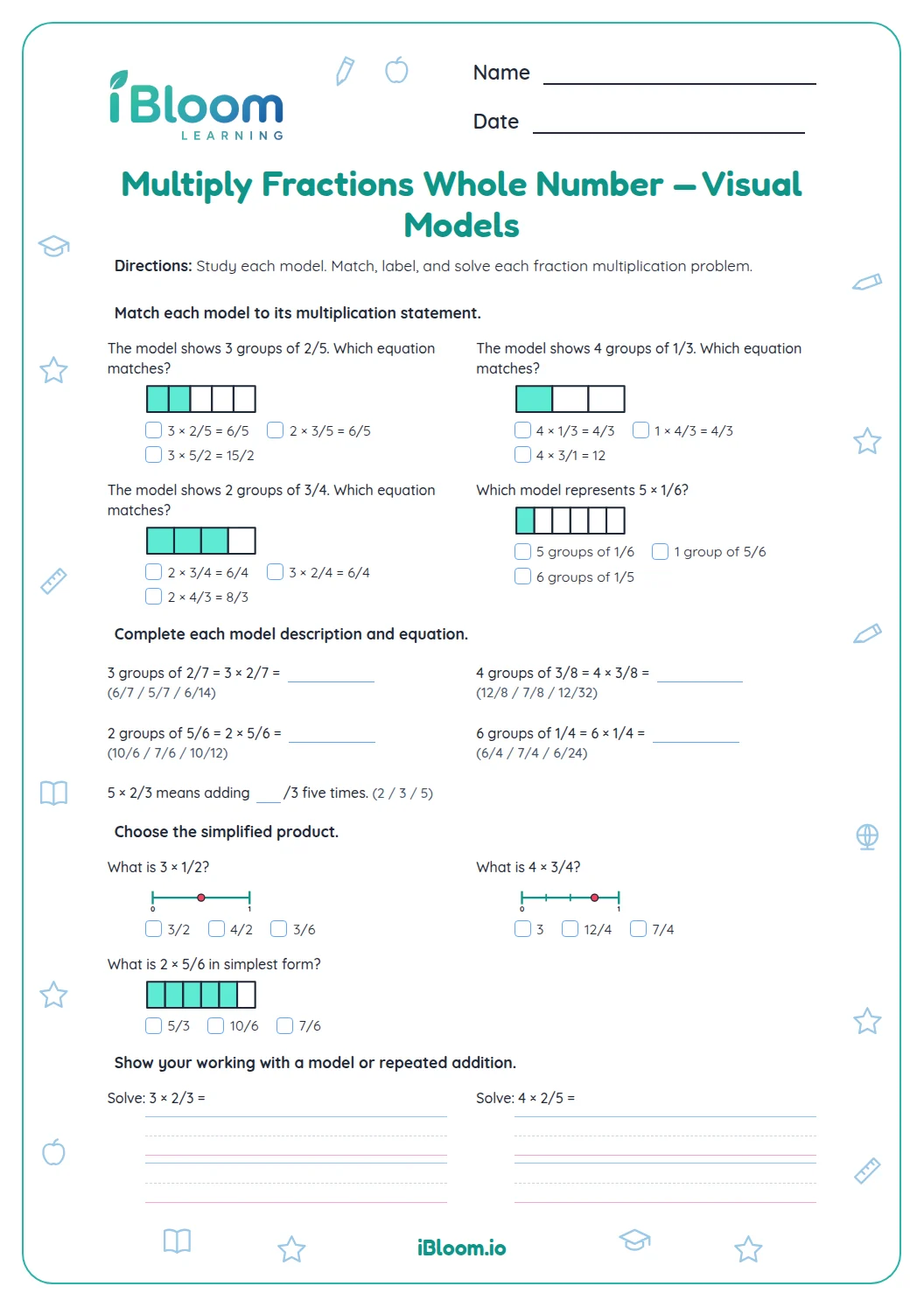
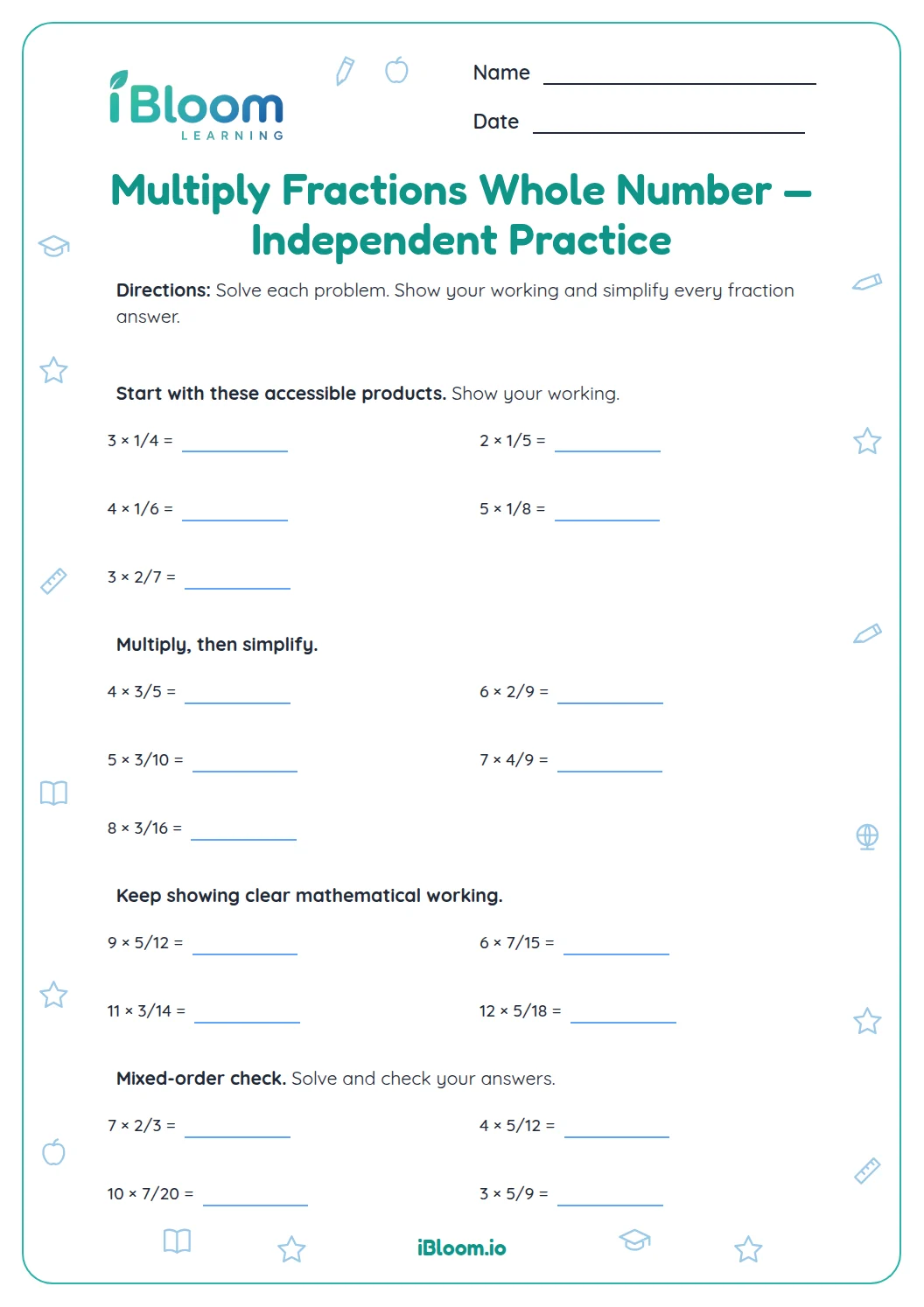


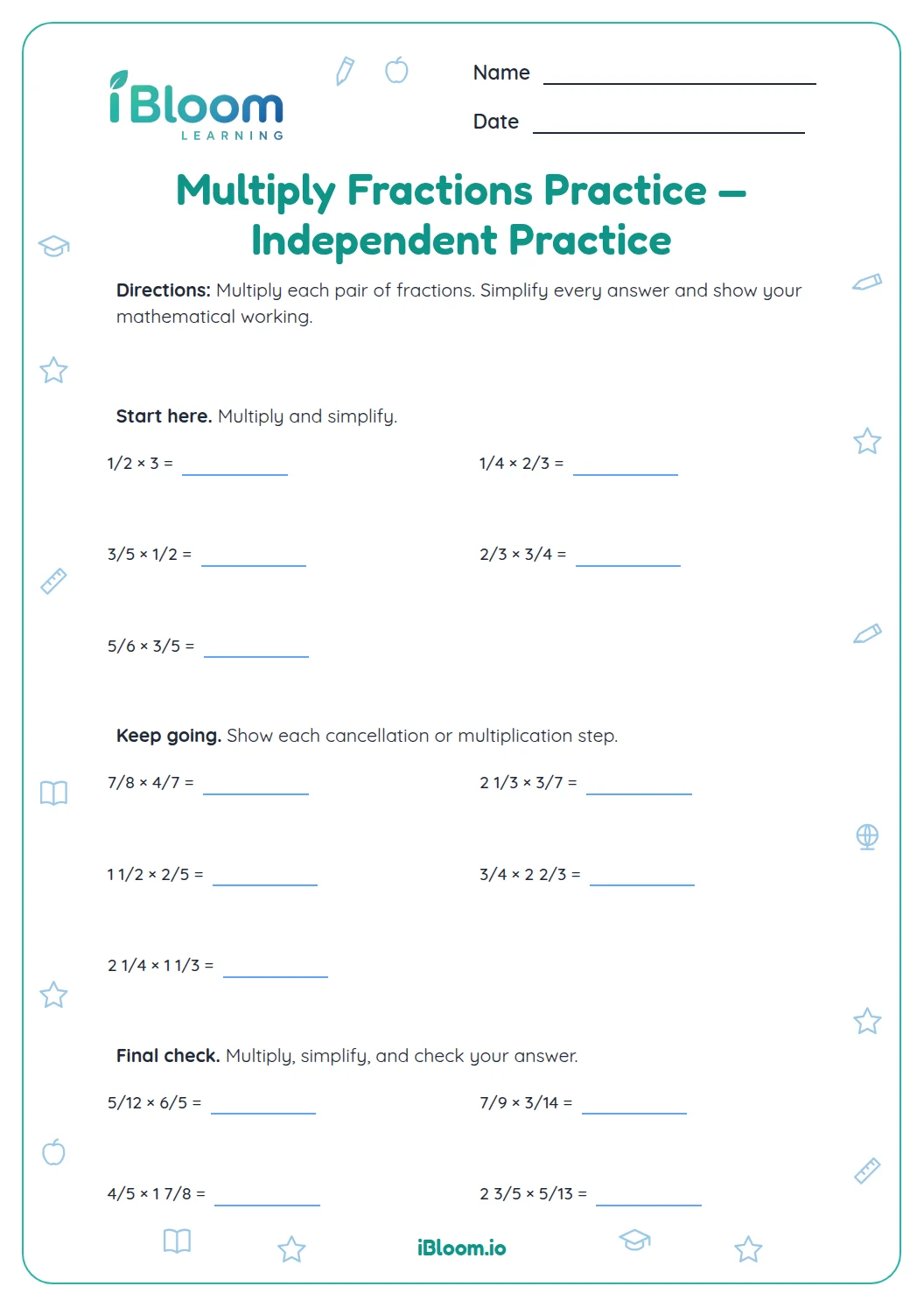
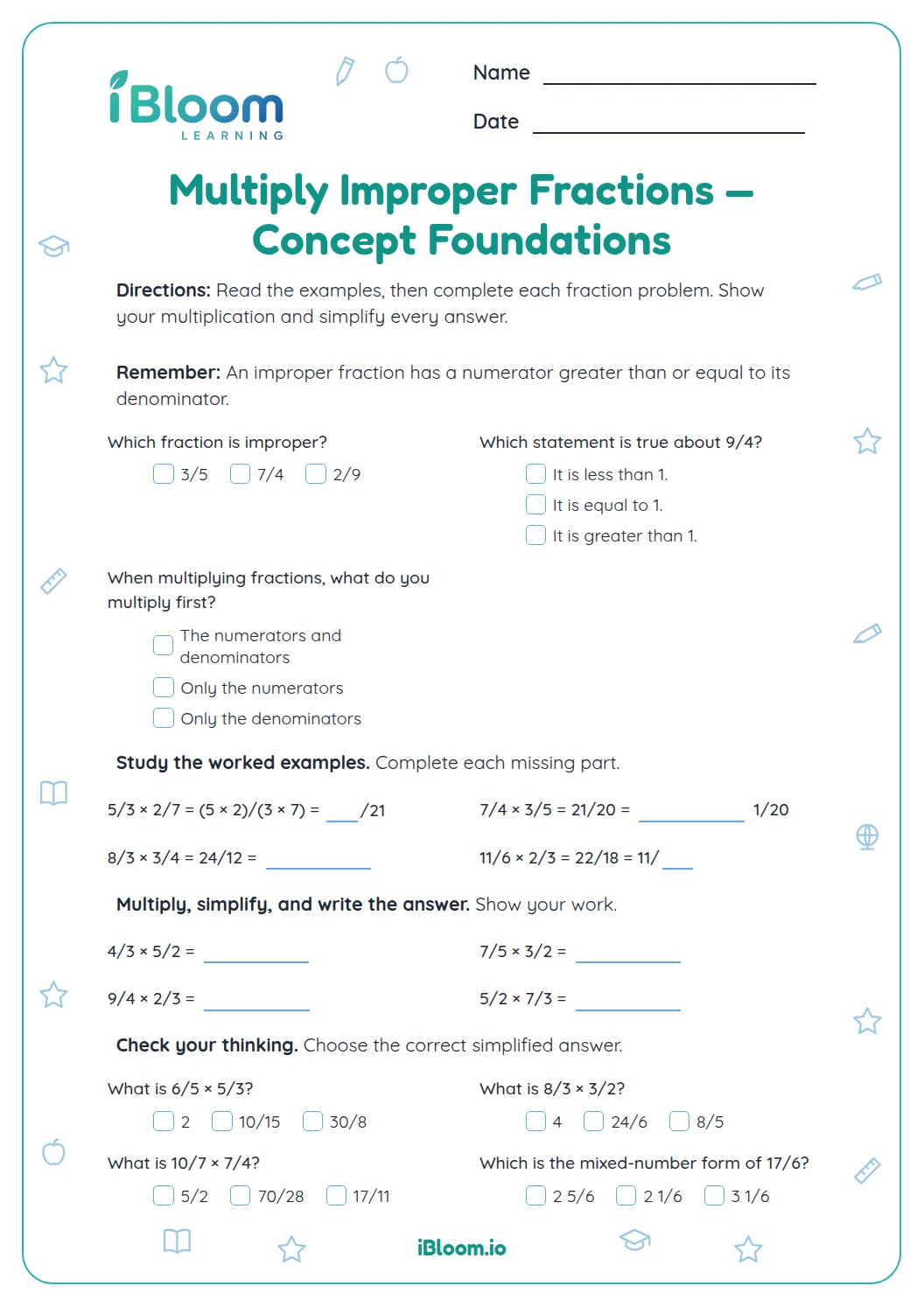
About this worksheet
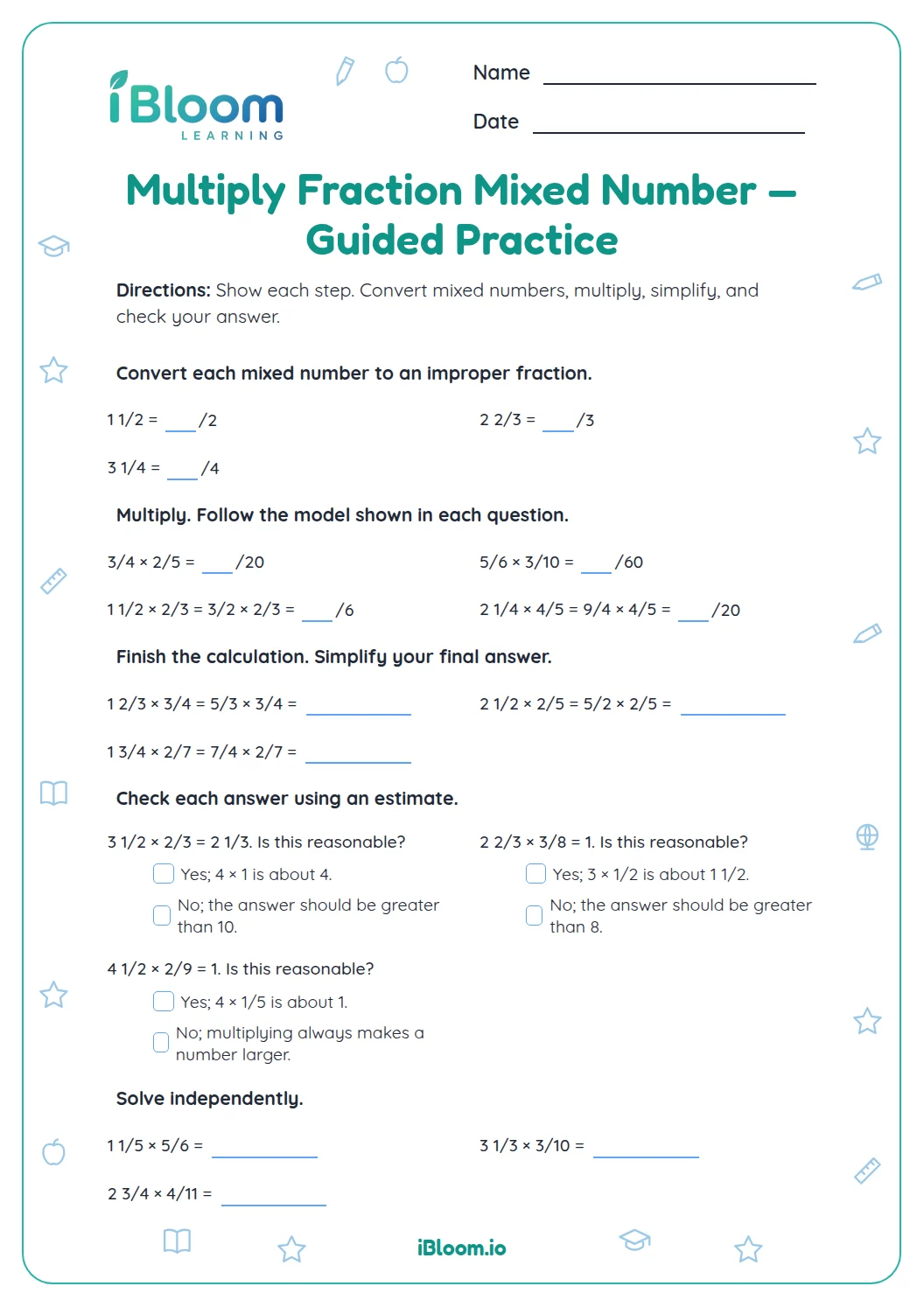
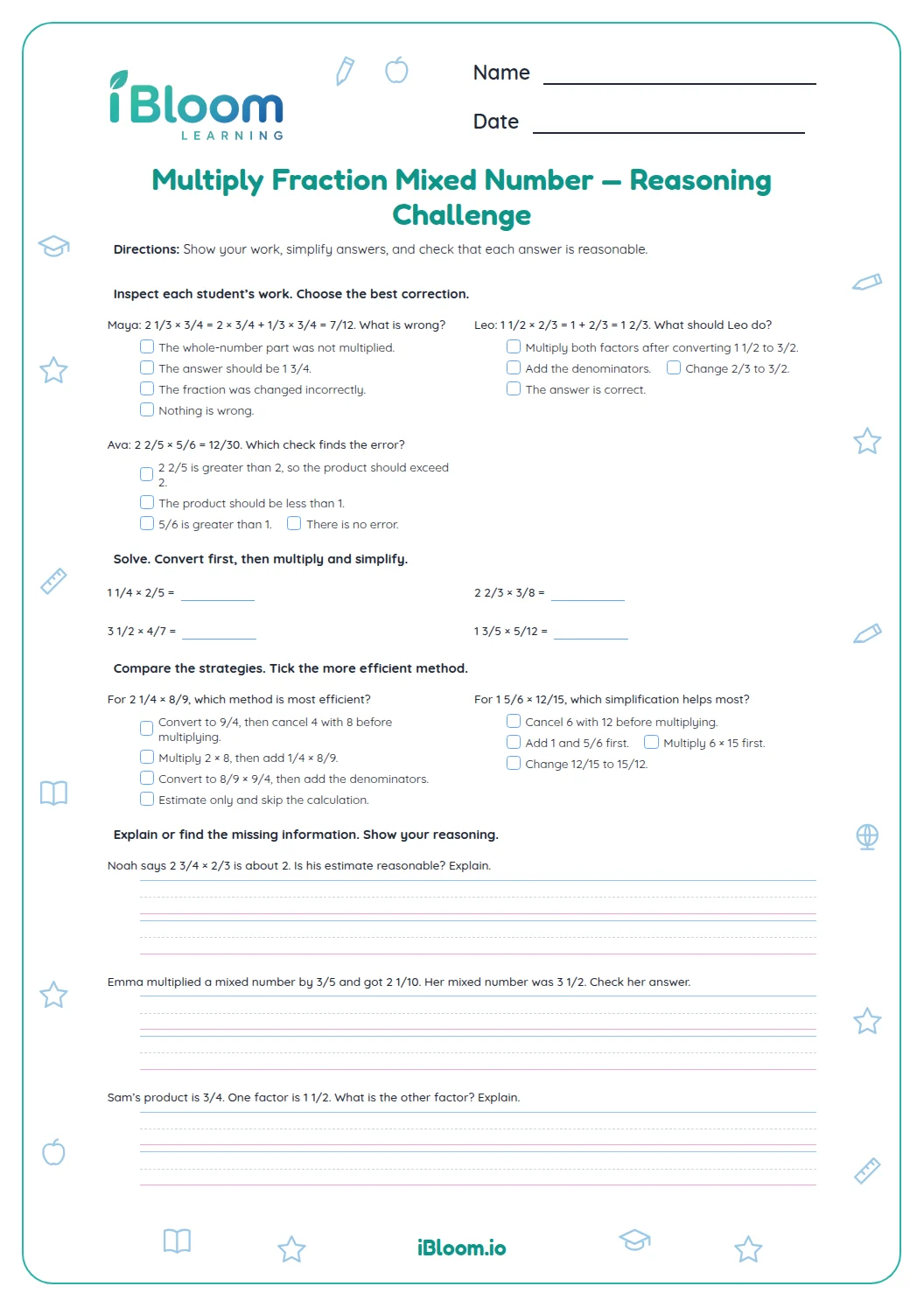
This free Grade 5 worksheet gives students 16 multiple-choice questions about multiplying a fraction by a mixed number. Nine shaded bars show mixed-number quantities; students choose the matching product equation. The final seven items ask students to calculate and simplify products. The work connects to CCSS 5.NF.B.4.a, interpreting a fraction product with a visual model. The answer key gives each correct equation or simplified product.
Aligned to 5.NF.B.4.a
How does a bar model connect to a product?
Each bar is partitioned into equal fractional parts, and fully shaded bars represent whole units. Question 1 shows one whole and one half, or 1 1/2. The fraction in the prompt tells students what part of that amount to find, and the matching choice records the multiplication.
For example, one half of 1 1/2 is 1/2 × 3/2, which equals 3/4. The bar names the mixed-number factor; converting it to an improper fraction makes the calculation clear.
- 1Read the bar: 1 1/2 = 3/2.
- 2Find one half of that amount: 1/2 × 3/2.
- 3The product is 3/4.
How do you simplify the product?
Multiply the numerators and denominators, then reduce the fraction if both share a factor. A product greater than one may be written as a mixed number. In question 8, 2/3 × 1 3/4 = 2/3 × 7/4 = 14/12, which simplifies to 7/6 or 1 1/6.
The shaded product model gives a visual check after the calculation. If the stated fraction is less than one, the product should be smaller than the mixed-number amount.
How do the last questions extend the practice?
Part A has nine multiple-choice items with mixed-number bars. Part B has seven multiple-choice calculations. Together the parts move from reading a visual factor to using the same multiplication process without a bar beside every item.
The models partition mixed-number quantities into whole units and equal fractional parts; the equations record each product.
How to use the fraction models
- 1Count the equal parts in the partial bar to name its fraction.
- 2Add the whole bars to the partial bar to write the mixed number.
- 3Convert the mixed number to an improper fraction.
- 4Multiply numerator by numerator and denominator by denominator.
- 5Simplify, then estimate whether the product should be less than or greater than the mixed-number amount.
Common mixed-number multiplication mistakes
The mistake
Multiplying the numerator by the whole number but forgetting the fractional part.
The fix
Convert the full mixed number to an improper fraction before multiplying.
The mistake
Adding denominators when multiplying.
The fix
Multiply the denominators, then simplify the resulting fraction.
The mistake
Leaving an improper fraction when a mixed number is easier to read.
The fix
Divide the numerator by the denominator and write the remainder as a fraction.
Common Core alignment
The bar models connect fraction products with partitioning equal parts of a quantity.
Use a visual fraction model to interpret and compute a fraction times a fraction.
On this sheet: Every problem multiplies a fraction by a mixed-number quantity shown in a bar model; the final part applies the product to a context.
Show the official wordingHide the official wording
Interpret the product (a/b) × q as a parts of a partition of q into b equal parts; equivalently, as the result of a sequence of operations a × q ÷ b. For example, use a visual fraction model to show (2/3) × 4 = 8/3, and create a story context for this equation. Do the same with (2/3) × (4/5) = 8/15. (In general, (a/b) × (c/d) = (ac)/(bd).
What to practice next
Make more practice
Further reading
Questions parents and teachers ask
How many questions are included?
There are 16 questions in two parts. The first nine match mixed-number bars with multiplication statements, and the final seven ask students to calculate and simplify products. The key gives a matching equation for each model and a simplified result for each direct calculation.
What does each shaded bar represent?
Each of the first nine shaded bars represents the mixed-number factor in the question. Fully shaded bars show whole units, and the final partial bar shows a fraction of one more whole. Students match that amount with a multiplication equation using the fraction named in the prompt.
How does question 1 work?
Question 1 shows 1 1/2 in the bar and asks for one half of that amount. Convert 1 1/2 to 3/2, then multiply 1/2 × 3/2 to get 3/4. The model helps identify the amount; the multiplication records the fraction of that amount.
Does the answer key show simplified answers?
Yes. The key gives the matching multiplication equation for each bar model and each direct product in simplified form. Products greater than one are written as mixed numbers when that is easier to read, such as 1 1/6 instead of 7/6.
What should I ask if my child is unsure of the product?
Ask them to name the mixed number shown in the bar, then convert it to an improper fraction. Multiply the numerators and denominators and simplify the result. If the stated factor is less than one, the product should be smaller than the original amount.