





About this worksheet
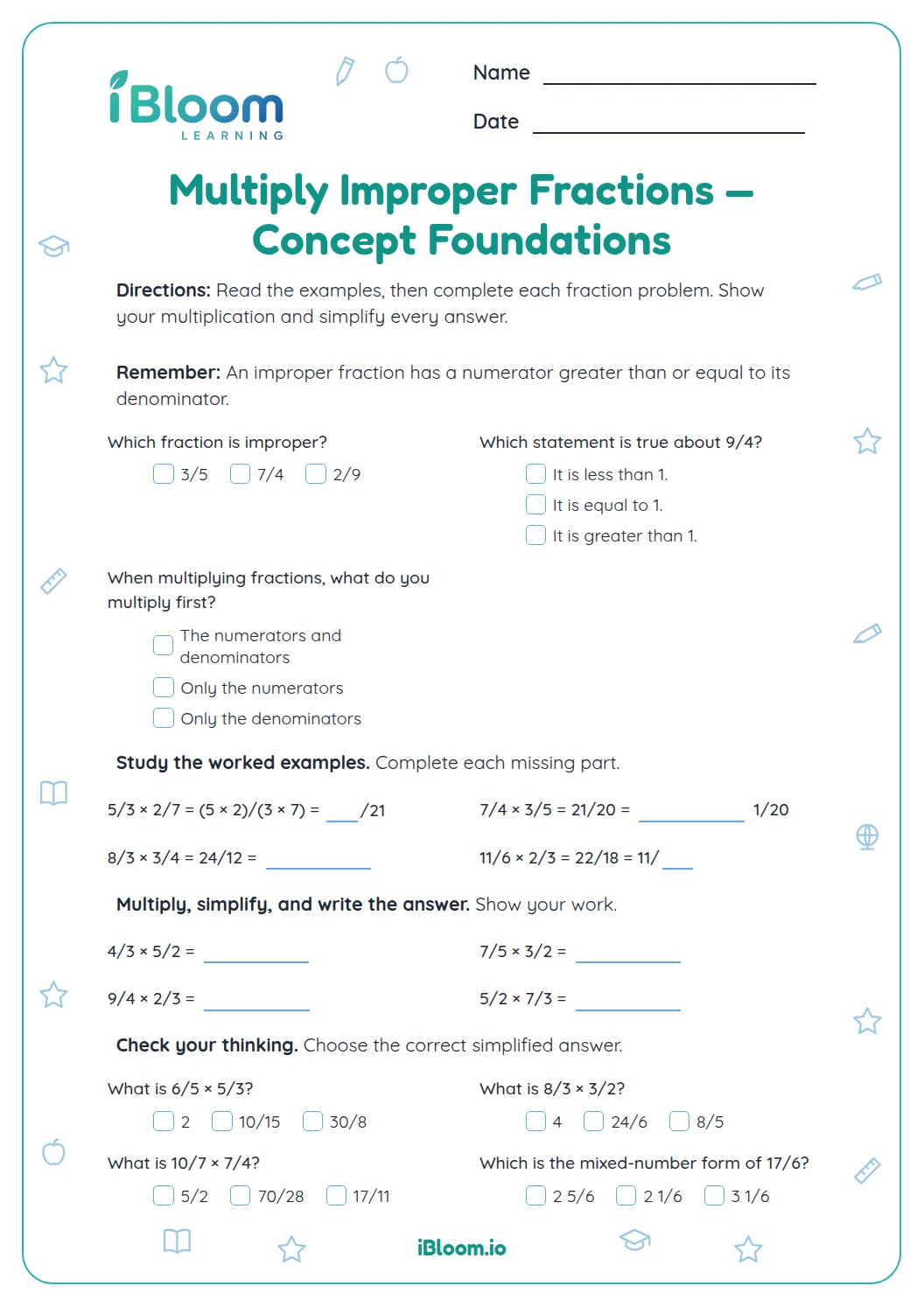
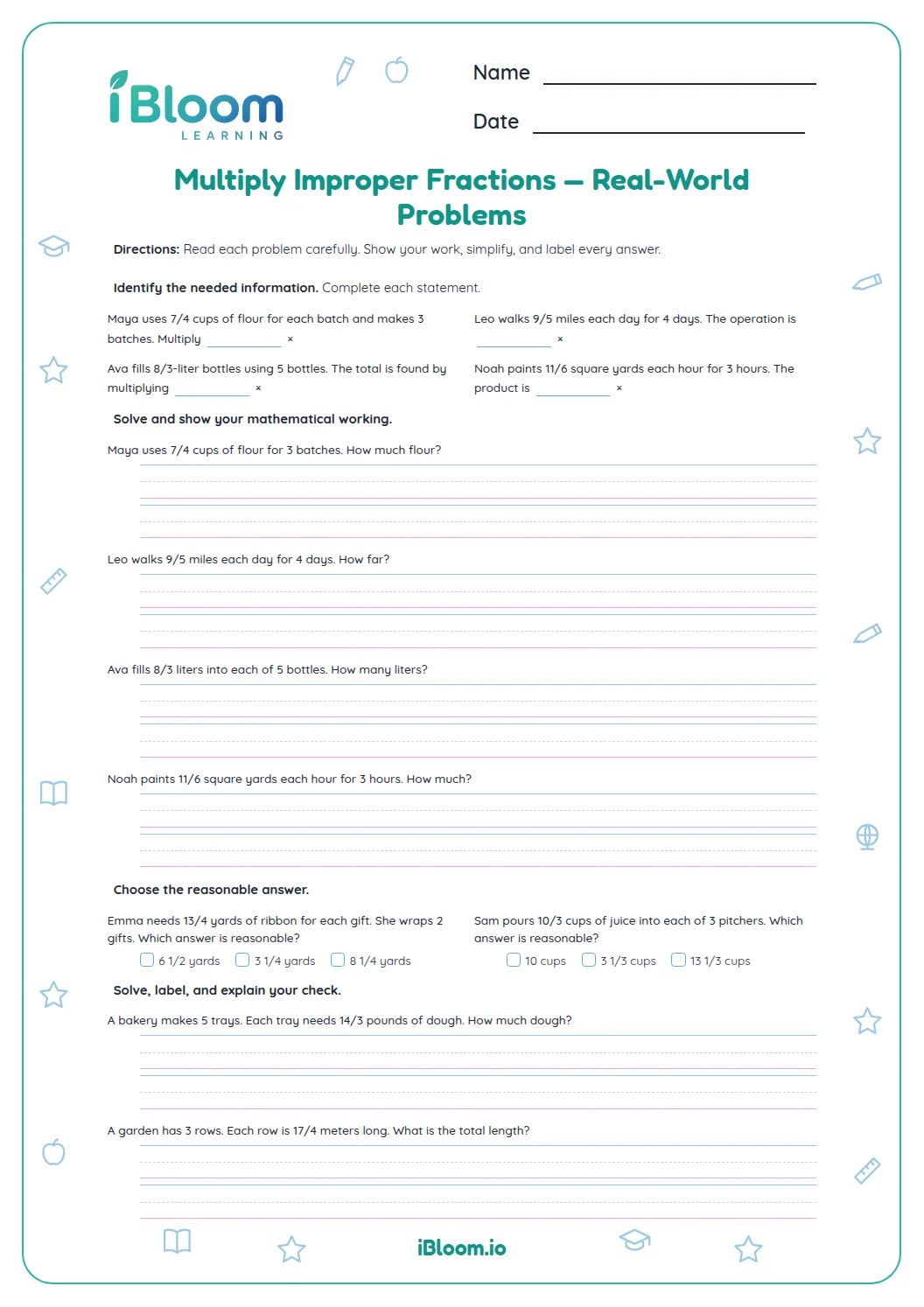
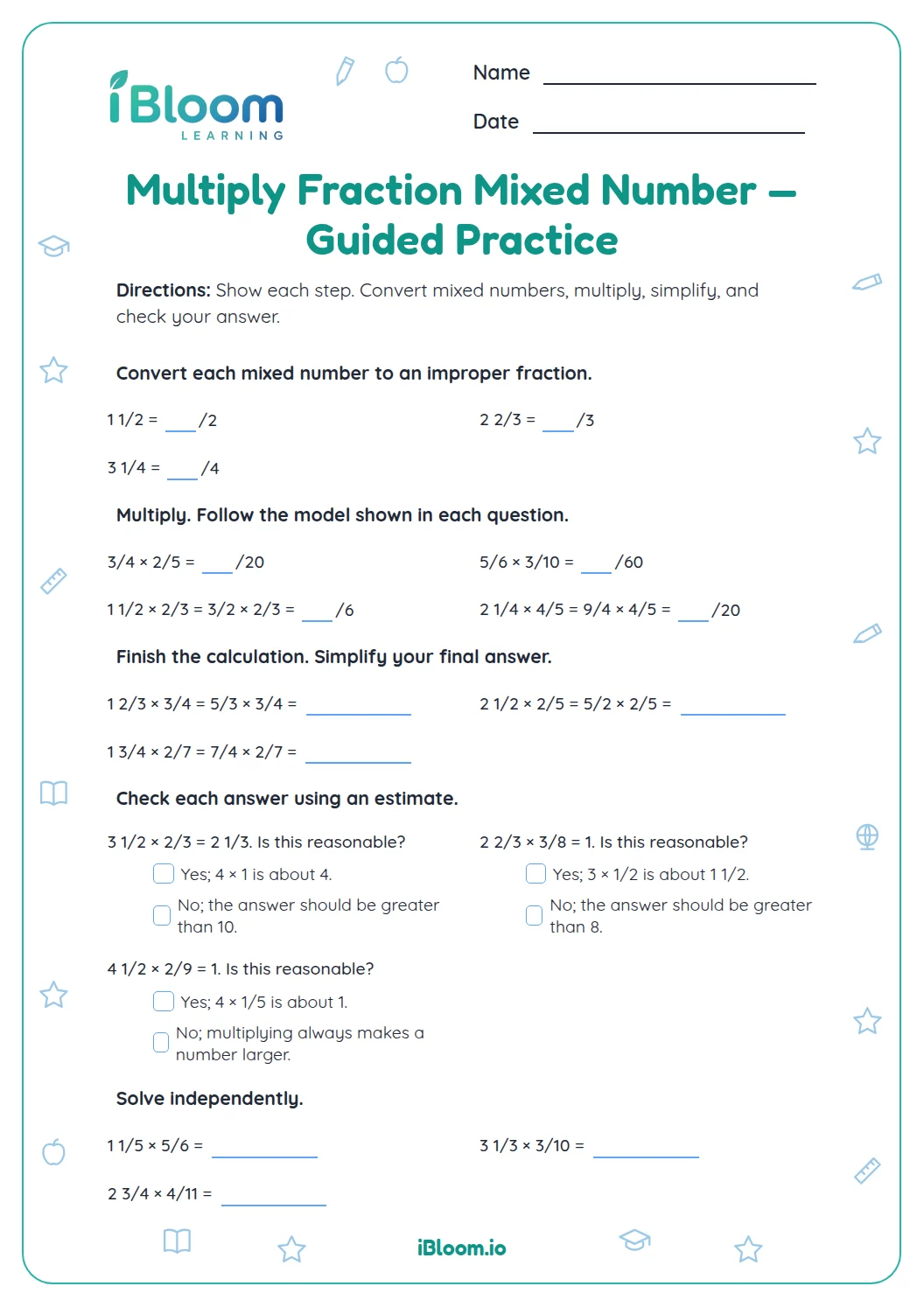
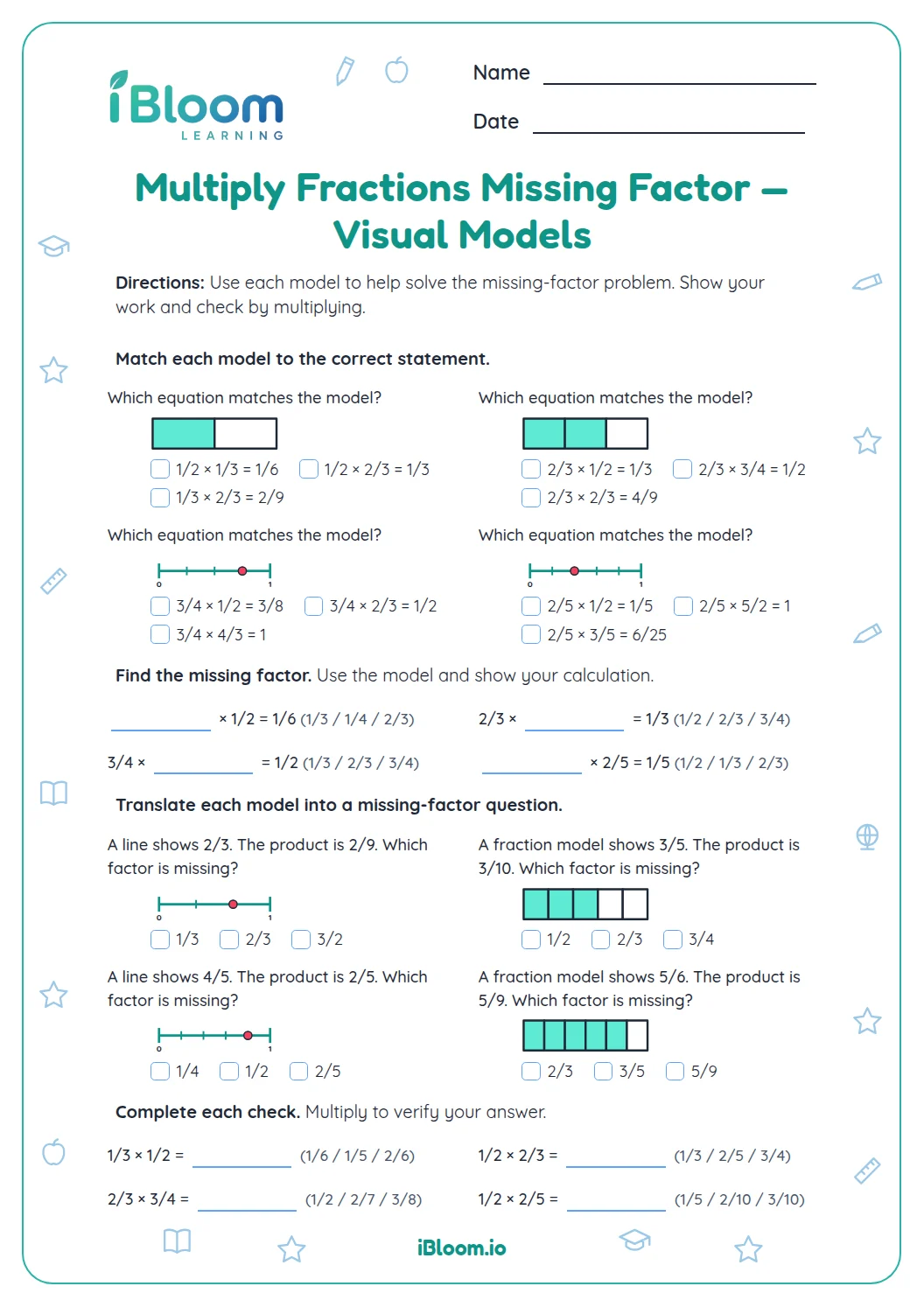
This free Grade 5 worksheet provides sixteen products of improper fractions for independent practice. Both factors in every item are greater than one. Part A uses four products that are already in simplest form, Part B has four products with common factors to remove, and Part C mixes eight more products, including whole-number results. Common Core 5.NF.B.4 connects this work to multiplying a fraction by a fraction. Each item has space for calculations. The separate answer key uses simplified improper fractions or whole numbers; equivalent simplified mixed numbers are also acceptable.
Aligned to 5.NF.B.4
What changes when both fractions are improper?
The multiplication rule stays the same: multiply numerators and multiply denominators. On this sheet, both factors in every problem are greater than one, so each product must be greater than either factor. This gives students a useful way to check the size of every answer.
Children can work directly with the written fractions. Keeping them in fraction form makes numerator and denominator multiplication easy to track.
How can students simplify before multiplying?
Divide a numerator and a denominator by a common factor. They may belong to different fractions because the entire expression is one product of numerators over one product of denominators. Keep a record of the reduced numbers in the working space.
- 1Question 5: 9/4 × 8/3
- 2Divide 9 and 3 by 3; divide 8 and 4 by 4.
- 3The remaining product is 3/1 × 2/1 = 6.
- 4Check by multiplying first: 72/12 = 6.
How do the three parts build independent practice?
Part A includes four products that stay as improper fractions in simplest form. Part B makes simplification more prominent: every product reduces, and two are whole numbers. Part C asks students to select their own calculation route for eight varied products.
Compare methods after the student finishes. Multiplying first and simplifying afterward is valid. Simplifying first can reduce the size of the multiplication, but accuracy and a clear record of the work matter more than using one particular route.
How to use this worksheet
- 1Check that the numerator is greater than the denominator in each factor.
- 2Multiply numerators and denominators in Part A, recording the work.
- 3In Part B, look for common factors before or after multiplying.
- 4Finish Part C and simplify every product completely.
- 5Check that each product exceeds both factors, then compare equivalent answers with the key.
Mistakes to discuss and fix
The mistake
Adding denominators, as in 5/3 × 7/4 = 35/7.
The fix
Multiply denominators: 3 × 4 = 12, so the product is 35/12.
The mistake
Canceling two numerators with each other.
The fix
Reduce only a numerator with a denominator by the same common factor.
The mistake
Leaving 72/12 as the final answer for question 5.
The fix
Finish simplifying: twelve fits into seventy-two six times, so write 6.
Common Core alignment
Multiply pairs of improper fractions and simplify each product.
On this sheet: All sixteen questions multiply a fraction greater than one by another fraction greater than one.
Show the official wordingHide the official wording
Apply and extend previous understandings of multiplication to multiply a fraction or whole number by a fraction.
What to practice next
Make more practice
Further reading
Questions parents and teachers ask
Should answers be mixed numbers or improper fractions?
Either form is acceptable when it is simplified. The printed key uses improper fractions and whole numbers so students can compare directly with their multiplication. For example, 35/12 and 2 11/12 are equivalent simplified answers. Check the value and simplification rather than requiring the key’s exact form.
Must students simplify before multiplying?
No, students may multiply first and simplify the resulting fraction. Simplifying across factors first is another valid route and can keep the arithmetic smaller. Question 5 works either way: multiplying gives 72/12, which simplifies to 6, while reducing the factors first gives 3 times 2.
Are all the factors greater than one?
Yes, both factors in every one of the sixteen problems are greater than one. Each numerator is larger than its denominator. That lets students use the same estimate throughout: the product should exceed both starting factors. An answer smaller than either factor is a reason to check the work.
Where can students show their calculations?
Each problem has working space for multiplication and simplification. Encourage students to keep the original factors readable and record any reductions clearly. If they use a separate notebook for longer calculations, have them write the question number beside the work so it can be checked against the sheet.
How can I review an incorrect product?
Check numerator multiplication, denominator multiplication, and simplification separately. Ask the student to point to each calculation instead of erasing the whole attempt. Then compare the product’s size with both factors. A correct intermediate fraction may need only one more reduction to match the value shown in the key.