




About this worksheet
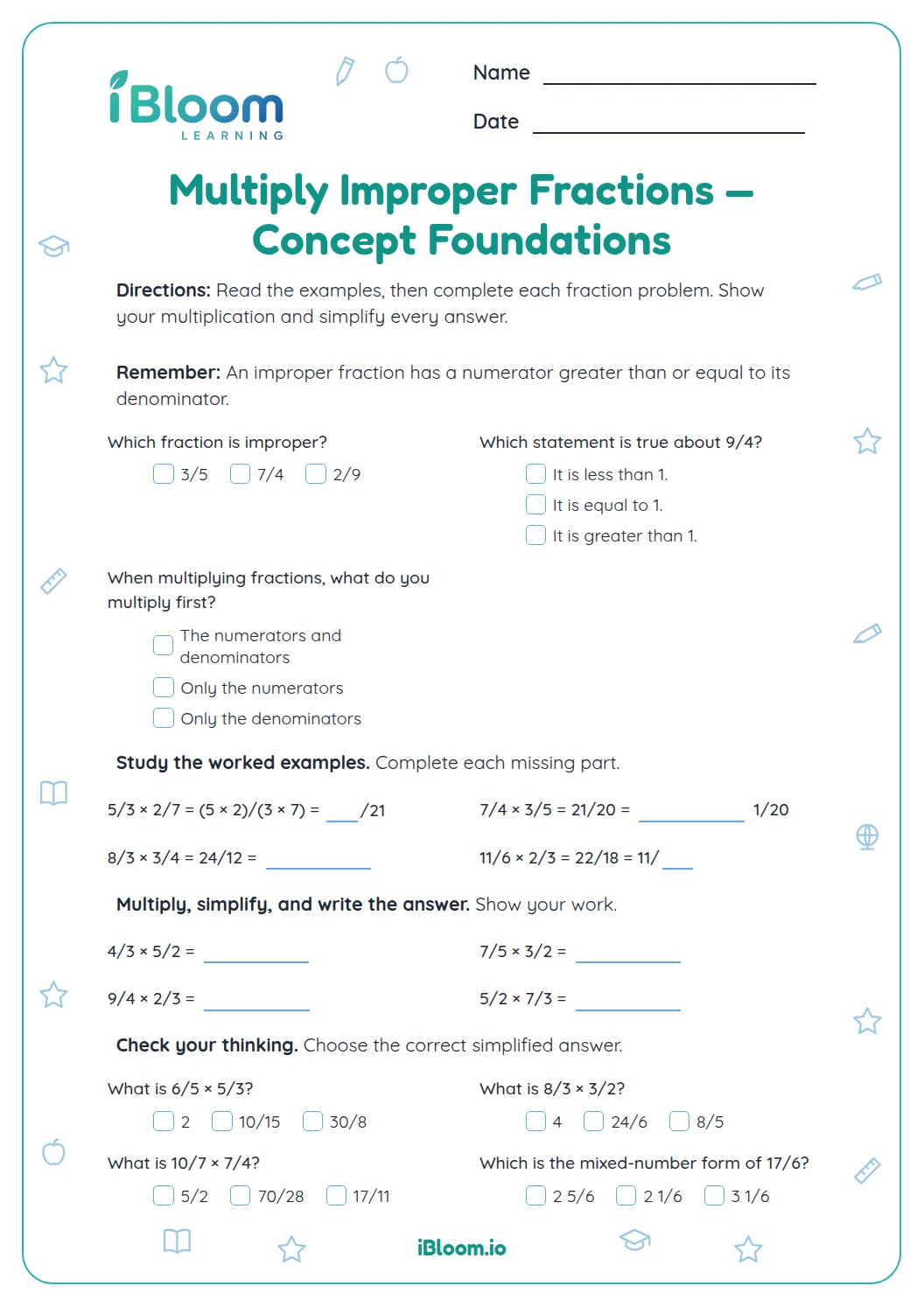
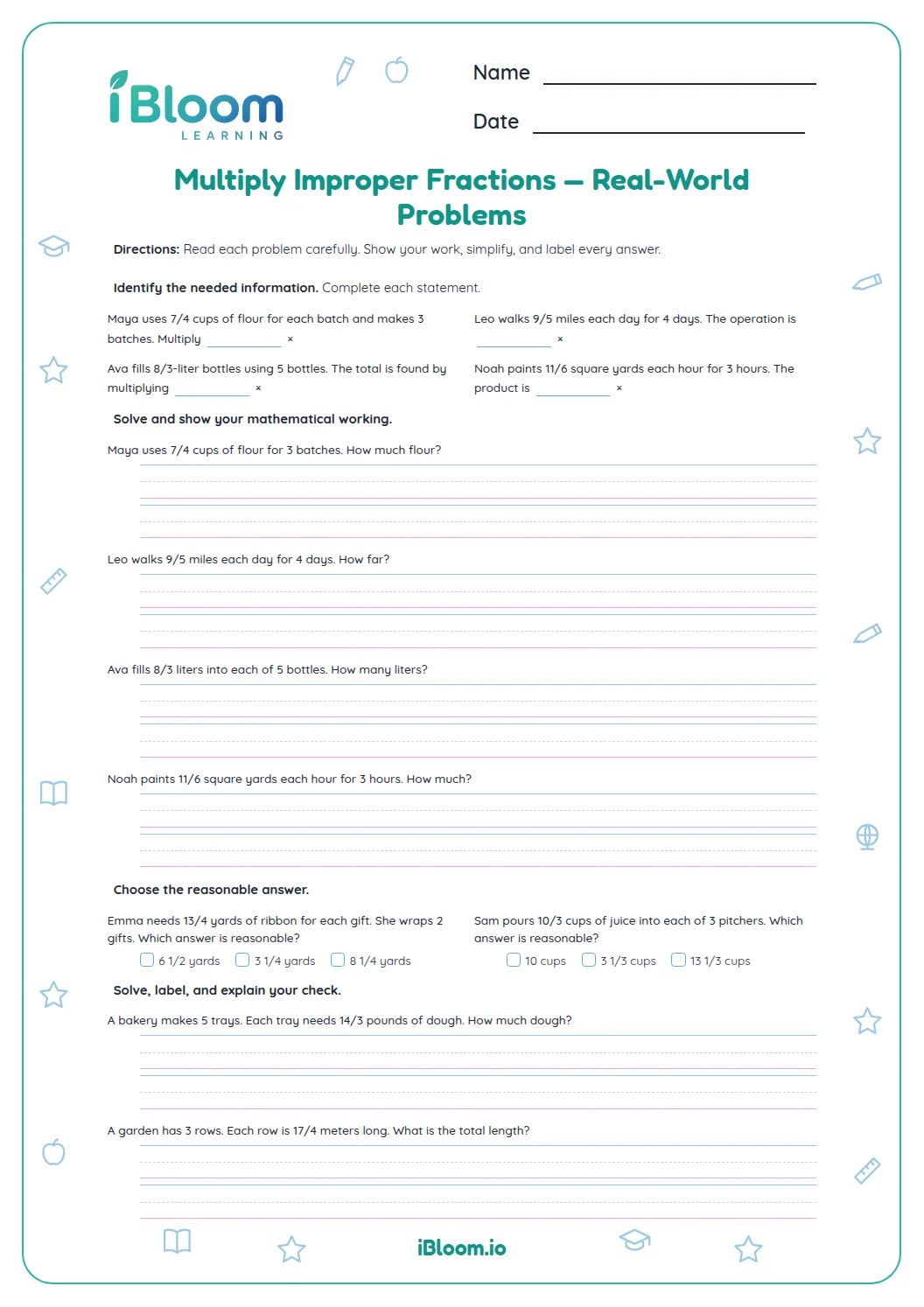
This Grade 5 reasoning worksheet contains 15 questions about multiplying improper fractions. Learners simplify products, compare two products with a shared factor, solve measures with units, and test a claim by calculating. The separate answer key gives the correct products and reasoning choices. It aligns with CCSS 5.NF.B.4.
Aligned to 5.NF.B.4
How do I get started?
Multiply numerators and denominators, simplify common factors, then compare the result with the factors to judge its size.
The first items build fluency with products; later questions apply multiplication to comparisons, measures, and a claim.
- 14/3 × 3/2 = 12/6 = 2. Cancel the common factors first to see the same product more quickly.
What changes across the questions?
A common error is multiplying across without simplifying and then leaving an unreduced fraction.
Reduce common factors before multiplying, or simplify the product afterward.
How can I use the answer key?
Learners calculate and simplify products, compare products, and check whether a product supports a student’s claim. The questions include improper fractions and a few unit contexts; the answer key lists the simplified results. Check the calculation against the original question, including its unit or place value.
How to use the worksheet
- 1Read the part heading and look at the model or number sentence.
- 2Name what is known and what the blank represents.
- 3Solve each item and write units or labels when the question asks for them.
- 4Check the answer by substituting it or using the inverse relationship.
Common mistakes and quick fixes
The mistake
A common error is multiplying across without simplifying and then leaving an unreduced fraction.
The fix
Reduce common factors before multiplying, or simplify the product afterward.
The mistake
Writing a value in the wrong place or unit.
The fix
Reread the label and keep the answer in the unit or place named.
The mistake
Accepting a result without checking it.
The fix
Substitute the answer or use an inverse operation to verify it.
Common Core alignment
This worksheet practices the listed Common Core skill.
Multiply numerators and denominators, simplify common factors, then compare the result with the factors to ju
On this sheet: Multiply numerators and denominators, simplify common factors, then compare the result with the factors to judge its size.
Show the official wordingHide the official wording
Apply and extend previous understandings of multiplication to multiply a fraction or whole number by a fraction.
What to practice next
Make more practice
Further reading
Questions parents and teachers ask
How many questions are included?
The printable has 15 questions across 3 sections, followed by a separate answer key. Learners can complete one section at a time, then check each result against the key. The worked example below explains one of the same multiply numerators and denominators, simplify common factors, then compare the result with the factors to judge its size. tasks.
What grade is this worksheet for?
This page is written for Grade 5. The prompts use the numbers and vocabulary shown on the worksheet, with each section building on the skill named in its heading. An adult may read a word problem aloud, while the learner chooses and records the mathematical steps.
How should learners check their answers?
Use the separate key after attempting the problems. Check the result in the original equation or situation: a missing value should make the equation true, and a measurement or fraction should keep the requested unit or form. For a missed item, redo that one step before moving on.
Can I print only the worksheet pages?
Yes. The worksheet pages and answer key pages are separate in the printable. Print the learner pages for practice and keep the key nearby for checking. If a child is working independently, cover the key until the questions are complete, then review any item that needs another attempt.
What can help if an item feels difficult?
Return to the representation used in the question: multiply numerators and denominators, simplify common factors, then compare the result with the factors to judge its size. Start by identifying the known quantities and the unknown, then write or calculate one step at a time. Check the result in context instead of relying only on whether the arithmetic seems reasonable.