




About this worksheet
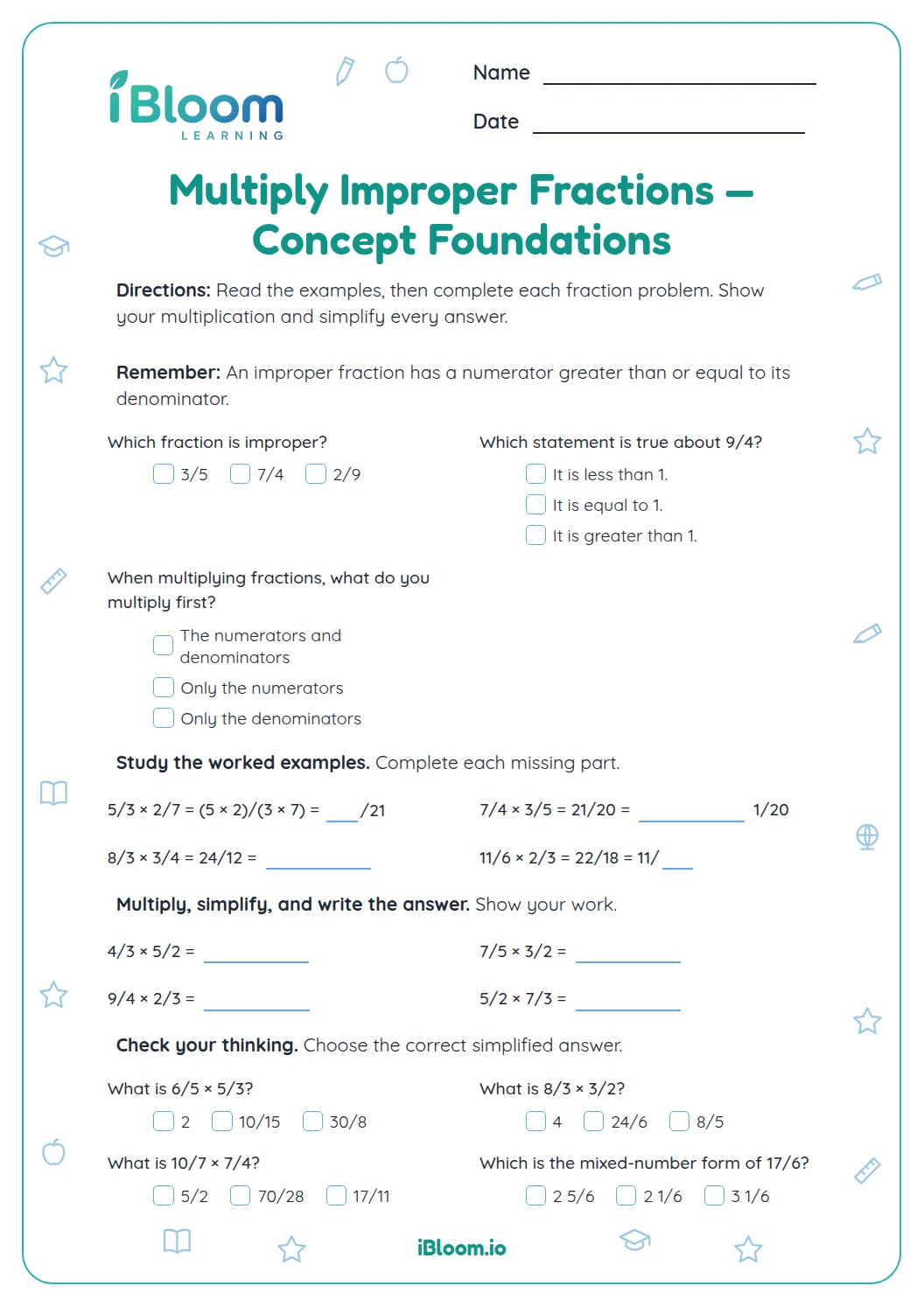
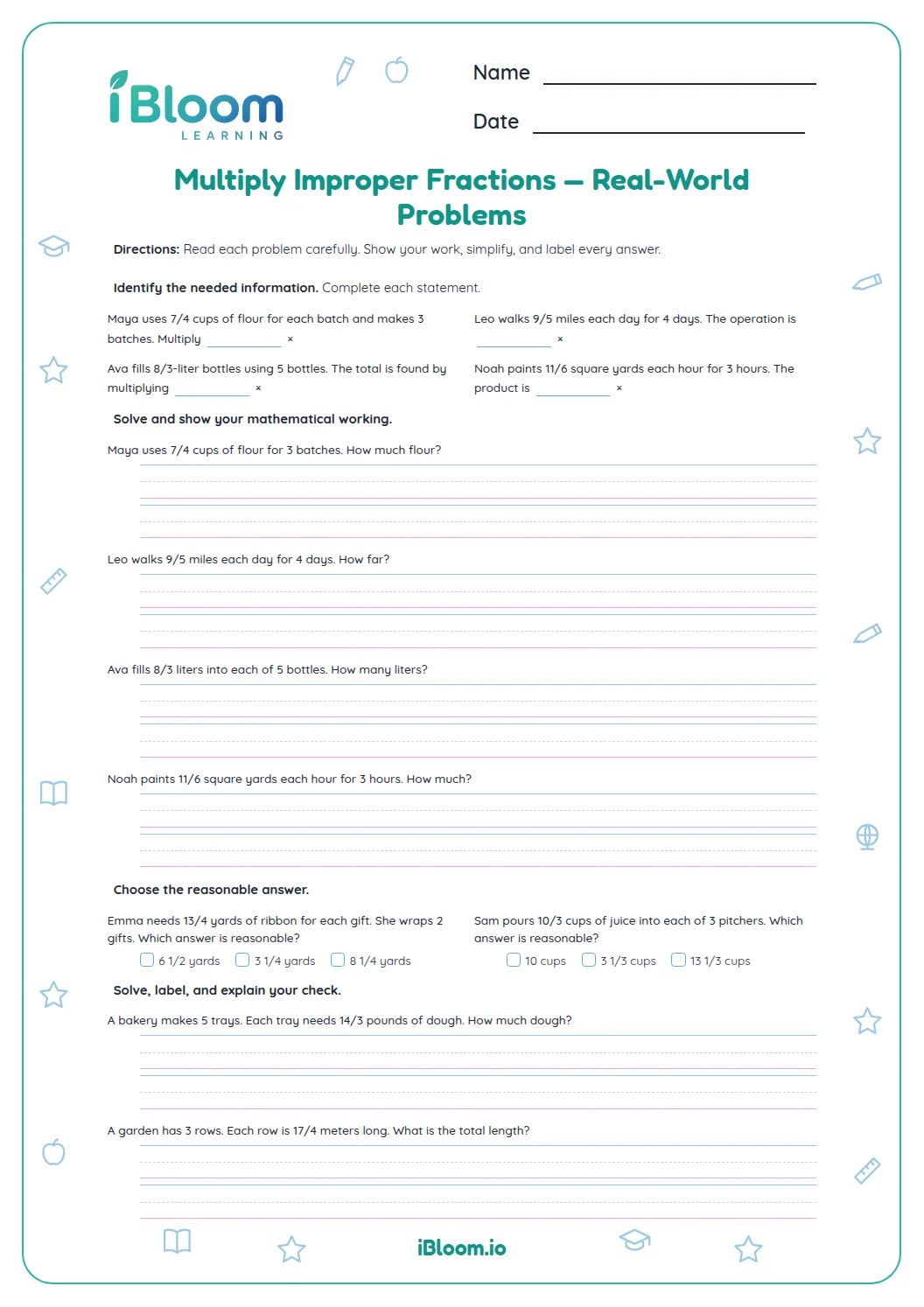
This free Grade 5 fractions worksheet guides students through multiplying improper fractions by fractions and whole numbers. It starts with products to simplify, then uses measurement situations and comparisons to connect the computation to quantities. The final prompts ask students to explain a multiplication idea. The page practices CCSS 5.NF.B.4 and includes a separate answer key.
Aligned to 5.NF.B.4
How do you multiply an improper fraction?
Multiply the numerators and denominators, then simplify. An improper fraction such as 5/3 is still a fraction, so 5/3 × 3/7 can be multiplied as 15/21 and reduced to 5/7. Canceling common factors first can make the arithmetic shorter.
- 15/4 × 2/5
- 2Cancel 5 with 5 and reduce 2/4 to 1/2.
- 3The product is 1/2.
How does a product answer a story problem?
A fraction of a quantity means multiply. Question 9 asks for 3/5 of a 5/3-yard ribbon, so multiply 3/5 × 5/3. The factors are reciprocal, and the result is 1 yard. Include the unit from the question.
- Part A: multiply and simplify products
- Part B: apply products to measurement situations
- Part C: compare products and check a claim
- Part D: write or explain a product
How can a product be checked?
Estimate its size and check whether simplification is complete. Multiplying 5/3 by 3/5 gives 1 because the factors undo each other. Multiplying a positive amount by a factor less than 1 should give a smaller amount.
How to use this multiplying improper fractions worksheet
- 1Multiply top numbers and bottom numbers.
- 2Look for common factors to reduce before or after multiplying.
- 3Write the product in simplest form.
- 4For a story problem, identify the fraction of the quantity and multiply.
- 5Keep the unit in a measurement answer.
- 6Estimate whether the answer should be smaller or larger than the starting quantity.
Common mistakes and quick fixes
The mistake
Adding numerators and denominators instead of multiplying.
The fix
Keep multiplication separate: multiply top by top and bottom by bottom.
The mistake
Stopping at an equivalent fraction that can still be reduced.
The fix
Check the numerator and denominator for a common factor.
The mistake
Leaving off the unit in a measurement problem.
The fix
Copy the unit named in the question after the numeric result.
Common Core alignment
This worksheet gives focused practice with the standard below.
Multiply fractions and interpret the product in a situation.
On this sheet: Products include improper fractions multiplied by fractions and whole numbers, including context problems.
Show the official wordingHide the official wording
Apply and extend previous understandings of multiplication to multiply a fraction or whole number by a fraction.
What to practice next
Make more practice
Further reading
Questions parents and teachers ask
What is an improper fraction?
An improper fraction has a numerator that is at least as large as its denominator, such as 7/4. It can represent a quantity greater than one whole. In this worksheet, students multiply improper fractions by fractions or whole numbers and simplify the resulting products.
How do you multiply two fractions?
Multiply the numerators together and the denominators together, then simplify the fraction. For example, 5/4 × 2/5 gives 10/20, which simplifies to 1/2. You can also cancel common factors first to keep the numbers smaller. Cancelling first can make those steps easier.
How do children solve “a fraction of” a quantity?
Multiply the quantity by the fraction. For question 9, 3/5 of 5/3 yards is 3/5 × 5/3, which equals 1 yard. The answer includes yards because the question asks for a measurement. This keeps the measurement unit in the final answer.
Should answers be simplified?
Yes. The worksheet directions ask children to simplify each product. Equivalent forms such as 15/10 and 3/2 have the same value, but 3/2 is simplified. A mixed number can also be used when it makes the size easier to read.
How many problems are included?
There are 16 questions across three parts: fraction products, applied situations and comparisons, and two explanation prompts. The answer key is separate. This gives students several chances to practice simplification and use multiplication in context. Students can review either set of items afterward.
Is there an answer key?
Yes. A separate answer key page lists each simplified product and word problem result, with units where needed. It also includes sample reasoning for the written prompts so an adult can check the idea without requiring the exact model wording.