






About this worksheet
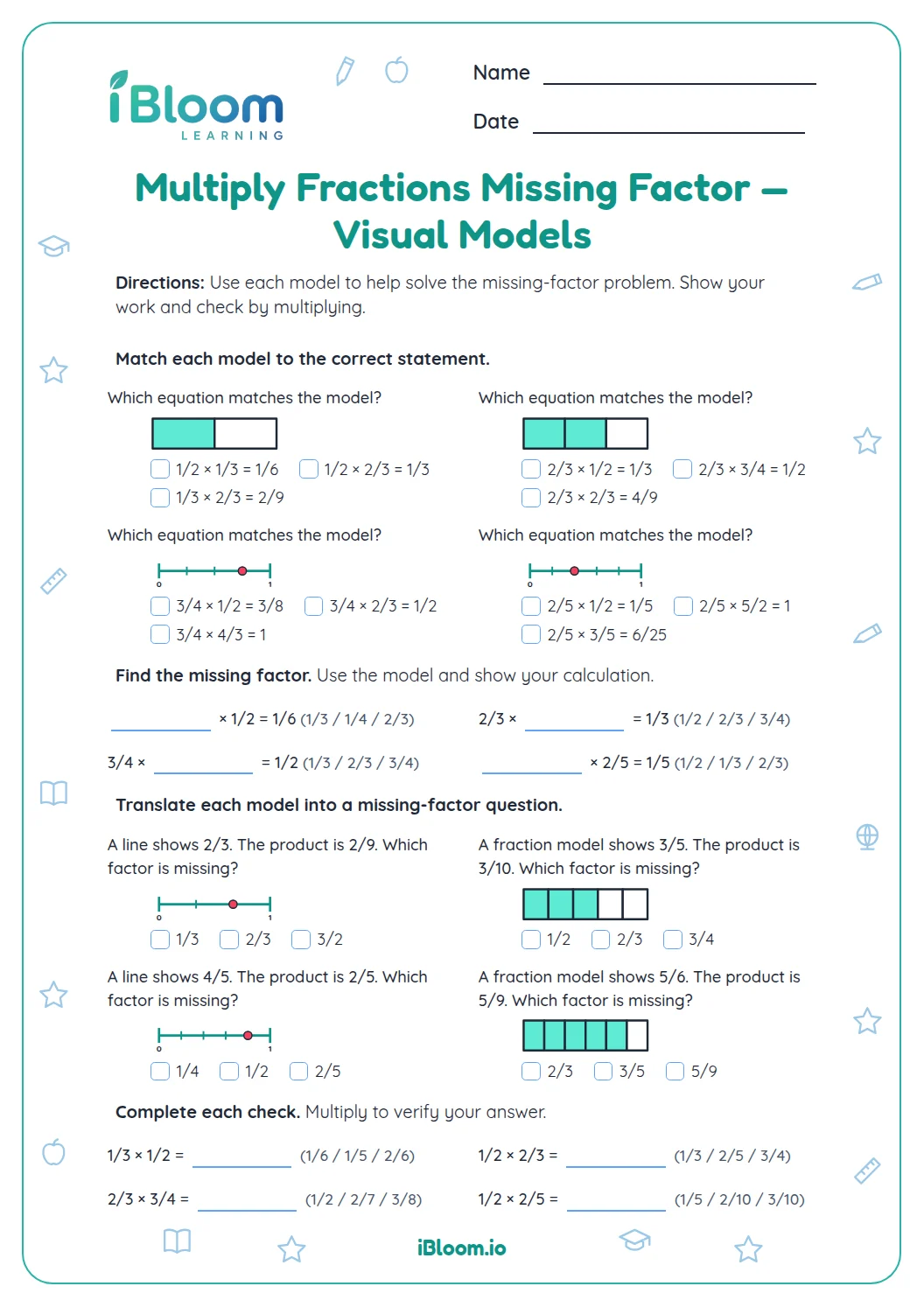
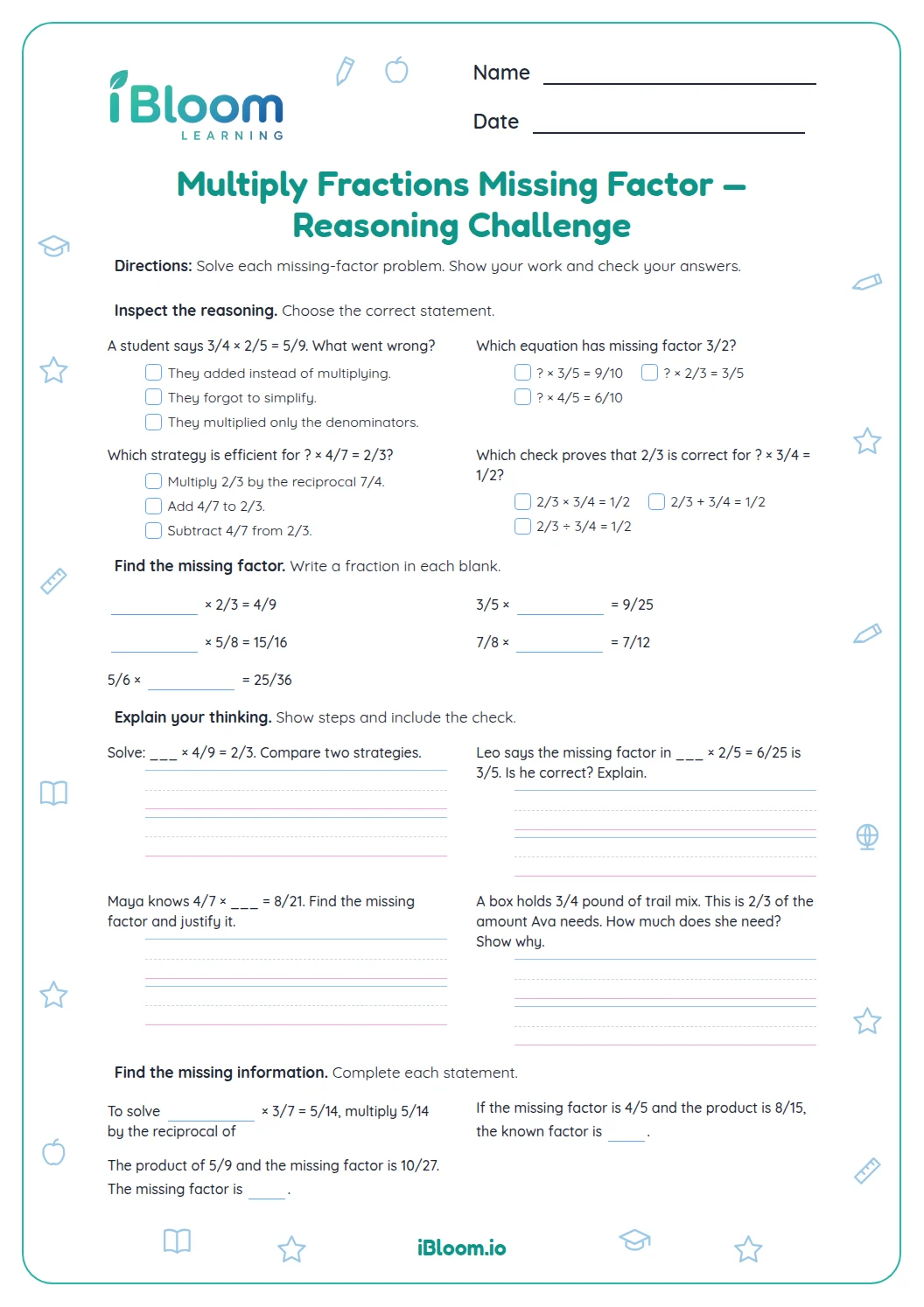
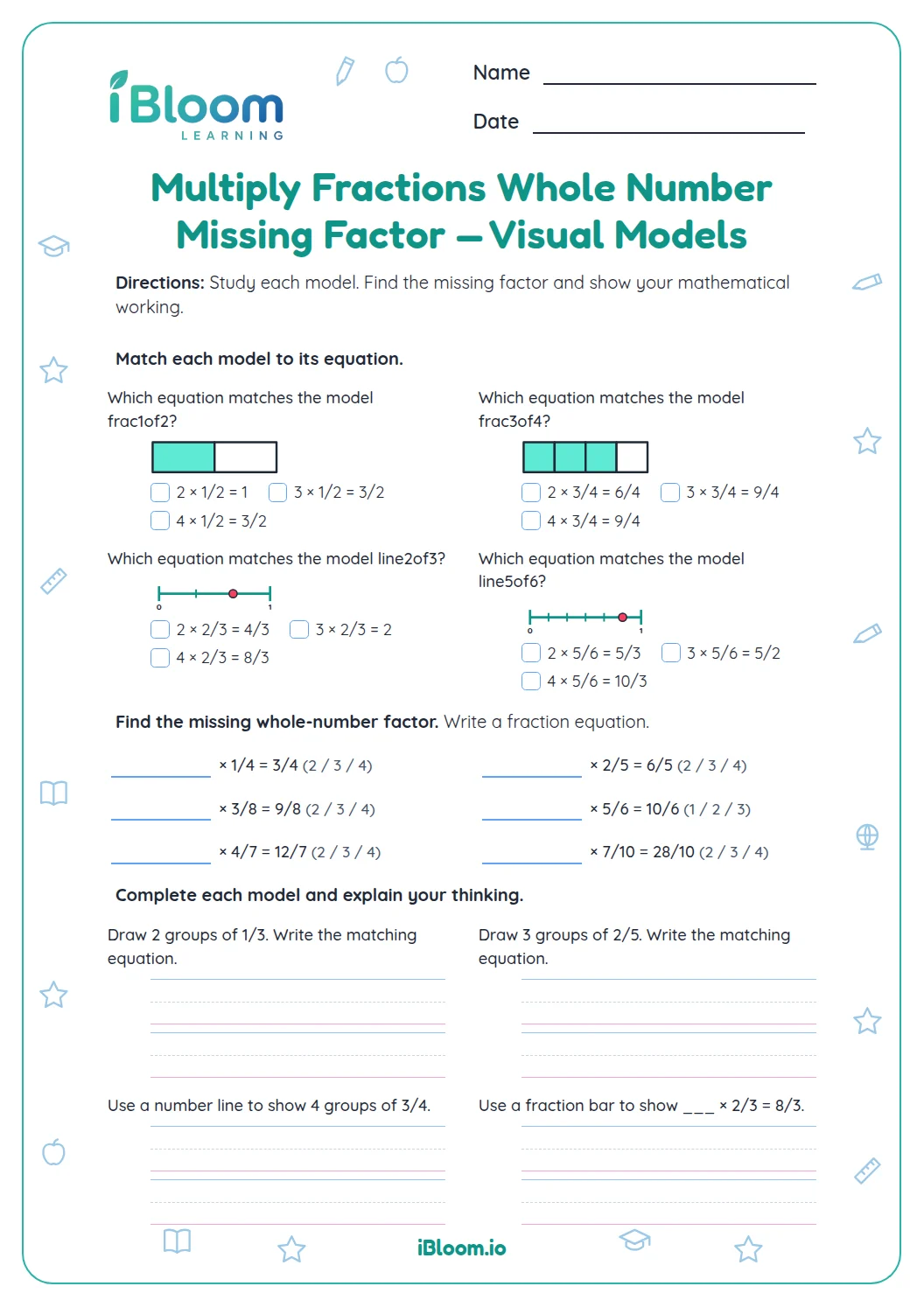
This free Grade 5 worksheet builds the meaning of a missing factor in fraction multiplication. Part A uses two shaded bars and two more choice questions to connect an unknown amount with its product. Part B has six equations with a factor missing on either side of the multiplication sign. Part C asks students to explain two answers using halves and equal parts. The 12 questions support Common Core 5.NF.B.4a by treating a fraction product as part of an amount. A separate answer key includes sample explanations.
Aligned to 5.NF.B.4a
What does the blank stand for?
The blank represents an entire factor, not just a numerator. Both factors describe amounts being multiplied, and the number after the equals sign is the product. Reading 1/2 × ___ as “half of what amount?” gives the equation a meaning before a child calculates.
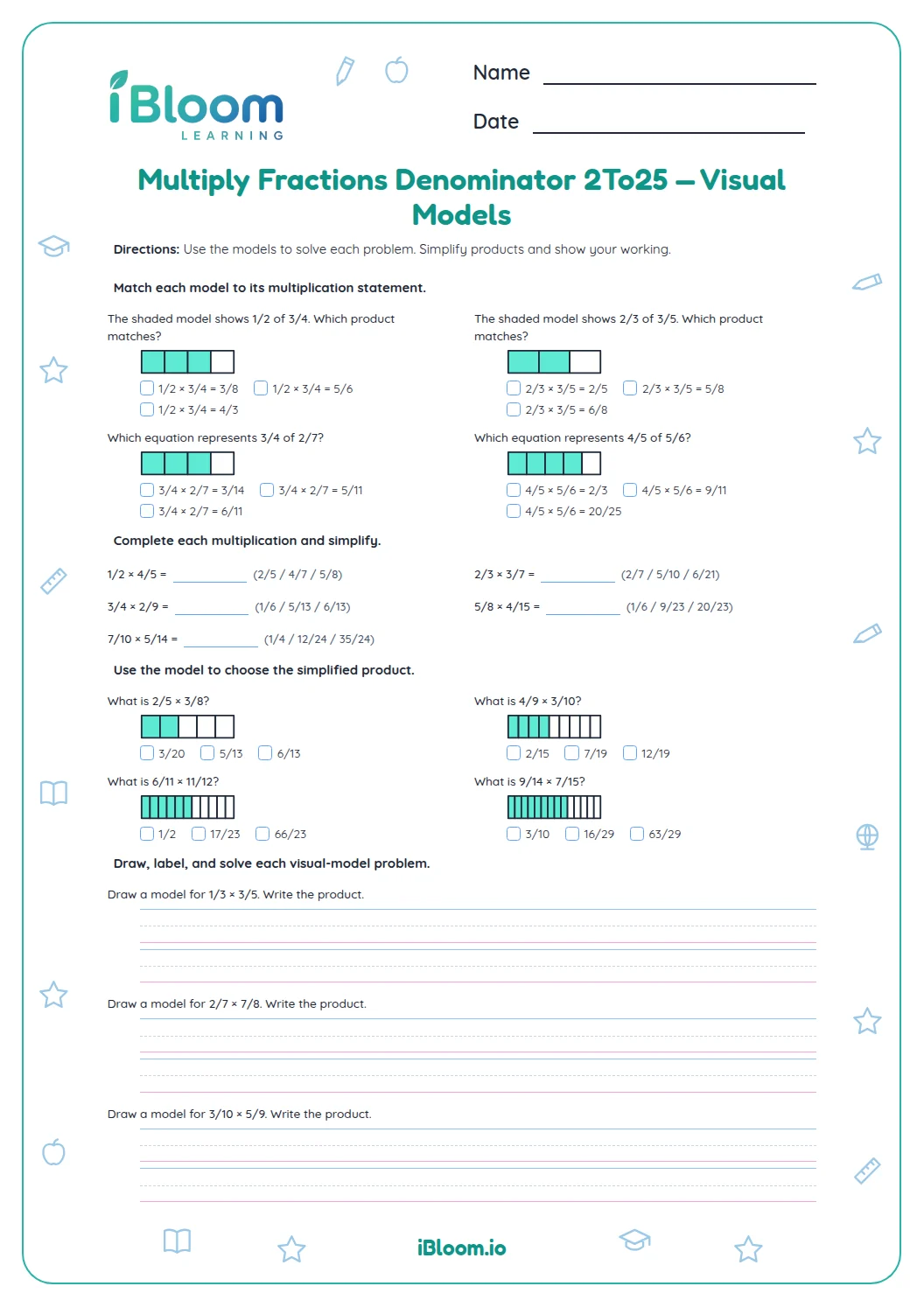
The first two questions show a possible starting amount in a shaded bar. Children connect that amount to its half. The bars make the whole and its equal parts visible.
How does the shaded bar help?
Question 1 shows three of four equal parts shaded. Half of that shaded amount is three eighths of the whole bar. The missing factor is therefore three fourths.
Students can check by multiplying numerators and denominators, then comparing the result with the given product.
- 11/2 × ___ = 3/8
- 2The shaded amount is 3/4.
- 31/2 × 3/4 = 3/8
- 4Missing factor: 3/4
How can students check each missing factor?
Substitute the proposed fraction into the original equation. For question 7, 2/3 × 3/4 gives 6/12, which is equivalent to 1/2. That equivalence confirms the answer. Questions 13 and 14 offer two more chances to use the inverse relationship and check by multiplication.
Part C makes students say why the answer works: question 11 asks about half, and question 12 asks about three equal parts. A multiplication check can support the explanation. Equivalent fractions are valid when they make the original equation true.
How to use this worksheet
- 1Read the first equation as “half of what amount is three eighths?”
- 2Use the shaded bar to identify the starting amount in question 1.
- 3Finish the four choices, checking that the selected number is a factor.
- 4Solve the six equations and multiply to check each answer.
- 5Read the two explanations aloud and compare their reasoning with the key.
Mistakes to notice and fix
The mistake
Writing 3/8 in the first blank because it is the visible product.
The fix
Ask for the starting amount. Half of 3/8 is 3/16; half of 3/4 is 3/8.
The mistake
Multiplying the known factor and product to get the missing factor.
The fix
Try the candidate in the original equation. The product must match the number after the equals sign.
The mistake
Rejecting 6/12 because the equation ends in 1/2.
The fix
Simplify 6/12 or compare equal portions of a whole; both name the same amount.
Common Core alignment
Interpret a fraction product as part of an amount and check a missing factor by multiplication.
On this sheet: Children interpret taking half of a fraction, find missing factors, and verify products.
Show the official wordingHide the official wording
Interpret the product (a/b) × q as a parts of a partition of q into b equal parts; equivalently, as the result of a sequence of operations a × q ÷ b. For example, use a visual fraction model to show (2/3) × 4 = 8/3, and create a story context for this equation. Do the same with (2/3) × (4/5) = 8/15. (In general, (a/b) × (c/d) = (ac)/(bd).
What to practice next
Make more practice
Further reading
Questions parents and teachers ask
What do the two fraction bars represent?
They represent the starting amounts in the first two equations: three fourths and two thirds. Each prompt says that half of the shaded amount gives the product. Children use the bar to name the unknown factor, then check that taking half produces the stated amount.
Must my child use division to find each factor?
Children can use known products and the meaning of taking a fraction of an amount. For example, half of one half is one fourth. For other questions, try a factor and multiply to check it. The key gives answers that can all be verified this way.
Are equivalent fraction answers acceptable?
Yes, an equivalent fraction is correct when it makes the equation true. In question 7, the key gives three fourths, but six eighths has the same value. Ask the child to simplify the answer or explain the equivalence, then multiply to verify the original product.
Why does the missing factor move to the left in some equations?
Changing the blank’s position helps children read the whole equation. In question 6, the unknown is multiplied by one third to make one sixth. The unknown is one half. The same checking routine works whether the blank comes before or after the multiplication sign.
What should the two written explanations include?
Each explanation should connect the chosen factor with the product. For question 11, a child can say that half of one half is one fourth. For question 12, they can divide three fourths into three equal parts and take two. The key supplies sample wording.