




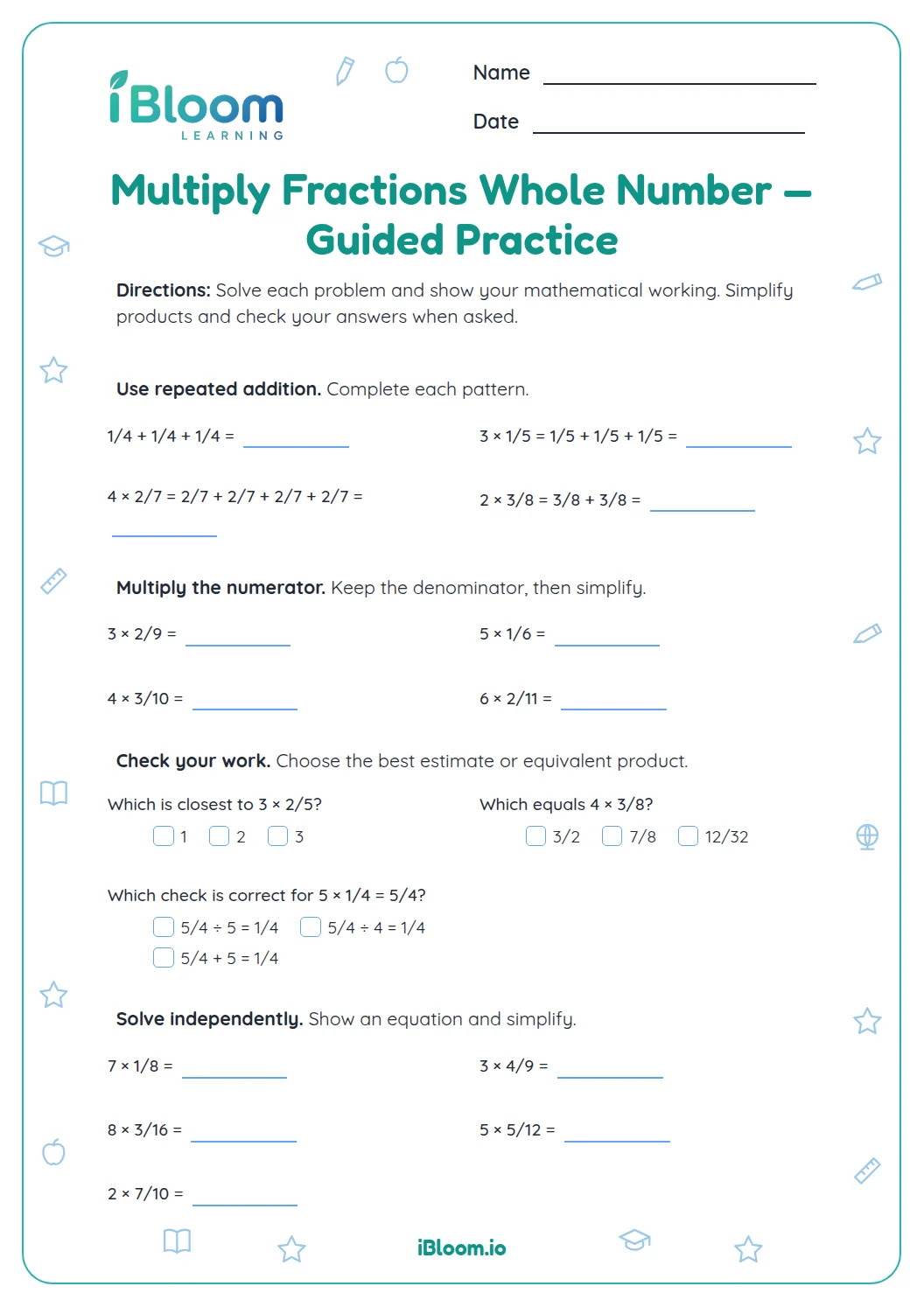
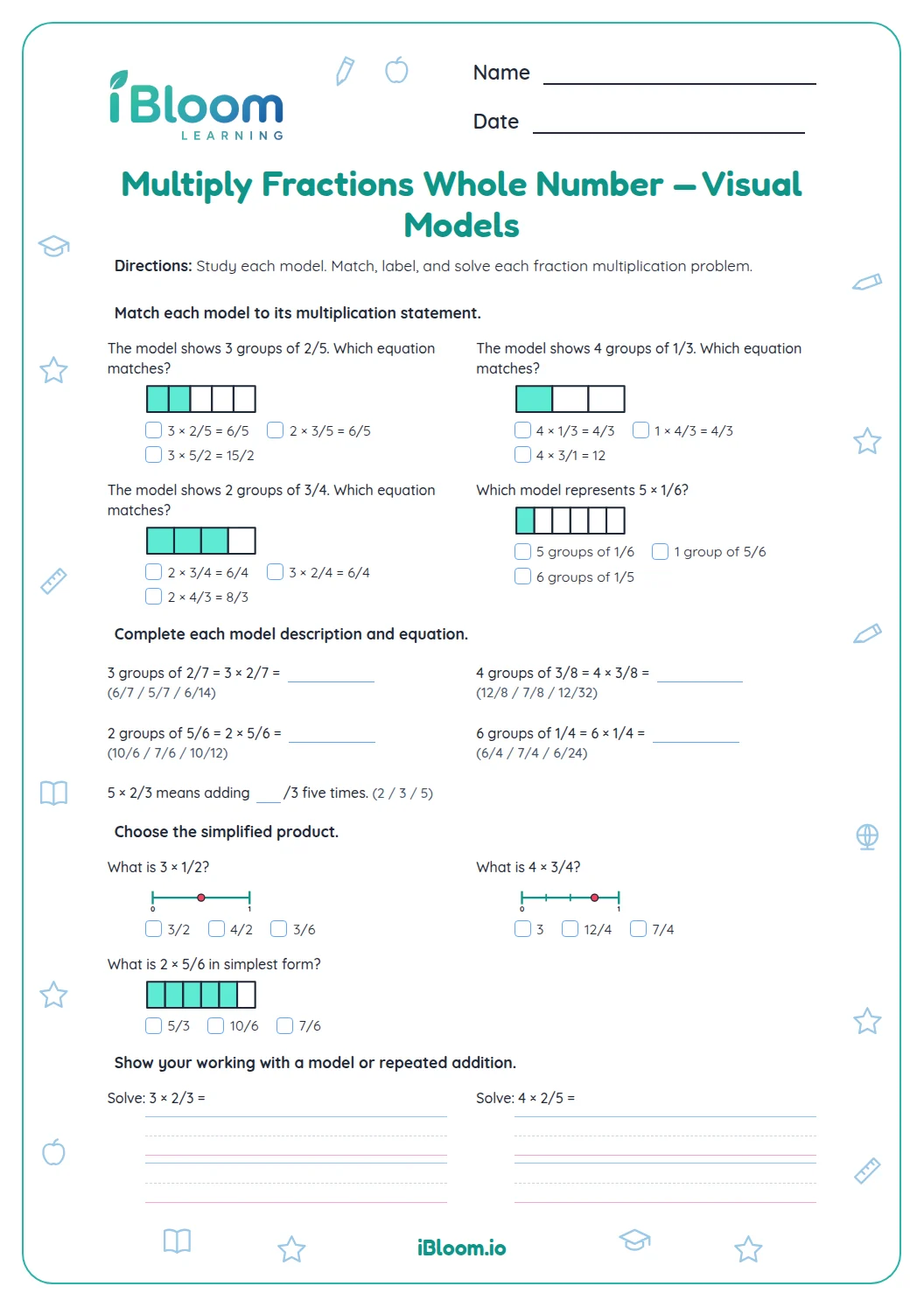
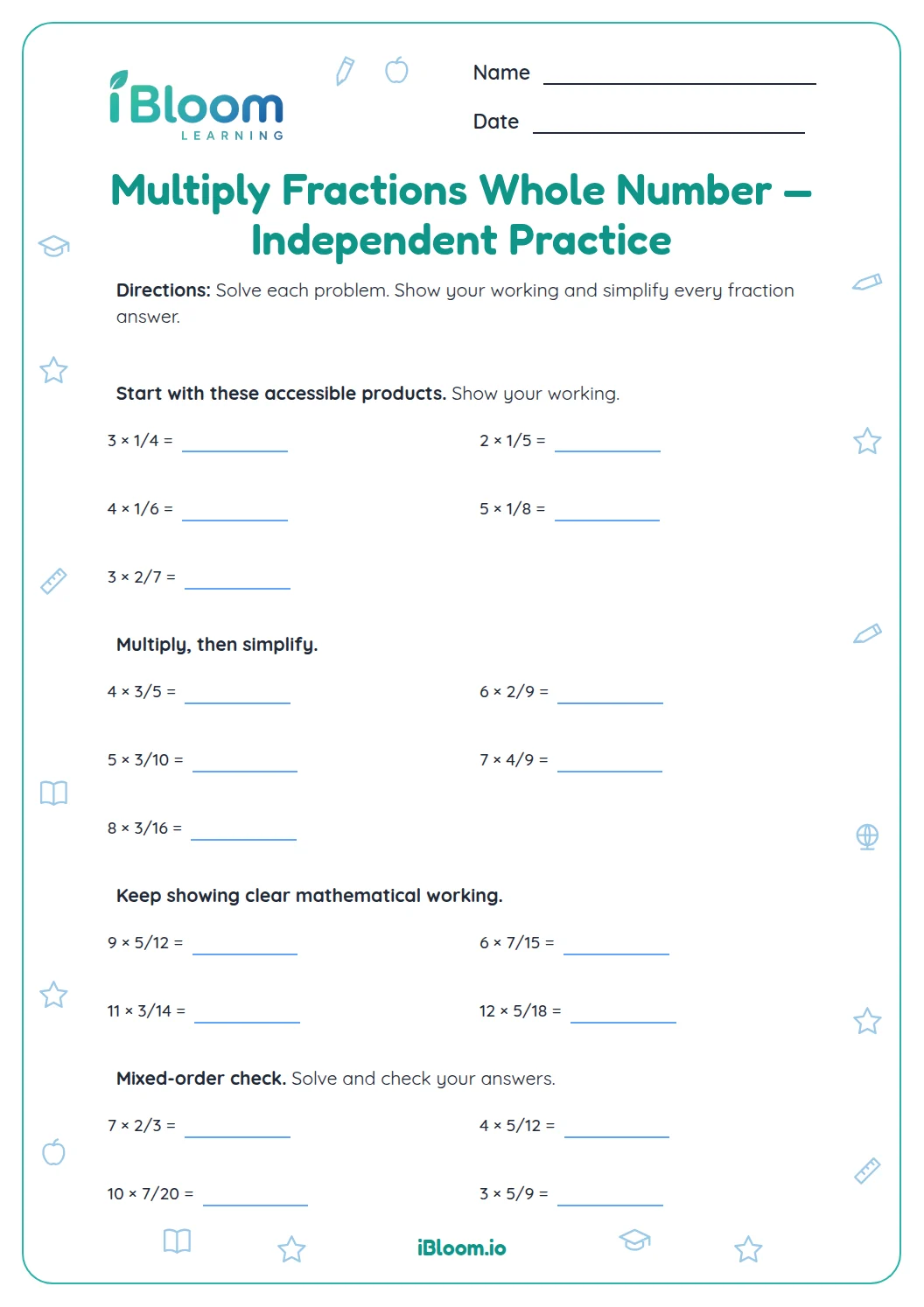
About this worksheet
The worksheet provides 15 chances to connect multiplication and division: ten missing-factor equations and five word problems. Students write each missing fraction in simplest form and use multiplication to check it. A separate answer key supports independent review.
Aligned to 5.NF.B.4
How do you find a missing factor?
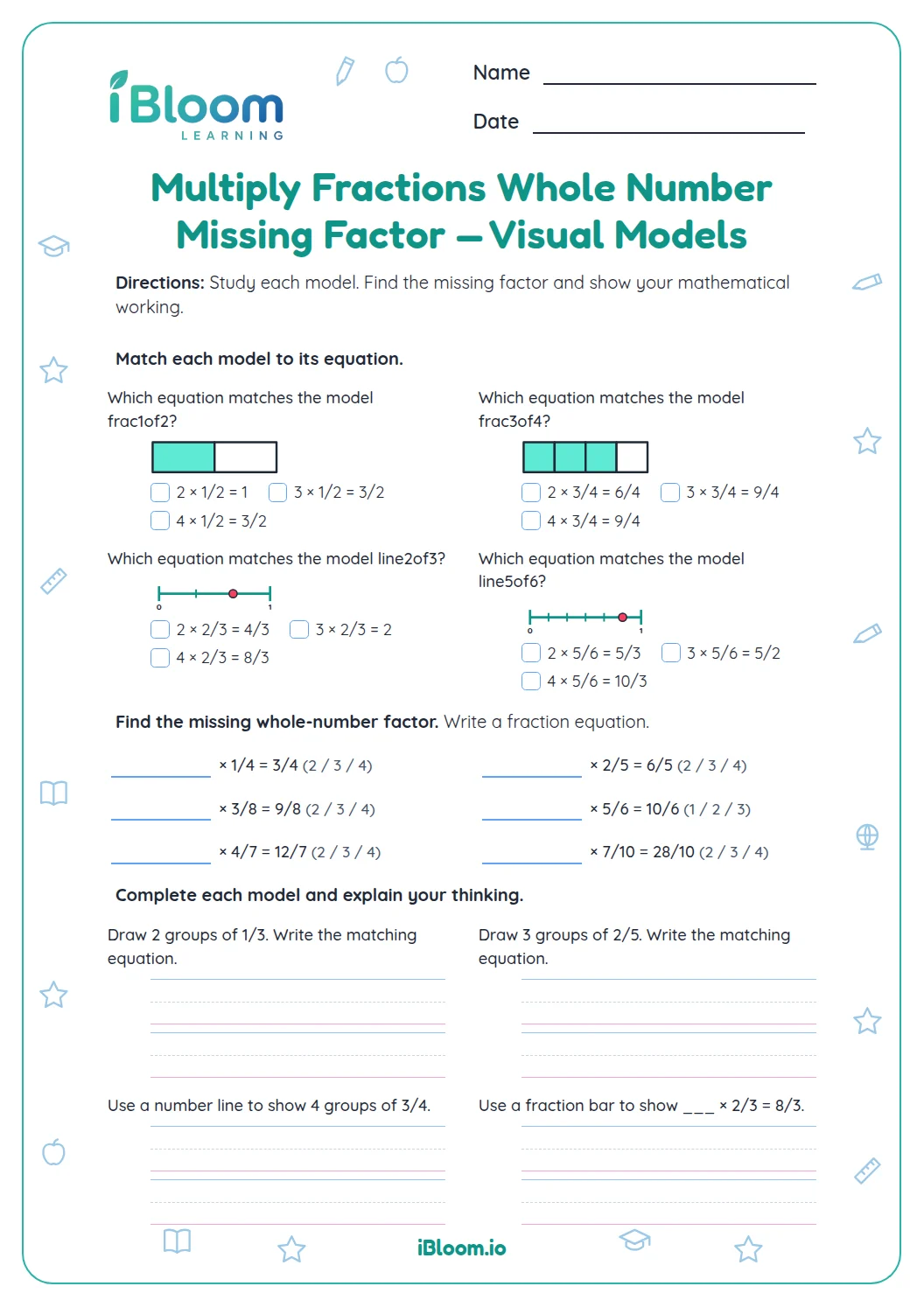
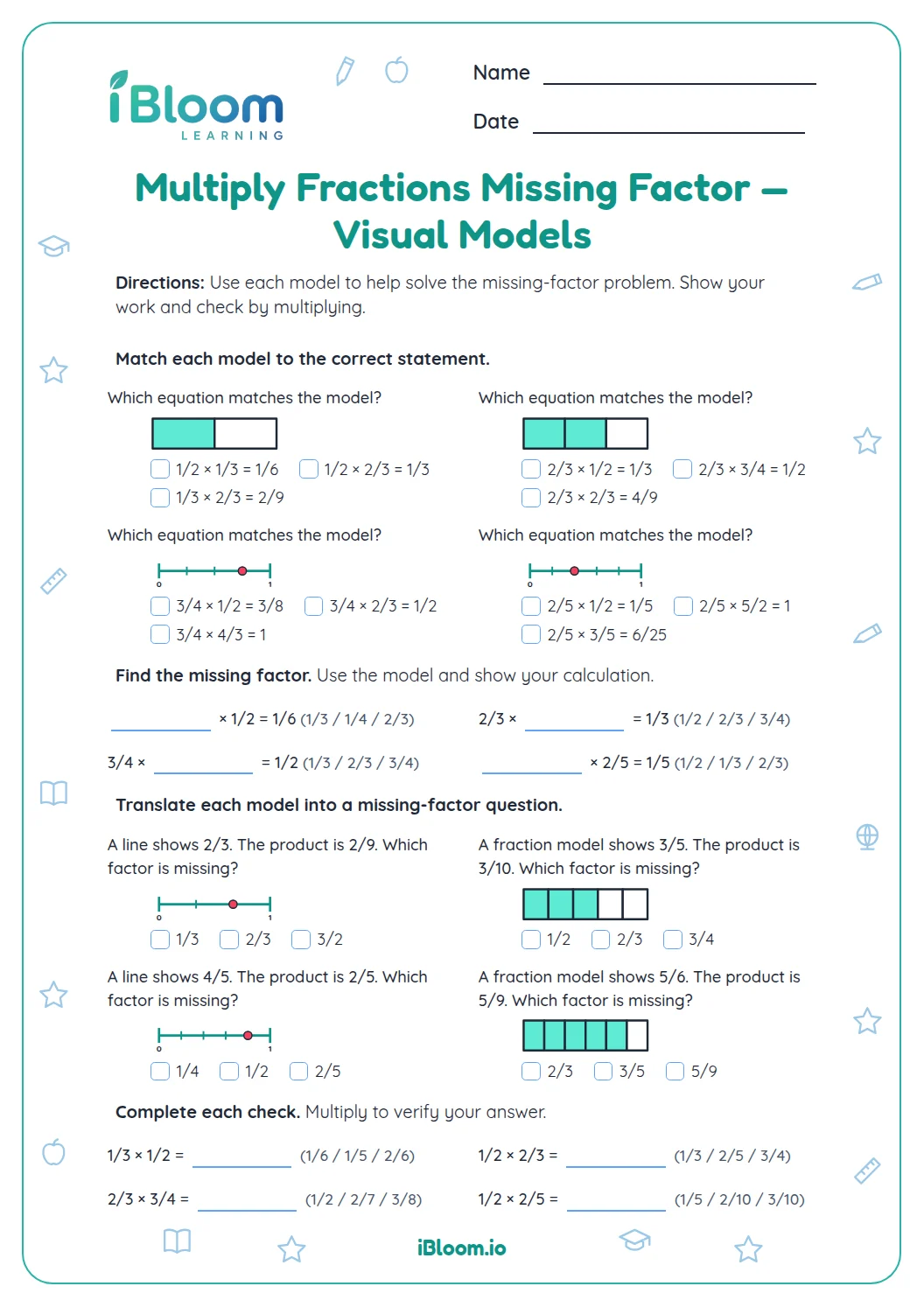
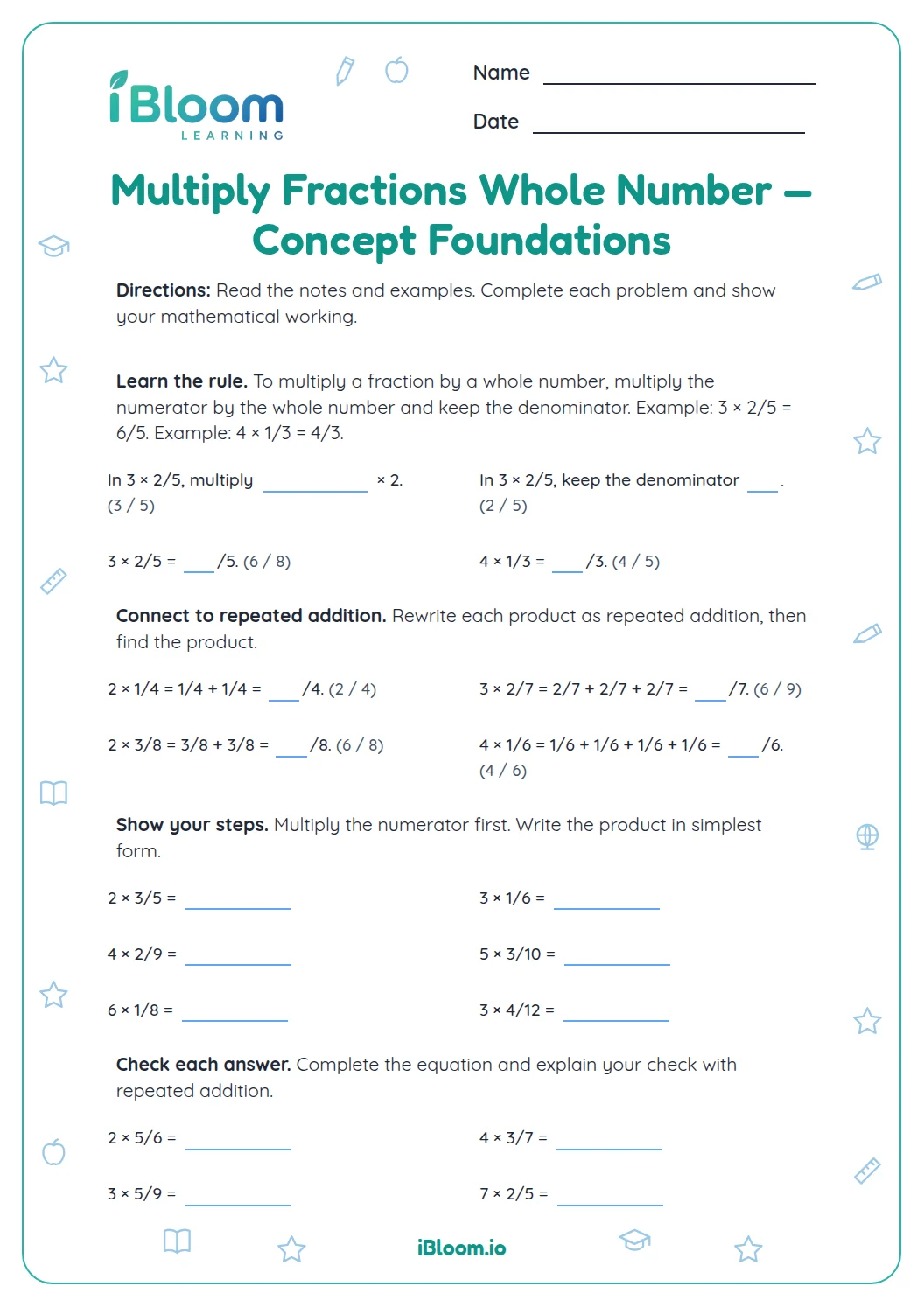
Use the relationship between factors and products. In 3 × ___ = 3/4, divide 3/4 by 3: the missing factor is 1/4. Multiply to check: 3 × 1/4 = 3/4.
When should you simplify?
Write the missing factor in simplest form. If a product is 15/5 and the known factor is 3, then the missing factor is 1, since 3 × 1 = 3. Keep the product and factor relationship visible as you work.
How do the stories use the same idea?
The ribbon question asks how many 1/8-yard pieces fit into 3/4 yard. Divide 3/4 by 1/8, or ask how many eighths are in six eighths: 6 pieces.
How to use this worksheet
- 1Read the product and known factor.
- 2Ask what number times the known factor makes the product.
- 3Use division or equivalent fractions to find the unknown.
- 4Simplify the missing fraction.
- 5Multiply to check, then label story answers with units.
Common mistakes and quick fixes
The mistake
Dividing the known factor by the product.
The fix
Check by multiplying your answer by the known factor.
The mistake
Forgetting to simplify.
The fix
Divide numerator and denominator by a common factor.
The mistake
Using the wrong operation in a story.
The fix
Write known factor × unknown = product before calculating.
Common Core alignment
This practice connects the worksheet activity to the following Common Core skill.
Multiply fractions and whole numbers to solve fraction problems.
On this sheet: Problems use a whole-number factor and fraction product to determine a missing factor or quantity.
Show the official wordingHide the official wording
Apply and extend previous understandings of multiplication to multiply a fraction or whole number by a fraction.
What to practice next
Make more practice
Further reading
Questions parents and teachers ask
How do you find a missing fraction factor?
Use the product and the known factor to determine what number belongs in the blank. For 3 × ___ = 3/4, divide 3/4 by 3 to get 1/4. Multiply 3 by 1/4 to check that the product is 3/4. Check by multiplying your simplified fraction by the whole number to recover the product.
Should missing fractions be simplified?
Yes. Write each answer in simplest form when possible. A simplified fraction makes the factor relationship easier to check; multiply it by the whole-number factor and confirm that the product matches the equation. For example, 3 × 1/4 equals 3/4, so 1/4 is the missing factor.
What is included in the story problems?
Five short situations use fractional amounts, repeated batches, or equal portions. Students translate each situation into multiplication or division reasoning, solve, and include the unit such as cups or meters in the answer. The story questions use multiplication or equal sharing to connect the quantities.
Can students use division to solve?
Yes. Division can reveal the unknown factor when the product and known factor are given. After dividing, students should multiply the result by the known factor as a quick check of the original equation. Keep the numerator and denominator together when dividing the product by the known factor.
Does the worksheet include an answer key?
Yes. The separate key lists the missing factors and story-problem results. For word problems, answers include the requested unit; students can compare their equation and calculation even if their wording differs. The key accepts equivalent forms where appropriate and shows simplified fraction answers.