





About this worksheet
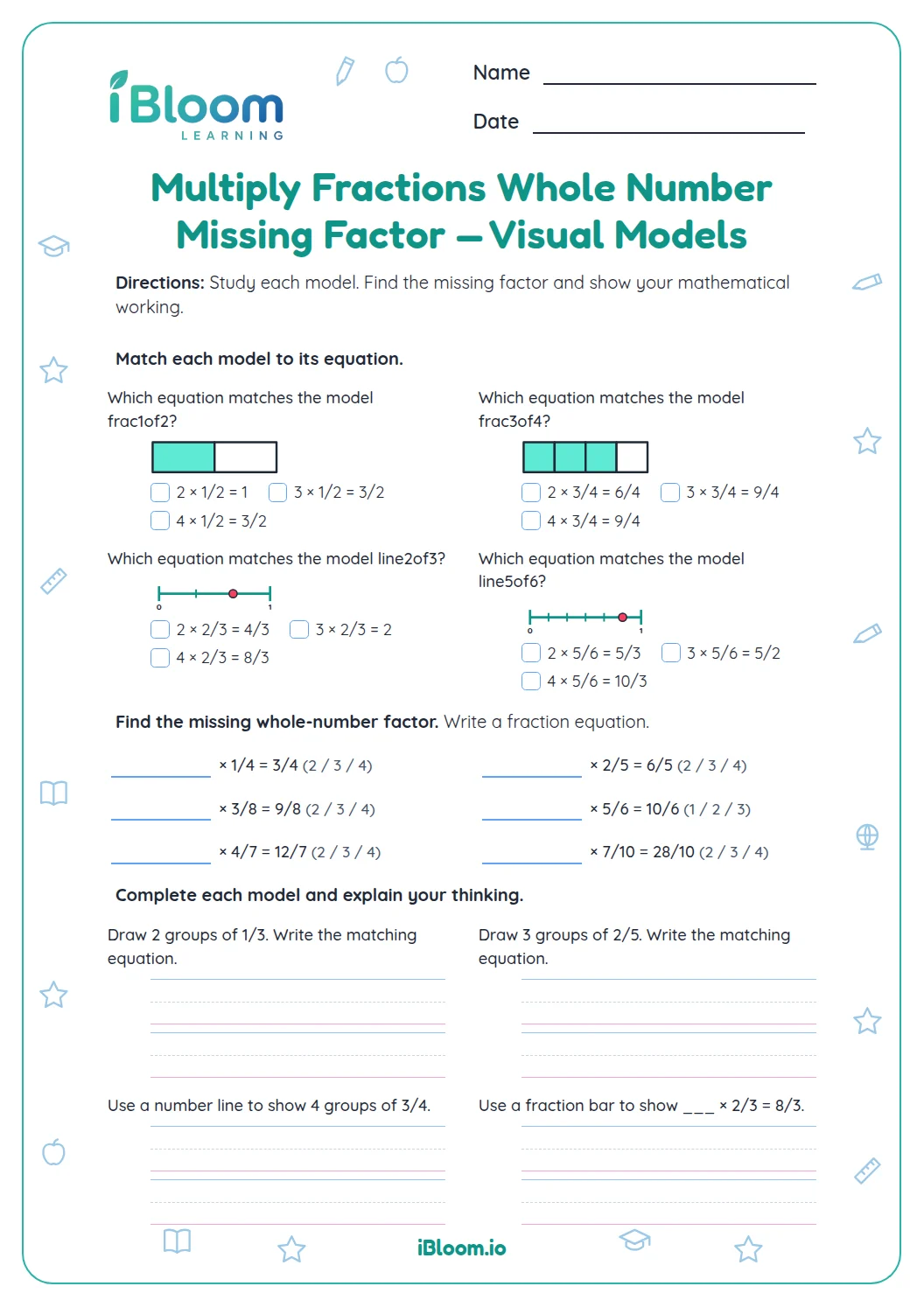
This free printable is for Grade 5 students practicing finding a missing factor in fraction multiplication equations. It has 20 questions with a separate answer key. The examples build from the core idea to independent practice. CCSS 5.NF.B.4
Aligned to 5.NF.B.4
How do you find a missing factor?
Use the product and the known factor to work backward. Divide the product by the known factor, or ask what number times that factor gives the product. Reduce the result when possible.
For question 1, 3 times the missing factor equals 3/4. Divide 3/4 by 3: 3/4 × 1/3 = 3/12 = 1/4.
- 13 × ___ = 3/4
- 2Divide 3/4 by 3.
- 33/4 × 1/3 = 1/4
- 4The missing factor is 1/4.
How can you check a fraction factor?
Multiply your answer by the known factor. Simplify the product and compare it with the product printed in the equation. Keep the whole number or fraction form clear as you calculate.
For example, 3 × 1/4 = 3/4, so 1/4 checks in question 1.
What kinds of equations are included?
The worksheet has 20 equations in two parts. Each asks for one missing factor in a multiplication equation. The answer key lists all 20 missing factors.
- Part A: Questions 1–10 practice varied unknown positions.
- Part B: Questions 11–20 continue with mixed factor types.
- Answer key: all 20 missing factors.
How to use this worksheet
- 1Identify the known factor and the product.
- 2Divide the product by the known factor.
- 3Simplify the fraction or mixed number.
- 4Substitute your result into the original multiplication equation.
- 5Check that the product matches.
Common mix-ups and quick fixes
The mistake
Dividing the known factor by the product.
The fix
Use product ÷ known factor to find the missing factor.
The mistake
Forgetting to reduce a fraction.
The fix
Divide numerator and denominator by a common factor when possible.
The mistake
Skipping the check.
The fix
Multiply the missing factor by the known factor and compare products.
Curriculum alignment
The worksheet practices applying multiplication and division relationships to fraction products.
Multiply a fraction or whole number by a fraction to find a product.
On this sheet: Each item finds a missing fraction factor in a whole-number or fraction product.
Show the official wordingHide the official wording
Apply and extend previous understandings of multiplication to multiply a fraction or whole number by a fraction.
What to practice next
Make more practice
Further reading
Questions parents and teachers ask
How do you solve a missing-factor equation?
Treat the product as the result of multiplying two factors. Divide that product by the factor you know to find the missing one. For example, 3 × ___ = 3/4 becomes 3/4 ÷ 3, which equals 1/4. Students can repeat the check by multiplying the answer by the given factor and simplifying the product.
What does the answer key include?
The separate two-page answer key lists the missing factor for each of the 20 equations. Students can check by multiplying each answer by the known factor and simplifying to see whether it matches the given product. Equivalent forms are acceptable when they name the same value as the missing factor.
Does the sheet use whole numbers and fractions?
Yes. The equations include whole-number factors and fractional factors, and the unknown factor can be in either position. This gives practice reading the equation carefully before choosing which division fact will uncover the missing value. The equations vary which factor is missing, so first identify the known factor in each one.
Why can division help find a factor?
Multiplication and division undo one another. If a known factor times an unknown factor gives a product, divide the product by the known factor. The quotient is the missing factor, which you can verify with multiplication. This reverse operation works because multiplication and division are inverse operations.
Should answers be simplified?
Yes, simplify a fraction when its numerator and denominator share a common factor. A simplified equivalent fraction has the same value, but it is easier to read and compare with the other factors in the equation. For example, a whole-number answer can also be written as an equivalent fraction when it has the same value.
How can a student check a result?
Put the proposed factor back into the original equation and multiply. For question 1, 3 × 1/4 equals 3/4, so the missing factor checks. This multiplication check catches errors made while dividing or simplifying. Encourage students to write each step clearly so they can see where a simplification happens.