






About this worksheet
This free printable Grade 5 worksheet is about the missing factor in a fraction times a whole number, such as ___ × 3 = 3/4 or 4 × ___ = 3/7. It builds the idea in steps: first multiply a whole number by a unit fraction, then find the missing fraction when the numerator splits evenly, then when it does not, and finally use the same equation in two sharing problems. It practices Common Core 5.NF.B.4.a and 5.NF.B.7.c and suits fifth graders who can multiply a fraction by a whole number. Fourteen questions and a separate answer key are included.
Aligned to 5.NF.B.4.a and 5.NF.B.7.c
What is a missing factor in a fraction times a whole number?
A factor is one of the numbers being multiplied. In ___ × 3 = 3/4, the product is 3/4 and one factor is 3, so the job is to find the other factor. Multiplication and division undo each other, so the missing factor is the product divided by the factor you know.
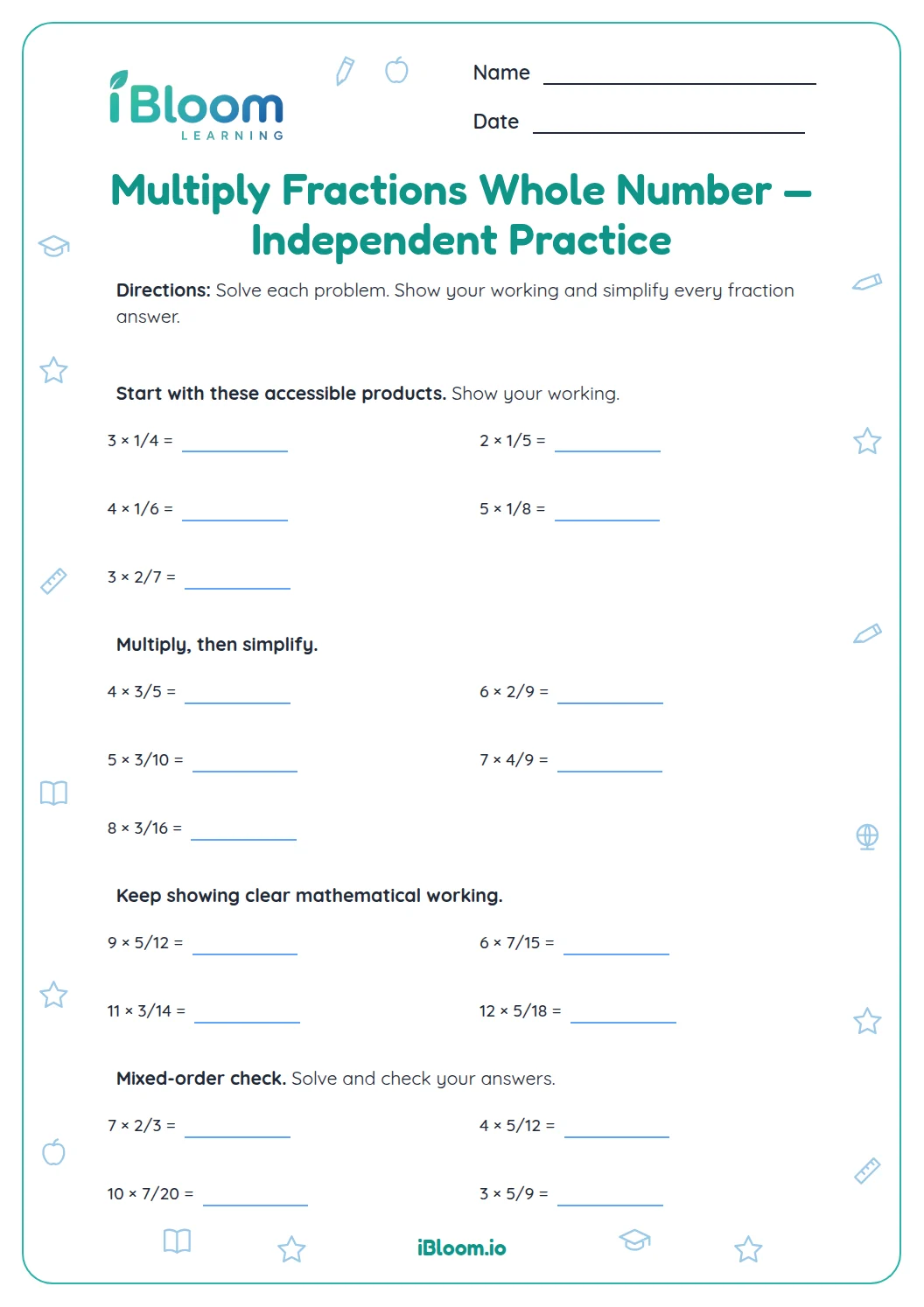
Part A prepares for this by running the multiplication forward: 3 × 1/5 means three pieces of size 1/5, which is 3/5. Part B then runs it backward.
- 1___ × 3 = 3/4
- 23/4 is 3 pieces, each 1/4 of a whole
- 3Split them into 3 equal groups: 1 piece, 1/4, in each
- 4Missing factor: 1/4
- 5Check: 1/4 × 3 = 3/4
What if the numerator does not divide evenly?
Part C has sentences like 3 × ___ = 2/5, where 2 pieces cannot be split into 3 equal groups of whole pieces. The fix is to cut every piece into smaller ones. One fifth cut into 3 equal parts is 1/15, so the unit is now fifteenths.
Two of those smaller pieces make 2/15. In short, the numerator stays and the denominator is multiplied by the whole number: 5 × 3 = 15. Children should still check by multiplying: 3 × 2/15 = 6/15, which equals 2/5.
- 13 × ___ = 2/5
- 2Cut 1/5 into 3 equal parts: 1/15 each
- 3The product has 2 fifths, so the factor has 2 of the small pieces: 2/15
- 4Check: 3 × 2/15 = 6/15 = 2/5
Why are the last two questions about sharing?
Sharing equally is division, and the missing factor is the share. If 3 friends share 1/2 of a pizza, each share times 3 must equal 1/2, so the equation is ___ × 3 = 1/2. This is the real-world side of 5.NF.B.7.c: dividing a unit fraction by a whole number.
Part D gives working space for a number sentence before the answer, so children show how the story became an equation.
What is on this worksheet?
Fourteen questions in four parts, going from a multiplication they already know to a missing factor they have to find.
- Part A, Build it: four whole numbers times a unit fraction, like 3 × 1/5
- Part B, Find the missing factor: four sentences where the numerator splits evenly, like ___ × 3 = 3/4
- Part C, Split the pieces: four sentences where it does not, like 3 × ___ = 2/5
- Part D, Share equally: two word problems with working space
- A two-page answer key with every missing fraction and both sharing answers
How to use this worksheet at home or in class
- 1Fold a paper strip into fourths and shade 3. Ask: if 3 friends share these 3 fourths equally, how much does each friend get?
- 2Do Part A together. Say 3 × 1/5 as three copies of one fifth, and write the answer as 3/5.
- 3In Part B, read each sentence aloud as a question: what number times 3 makes 3/4? Then ask your child to divide.
- 4In Part C, have your child draw the first fraction and cut each piece into the number of parts the whole number shows. The new unit gives the denominator.
- 5In Part D, write the number sentence with a blank first, then solve and label the answer.
- 6Check with the answer key. For any miss, multiply the answer by the whole number and see whether the product comes back.
Common mistakes and quick fixes
The mistake
Multiplying instead of dividing, writing 9/4 for ___ × 3 = 3/4.
The fix
Check by multiplying: 9/4 × 3 is far more than 3/4. The missing factor has to be smaller than the product, so divide 3/4 by 3.
The mistake
Dividing the denominator by the whole number, as in ___ × 4 = 3/8 giving 3/2.
The fix
Splitting into more equal parts makes smaller pieces, so the denominator gets bigger: 8 × 4 = 32, and 3/32 × 4 = 12/32 = 3/8.
The mistake
Dividing only the numerator and stopping at a remainder, as in 2 ÷ 3 for 3 × ___ = 2/5.
The fix
Cut each fifth into 3 smaller pieces first. One fifth becomes 1/15, so 2 fifths are 2/15.
Common Core alignment
This sheet practices Grade 5 fraction multiplication and sharing a unit fraction among a whole number of people.
Understand a fraction times a whole number as splitting it into equal parts and taking some.
On this sheet: Children multiply whole numbers by unit fractions and find the missing factor, checking each answer by multiplying.
Show the official wordingHide the official wording
Interpret the product (a/b) × q as a parts of a partition of q into b equal parts; equivalently, as the result of a sequence of operations a × q ÷ b.
Solve real-world problems that share a unit fraction equally among some people.
On this sheet: Part D shares 1/2 of a pizza among 3 friends and 1/3 pound of grapes among 4 children, using equations.
Show the official wordingHide the official wording
Solve real world problems involving division of unit fractions by non-zero whole numbers and division of whole numbers by unit fractions, e.g., by using visual fraction models and equations to represent the problem.
What to practice next
Make more practice
Further reading
Questions parents and teachers ask
Is this a multiplication or a division worksheet?
Both. Every sentence is a multiplication with one number missing, and the missing number is found by dividing the product by the factor you know. Children then multiply to check, which is why the sheet keeps both operations side by side. Seeing them as opposites is the main idea of the sheet.
What is the answer to ___ × 3 = 3/4?
The answer is 1/4. The product 3/4 is three pieces of size 1/4, and splitting them into 3 equal groups puts one piece in each. Check: 1/4 × 3 = 3/4. This is question 5, and the answer key shows 1/4 on the blank.
What do children do when the numerator will not divide evenly?
They cut each piece into smaller equal pieces. For 3 × ___ = 2/5, one fifth becomes 3 pieces of 1/15, so the product 2/5 is 6/15, and each of the 3 equal parts is 2/15. As a shortcut, keep the numerator and multiply the denominator by the whole number.
Why does Part A multiply a whole number by a unit fraction first?
It shows the direction of the multiplication before the sheet asks children to reverse it. When 3 × 1/5 = 3/5 is fresh, the missing-factor sentences in Parts B and C are easier to read: they ask which fraction, repeated 3 times, makes the product.
How can children check their answers on their own?
They multiply the answer by the whole number from the sentence and see if the product matches. For ___ × 5 = 10/11, a child who writes 2/11 checks 2/11 × 5 = 10/11. If the product does not match, the child divides again. Checking builds confidence and catches slips.
Is there an answer key for this worksheet?
Yes. A separate two-page answer key gives the product for each Part A question, the missing fraction for every sentence in Parts B and C, and both sharing answers with their units. Print the worksheet by itself and keep the key for checking, or download both from this page as a free PDF.