





About this worksheet
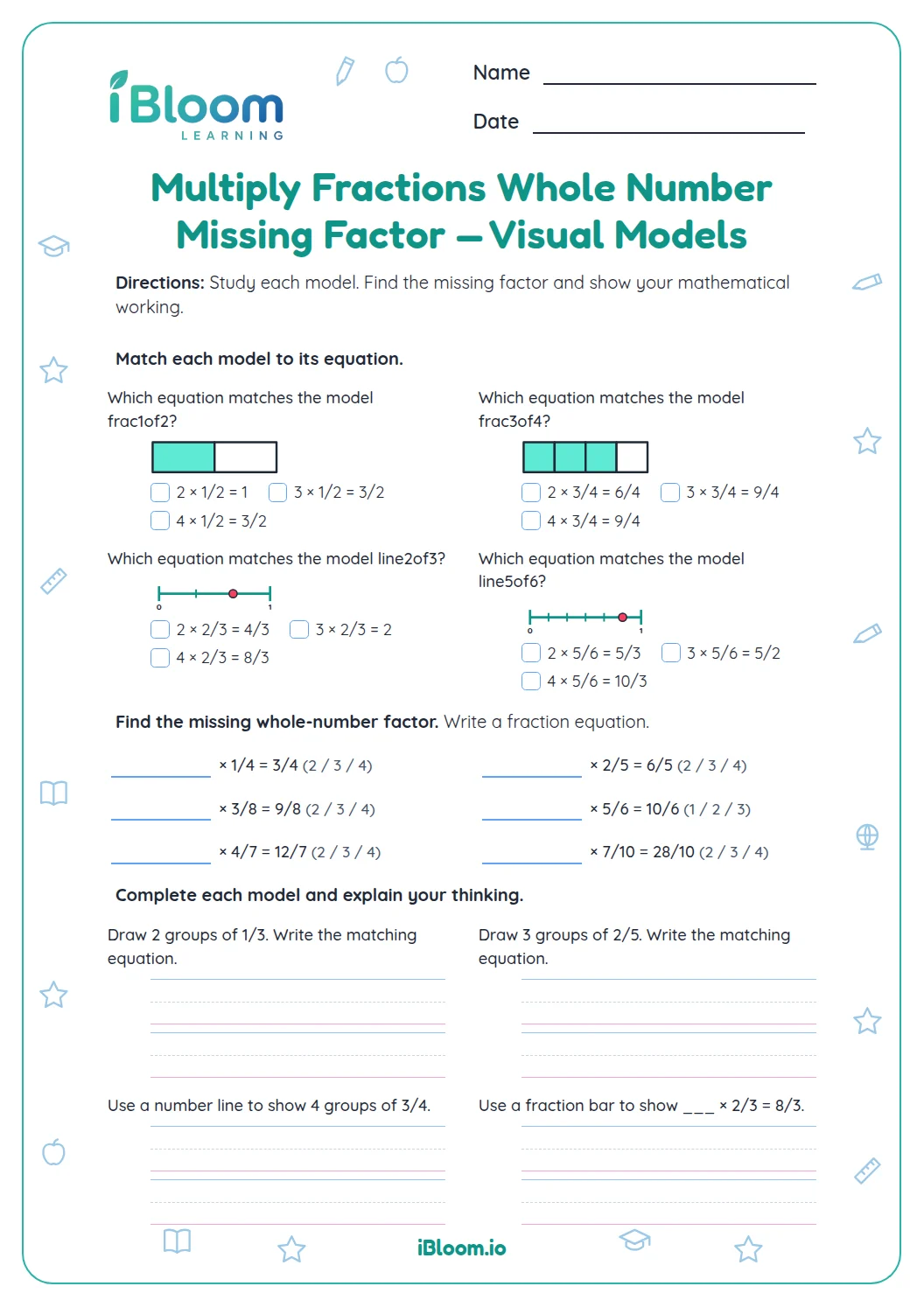
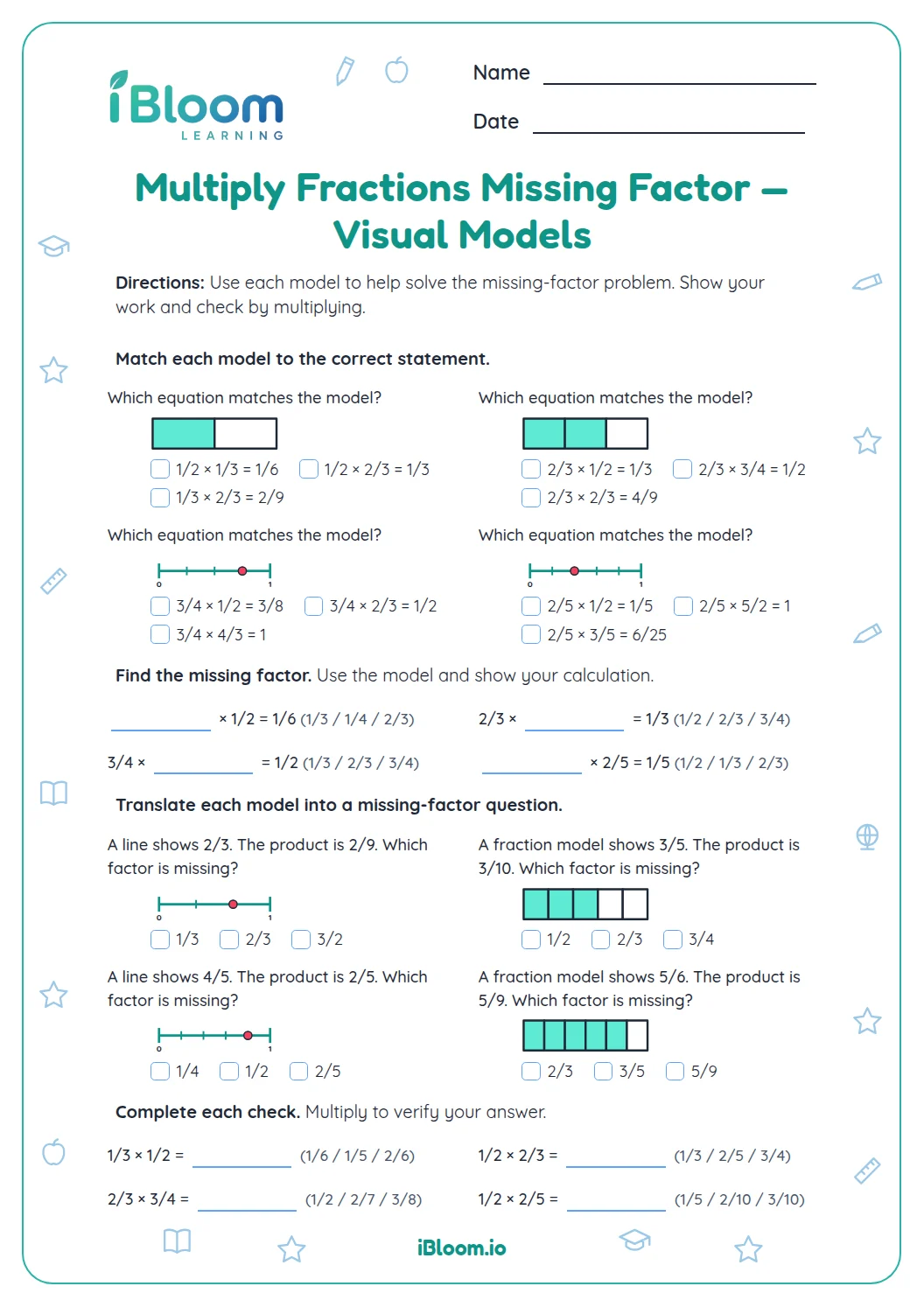
This Grade 5 worksheet practices finding a whole when a fractional part is known. In each of 14 situations, students complete a multiplication equation with the missing whole, then check by multiplying the fraction by their answer. The contexts include lengths, capacities, counts, and area; the work connects to CCSS 5.NF.B.4.
Aligned to 5.NF.B.4
How does fraction multiplication represent the story?
A fraction of a quantity is found by multiplying the whole by that fraction. If 3/4 of a roll is 9 feet, the equation is 3/4 × n = 9. The unknown n is the complete roll, not the measured part.
- 13/4 × ___ = 9
- 23/4 × 12 = 9, so the whole is 12
How can you solve for the missing whole?
The whole is the amount that the fraction describes. If 2/5 of a jug is 6 liters, then 2/5 × capacity = 6. The missing factor is the jug’s full capacity.
How can you check the answer?
Substitute the answer into the equation to check it. For 3/4 × 12 = 9, one fourth of 12 is 3, and three fourths is 9. The answer key lists each missing whole.
How to use this worksheet
- 1Identify the fraction and the known part.
- 2Write or read the equation: fraction × whole = part.
- 3Find the missing whole number.
- 4Keep the unit named in the story in mind.
- 5Multiply to check that the fraction of your whole equals the given part.
Common mistakes and quick fixes
The mistake
Treating the known part as the whole
The fix
The story says the known amount is only a fraction of the complete quantity. Find the larger whole.
The mistake
Dividing by the numerator only
The fix
Divide by the entire fraction, such as 9 ÷ 3/4, or multiply by its reciprocal.
The mistake
Forgetting to check
The fix
Multiply your proposed whole by the stated fraction. The product should equal the given part.
Common Core alignment
This worksheet gives students focused practice with a grade-level skill.
Use multiplication to find a fractional part of a whole-number quantity.
On this sheet: Use multiplication to find a fractional part of a whole-number quantity.
Show the official wordingHide the official wording
Apply and extend previous understandings of multiplication to multiply a fraction or whole number by a fraction.
What to practice next
Make more practice
Further reading
Questions parents and teachers ask
What does “missing whole” mean on this worksheet?
The known number is only a fractional part of an amount, and students find the full amount. If 3/4 of a ribbon measures 9 feet, the whole ribbon is longer than 9 feet. The equation shows the relationship. Students can write the relationship as fraction × whole = known part before calculating.
Why does the answer have to be larger than the known part?
Each fraction in the questions is less than one whole. A fraction of an amount is therefore smaller than the full amount. For example, 2/5 of a jug is 6 liters, while the whole jug holds 15 liters. The completed equation shows why the full amount exceeds its fractional part.
How do I solve 3/4 × n = 9?
Find a number whose three fourths equal 9. Since 3/4 × 12 = 9, the missing whole is 12. The ribbon problem uses this same relationship and asks for the full length. Multiplying the fraction by 12 gives 9, so the missing factor makes the equation true.
How can multiplication check a missing whole?
Replace the blank with your answer and multiply by the fraction. If the product matches the known part, the equation is true. For example, 4/5 × 25 equals 20, confirming the garden row total. This check uses the same multiplication relationship printed in the questions.
Should the answer include units?
The worksheet asks for the missing whole in contexts with units such as feet, liters, pages, and square meters. Use the unit from the story when describing the result, even though the equation’s blank holds the number. Units describe the story context; the equation blank itself is the missing number.