






About this worksheet
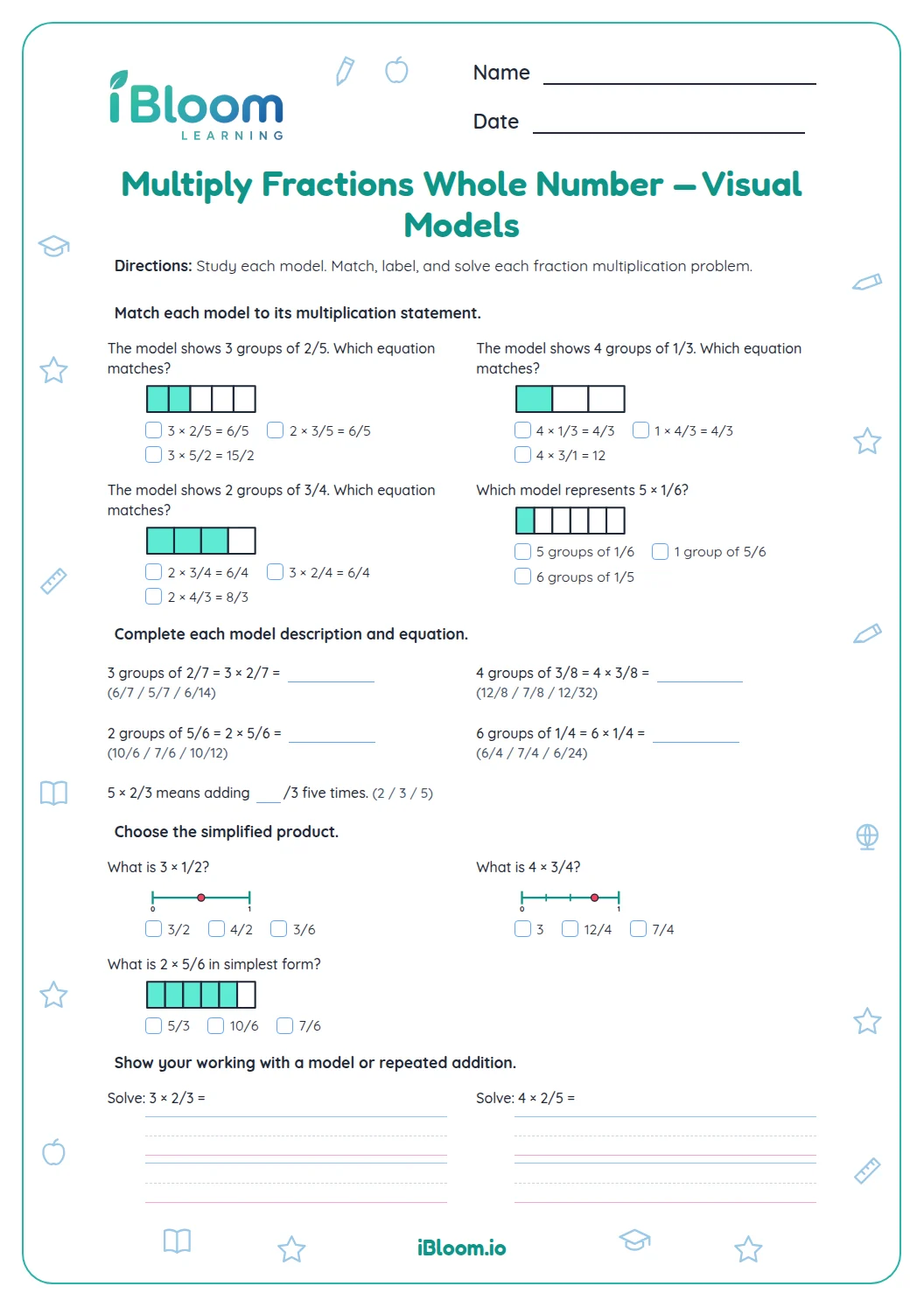
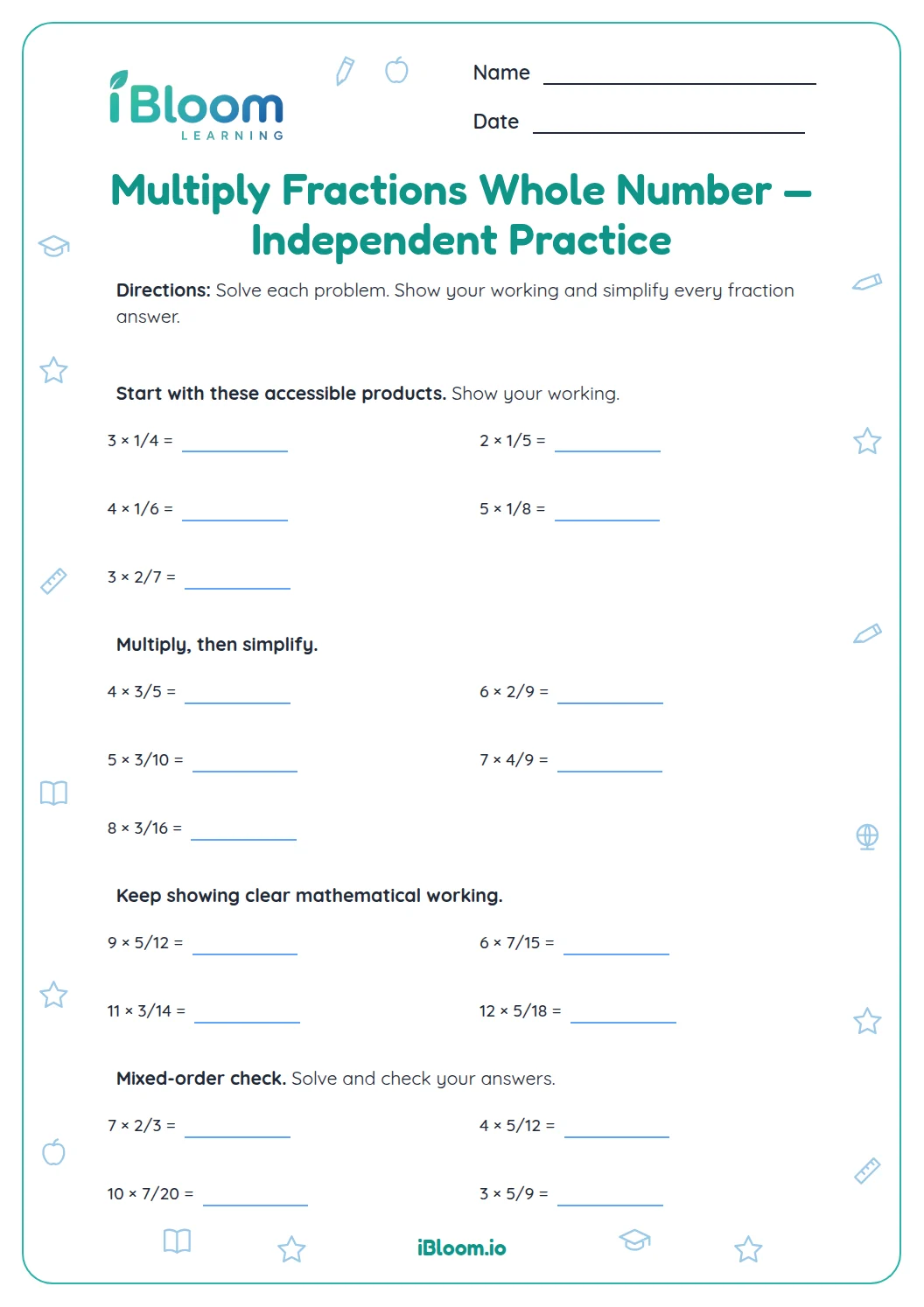
This Grade 5 worksheet presents fraction multiplication through 16 questions. The first eight pair a shaded area model with a fraction-of-a-whole-number problem. Learners then multiply fraction factors and apply the operation to a recipe, ribbon, area, and reading situation. A separate key shows answers. The work practices CCSS 5.NF.B.4.
Aligned to 5.NF.B.4
How do you find a fraction of a whole number?
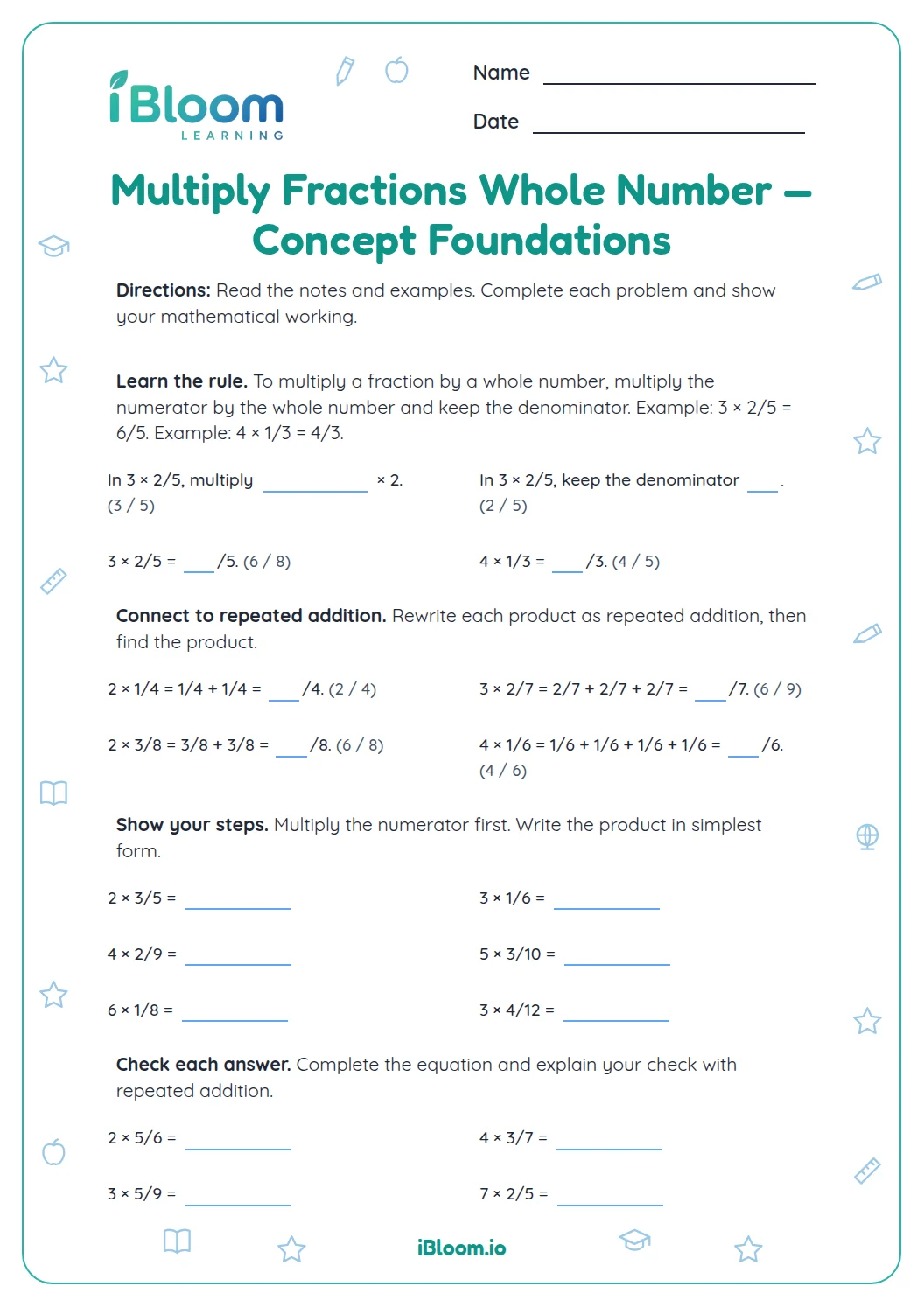
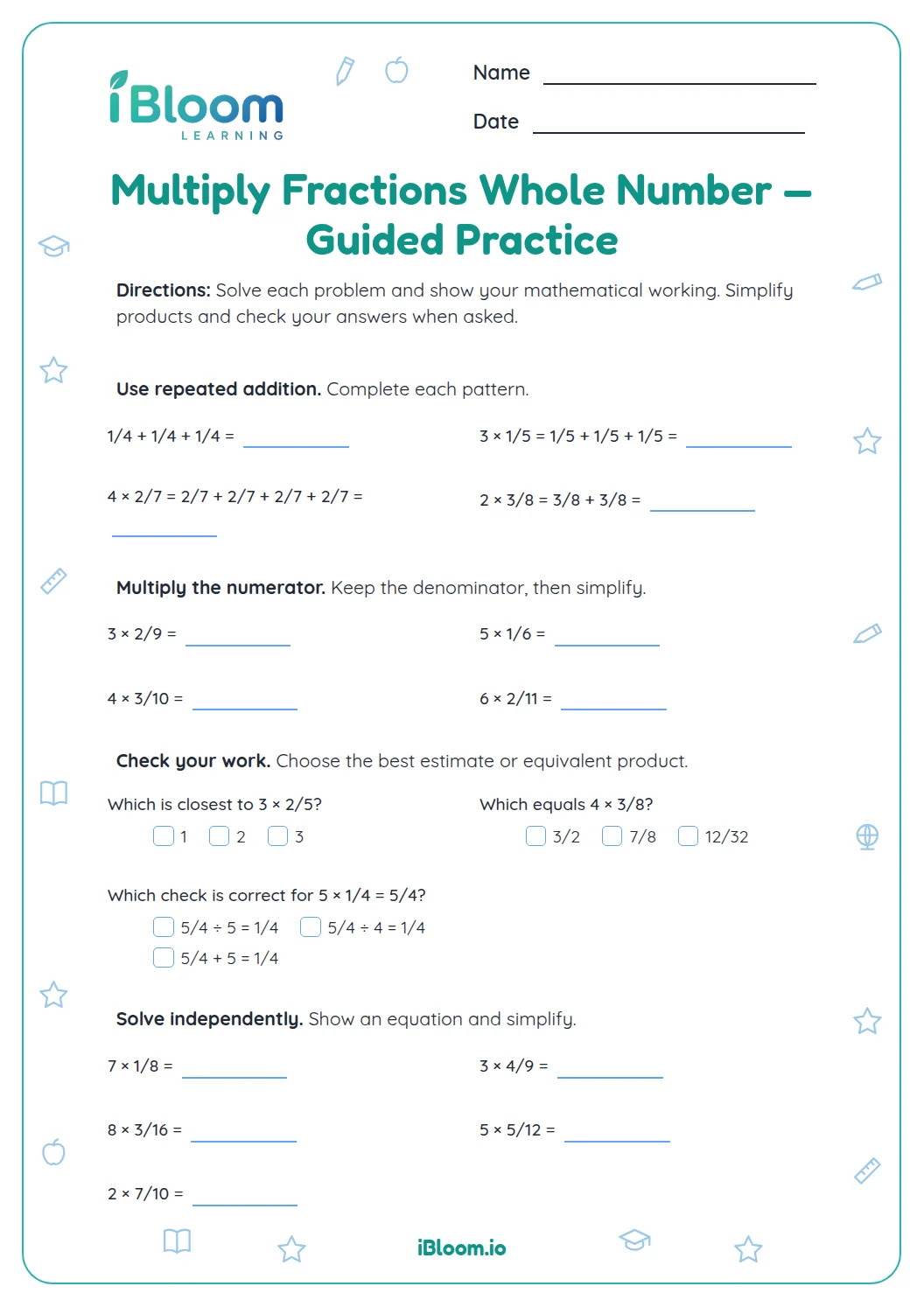
A fraction names equal parts of a whole. To find 2/3 of 4, first divide 4 into 3 equal groups; each group is 4/3. Taking 2 of those groups gives 8/3, or 2 2/3.
Question 1 uses a bar divided into thirds with two parts shaded. Multiply 2 × 4 and divide by 3 to get 8/3.
- 12/3 of 4
- 22 × 4 ÷ 3
- 38/3 = 2 2/3
How do you multiply two fractions?
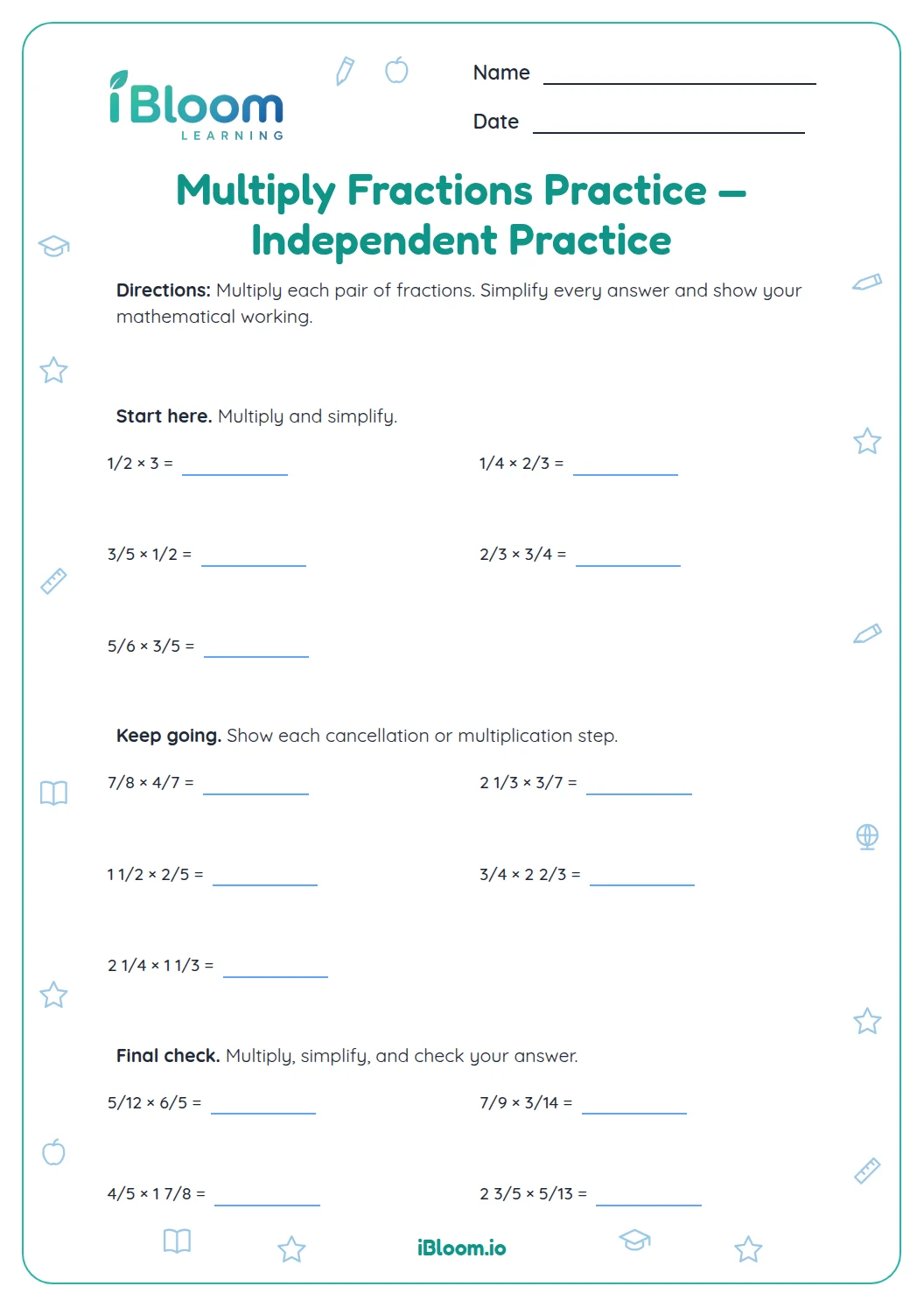
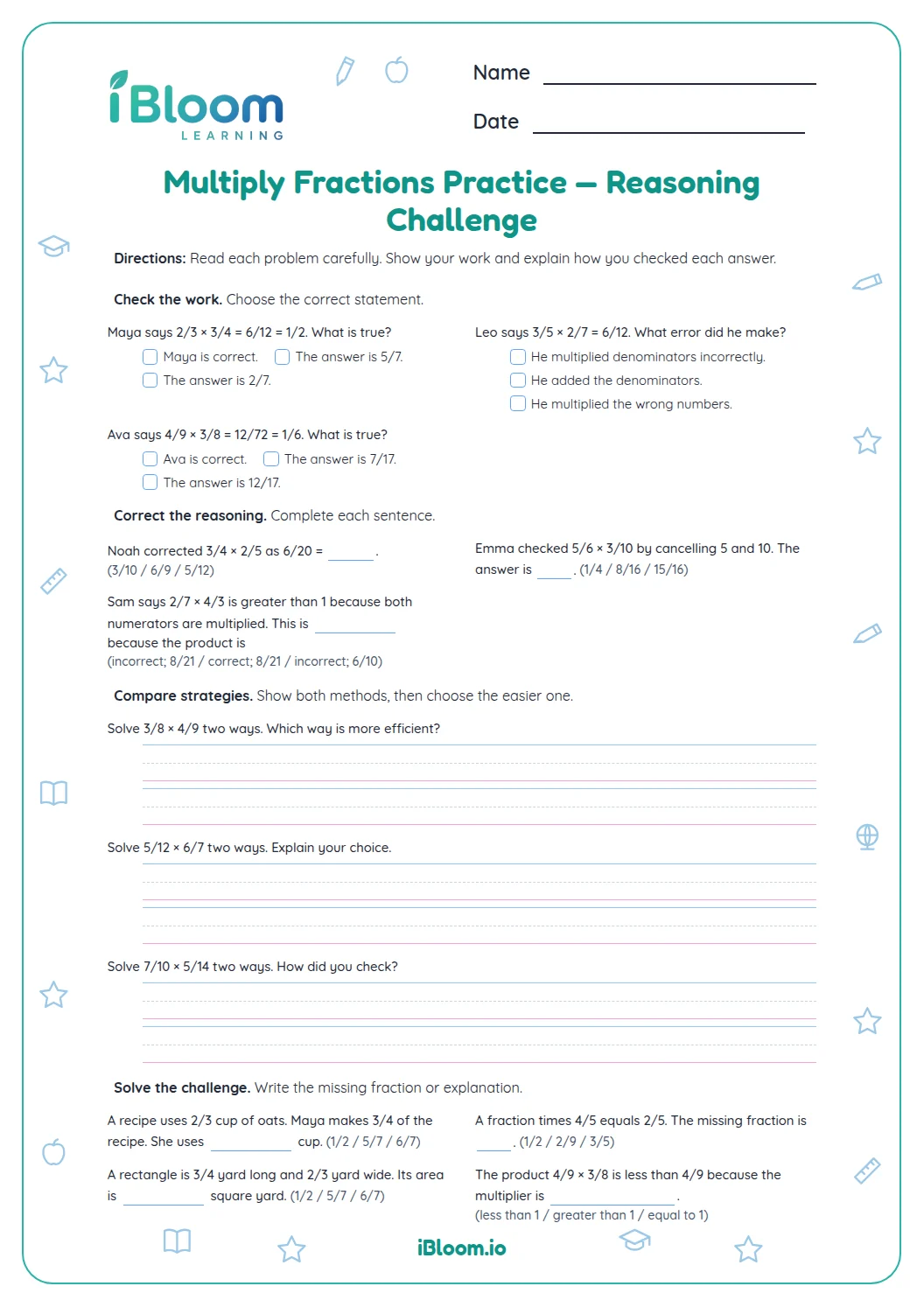
Multiply the numerators to find the product numerator and multiply the denominators to find the product denominator. Simplify the result when the numerator and denominator share a factor. For 2/3 × 3/5, the product is 6/15, which simplifies to 2/5.
What do the final problems ask?
The last part puts multiplication into familiar settings. Read the quantities carefully, write a multiplication equation, and include the unit for a measurement answer.
- Part A: use eight fraction bar models for fraction-of-a-whole-number questions
- Part B: multiply and simplify four fraction products
- Part C: solve four recipe, ribbon, area, and reading problems
How to use this worksheet
- 1Read the numerator and denominator in the model.
- 2Identify the whole number or second factor in the prompt.
- 3Multiply the numerator by the whole number, or multiply corresponding fraction parts.
- 4Simplify the product if it has a common factor.
- 5For a story, include the requested unit in the answer.
Mistakes to watch for
The mistake
Multiplying denominators but forgetting the numerators.
The fix
Write the numerator product and denominator product on separate lines.
The mistake
Treating “of” as addition.
The fix
Rewrite “2/3 of 4” as 2/3 × 4.
The mistake
Leaving a reducible fraction unsimplified.
The fix
Check whether the numerator and denominator share a common factor.
Common Core alignment
The questions use visual fraction reasoning and multiplication to find fraction products.
Multiply a fraction or whole number by a fraction.
On this sheet: The models and equations show fractions of whole numbers and fraction-by-fraction products.
Show the official wordingHide the official wording
Apply and extend previous understandings of multiplication to multiply a fraction or whole number by a fraction.
What to practice next
Make more practice
Further reading
Questions parents and teachers ask
What does “of” mean in a fraction problem?
In these questions, “of” means multiply. For example, 2/3 of 4 is 2/3 × 4. Divide 4 into three equal groups, then take two groups, or calculate 2 × 4 ÷ 3. Both ways give 8/3, which is 2 2/3.
Why are some answers mixed numbers?
A fraction product can be greater than one whole. For instance, 2/3 of 4 is 8/3, which is 2 2/3. The mixed number names two whole units and two thirds of another, while the improper fraction keeps the multiplication result in fraction form.
How should a child multiply two fractions?
Multiply the numerators together and the denominators together, then simplify if possible. For 2/3 × 3/5, multiply to get 6/15 and reduce to 2/5. The product stays equivalent because dividing the numerator and denominator by the same factor does not change its value.
What do the visual models show?
Each area grid is divided into equal rows, and its shaded rows show the fraction factor. The columns represent the number of wholes in the prompt. For 2/3 of 4, two of three rows are shaded across four wholes, representing eight thirds.
Does the key accept equivalent fractions?
The answer key gives simplified forms for quick checking. Equivalent fractions represent the same amount, and mixed-number answers may also be written as improper fractions when the value is clear. Story answers should keep their requested unit, such as cups, yards, or pages.