








About this worksheet
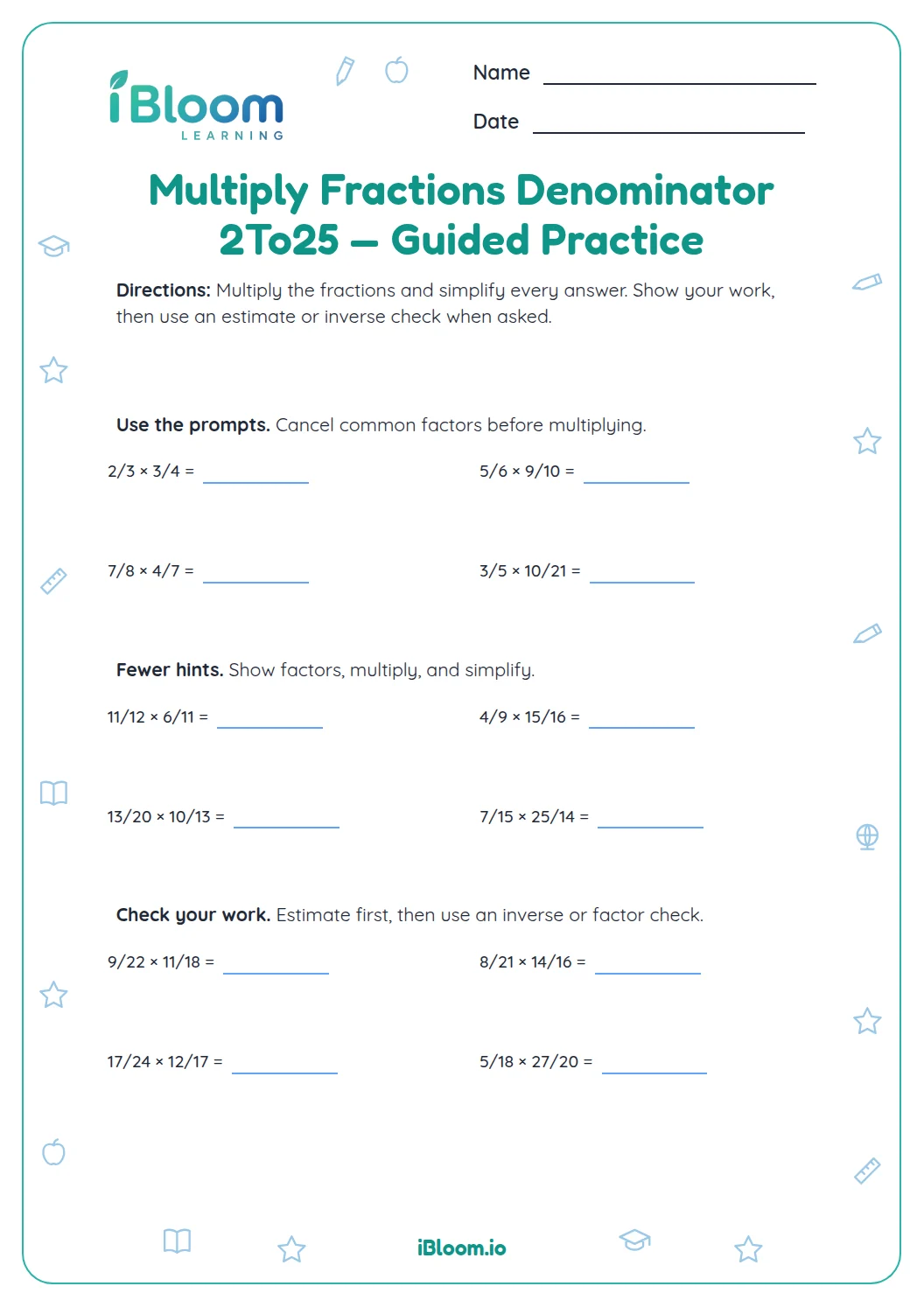
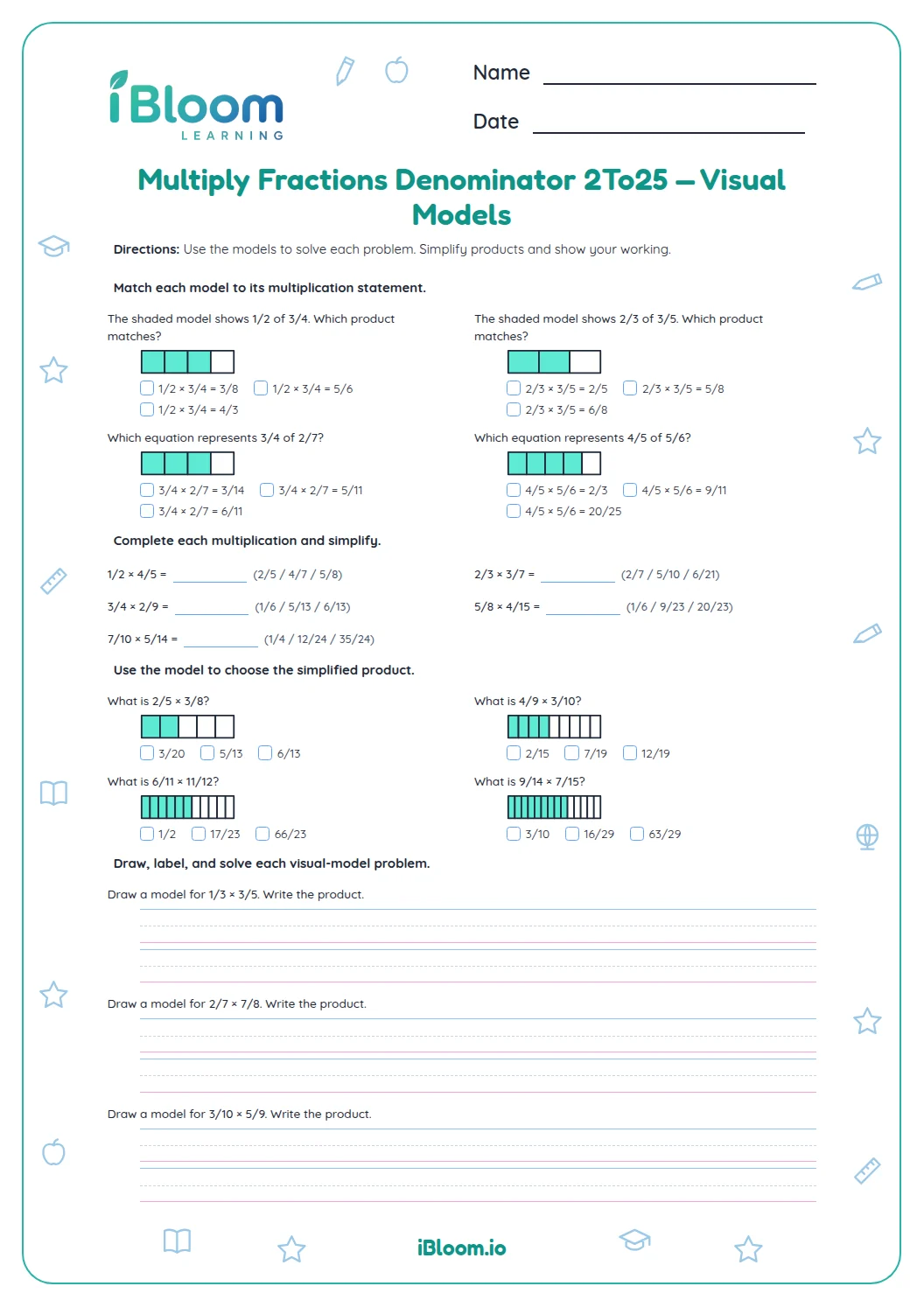
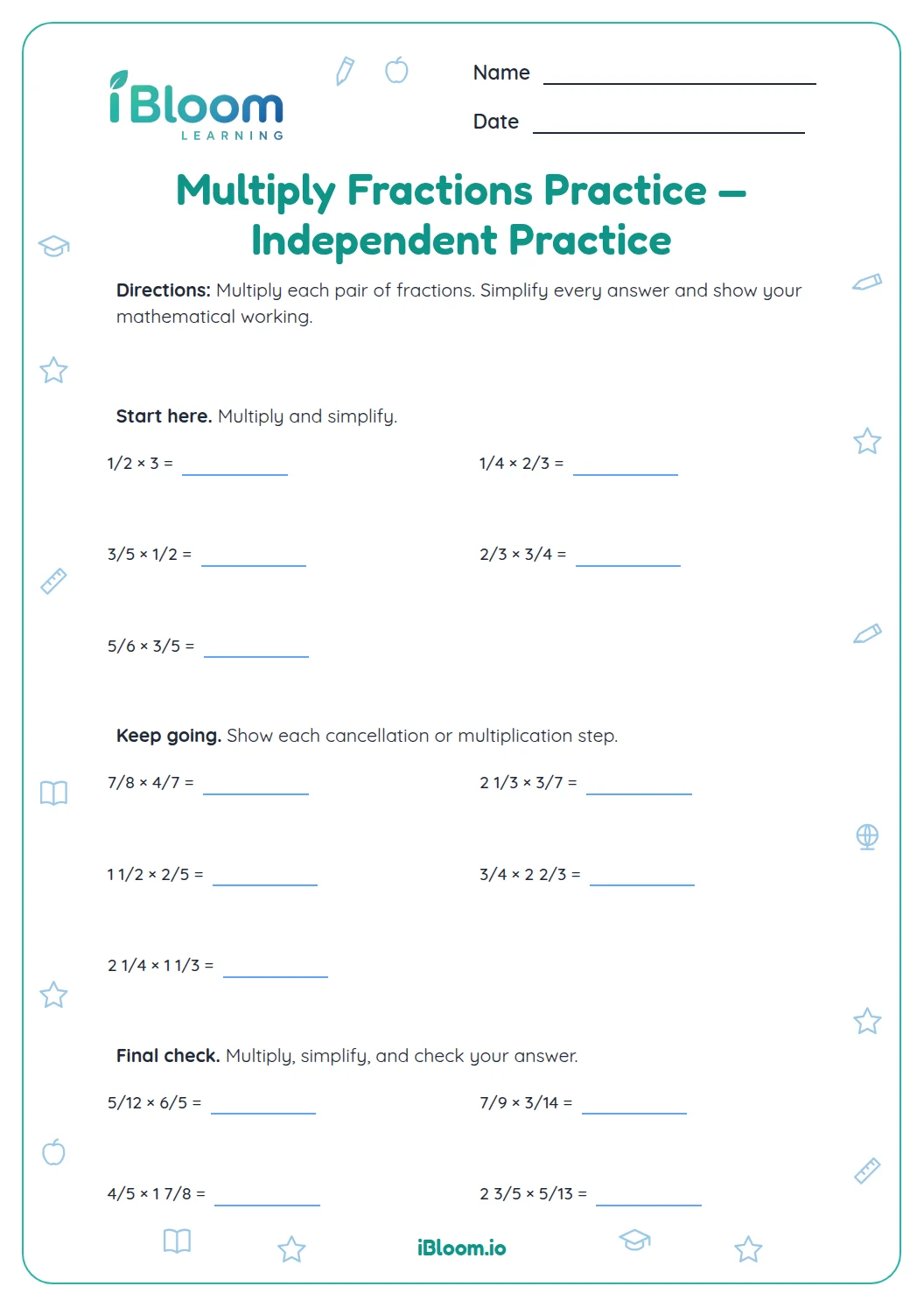
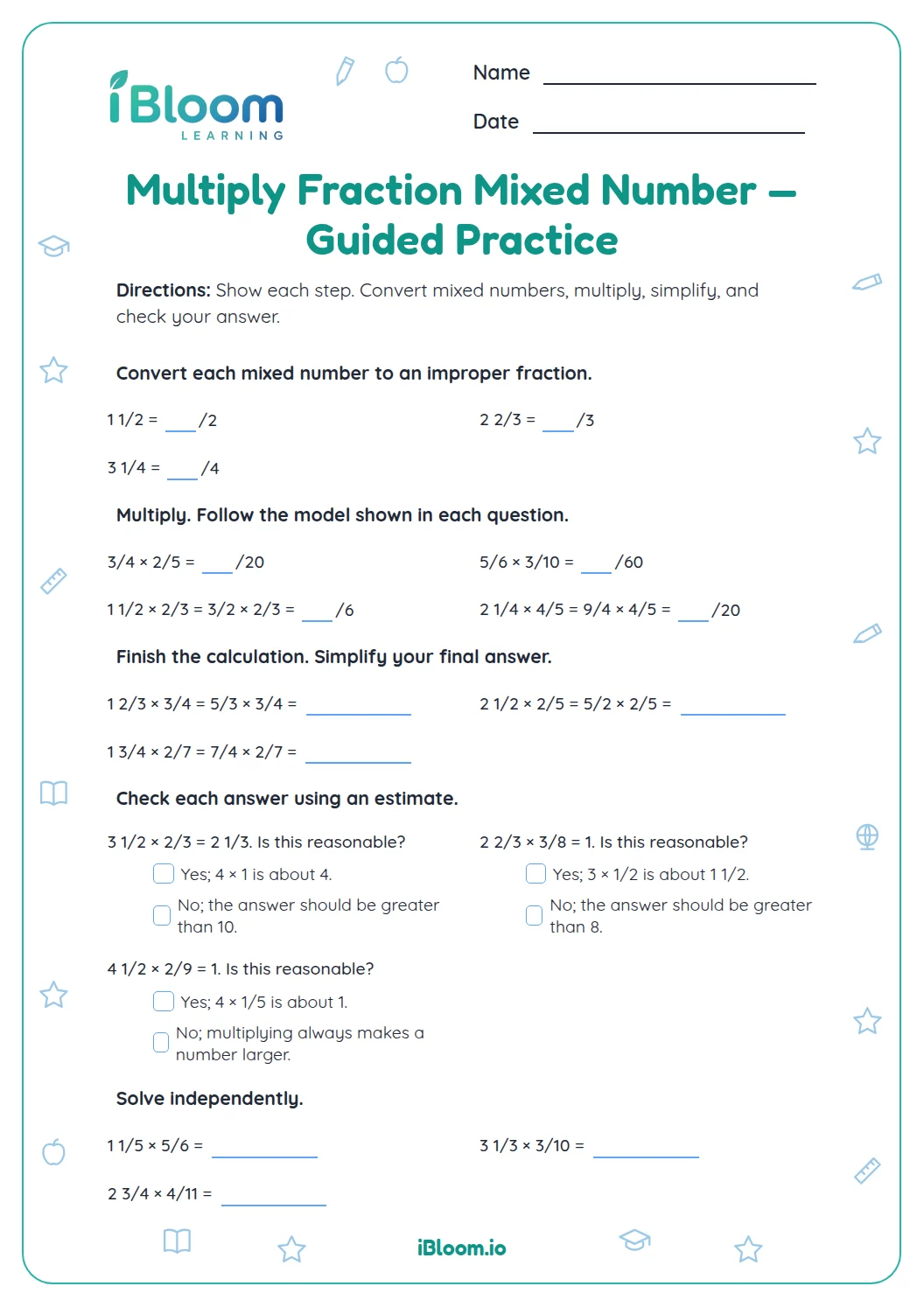
This Grade 5 guided practice sheet develops multiplication of fractions with denominators from 2 to 12. Students first multiply and simplify numerical products, then model the operation in real situations, compare products, and correct a common error. The progression gives repeated practice with reducing before or after multiplying. It aligns with CCSS 5.NF.B.4, and includes a separate answer key.
Aligned to 5.NF.B.4
What are the steps for multiplying fractions?
Multiply across: numerator times numerator and denominator times denominator. Then simplify the product by dividing its numerator and denominator by a common factor.
Question 1 gives 2/3 × 3/5. The product is 6/15, which reduces to 2/5. You can also cancel the 3 factors first, then multiply.
- 12/3 × 3/5
- 2Multiply: 2 × 3 over 3 × 5 = 6/15
- 3Divide top and bottom by 3
- 4Answer: 2/5
When can you simplify before multiplying?
Look for a numerator and denominator that share a factor, even across the multiplication sign. In question 2, the 7 in 4/7 and 7/8 cancel to 1, leaving 4/8, or 1/2.
Reducing first keeps numbers smaller while preserving the product. A final check can confirm the same simplified result.
What does fraction multiplication mean in a story?
Multiplication can find a fraction of another fraction or a fractional area. In question 11, the rectangular bed’s area is 3/4 × 2/5 square meter, so the result is 6/20 = 3/10 square meter.
In question 12, 3/8 of the pitcher’s capacity is taken from the 5/6-full context: 5/6 × 3/8 = 15/48 = 5/16 of its full capacity.
How can you check a fraction product?
Estimate the size before multiplying. If both factors are less than 1, their product should be smaller than either factor. Then simplify and check that the fraction is in lowest terms.
Question 16 shows a common mistake: multiplying denominators by addition. The correct product is 6/24 = 1/4.
How to use this worksheet
- 1Use question 1 to practice multiplying across and reducing.
- 2In questions 2–10, look for factors that can cancel before multiplying.
- 3For each context problem, write the two fractions as factors and include the unit.
- 4Estimate whether the product should be smaller than either factor.
- 5Finish by comparing the products and correcting the sample error.
Common mistakes and quick fixes
The mistake
Adding denominators, such as writing 6/11 for 2/3 × 3/8.
The fix
Multiply both pairs: numerator by numerator and denominator by denominator, then simplify.
The mistake
Stopping at an equivalent but unsimplified product such as 6/15.
The fix
Find a common factor in the numerator and denominator and divide both by it.
The mistake
Reporting a number without the context unit for area or distance.
The fix
Keep square units for area and the original unit for a fractional length.
Common Core alignment
The sheet practices multiplication of fractions as finding a fraction of a quantity and interpreting area.
Multiply fractions and interpret the product as a fraction of a quantity.
On this sheet: The computation, area, and capacity questions multiply a fraction by a fraction.
Show the official wordingHide the official wording
Apply and extend previous understandings of multiplication to multiply a fraction or whole number by a fraction.
What to practice next
Make more practice
Further reading
Questions parents and teachers ask
Do students multiply across the fraction bars?
Yes. Multiply the numerators to make the new numerator and the denominators to make the new denominator. Then simplify. In question 1, 2/3 × 3/5 = 6/15, and dividing both numbers by 3 gives 2/5. The worked examples on this page show the same steps in a clear order.
Can a student simplify before multiplying?
Yes. Any common factor shared by a numerator and the opposite denominator can be canceled first. Question 2 has a factor of 7 that cancels, leaving 4/8, which simplifies to 1/2. The worked examples on this page show the same steps in a clear order.
What does 3/4 × 2/5 mean in the garden problem?
It finds the area of a rectangle that is 3/4 meter by 2/5 meter. Multiply to get 6/20 square meter, then simplify to 3/10 square meter. Area is reported in square units. The worked examples on this page show the same steps in a clear order.
Why is 6/11 not the answer to 2/3 × 3/8?
That answer comes from multiplying the numerators but adding the denominators. Fraction multiplication requires multiplying both pairs: 2 × 3 = 6 and 3 × 8 = 24. Then simplify 6/24 to 1/4. The worked examples on this page show the same steps in a clear order.
How do I know whether a fraction product is reasonable?
If both factors are positive fractions smaller than one, the product should be smaller than either factor. For 2/3 × 3/5, a result of 2/5 is smaller than both 2/3 and 3/5, so its size is reasonable. The worked examples on this page show the same steps in a clear order.