





About this worksheet
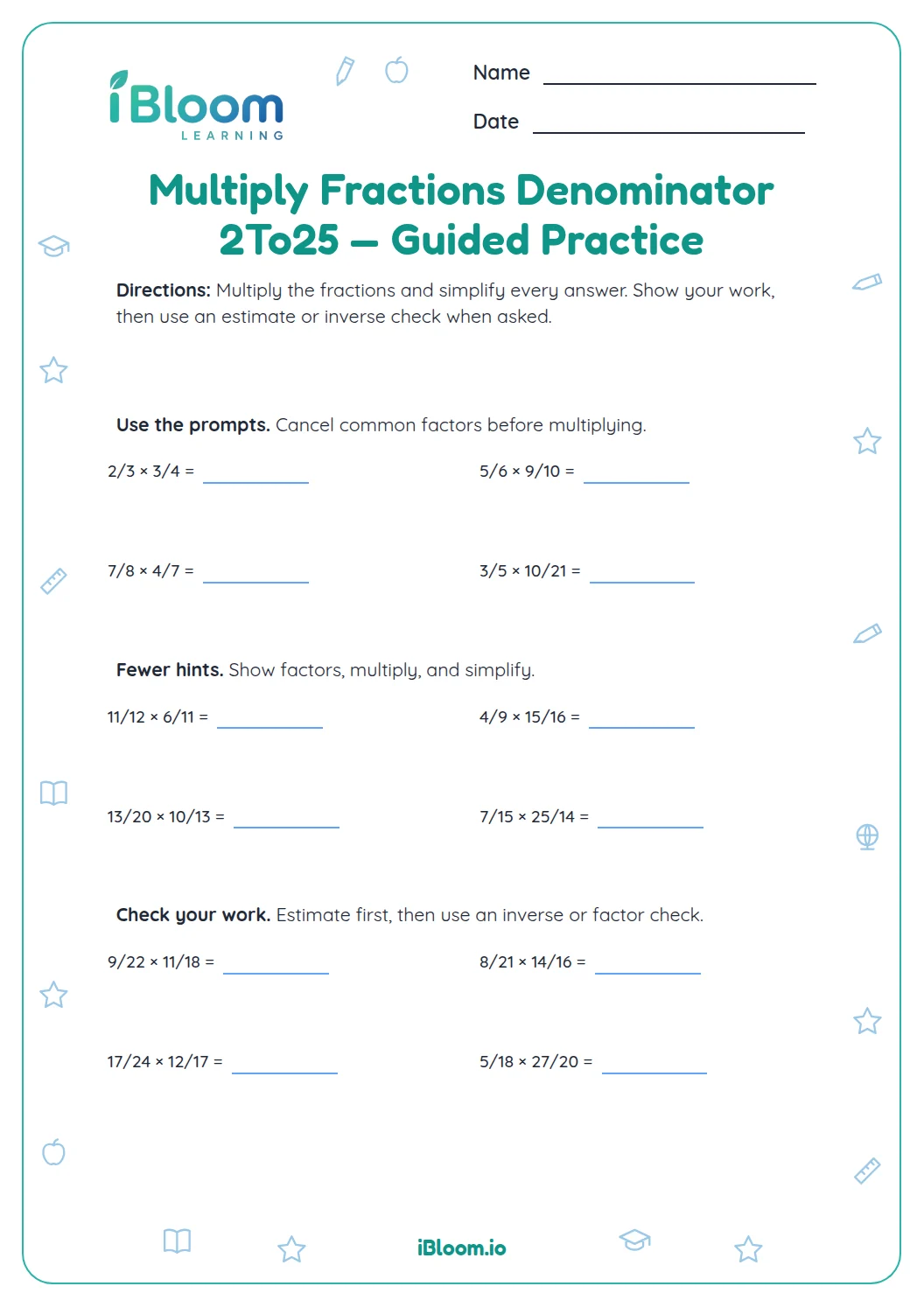
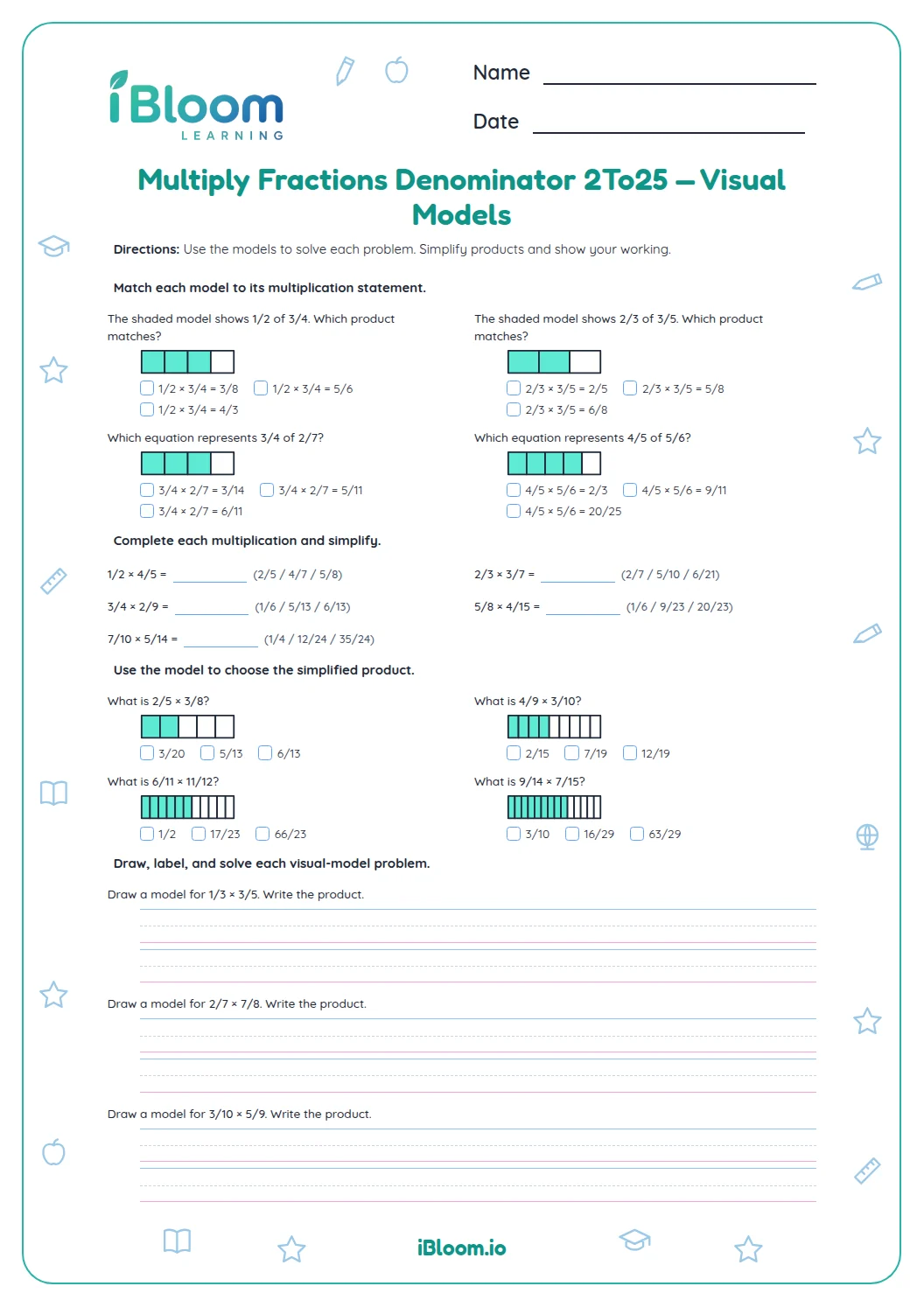
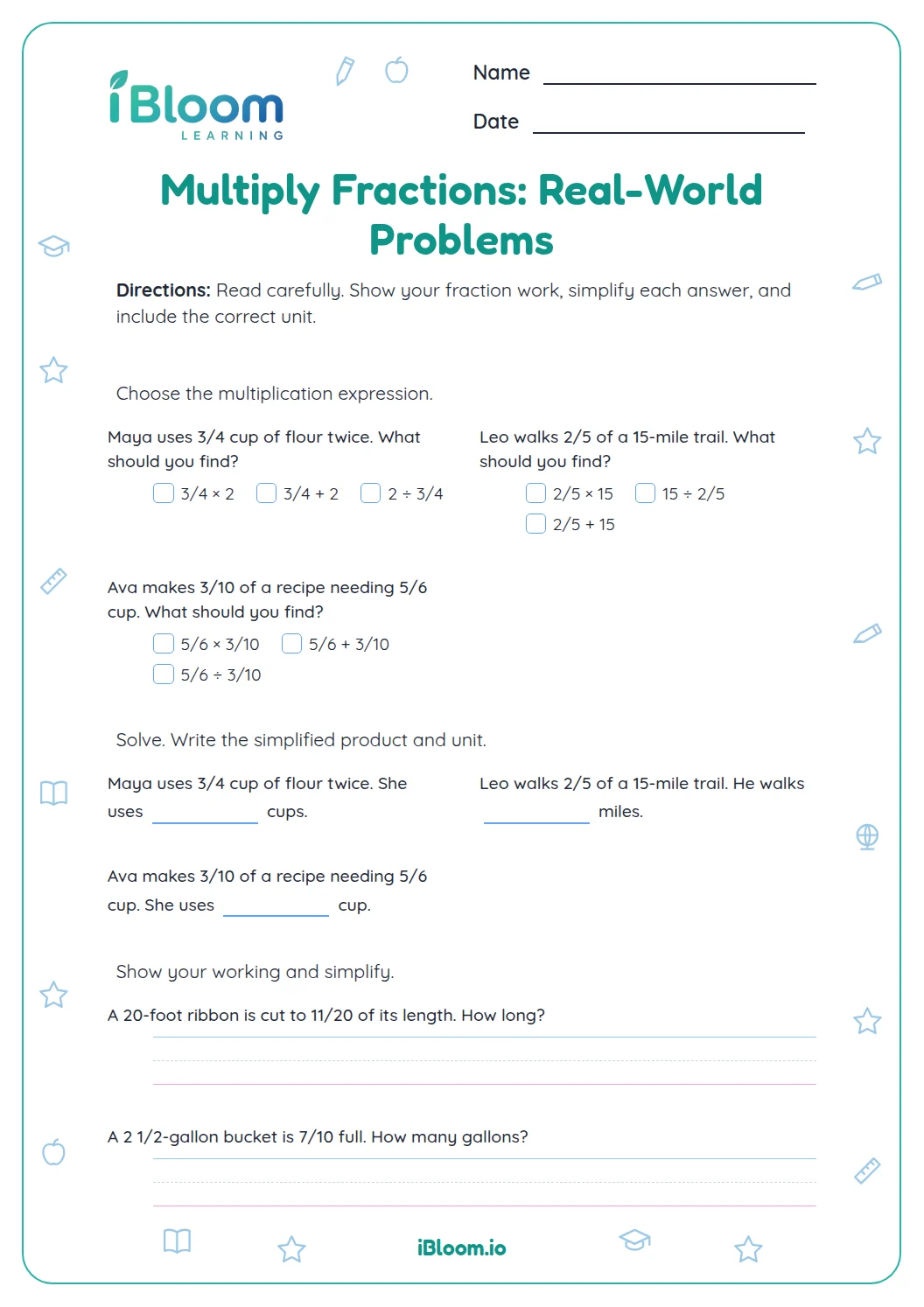
This Grade 5 printable has 16 fraction multiplication problems. The first two parts practice products with denominators from 2 through 25 and simplifying; Part C uses four short situations to interpret “of” as multiplication. The sheet aligns with CCSS 5.NF.B.4 and includes a separate answer key with simplified products.
Aligned to 5.NF.B.4
How do you multiply and simplify two fractions?
Multiply the numerators and multiply the denominators. Then reduce if the product has a common factor.
- 11/2 × 2/3 = 2/6 = 1/3
When can students simplify before multiplying?
A factor in one numerator can cancel with a factor in the other denominator. This keeps the arithmetic smaller while preserving the product.
- 13/4 × 8/9 = 2/3
How does multiplication appear in the story problems?
Each story asks for a fractional part of another amount. Identify the amount and the fraction of it, multiply, and label the result with the unit from the question.
- 1A 5/6-yard ribbon: 3/5 of it is 1/2 yard.
How to use this worksheet
- 1Multiply numerator by numerator and denominator by denominator.
- 2Simplify the product by dividing both terms by a common factor.
- 3In Part B, look for factors that can cancel before multiplying.
- 4For each story, identify the fractional amount and the fraction of that amount.
- 5Check the simplified result and its unit with the answer key.
Fraction multiplication checks
The mistake
Multiplying only the numerators.
The fix
Multiply the two denominators as well; then simplify the complete fraction.
The mistake
Subtracting the same number from numerator and denominator.
The fix
Simplify by dividing top and bottom by the same common factor.
The mistake
Leaving an answer reducible.
The fix
Check whether numerator and denominator still share a factor before recording the final product.
Common Core alignment
Multiply a fraction by a fraction, and interpret products as parts of a whole.
On this sheet:
Show the official wordingHide the official wording
Apply and extend previous understandings of multiplication to multiply a fraction or whole number by a fraction.
What to practice next
Make more practice
Further reading
Questions parents and teachers ask
Do students need to simplify every product?
Yes. The directions ask students to simplify, and the key gives reduced answers. For example, 3/4 × 8/9 becomes 2/3 after canceling common factors. If a product is already in simplest form, it can be written as it is. Ask the learner to point to the two fractions before multiplying and simplifying.
What is in the four story problems?
Part C asks students to find a fraction of a fractional amount in recipe, ribbon, garden-path, and pitcher situations. Each gives enough information to write a multiplication sentence and answer with a unit where the situation uses one. Ask the learner to point to the two fractions before multiplying and simplifying.
Can students cancel before multiplying?
Yes. Part B is specifically labeled for using a common factor first. Students can reduce across the two fractions, multiply the remaining numerators and denominators, and check that the result matches the direct product. Ask the learner to point to the two fractions before multiplying and simplifying.
How many pages should I print?
The printable has two worksheet pages and a separate two-page answer key. Print the worksheet for practice and keep the key aside until students finish or need to check their work. Ask the learner to point to the two fractions before multiplying and simplifying.
What should I check in a fraction product?
Check that both numerators and both denominators were multiplied, then look for a common factor in the result. In a story problem, also check that the answer describes the requested fraction of the given amount and includes the right unit. Ask the learner to point to the two fractions before multiplying and simplifying.