





About this worksheet
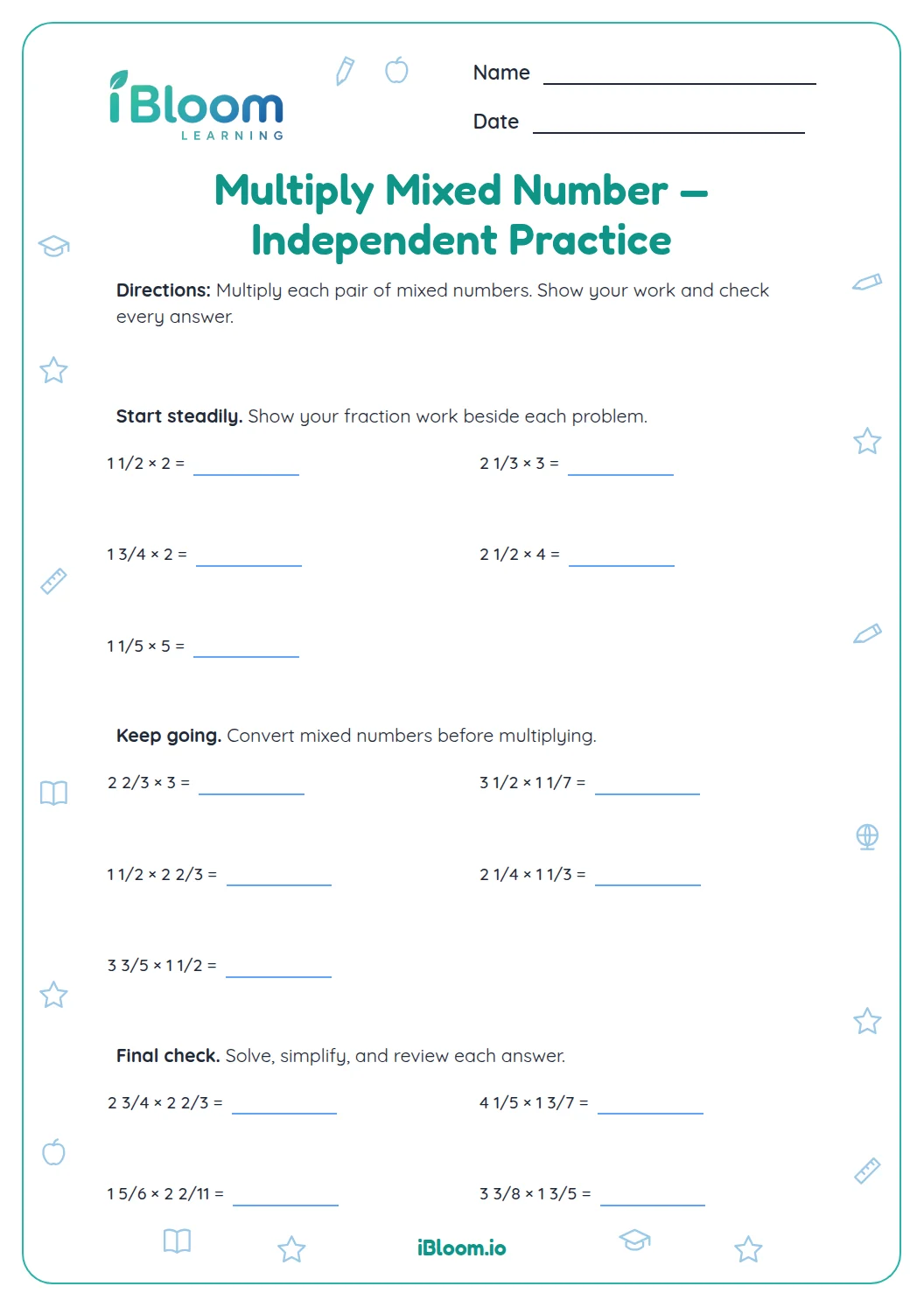
This Grade 5 worksheet has fourteen word problems that each multiply a proper fraction by a mixed number. Part A uses halves and thirds to find portions of ribbon, flour, soil, and a walk. Part B adds four portion problems and two rate problems about water flow and gravel. Students complete twelve quantity blanks, then finish with two short-answer problems about seed and a shelf. These real-world applications practice Common Core 5.NF.B.6. The final two problems have working space, and a separate answer key lists the simplified amounts.
Aligned to 5.NF.B.6
Why does finding a part call for multiplication?
Twelve problems ask for a fraction of a measured quantity. In question 5, guests drink three fourths of the 2 2/3 liters in a jug. Multiplying gives the amount they drink.
In the portion problems, a fraction between zero and one multiplies a positive measured amount, so the portion is smaller than the starting amount. Questions 9 and 10 use fractional rates with mixed-number time or distance to find water or gravel.
How do students convert and multiply?
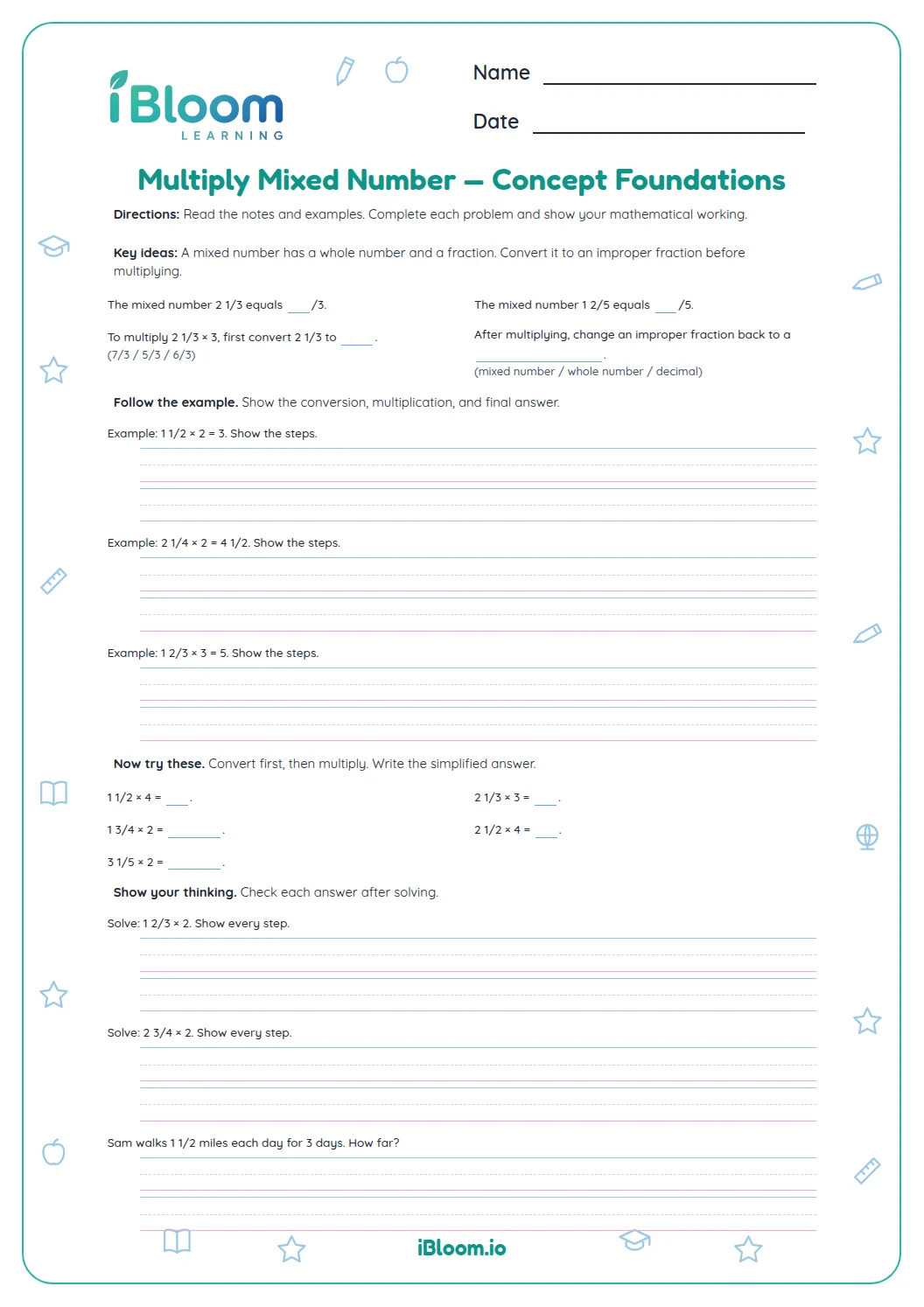
To rewrite a mixed number, multiply its whole-number part by the denominator, then add the numerator. Keep the denominator. For 3 1/2, three wholes contain six halves, so there are seven halves altogether.
- 11/2 × 3 1/2 = 1/2 × 7/2
- 21 × 7 = 7 and 2 × 2 = 4
- 37/4 = 1 3/4
- 4Nia uses 1 3/4 yards of ribbon.
How should students record and check the answer?
Every question asks for a product of a proper fraction and a mixed number. Write the requested unit beside each answer. The key uses simplified values; equivalent fractions are also correct.
Question 8 produces 15/8 cups, or 1 7/8 cups. That is less than the original 2 1/2 cups and greater than half of that quantity, which fits taking three fourths of it.
Use the worksheet step by step
- 1Read the context and identify the fraction, mixed number, and requested unit.
- 2Write the multiplication and keep the unit attached to the quantity.
- 3Rewrite the mixed number as an improper fraction.
- 4Multiply the numerators and denominators, simplifying common factors when useful.
- 5Express the result in simplest form with the correct unit.
- 6Check portions against the starting amounts; for rate problems, check that the total and its unit make sense.
Mistakes to check and how to fix them
The mistake
Changing 3 1/2 to 4/2.
The fix
Count three wholes as six halves, then add one half to get 7/2.
The mistake
Multiplying only the fractional part of 2 1/4 by 2/3.
The fix
Convert the entire mixed number to 9/4 so the two wholes are included.
The mistake
Assuming every multiplication answer must get larger.
The fix
In the portion problems, multiplying by a proper fraction gives an amount smaller than the starting quantity.
Common Core alignment
Represent and solve everyday problems by multiplying fractions and mixed numbers.
On this sheet: Ten portion problems and two rate problems multiply proper fractions by mixed numbers; Part C asks for equations.
Show the official wordingHide the official wording
Solve real world problems involving multiplication of fractions and mixed numbers, e.g., by using visual fraction models or equations to represent the problem.
What to practice next
Make more practice
Further reading
Questions parents and teachers ask
Does every problem multiply a fraction by a mixed number?
Yes. Each of the fourteen items pairs a proper fraction with a mixed number. Most find portions of measured quantities, such as ribbon or soup. Two multiply a fractional rate by a mixed-number time or distance to find the total water or gravel needed.
Do students need a common denominator?
No common denominator is needed to multiply these fractions. Rewrite the mixed number as an improper fraction, multiply the numerators, and multiply the denominators. Students may simplify common factors before multiplying or simplify the product afterward. Either approach gives the same amount when carried out correctly.
Can an answer be an improper fraction?
Yes, an equivalent improper fraction gives the same quantity. For example, question 1 can be written as 7/4 yards or 1 3/4 yards. The key uses simplified mixed numbers for answers above one. Encourage students to retain the unit whichever fraction form they use.
Why is a fractional portion smaller than the starting amount?
Each portion problem asks for a proper fraction of a positive amount. A proper fraction is less than one, so taking that portion gives less than the full quantity. In question 6, five sixths of 4 1/2 miles is 3 3/4 miles, which passes that check.
How can I help with the recipe problem?
Ask the student to identify 2 1/4 cups as the full recipe amount and 2/3 as the part being made. Then multiply 2/3 × 9/4. The product is 3/2 cups, or 1 1/2 cups. Have the student compare that amount with the full recipe.
How can students check a portion problem?
Check that the multiplication uses both the fraction and the full mixed number, then compare the result with the starting amount. For example, 2/5 of 3 3/4 yards is 1 1/2 yards, which is less than the full ribbon length.