




About this worksheet
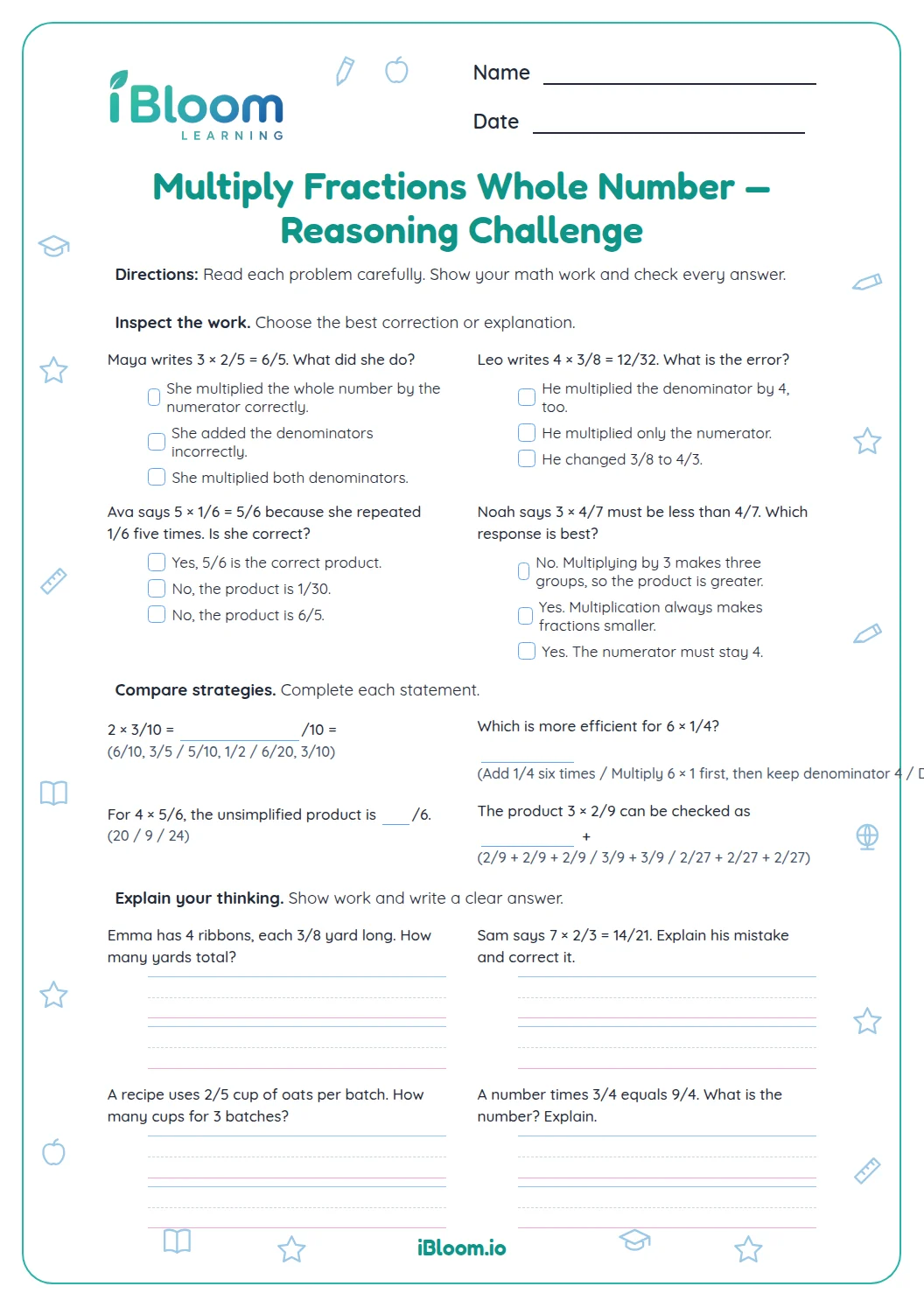
This free Grade 5 worksheet practices multiplying a fraction by a whole number in real-world situations. Learners first choose an expression, then solve problems about recipes, fabric, distance, and supplies, and finally check the size and form of their answers. The 15 questions follow the original sheet’s plan, solve, and check sequence. A separate answer key shows answers and a sample explanation. The practice aligns with Common Core 5.NF.B.6.
Aligned to 5.NF.B.6
How do you choose an expression?
Find the amount in one group and the number of equal groups. For 3/4 cup in each of 4 batches, use 4 × 3/4. The units help show that the answer is cups of oats, not batches.
How do you calculate the total?
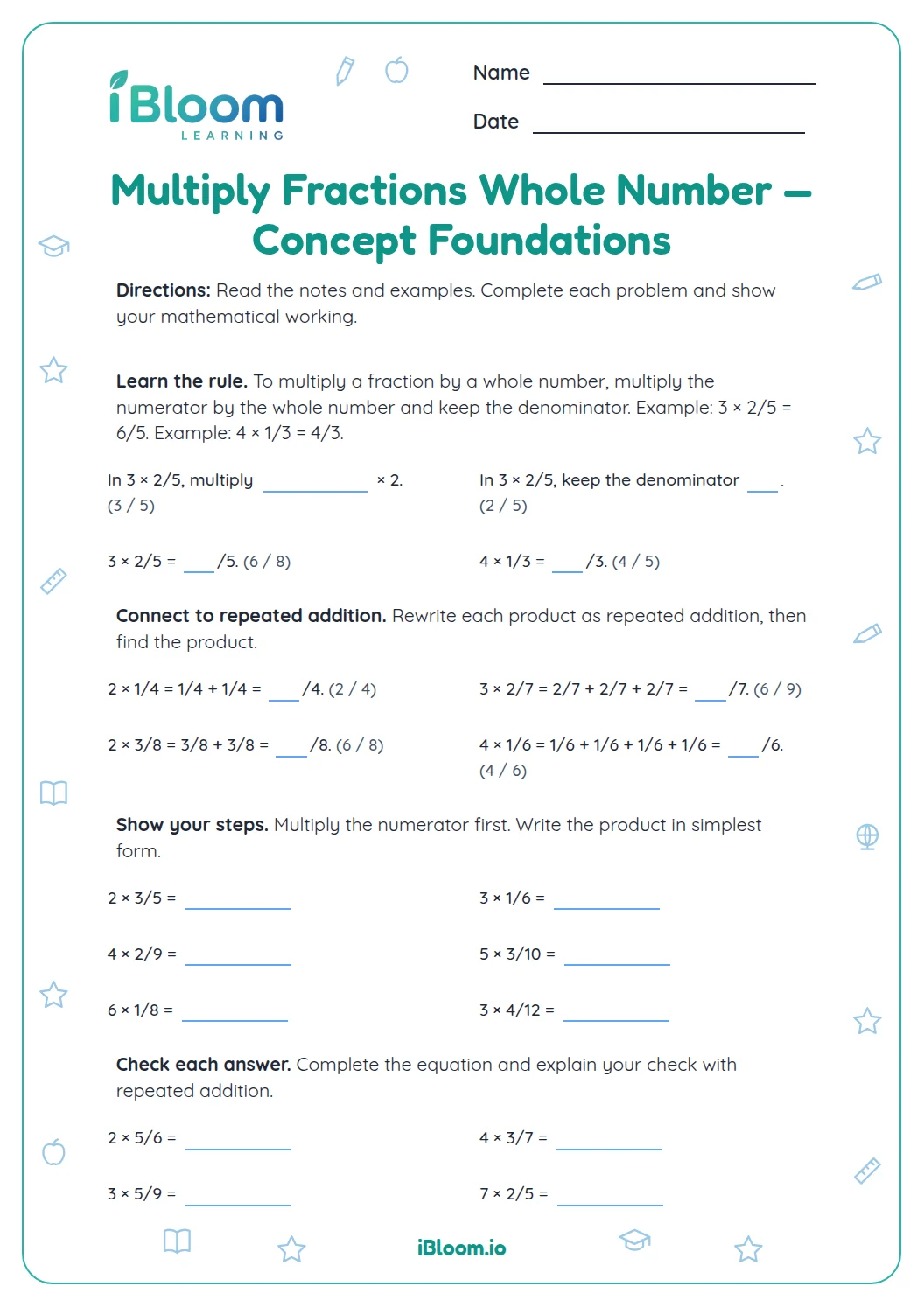
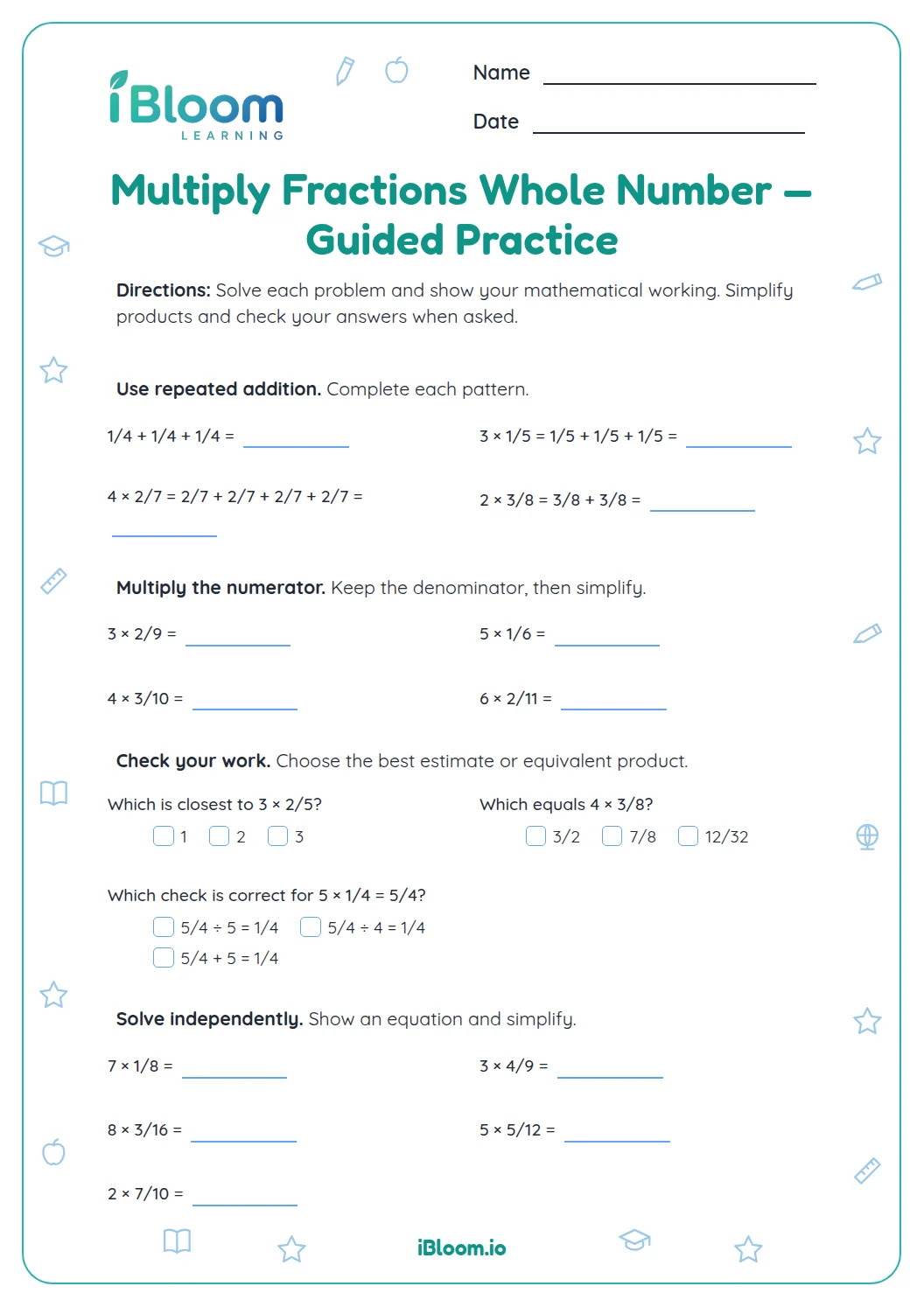
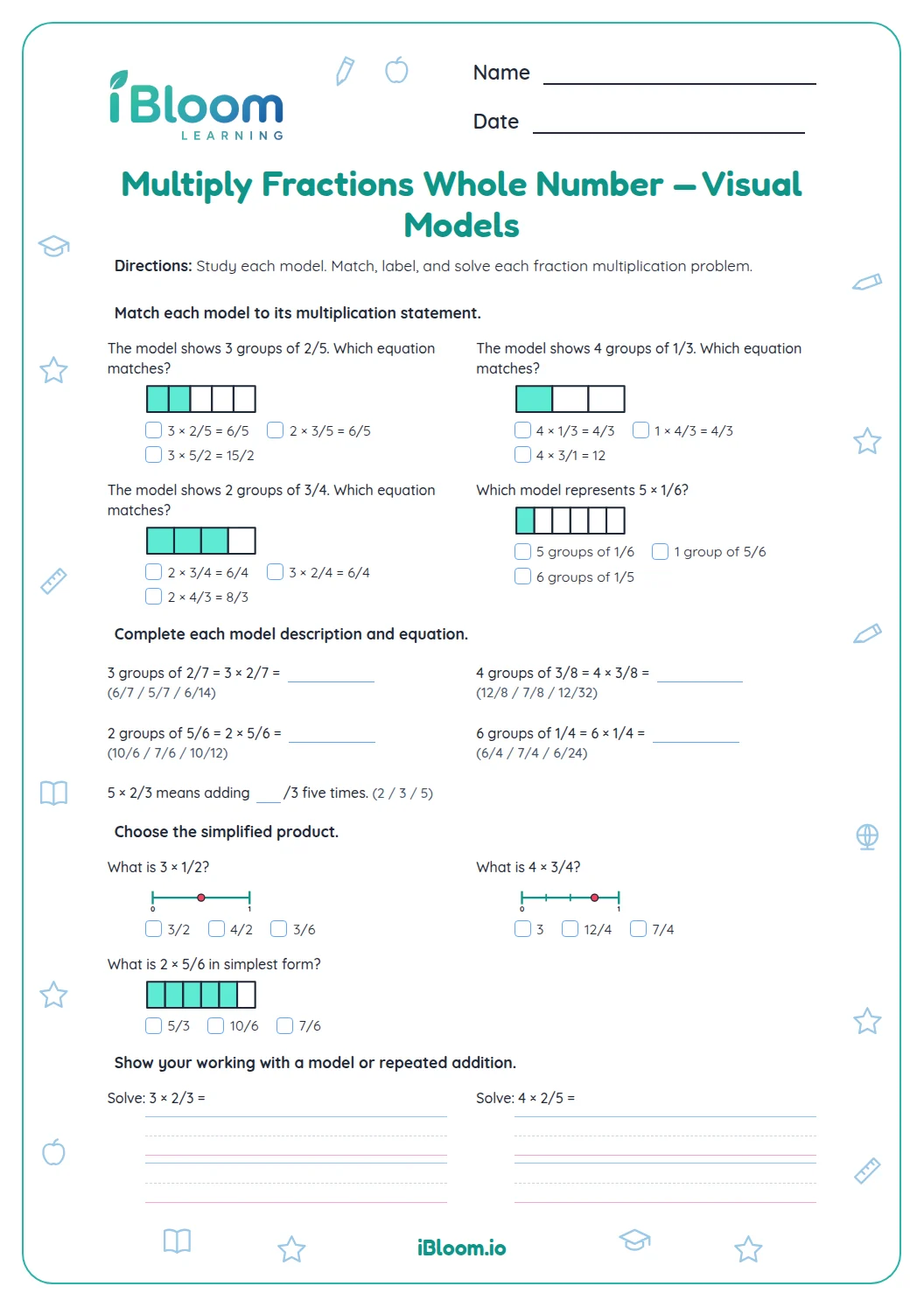
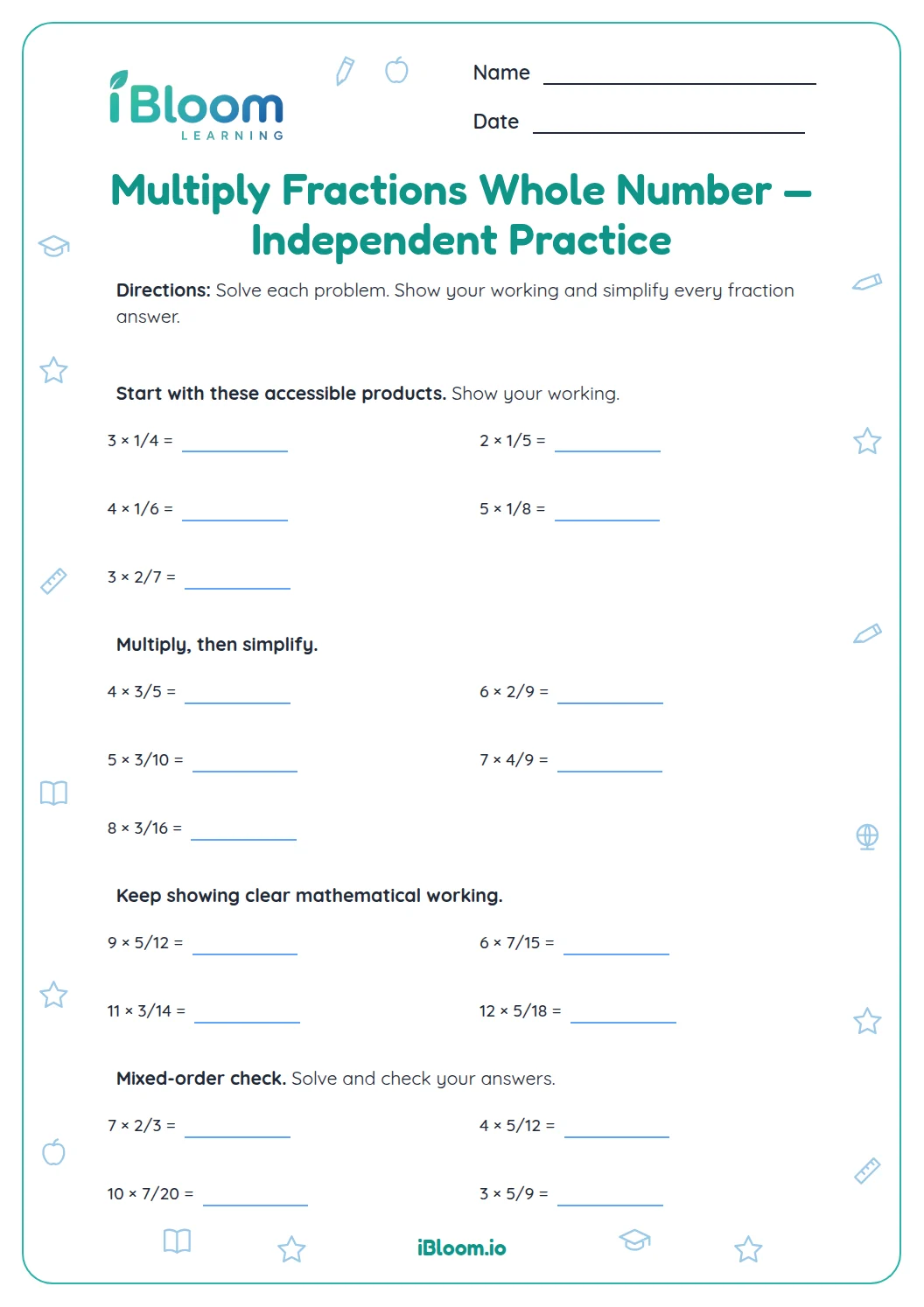
Multiply the numerator by the whole number and keep the denominator: 4 × 3/4 = 12/4 = 3. Simplify or convert an improper fraction when needed, then include the unit from the story.
- 14 batches × 3/4 cup per batch
- 24 × 3/4 = 12/4 = 3
- 3The total is 3 cups of oats.
How can you check whether the answer makes sense?
Estimate the size before or after calculating. Four groups of 3/4 should total more than 3/4, and 4 × 3/4 is exactly 3. Also check that the unit describes the amount being found.
How to solve the problems
- 1Identify the fraction amount in one group.
- 2Count the number of equal groups.
- 3Write whole number × fraction.
- 4Multiply the numerator and simplify the result.
- 5Label the answer and compare it with a quick estimate.
Common mistakes and quick fixes
The mistake
Adding the group count to the fraction.
The fix
Use multiplication because the same fractional amount repeats in equal groups.
The mistake
Multiplying both numerator and denominator by the whole number.
The fix
Multiply the numerator; keep the denominator, then simplify.
The mistake
Leaving an improper fraction unsimplified when a mixed number is clearer.
The fix
Divide the numerator by the denominator and label the whole and remaining parts.
Solve real-world problems by multiplying a fraction by a whole-number group count.
On this sheet:
Show the official wordingHide the official wording
Solve real world problems involving multiplication of fractions and mixed numbers, e.g., by using visual fraction models or equations to represent the problem.
What to practice next
Make more practice
Further reading
Questions parents and teachers ask
How many problems are on the worksheet?
There are 15 questions in two parts. Learners choose multiplication expressions, solve real-world fraction problems, and check or explain results. The separate answer key includes the numerical answers and a sample explanation for the item about correcting a product. Read the printed question again, explain the choice or calculation, and then use the separate key to confirm the result.
How do I multiply 3/4 by 4?
Multiply the numerator by 4 and keep the denominator: 3 × 4 = 12, so 4 × 3/4 = 12/4 = 3. In question 1, each batch uses 3/4 cup, so four batches use 3 cups of oats. Read the printed question again, explain the choice or calculation, and then use the separate key to confirm the result.
Should answers be simplified?
Yes, simplify an answer when possible and include the unit from the story. For example, 20/8 miles can be written as 2 1/2 miles. The key shows the expected simplified form, while equivalent correct forms may also be accepted. Read the printed question again, explain the choice or calculation, and then use the separate key to confirm the result.
What does the answer-check section ask learners to do?
The final part asks learners to decide whether a result is reasonable, solve a last story, and explain a correction. These checks connect the arithmetic to group size and help children notice when a fraction product has been written incorrectly.
Is an answer key included?
Yes. A separate answer key gives the result for each question, including units. It also provides a sample explanation for correcting 6/21 to 6/7 cup, so an adult can compare the learner’s reasoning with the multiplication. Read the printed question again, explain the choice or calculation, and then use the separate key to confirm the result.