



About this worksheet
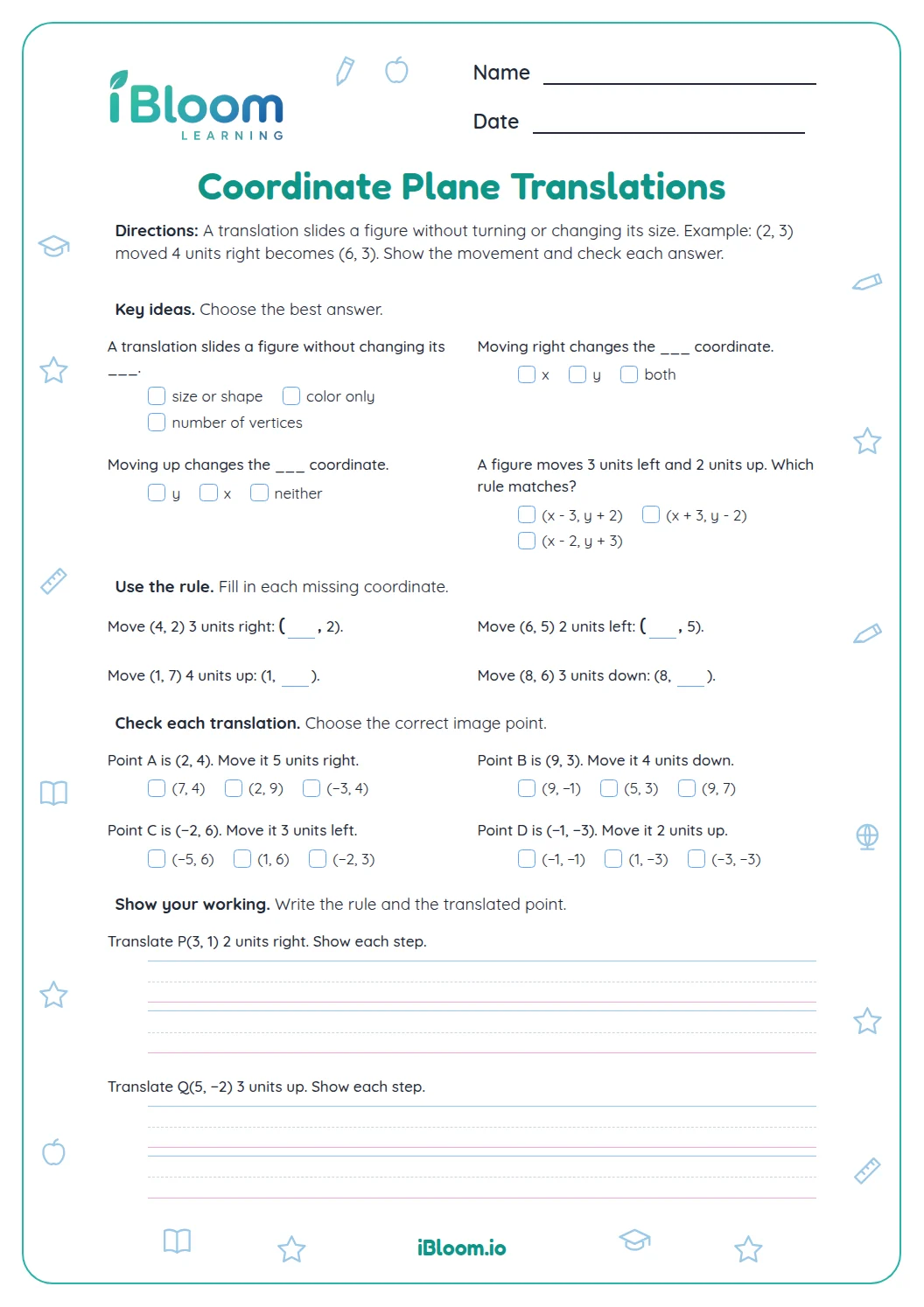
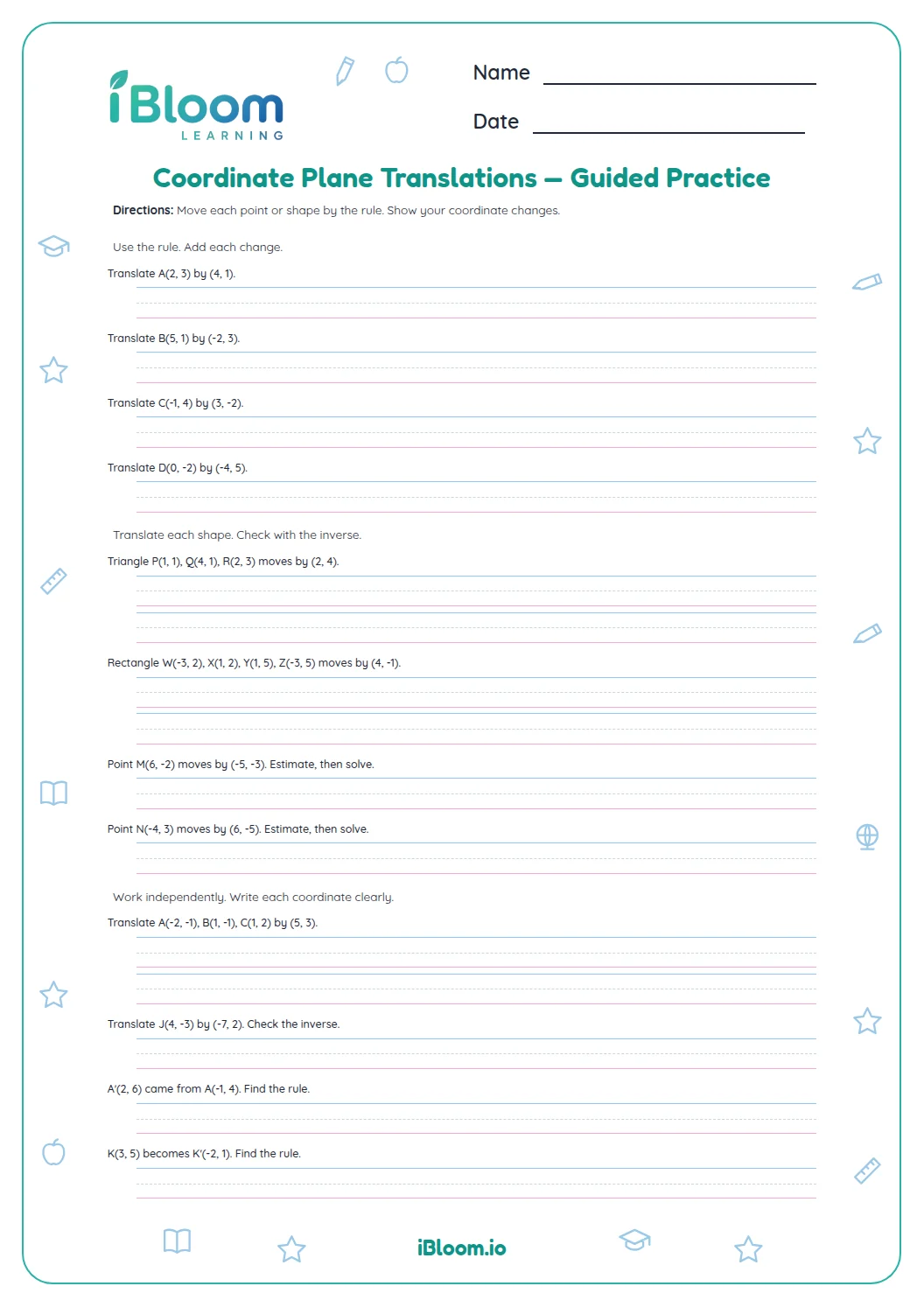
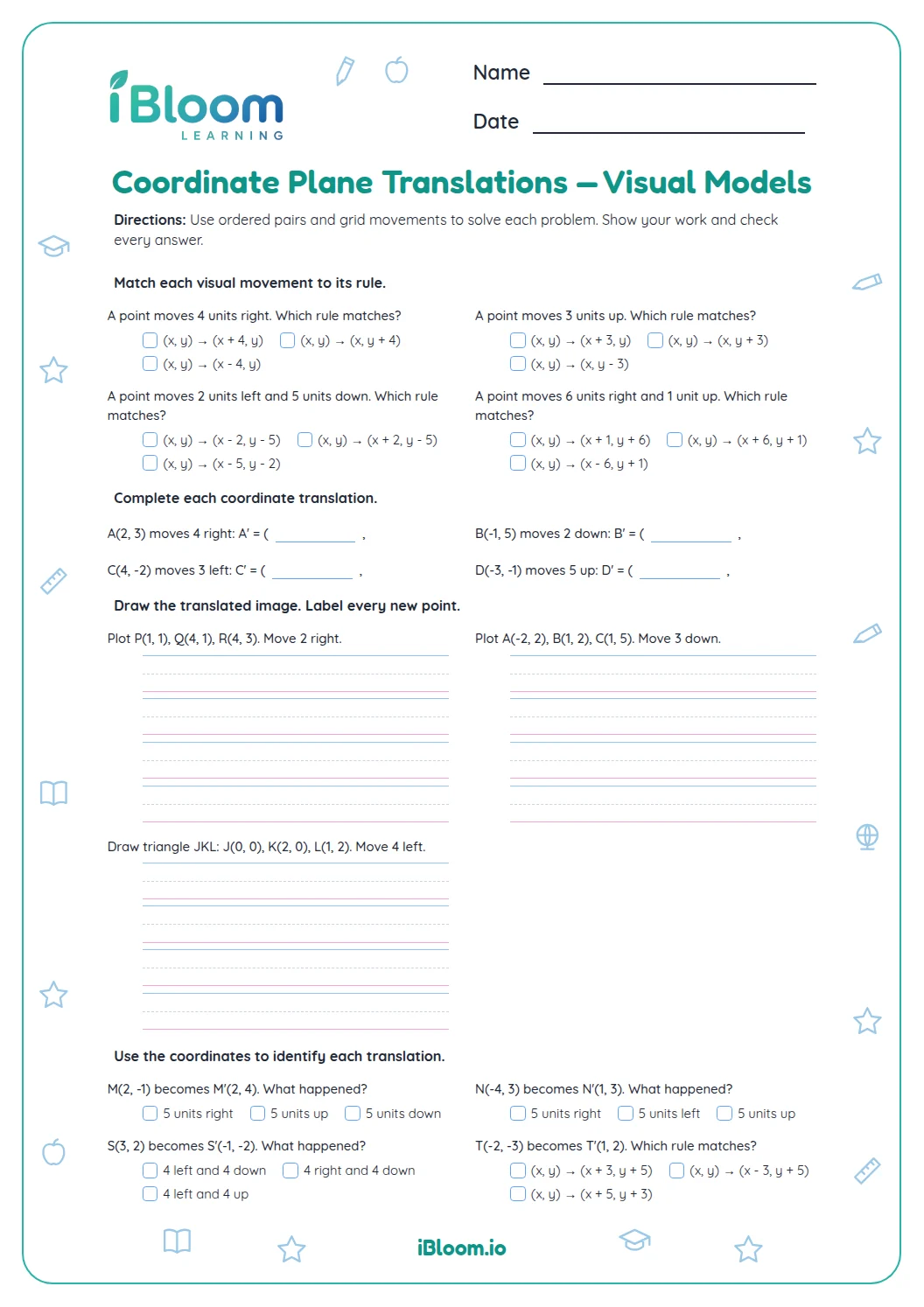
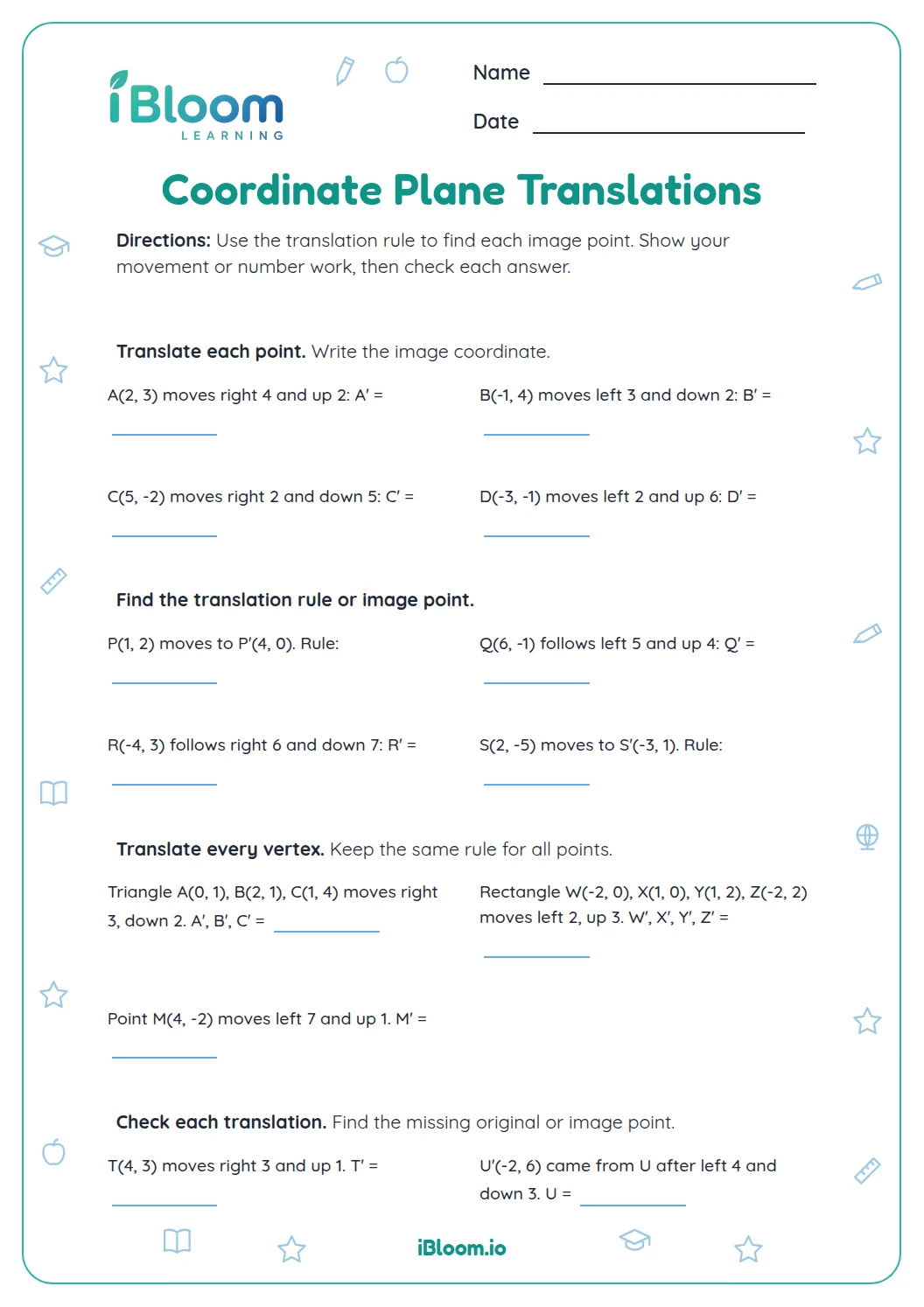
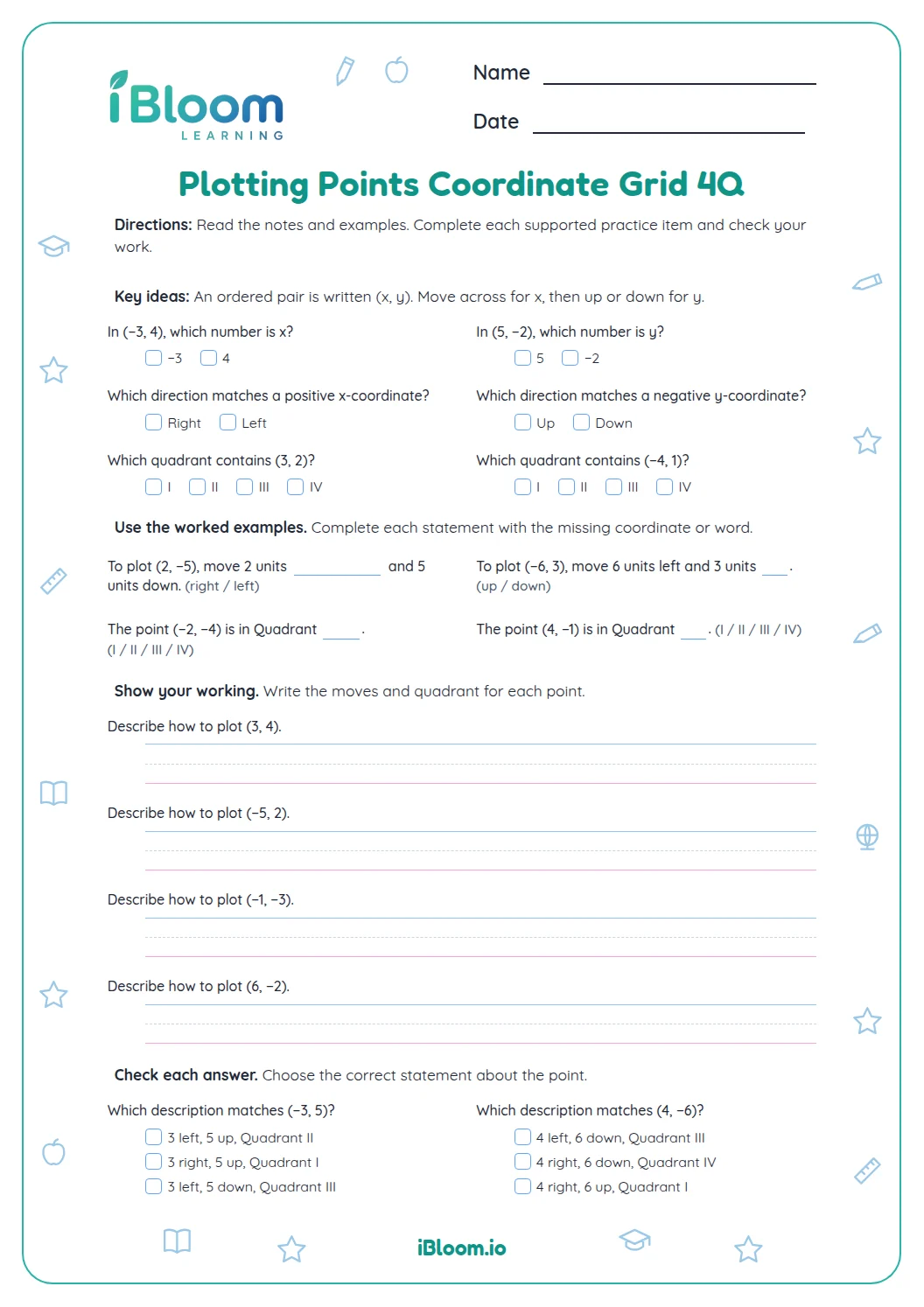
This Grade 5 geometry worksheet gives students 14 opportunities to translate points in the first quadrant and describe how coordinates change. They move points right, left, up, and down; find new ordered pairs; reverse a translation; and interpret map and location situations. The answer key shows the resulting coordinates and brief movement explanations. The tasks practice Common Core 5.G.A.2 by graphing ordered pairs and interpreting them in real-world contexts.
Aligned to 5.G.A.2
How does a one-direction move change a point?
An ordered pair is written (x, y). Right and left moves change x; up and down moves change y. For question 1, moving A(2, 1) three units right gives A′(5, 1).
- 1Start at (2, 1). Add 3 to x and keep y at 1.
- 2The new point is (5, 1).
How do you translate a point in two directions?
Apply each move to its matching coordinate. In question 5, the park at (2, 3) moves 2 right and 1 up: x becomes 4 and y becomes 4, so the new point is (4, 4).
How do coordinates describe a place on a map?
A library, park, or robot can be treated as a point on a grid. Translate the ordered pair using the stated direction, then check that the new location stays consistent with the story.
How to use this worksheet
- 1Read the starting point as (x, y), in that order.
- 2Decide whether the move is horizontal, vertical, or both.
- 3Add for right and up; subtract for left and down.
- 4Keep the coordinate that does not move unchanged.
- 5Check that the new point matches the context and direction.
Common mistakes and quick fixes
The mistake
Changing y for a move to the right.
The fix
Right and left are horizontal, so update x and keep y fixed.
The mistake
Adding for a move down.
The fix
Down decreases y; up increases y.
The mistake
Reversing the order in an ordered pair.
The fix
Write x first and y second every time: (x, y).
Curriculum alignment
This worksheet practices 5.G.A.2 through its question set.
Graph and interpret ordered pairs by translating points in map and location contexts.
On this sheet: The questions directly practice the named skill through identification, application, and explanation.
Show the official wordingHide the official wording
Represent real world and mathematical problems by graphing points in the first quadrant of the coordinate plane, and interpret coordinate values of points in the context of the situation.
What to practice next
Make more practice
Further reading
Questions parents and teachers ask
Which coordinate changes when a point moves right or left?
The x-coordinate changes during a horizontal move. Moving right increases x, and moving left decreases x; the y-coordinate stays the same. Have students point to the clue in the question or passage and explain how it supports the choice they made.
Which coordinate changes when a point moves up or down?
The y-coordinate changes during a vertical move. Moving up increases y, and moving down decreases y; the x-coordinate stays the same. Have students point to the clue in the question or passage and explain how it supports the choice they made.
How many problems are on the worksheet?
There are 14 problems in four parts. Students find translated coordinates, identify a move from two points, and use the same reasoning in map and location situations. Have students point to the clue in the question or passage and explain how it supports the choice they made.
What does the answer key show?
The key gives the new coordinate or the direction and distance of each translation. For example, moving A(2, 1) three units right changes x from 2 to 5 and keeps y at 1. Have students point to the clue in the question or passage and explain how it supports the choice they made.
Which coordinate standard does this practice connect to?
The worksheet connects to CCSS 5.G.A.2: graphing ordered pairs and interpreting coordinate values in real-world and mathematical situations. Have students point to the clue in the question or passage and explain how it supports the choice they made.