




About this worksheet
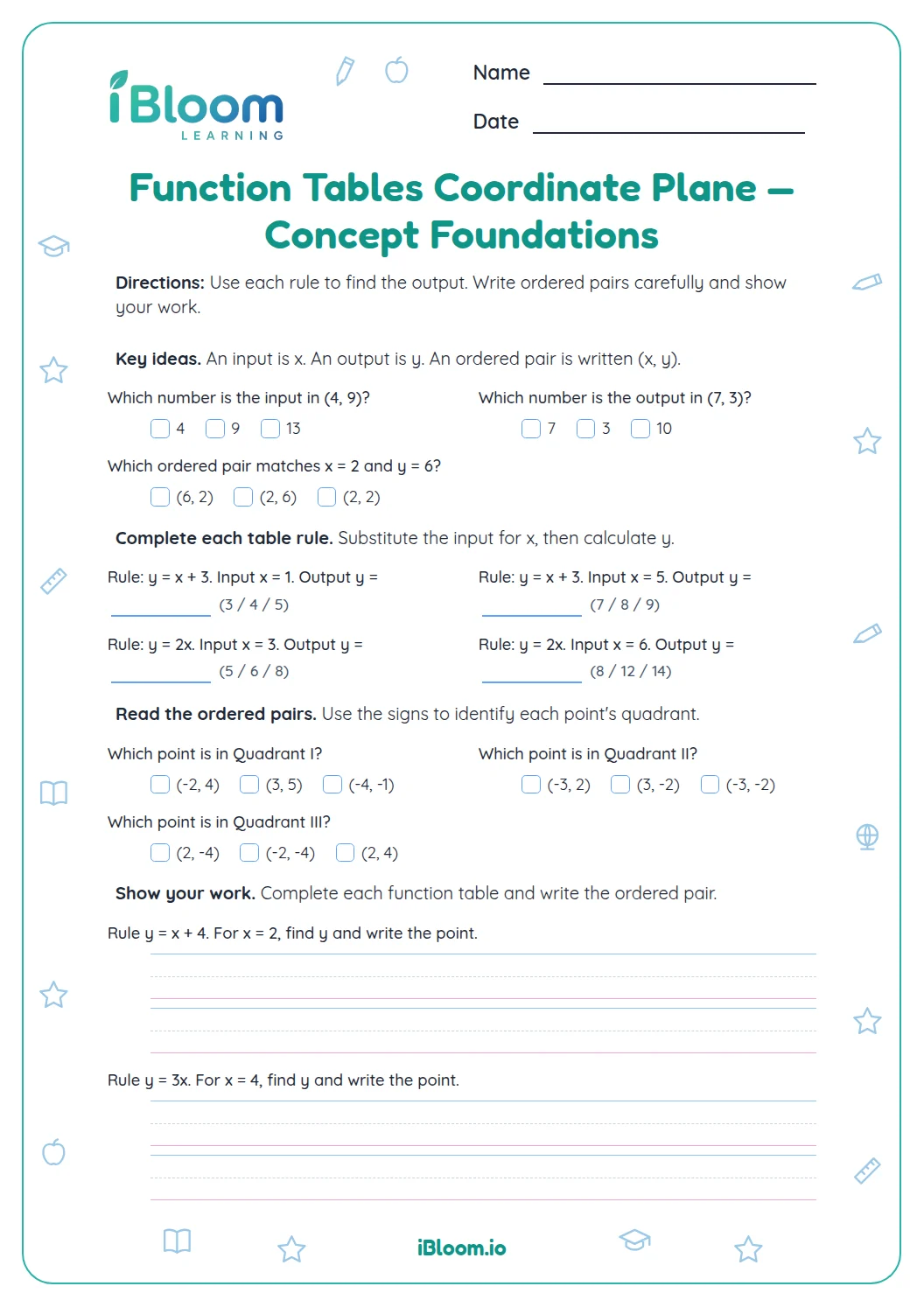
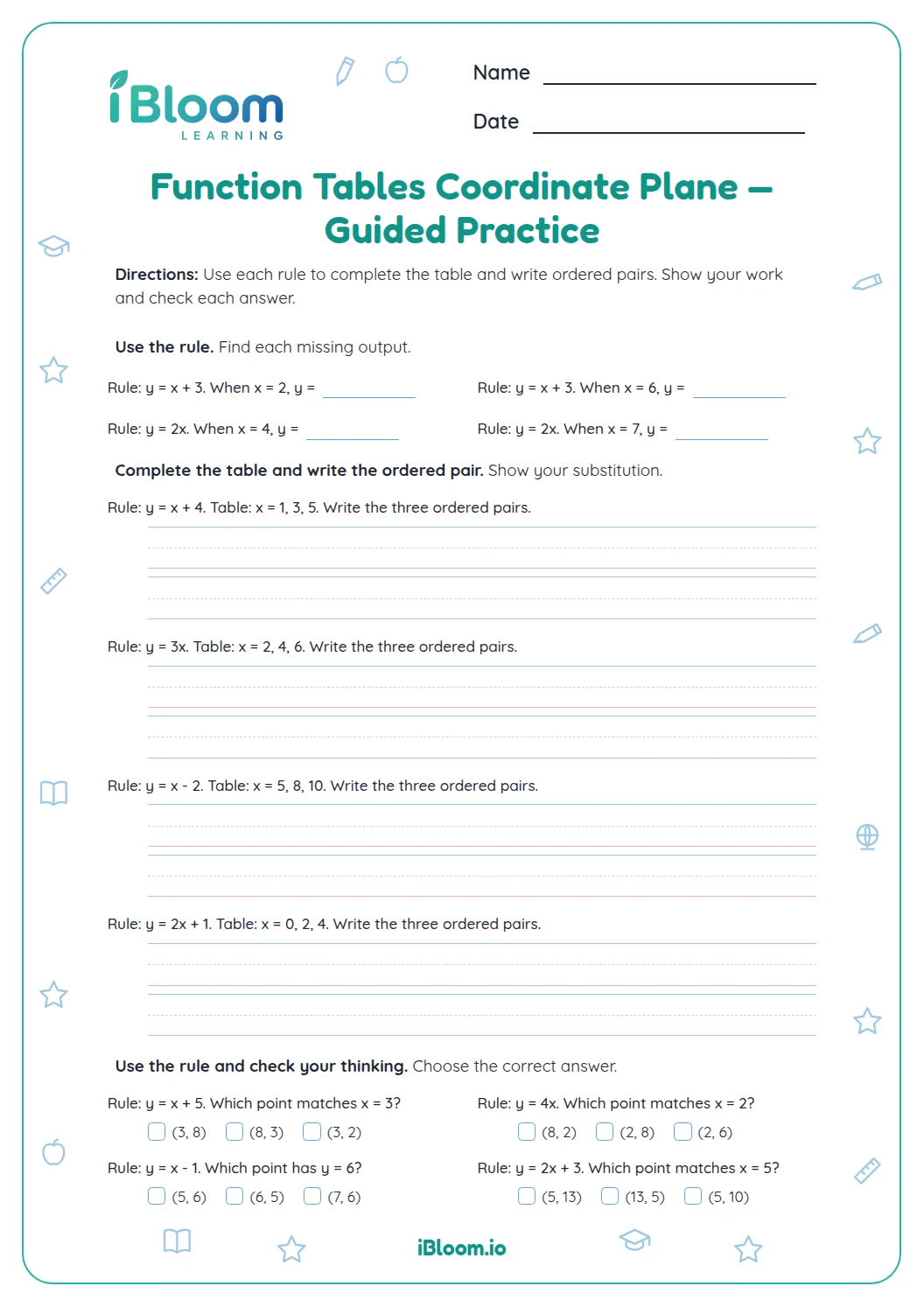
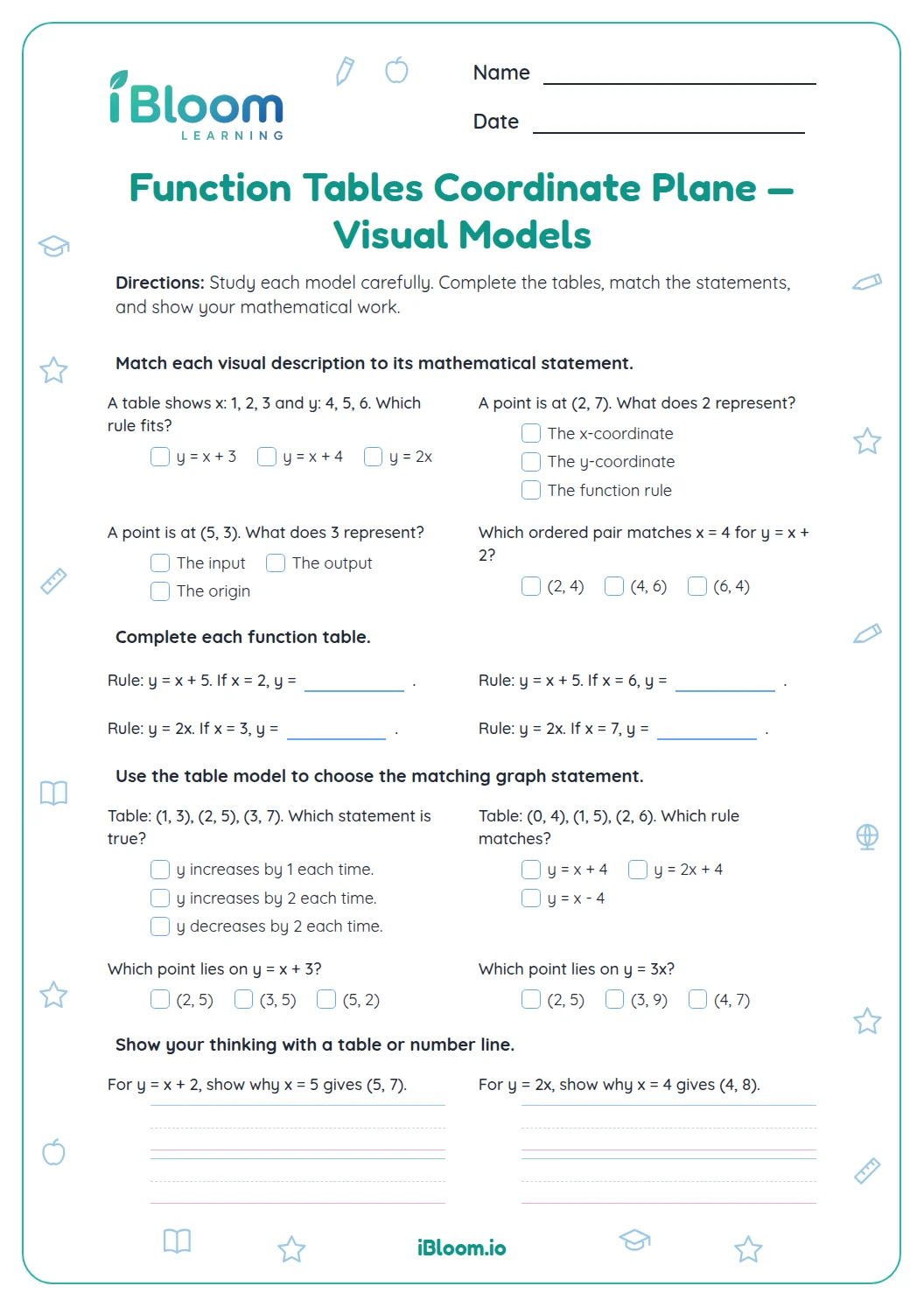
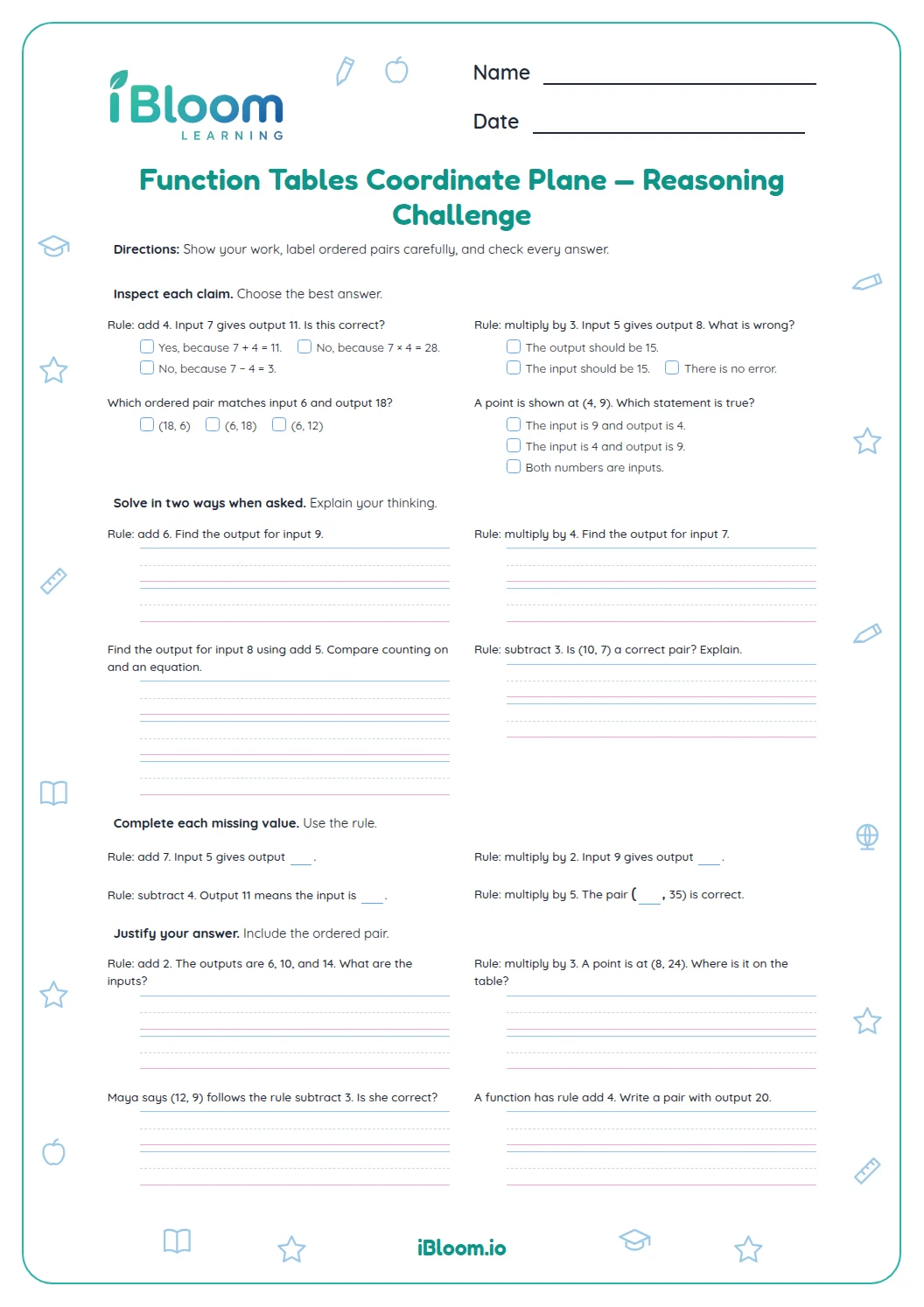
This free Grade 5 worksheet connects input-output rules and everyday situations with coordinate reading. Students complete two small tables, find outputs from three more rules, solve two cost problems, and read seven points or ordered pairs. The coordinate questions practice CCSS 5.G.A.1. A separate answer key lists the outputs and coordinates.
Aligned to 5.G.A.1
How do you find an output from a rule?
Replace x with the input value, then calculate y. In question 1, when x = 2, y = 3 × 2 + 2, so the missing output is 8.
- 1Rule: y = 3x + 2
- 2Input 2: y = 3 × 2 + 2 = 8
- 3Ordered pair: (2, 8)
How can a rule model a real situation?
A starting fee plus a cost for each item can be written as y = rate × number + starting amount. For the craft booth, four kits at $2 each plus $3 costs $11.
How do you read a coordinate pair?
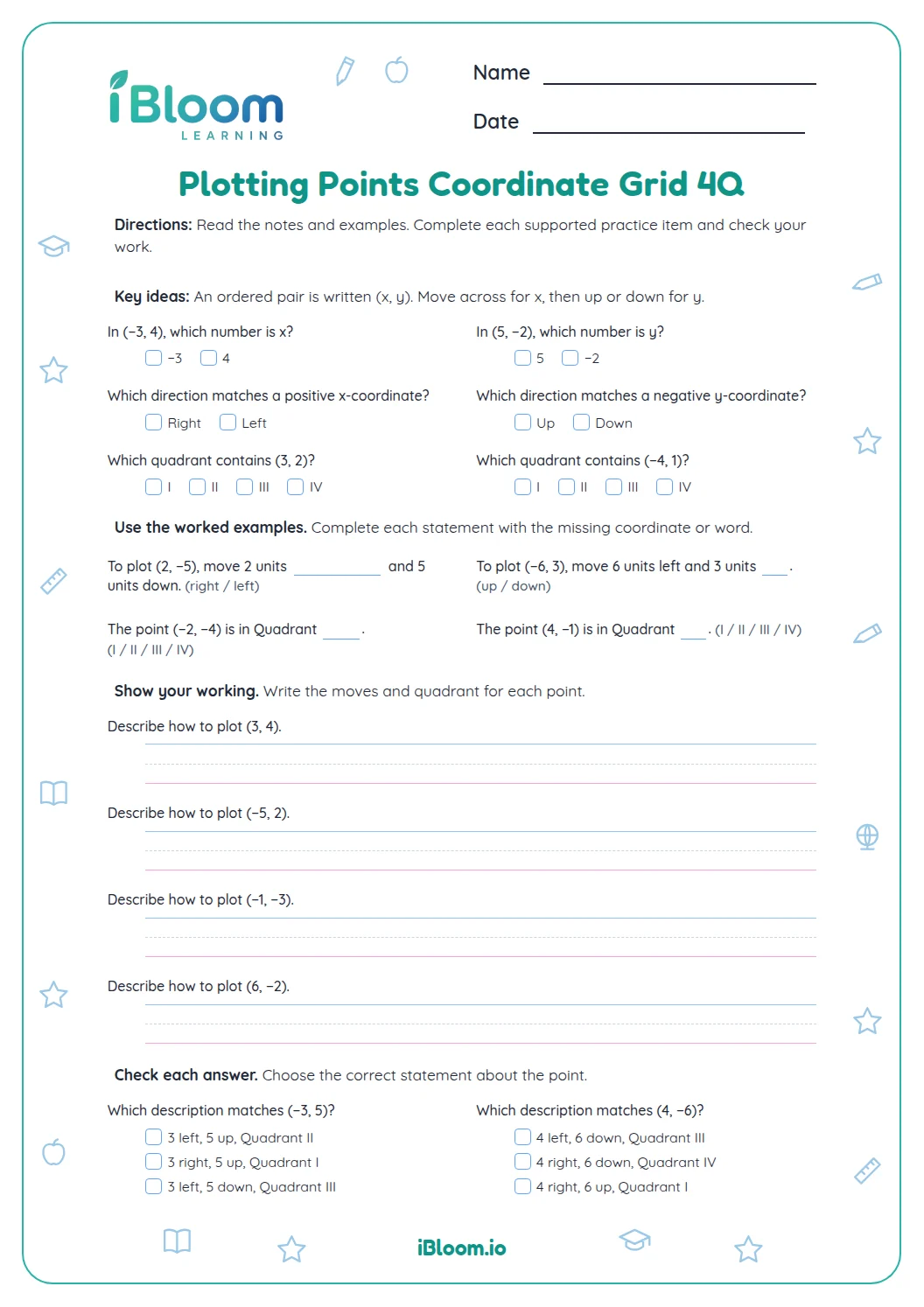
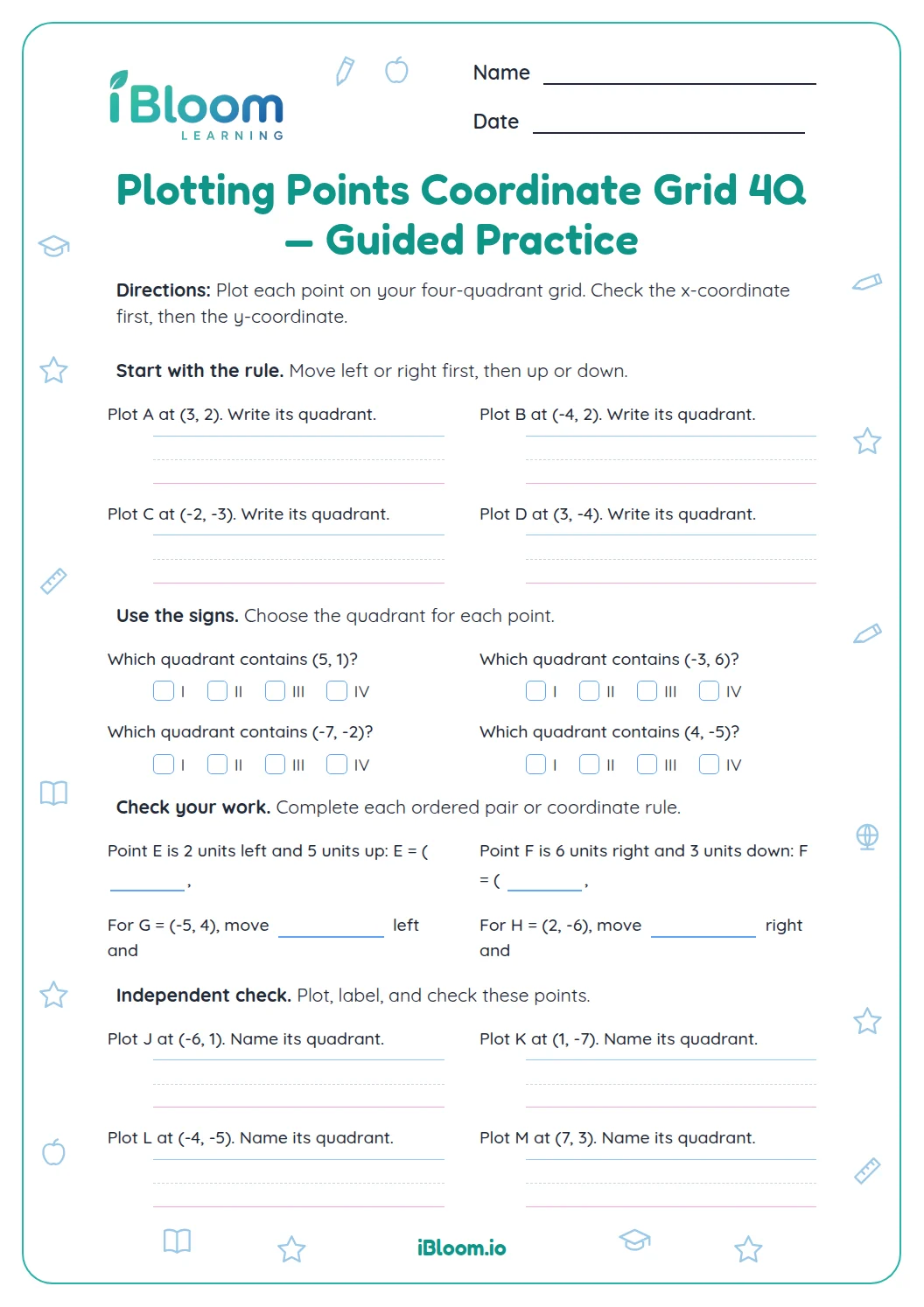
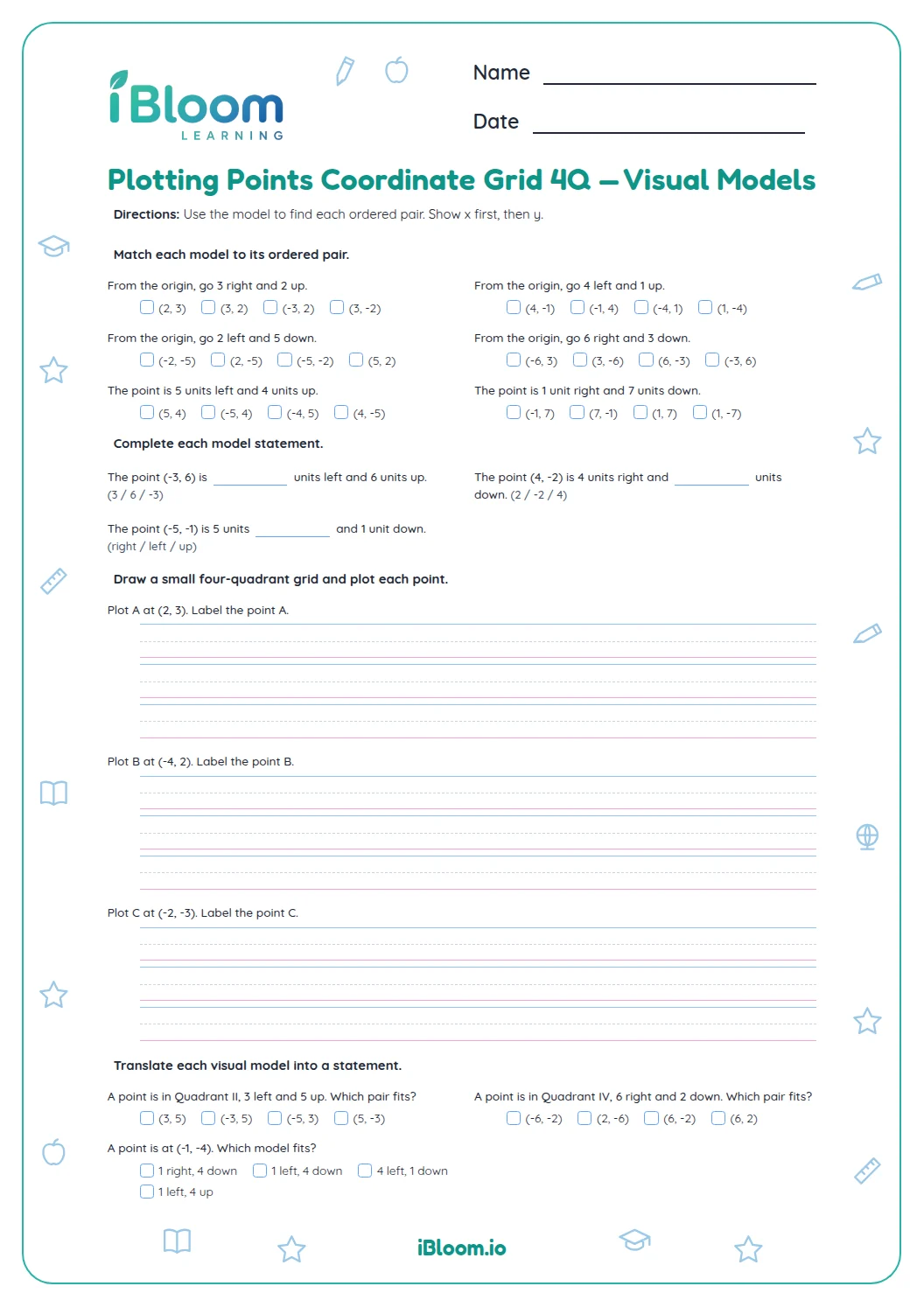
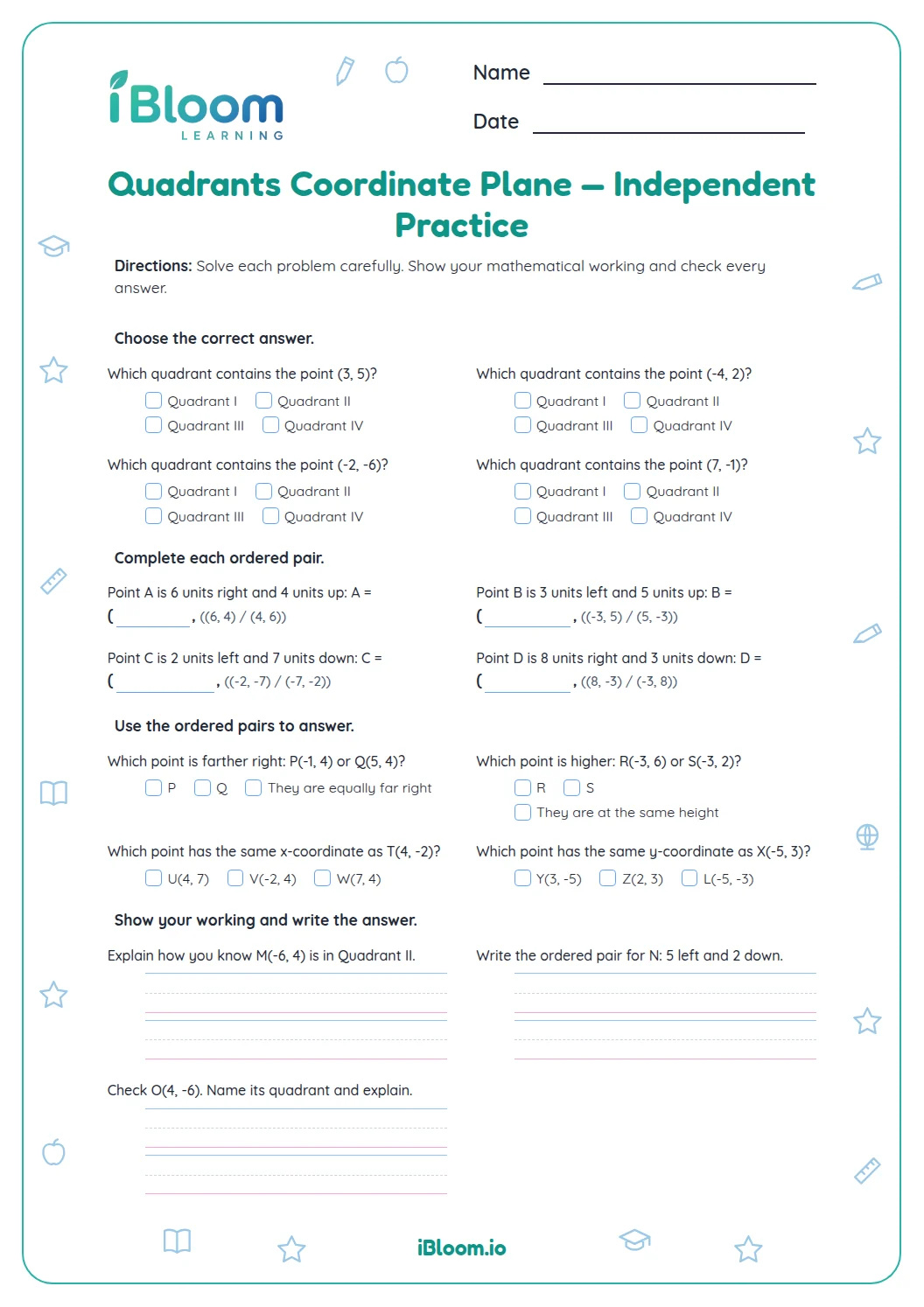
Read horizontally from the origin to find x, then vertically to find y. The point labeled A in question 11 is (2, 5): move 2 units right and 5 units up.
How to use this worksheet
- 1Read the rule and identify the input value.
- 2Substitute the input for x, then calculate the output y.
- 3In a story, identify a starting amount and the amount added per item, hour, or day.
- 4Write money answers with a dollar sign and count answers with their units.
- 5To read a point, move across for x first and then up for y.
- 6Check a table output by substituting the input into the rule again.
Common mistakes and quick fixes
The mistake
Reversing x and y in an ordered pair.
The fix
Read across first for x, then up for y.
The mistake
Forgetting the starting fee in a cost rule.
The fix
Add the fixed amount after multiplying the rate by the input.
The mistake
Multiplying when the rule also includes addition or subtraction.
The fix
Substitute the input and follow the rule in order, including its constant.
Common Core alignment
Students read and interpret points in the first quadrant of a coordinate plane.
Interpret ordered pairs using the horizontal and vertical axes.
On this sheet: The grids ask students to read x and y values and interpret a real-world coordinate.
Show the official wordingHide the official wording
Use a pair of perpendicular number lines, called axes, to define a coordinate system, with the intersection of the lines (the origin) arranged to coincide with the 0 on each line and a given point in the plane located by using an ordered pair of numbers, called its coordinates. Understand that the first number indicates how far to travel from the origin in the direction of one axis, and the second number indicates how far to travel in the direction of the second axis, with the convention that the names of the two axes and the coordinates correspond (e.g., x-axis and x-coordinate, y-axis and y-coordinate).
What to practice next
Make more practice
Further reading
Questions parents and teachers ask
What does a function rule do?
The first section gives a rule and table with one missing output. Students substitute the input for x, calculate y, and check the result against the rule. For question 1, x = 2 gives y = 8. The same substitution method works for each rule.
How many tables are included?
Two small input-output tables are included, each with a rule and a missing output. Three additional rule questions and two cost stories give more practice finding outputs. The coordinate section has seven questions with plotted points or ordered pairs.
How do the story problems use rules?
A fixed starting fee stays the same while the per-item or per-mile charge changes with the input. Multiply the rate by the quantity, then add the starting amount. Four kits at $2 each plus $3 costs $11. For example, $3 + ($2 × 4) = $11.
How do I read an ordered pair?
The first number is x, or the horizontal distance from the origin. The second number is y, or the vertical distance. For (4, 7), move right 4 and up 7. For (4, 7), the first number means four units across from the origin, and the second means seven units up. Coordinate grids on the worksheet use first-quadrant points.
Does the worksheet include an answer key?
Yes. A separate answer key provides each missing table output, each real-world result, and the coordinates read from the grid. The answer key lists each missing output, each story result, and the coordinate information. Students can recheck a table by substituting its input into the rule a second time.