




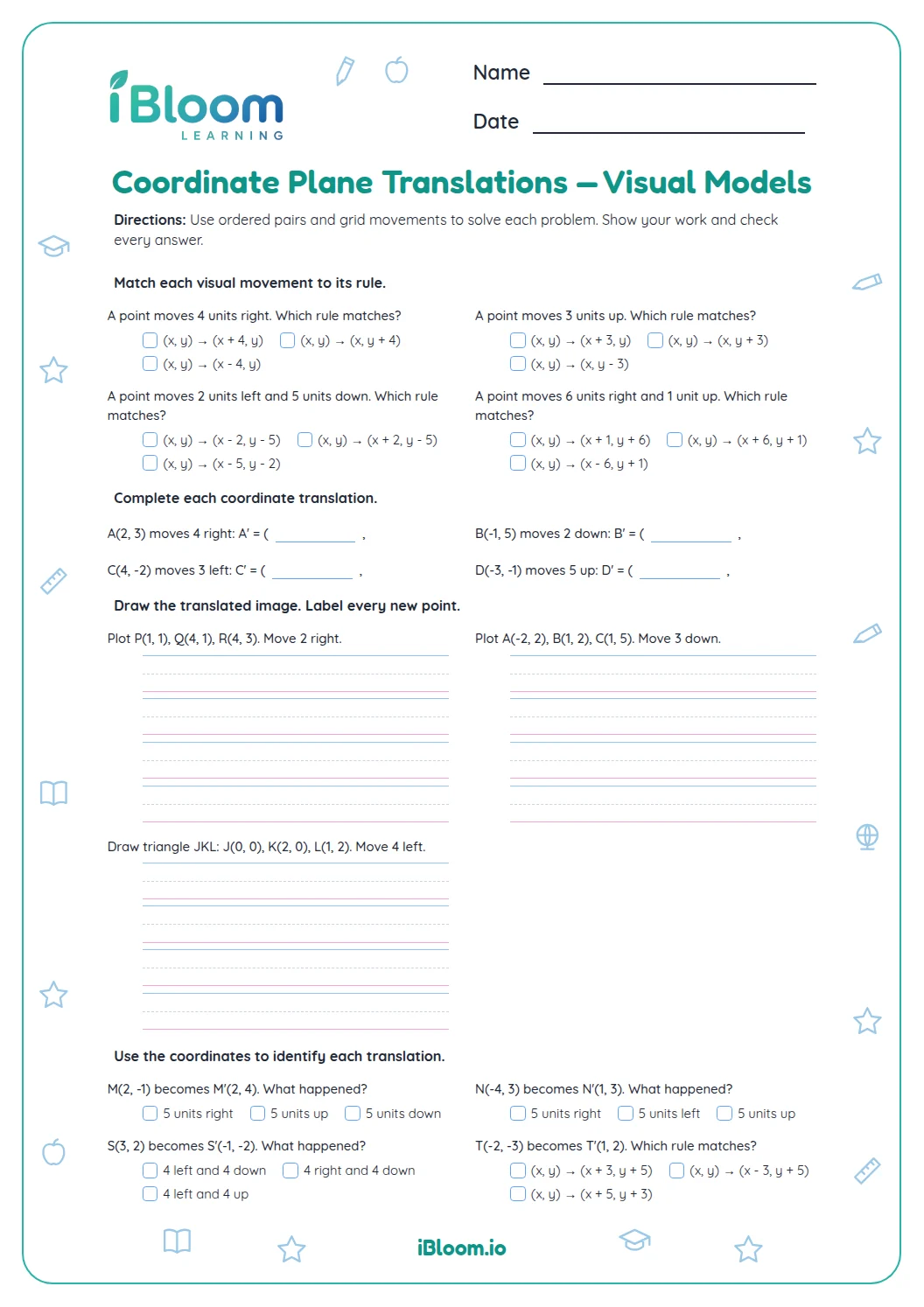
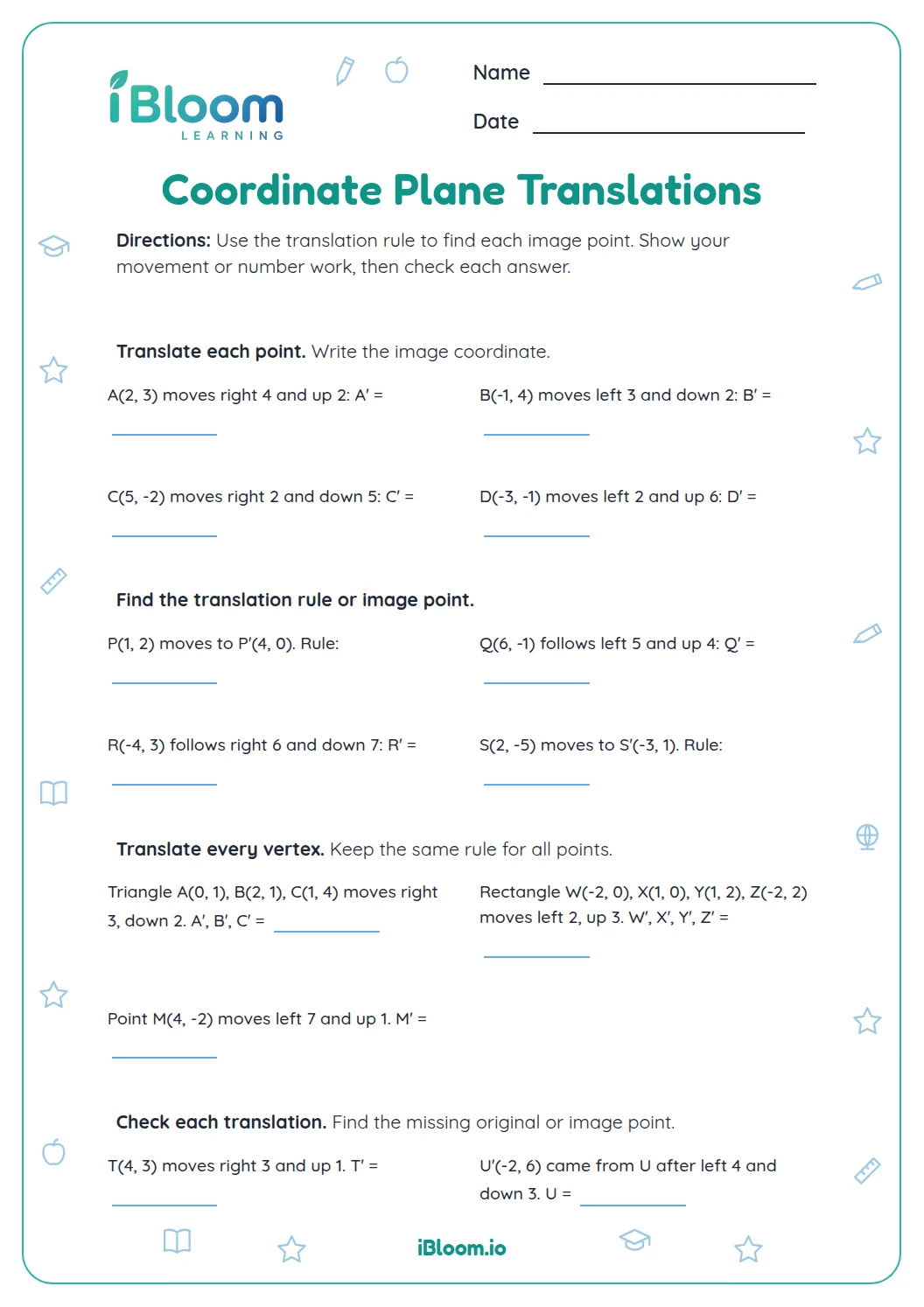
About this worksheet
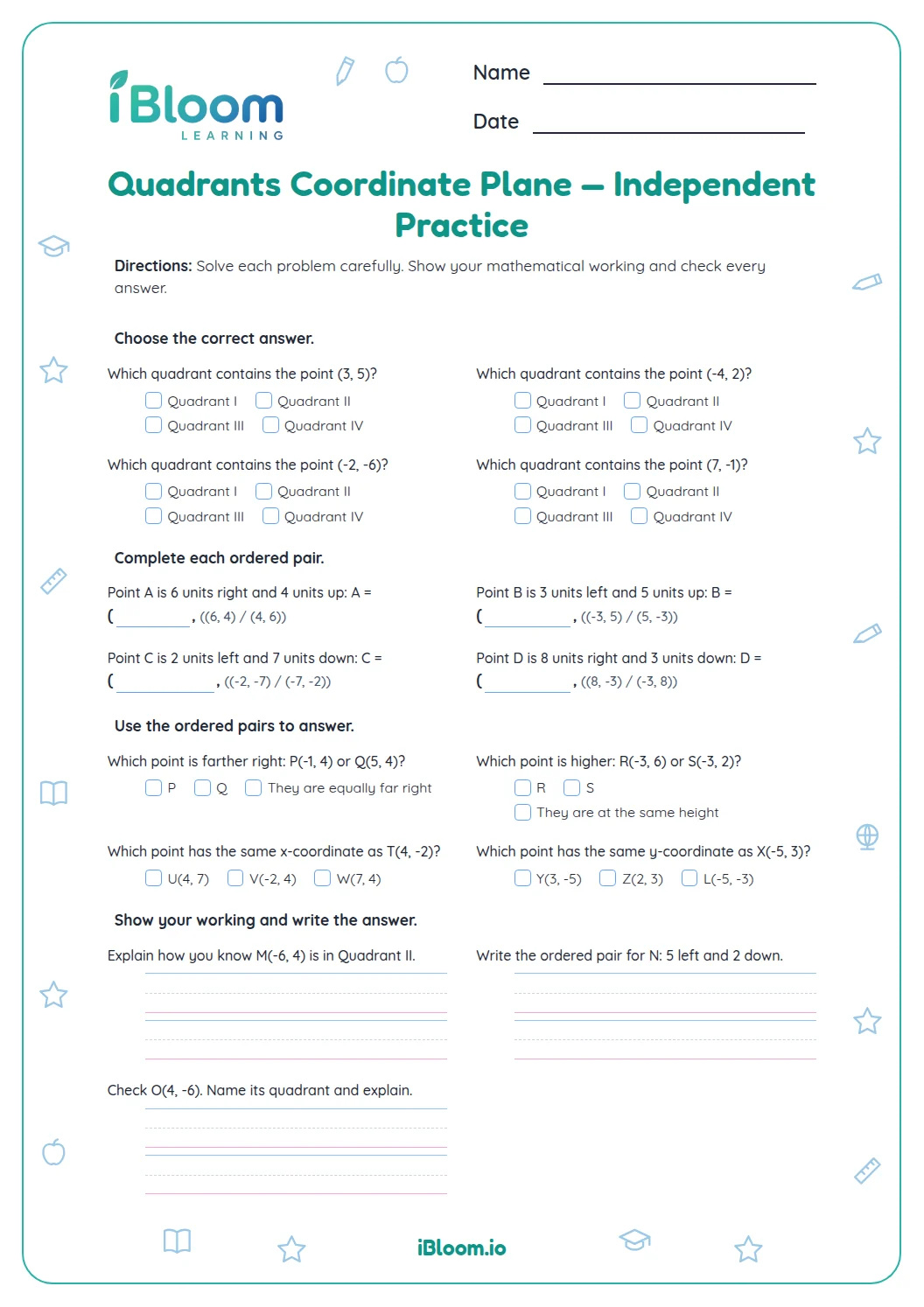
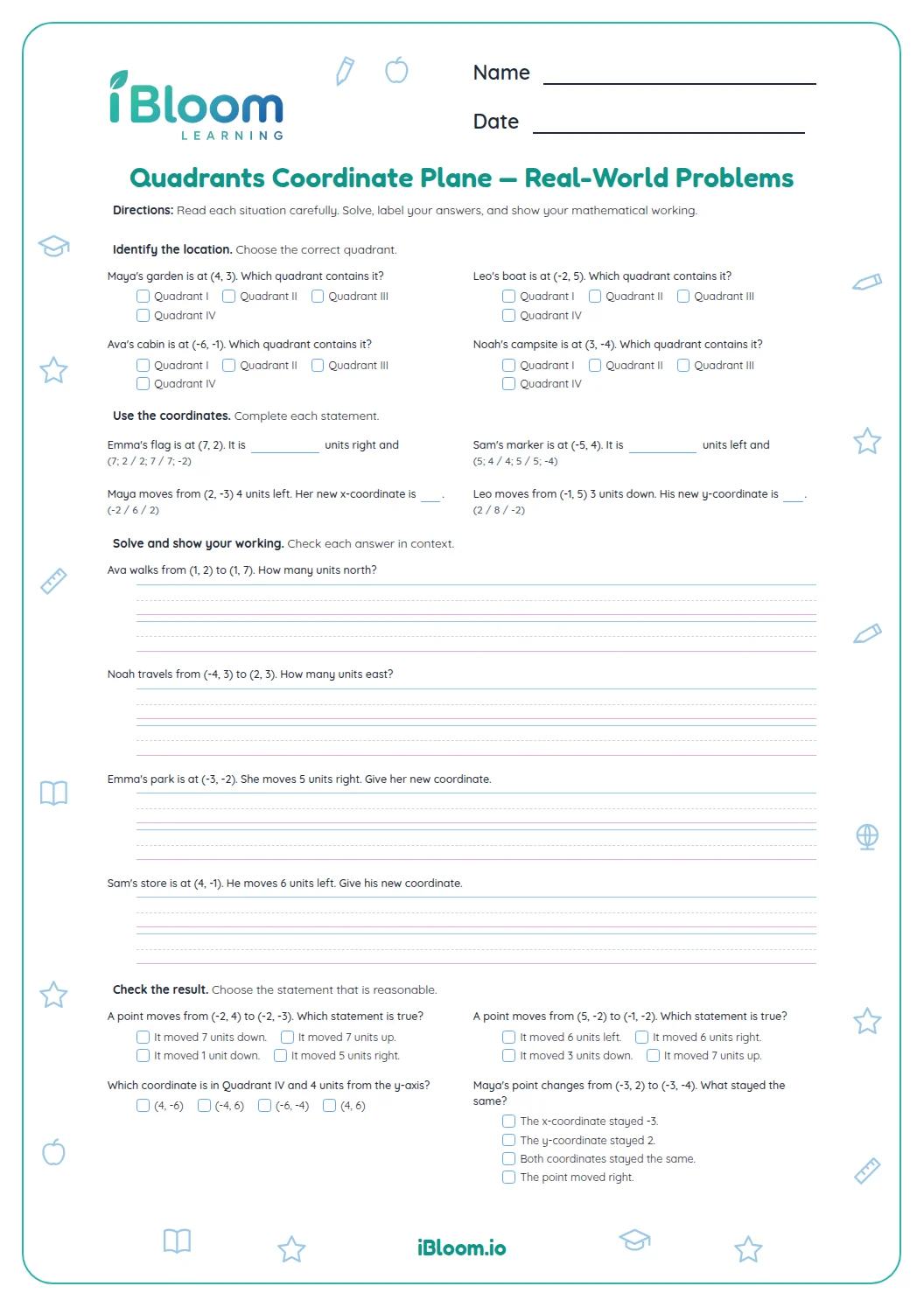
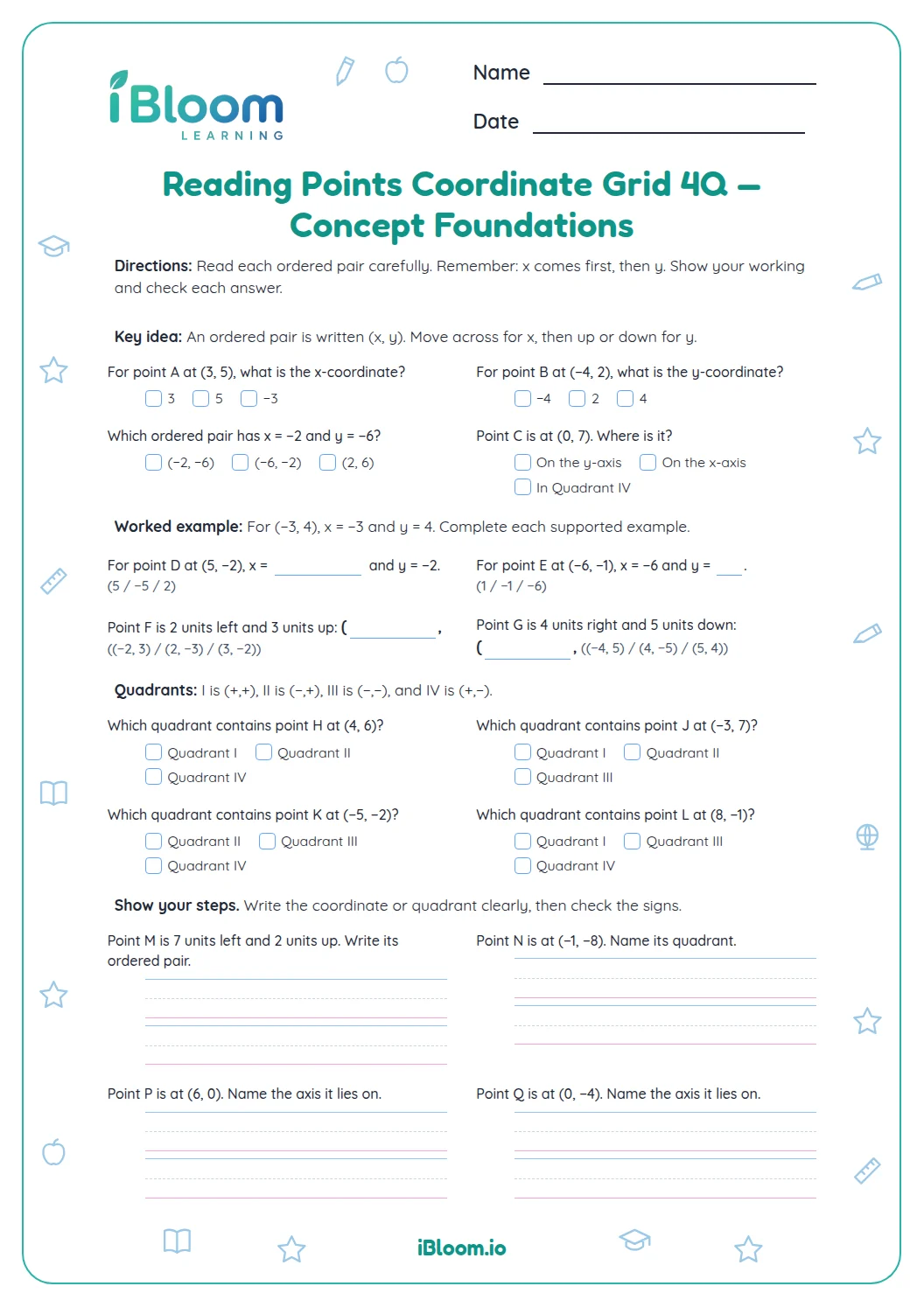
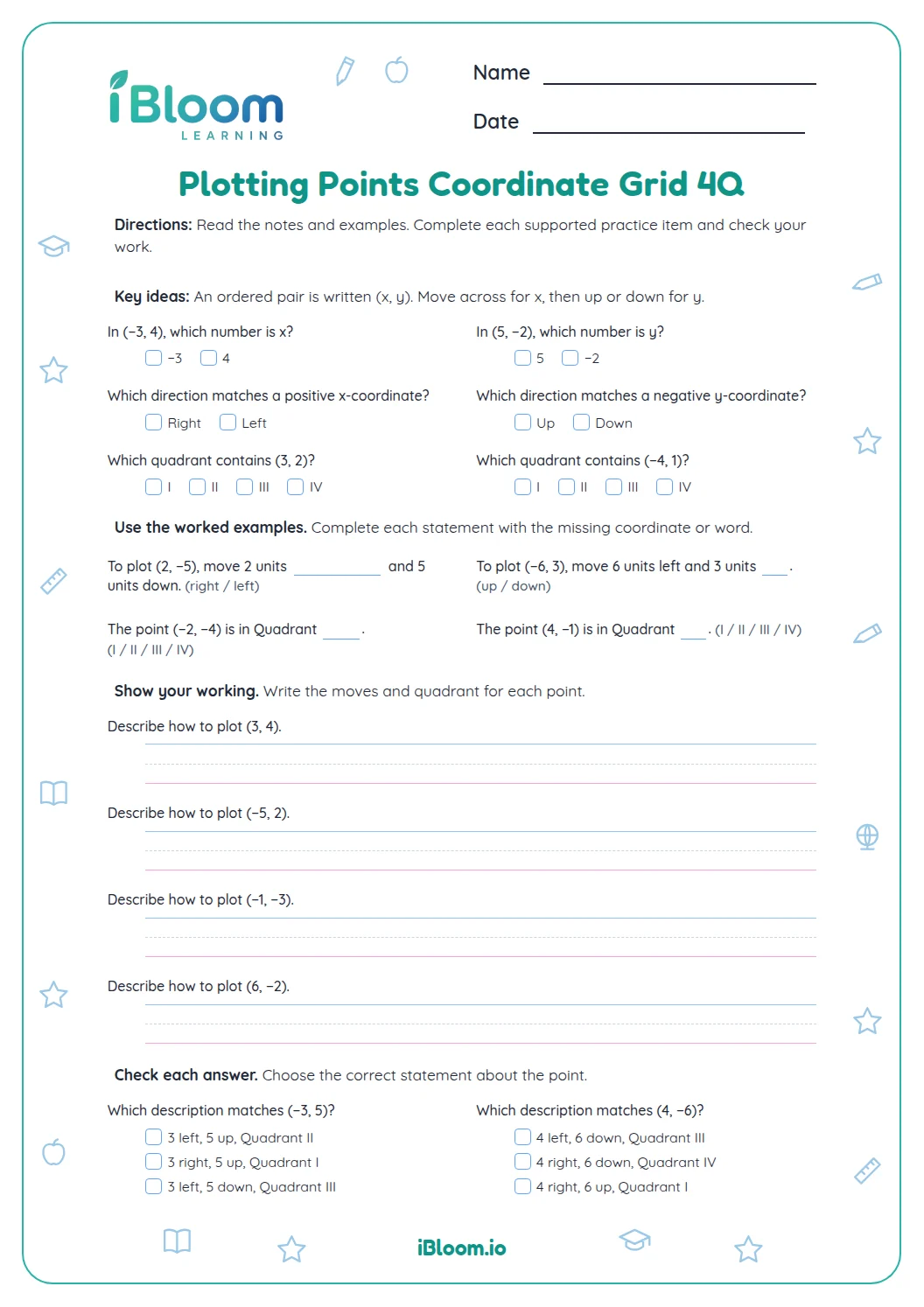
This free printable Grade 5 worksheet asks students to reason about coordinate pairs. Eight multiple-choice questions check claims and strategies about quadrants, direction, axes, and reflections; four short completions apply the sign rules; two written responses explain a location and a reflection. Students use the order (x, y), connect positive and negative values with direction, and check whether zero places a point on an axis. The work practices Common Core 6.NS.C.6b, interpreting signs in ordered pairs and relating sign changes to reflections. A separate answer key gives every answer and sample explanations.
Aligned to 6.NS.C.6b
How do students check a quadrant claim?
Ask which direction each coordinate describes. The first number, x, gives left or right; the second, y, gives down or up. A negative x and a positive y put a point in the upper-left region, Quadrant II. Both signs matter.
Part A includes plausible mix-ups: reversing x and y, confusing Quadrants II and IV, and placing a point on the wrong axis. Read the claim, decide the correction, and then check the choices. Two strategy questions ask students to check both signs and choose the sign of a missing coordinate.
- 1Question 1: Maya puts (−4, 2) in Quadrant IV.
- 2x = −4 means left; y = 2 means up.
- 3The correction is Quadrant II.
What changes when one coordinate is zero?
Zero means no movement in that direction. For (−5, 0), move left five units and make no vertical move: the point lies on the x-axis. For (0, 6), make no horizontal move and go up six units: the point lies on the y-axis.
Part B asks students to name these axes and identify two quadrants. At (0, 0), both moves are zero; that point is the origin where the axes meet.
How can a student explain a reflection?
Reflecting across the x-axis preserves x and changes the sign of y. In question 14, (2, −1) becomes (2, 1). The two points are equally far below and above the x-axis.
Part C also asks for an example in Quadrant II. Accept any ordered pair with a negative x-coordinate and a positive y-coordinate, together with an explanation of both signs. The key gives one sample.
How to use this worksheet
- 1Review the four sign pairs before starting Part A.
- 2For each claim, read the x-coordinate aloud before the y-coordinate.
- 3In Part B, check for zero before naming a quadrant.
- 4Have the student write both a coordinate pair and a reason in Part C.
- 5Compare the explanations with the key, accepting equivalent reasoning.
Mistakes to check together
The mistake
Calling (−4, 2) Quadrant IV.
The fix
Read the signs in order: negative x means left, positive y means up, so the quadrant is II.
The mistake
Putting (−5, 0) on the y-axis because y is zero.
The fix
Zero y means no vertical move; the point stays on the horizontal x-axis.
The mistake
Changing x when reflecting across the x-axis.
The fix
Keep the horizontal position; change the vertical coordinate from −1 to 1.
Common Core alignment
Use coordinate signs to identify quadrants and explain reflections.
On this sheet: Students check quadrant claims and explain which coordinate changes sign in a reflection.
Show the official wordingHide the official wording
Understand signs of numbers in ordered pairs as indicating locations in quadrants of the coordinate plane; recognize that when two ordered pairs differ only by signs, the locations of the points are related by reflections across one or both axes.
What to practice next
Make more practice
Further reading
Questions parents and teachers ask
Does my child need to plot every point?
No; the questions ask students to reason from coordinate pairs and signs. Start by reading x and y in order, then connect each sign with a direction. For question 1, negative x means left and positive y means up, which identifies Quadrant II.
What do the Roman numerals mean?
I, II, III, and IV name the four quadrants. Starting in the upper-right region and moving counterclockwise gives I, II, III, IV. Pair those names with the signs: positive-positive, negative-positive, negative-negative, and positive-negative. Part B asks students to use these names for two coordinate pairs.
Why is a point on an axis different?
An axis is a boundary between quadrants, so a point on an axis has no quadrant number. In question 10, (−5, 0) lies on the x-axis because its vertical coordinate is zero. Question 11 reverses the situation: (0, 6) lies on the y-axis.
Can the explanation in question 13 differ from the key?
Yes; any pair with negative x and positive y can work. For example, (−3, 4) and (−8, 1) are both in Quadrant II. The student should explain both signs, so check the coordinate pair and the reason together instead of requiring the sample numbers.
What should the reflection explanation include?
It should state the new pair, (2, 1), and explain that x stays the same while y changes sign. The original point is one unit below the x-axis; its reflection is one unit above. The answer key includes a short model explanation for checking this reasoning.