



About this worksheet
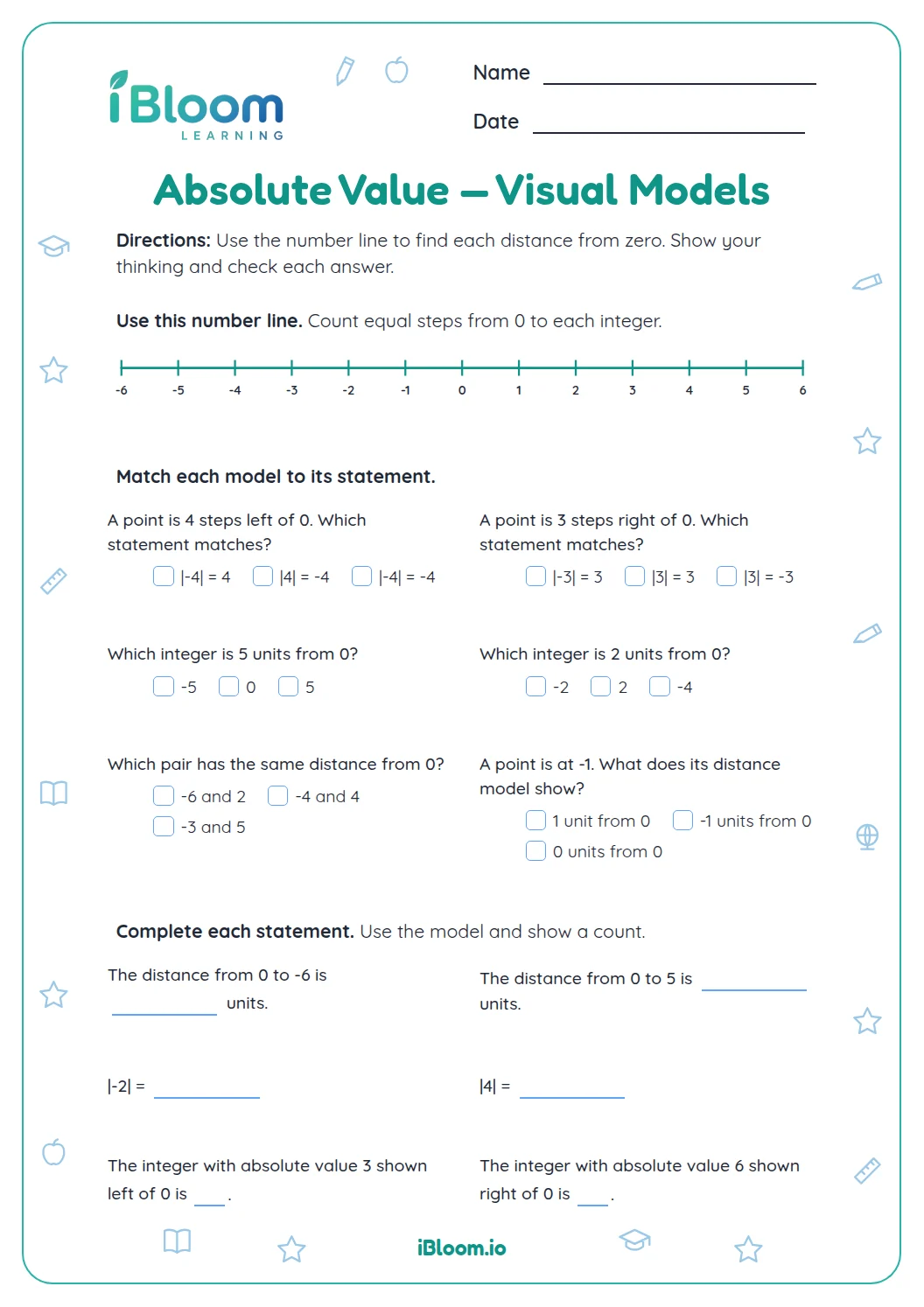
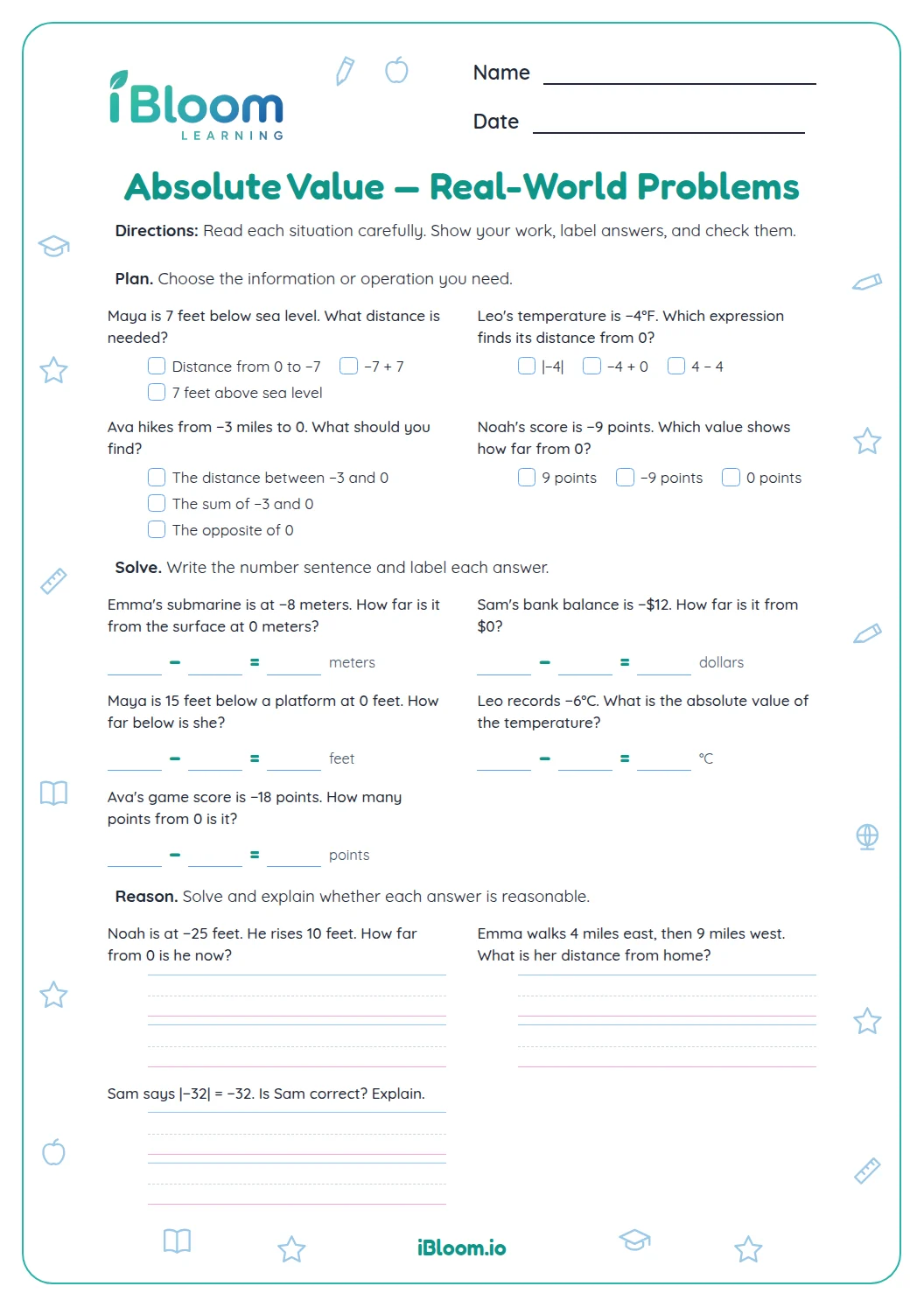
This printable Grade 5 math worksheet practices absolute value and distance from zero. Students evaluate absolute values, compare distances from zero, and interpret integer locations in short contexts. It includes 16 questions: absolute values, comparisons, integers, and contexts and a separate answer key.
Aligned to 6.NS.C.7.c
How do I work with absolute value and distance from zero?
Students evaluate absolute values, compare distances from zero, and interpret integer locations in short contexts.
Absolute value measures distance from zero.
- 1|−7| = ___
- 2Distance from 0 is 7 units.
- 3So |−7| = 7.
What practice is included?
16 questions: absolute values, comparisons, integers, and contexts. The questions move from direct practice to applying the same idea.
How to use this worksheet
- 1Read the integer inside the bars.
- 2Find its distance from zero.
- 3Remember that distance is not negative.
- 4For comparisons, compare the distances.
- 5Use the context to name what the distance measures.
Common mistakes and quick fixes
The mistake
Keeping the negative sign in an absolute value.
The fix
Absolute value is a distance, so write a nonnegative result.
The mistake
Comparing integers instead of their absolute values.
The fix
Find each distance from zero before deciding which is greater.
The mistake
Giving only one value when |n| = 6.
The fix
Both −6 and 6 are six units from zero.
Common Core alignment
This worksheet practices the standard named below through its questions.
Interpret absolute value as distance from zero and magnitude in context.
On this sheet: Students evaluate absolute values, compare distances, and interpret magnitude in signed contexts.
Show the official wordingHide the official wording
Understand the absolute value of a rational number as its distance from 0 on the number line; interpret absolute value as magnitude for a positive or negative quantity in a real-world situation.
What to practice next
Make more practice
Further reading
Questions parents and teachers ask
How many questions are included?
The worksheet has 16 questions. Students evaluate absolute values, compare distances from zero, name integers on either side of zero, and interpret short contexts. The answer key is separate. Encourage the learner to sketch a number line when comparing an integer with zero. Invite learners to show how each answer connects to distance on a number line.
What does absolute value mean here?
Absolute value is distance from zero on the number line. Since distance cannot be negative, |−7| = 7 and |5| = 5. Encourage the learner to sketch a number line when comparing an integer with zero. A quick number-line sketch can help make the distance visible.
How do students compare −6 and 4 by absolute value?
Find each distance from zero: |−6| = 6 and |4| = 4. So −6 is farther from zero. Encourage the learner to sketch a number line when comparing an integer with zero. A quick number-line sketch can help make the distance visible.
Can an absolute value equation have two answers?
Yes. If |n| = 6, then n can be −6 or 6 because both integers are six units from zero. Encourage the learner to sketch a number line when comparing an integer with zero. A quick number-line sketch can help make the distance visible.
What do the context questions practice?
They connect signed integers with distance from a reference point. For example, a diver at −11 meters is 11 meters from sea level. Encourage the learner to sketch a number line when comparing an integer with zero. A quick number-line sketch can help make the distance visible.
Is the answer key included?
Yes. The separate answer key lists answers for all 16 items. It shows that |−9| and |9| are both 9 because each number is 9 units from zero. This connects the notation directly to distance. Learners can compare those distances with the earlier examples.