



About this worksheet
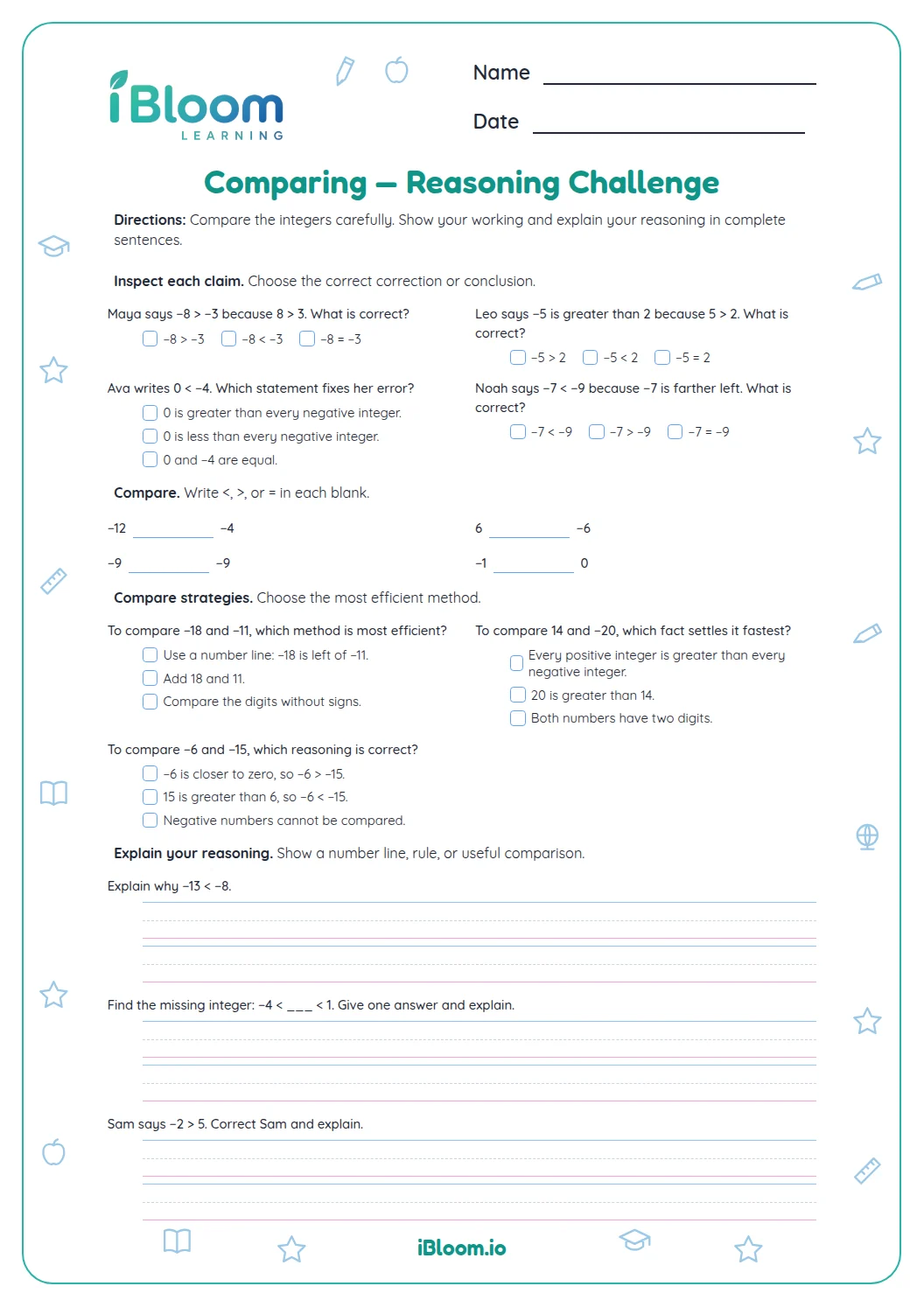
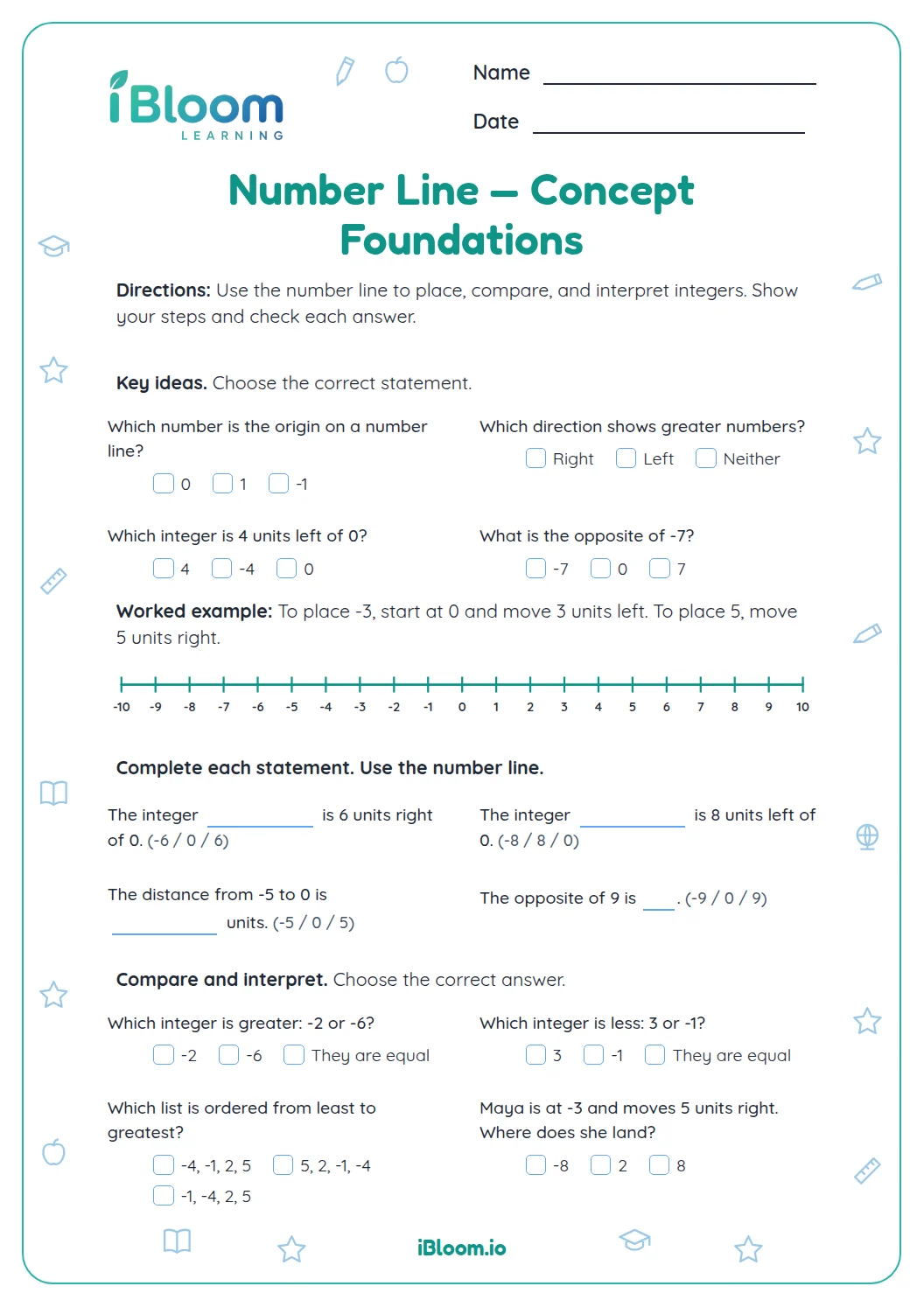
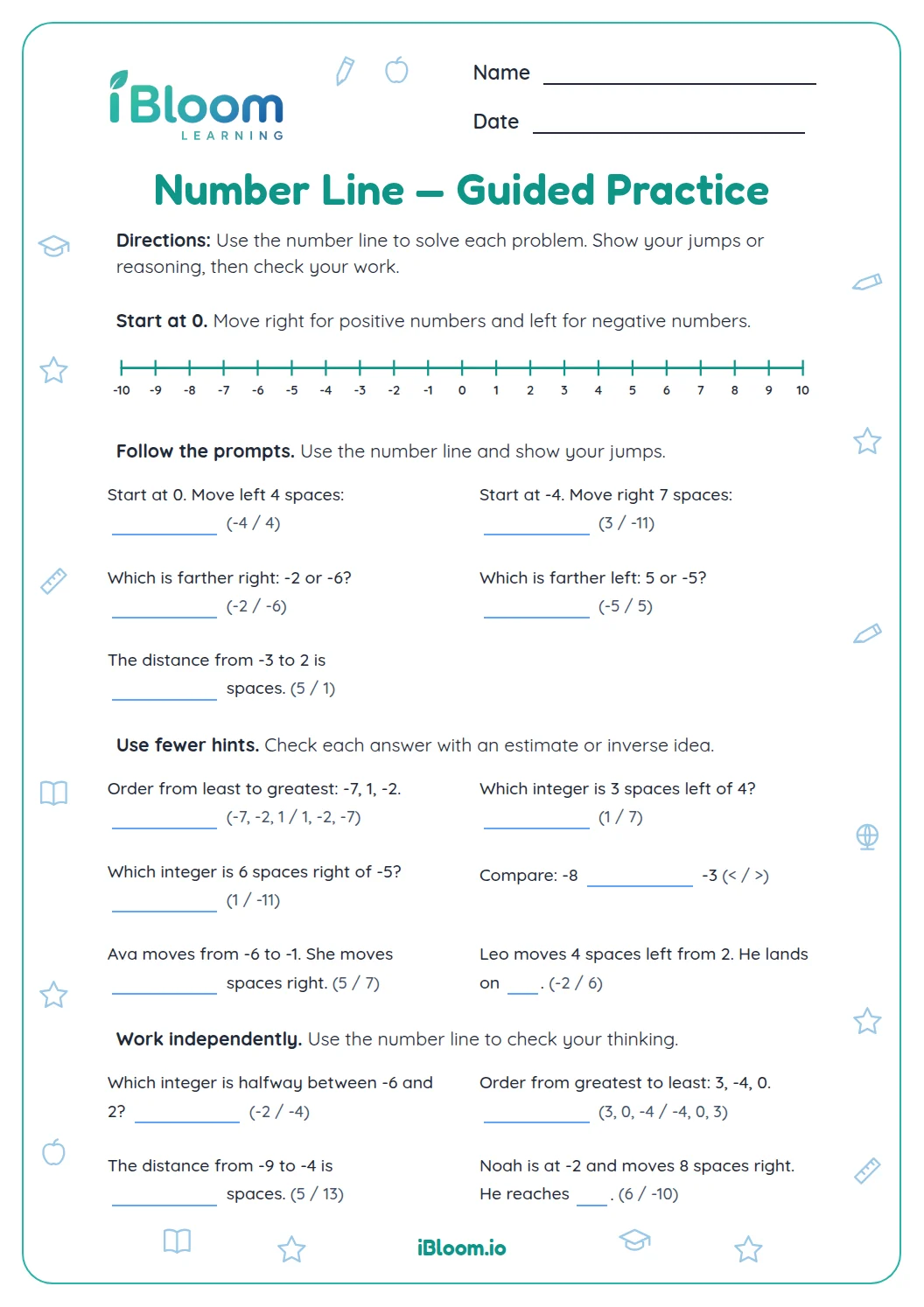
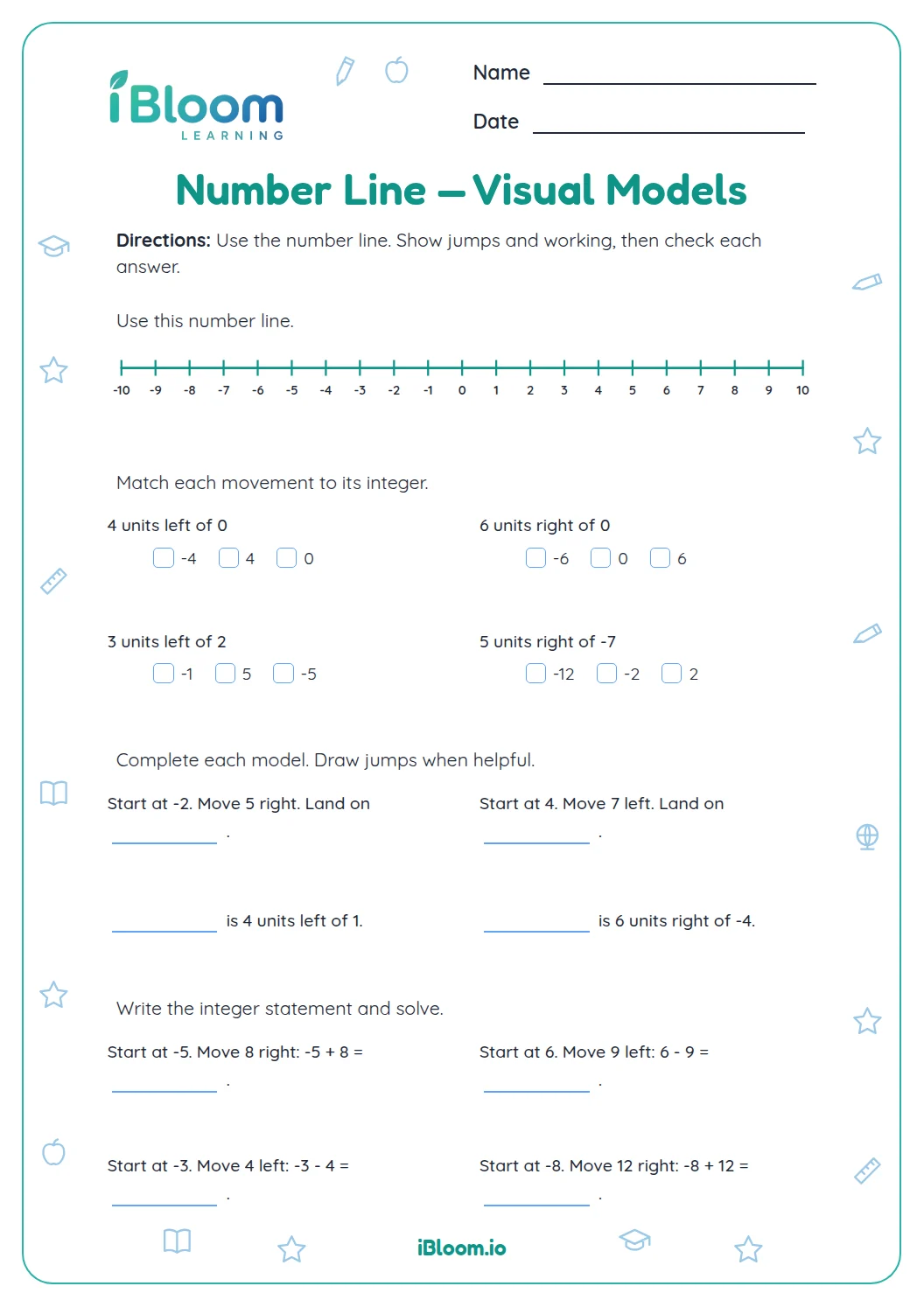
This Grade 5 printable provides guided practice comparing and ordering positive and negative integers. Students use comparison symbols, order small sets, read a labeled number line, and apply integer order to elevation and temperature contexts. A separate answer key gives the correct comparisons and sample explanations. The worksheet practices interpreting inequality through relative number-line position and explaining integer order in real-world contexts.
Aligned to 6.NS.C.7.a and 6.NS.C.7.b
How can you compare integers?
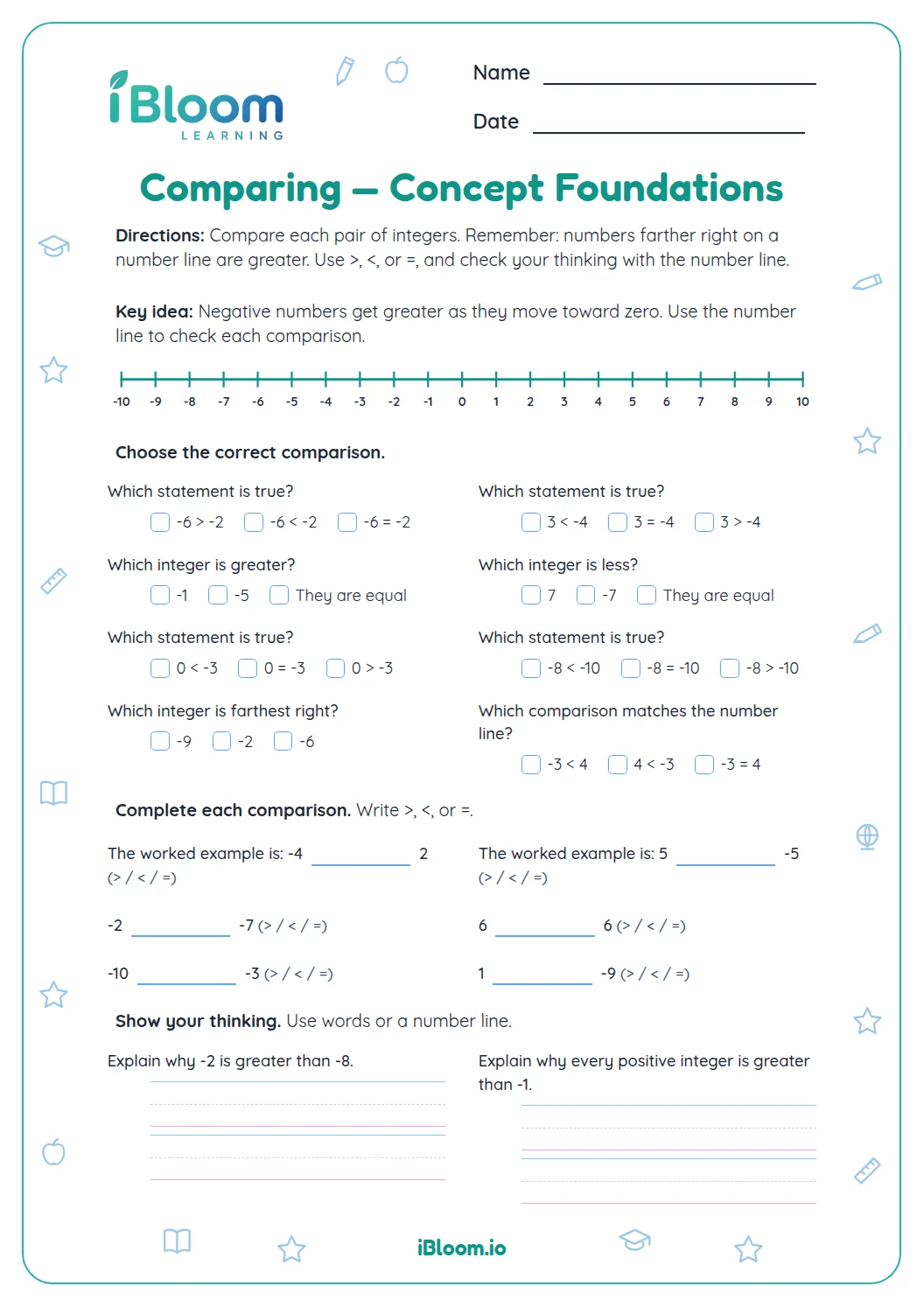
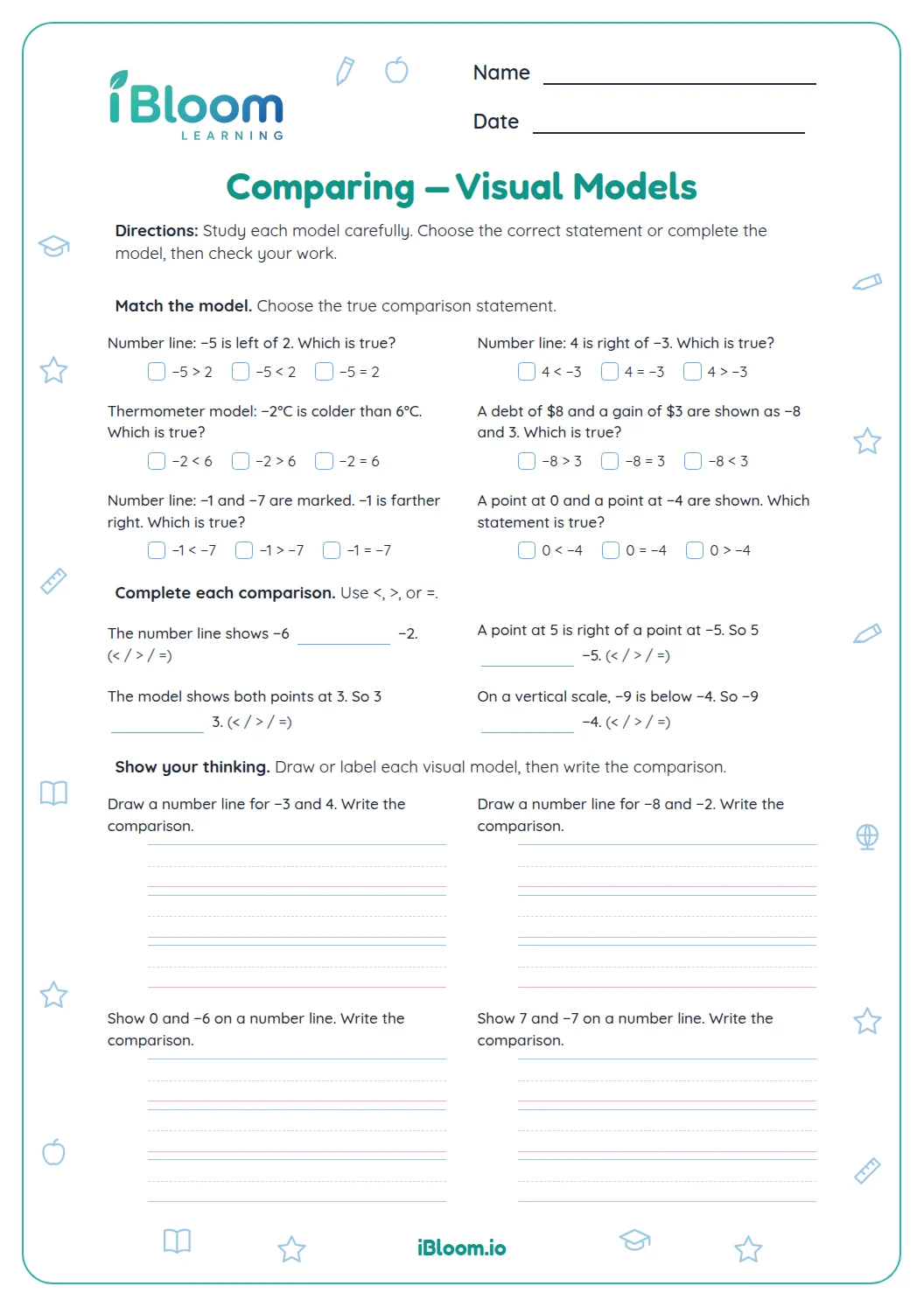
On a number line, values farther right are greater. Use that direction to choose <, >, or = and to order several values.
- 1−8 is left of −3.
- 2So −8 < −3.
How can you choose the greater or lesser value?
The direct comparisons ask for the greater or lesser integer. Question 9 uses a labeled number line to identify which point lies farther right.
How do integers describe real situations?
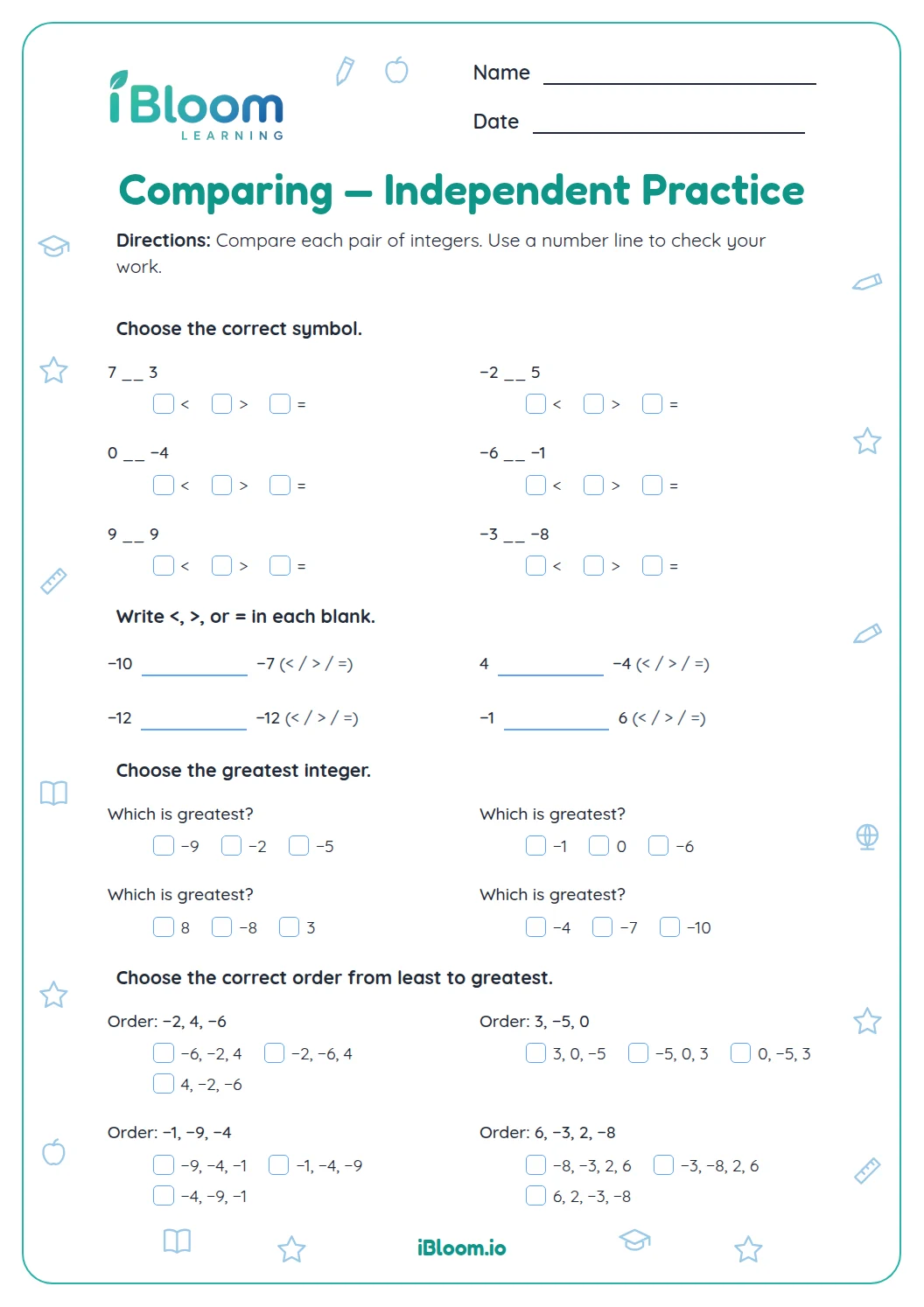
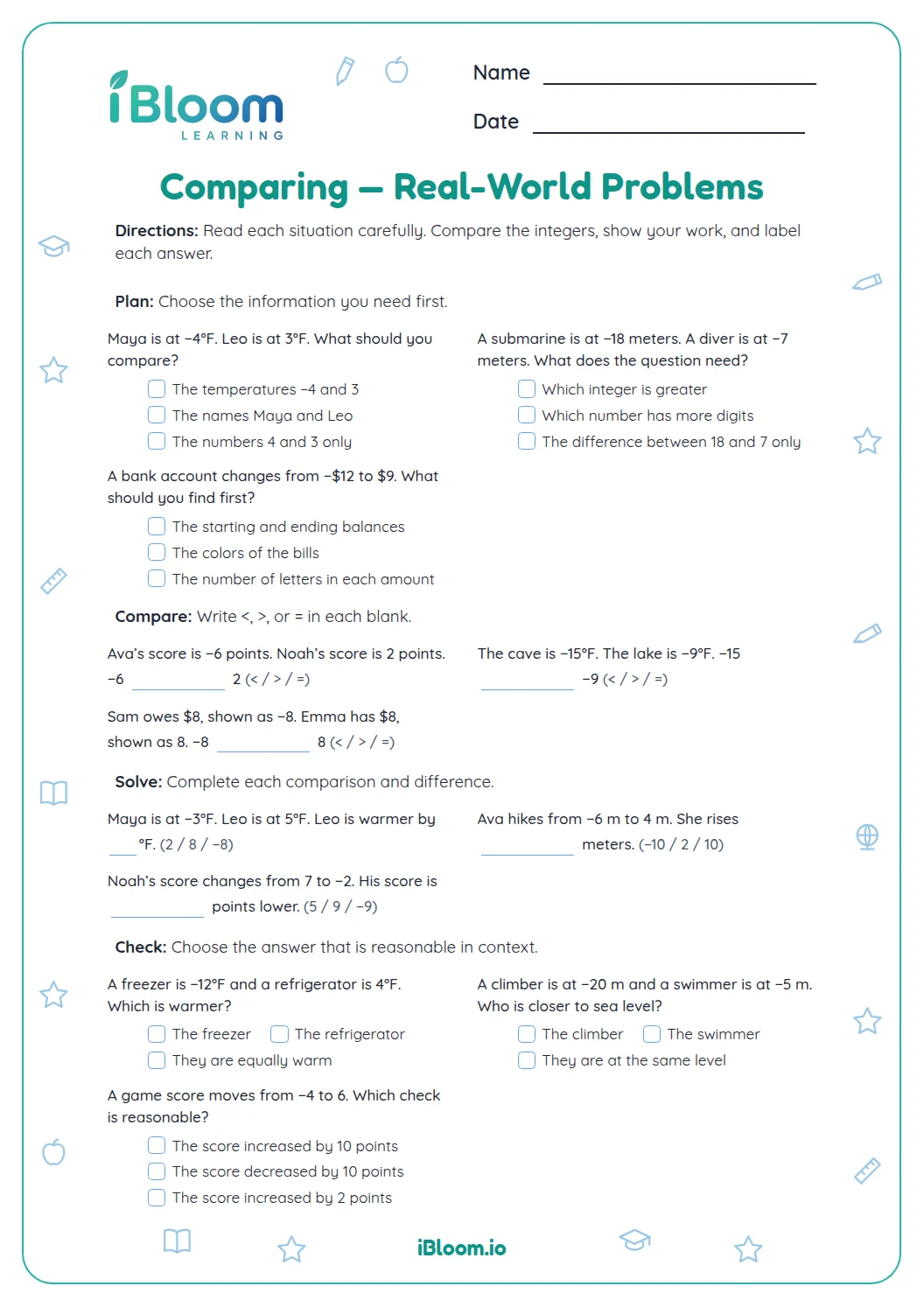
Question 9 compares diver depths relative to the surface, and Question 10 compares temperatures at dawn and noon. Question 11 reads two points on a number line. Questions 12–14 reinforce ordering negative values.
How to use this worksheet
- 1Mark zero and each given integer mentally or on a quick number line.
- 2Compare positions from left to right before choosing a symbol.
- 3For an ordered list, start at the left for least to greatest and at the right for greatest to least.
- 4Read the context carefully and keep the feet or temperature unit in your answer.
- 5Check each symbol and list with the separate answer key.
Integer comparison mistakes and fixes
The mistake
Thinking −11 is greater than −4 because 11 is greater than 4.
The fix
Place both values on the number line; −11 is farther left, so it is less.
The mistake
Treating zero as a negative number.
The fix
Remember zero is greater than every negative integer and less than every positive integer.
The mistake
Ordering a list from right to left when asked for least to greatest.
The fix
Begin with the leftmost, smallest value and move right.
Common Core alignment
This page practices interpreting integer order through number-line position and everyday contexts.
Interpret integer inequalities by comparing positions on a number line.
On this sheet: Students compare integers, use a labeled number line, and explain which values lie farther right.
Show the official wordingHide the official wording
Interpret statements of inequality as statements about the relative position of two numbers on a number line diagram. For example, interpret -3 > -7 as a statement that -3 is located to the right of -7 on a number line oriented from left to right.
Explain integer order in real-world temperature and elevation contexts.
On this sheet: Students compare signed temperatures and elevations and state what the ordered values mean.
Show the official wordingHide the official wording
Write, interpret, and explain statements of order for rational numbers in real-world contexts.
What to practice next
Make more practice
Further reading
Questions parents and teachers ask
How do I compare negative integers?
On a number line, the value farther right is greater. For two negative integers, the one closer to zero is greater, so −3 > −8. This worksheet asks students to use that idea with symbols, ordered lists, and a labeled number line.
Why is −11 greater than −14?
Both values are negative, but −11 is closer to zero and farther right on the number line. Compare the positions rather than the digits alone. The same left-to-right rule works for any pair of integers on the sheet. The same rule works when comparing any two negative integers.
How can I order a mixed set?
For least to greatest, begin with the leftmost value and move right. For greatest to least, start at the rightmost value. Question 5 orders −2, 4, and −7 from least to greatest; the later list gives another check. Check each value from left to right on a number line.
How do integers describe elevation or temperature?
A negative value can represent a location below a reference point or a temperature below zero. Compare the signed values to decide which place is higher or which temperature is lower. Keep the context and units in your response. Write the units beside the temperature or location.
What should an explanation include?
A useful explanation refers to number order: for example, −10 is less than −2 because it lies farther left. The later ordering item lists −10 and −2 from least to greatest, and the answer key shows the ordered pair. A quick sketch can support the comparison.